The Sacred Mountain That Awakens Only in Summer: A Ride Up Mount Norikura, a Conversation at 2,720 Meters Above the Clouds
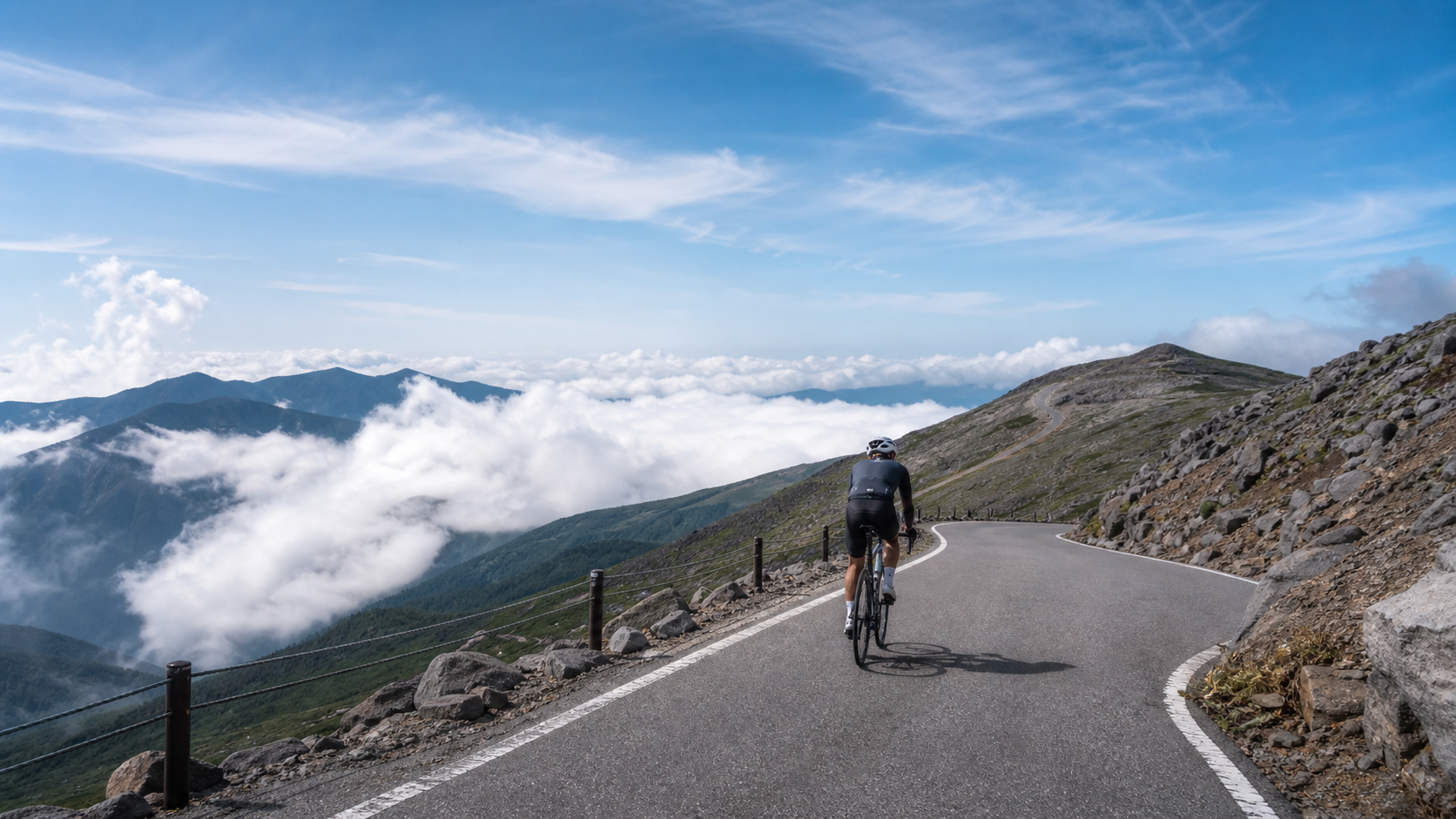
Some mountains, you go to conquer; others are waiting for you to grow old enough to understand them. Mount Norikura belongs to the latter.
The Road to the Clouds
I first heard the name “Norikura” from a senior rider. He said, “Have you ridden Norikura? If you haven’t, don’t say you’ve ridden the mountains of Japan.” At the time, I shrugged it off—it’s just a climb, right? How high can an elevation really get?
Later, I understood that Norikura’s significance was never just about the elevation number. Mount Norikura straddles Nagano and Gifu prefectures, a volcanic peak group at the southern end of the Northern Alps. And the highest point legally reachable by bicycle—the “Tateyama” (畳平) at 2,720 meters—is the highest point on paved roads in all of Japan. This roughly 20.5-kilometer, 1,250-meter-climbing, 6.9% average gradient Norikura Echo Line is like a ladder to the clouds.
About an hour’s drive from Matsumoto City in Nagano Prefecture brings you to Norikura Highland at 1,460 meters. This is the true starting point of the journey, and the beginning of your conversation with the mountain. When you unload your bike from the rack, click into your cycling shoes, and look up at that peak half-shrouded in clouds, you get a subtle premonition: these next 20 kilometers will change your understanding of what “climbing” truly means.
The Morning Before Departure
I like to wake up before the sky is fully light, while the entire highland is still asleep in the morning mist, checking each piece of gear one by one. The Norikura Highland in the early morning has an almost sacred stillness—the air is crisp, dew wets the grass blades, and occasionally a bird call drifts from afar. It’s the gentlest moment of the mountain’s day.
I’ll slowly finish a cup of hot coffee, fill my bottles, stuff energy gels into my pockets, and then swing a leg over the bike. In that moment, there’s always a hint of nervousness—not fear, but a solemnity before an unfolding long conversation. Norikura isn’t a road you can ride with a casual laugh; it demands your full attention, it demands you give yourself over to it. And before the first pedal stroke, I always look up at that peak still hidden in the clouds and say to it in my heart: “Today, please take care of me.”
A Mountain That Only Awakens in Summer
The most captivating—and most unforgiving—aspect of Norikura is its seasonality. Because of the extreme altitude, this road is open to traffic for only a few short months from summer to early autumn each year; the rest of the time, it’s sealed under ice and snow.
This means Norikura isn’t a mountain you can visit at your whim. It’s like a hermit living in deep seclusion, opening its gates only briefly at the height of summer. And precisely because of this, every chance to ride Norikura carries a precious sense of “being there at just the right time.”
Locals say Norikura’s summer is as short as a dream—alpine plants bloom and set seed with desperate effort within just a few weeks, completing a full year’s life cycle before the next winter arrives. Along the roadside, you’ll see alpine rhododendrons and fringed galax—plants that can only survive at high altitudes—and like the riders, they’re racing against time. This “urgency of life” is a unique emotion you can only feel riding on Norikura. You’ll suddenly realize that you, gasping for breath as you push the pedals, and those little plants blooming for dear life by the roadside, are doing the same thing—living as fully as possible within a limited time.
Because of this seasonality, “whether you can actually ride it” becomes a matter of luck. You might arrange your leave and book flights from far away, only to find rain, fog, or even early snowfall on the mountain those days. Norikura doesn’t guarantee every visitor a successful summit—and this “no guarantee” is precisely what makes it more alluring. It reminds you that humans are always small in the face of nature; all you can do is prepare yourself and humbly wait for the day the mountain is willing to accept you. When that day finally comes—when the sky happens to clear, when you happen to be in good form—you’ll cherish this hard-won gift all the more.
From Forest to Volcano: A Landscape Theater Climbing Ever Upward
What makes Norikura most unforgettable is the drama of landscapes transforming as altitude rises. The road itself is an open-air museum of landscapes.
At the start, you’re enveloped in dense coniferous forest. Sunlight filters through the treetops, casting dappled light, and the air carries the moist scent of earth and resin. This is the world of temperate forests—birdsong, insect chirps, the rustle of wind through leaves—forming a reassuring backdrop.
As altitude gains, the trees gradually shorten and thin out. Past the Mitsumotaki area, the forest begins to recede. Then, after a certain switchback, you suddenly “burst out” of the forest—this is the so-called “tree line.” Beyond this invisible yet very real boundary, trees can no longer grow, replaced by low alpine shrubs, bare volcanic scree, and an endless expanse of sky.
This moment of “breaking through the tree line” is the most stunning gift Norikura gives to riders. You feel an almost religious awe: you are leaving the forest of the human world, entering the realm of the gods. In the distance, the peaks of the Northern Alps appear and disappear above a sea of clouds; below, the road you’ve been spiraling up winds like a silver ribbon around the mountainside. In that instant, physical pain seems to be stripped away, leaving only a pure, almost tear-inducing grandeur.
I’ll never forget the first time I rode there. A second earlier, I was in the deep green forest counting breaths and staring at my computer; the next, I looked up and the whole world suddenly “opened.” The sky was so close, so close I felt I could reach out and grab a handful of cloud; the air was cold yet impossibly clean, each breath like cleansing my lungs. I even forgot I was climbing a 6.9% gradient, forgot how sore my legs were—in that moment, I was just a tiny yet immensely happy person standing between heaven and earth. This experience cannot be replicated by any indoor trainer or virtual riding software. It belongs only to those who have truly carried themselves up a high mountain, pedal by pedal.
The Silence That Private Cars Can’t Reach
Norikura has another special feature: it’s a “pure land.”
Due to environmental protection, private cars are not permitted to drive to the summit during the controlled period; only shuttle buses, taxis, and permitted vehicles can go up. This means when you ride the Norikura Echo Line, there’s no endless stream of car exhaust, no roaring engine noise—only your breath, your heartbeat, the subtle sound of the chain turning, and the wind.
This kind of silence is a luxury long absent for many city riders. In Taiwan, we’re used to fighting for road space with cars, used to exhaust fumes and horns. On Norikura, all of that disappears. In the oxygen-deprived, laborious high-altitude climb, this silence becomes a comfort instead. You slip into a strange meditative state—the world shrinks to just “the next pedal stroke,” time seems to stretch, and every moment is crystal clear. Many who have ridden Norikura say it’s the “quietest and most focused” stretch of road in their cycling careers.
In that silence, you hear many sounds you normally can’t: how your breathing shifts from steady to rapid, and how it gradually settles as you deliberately regulate it; how your heartbeat rises and falls with the gradient; the faint crunch of tires over loose gravel; the low hum of wind passing through helmet vents. These sounds compose a duet belonging only to you and this mountain. And within this piece, you gradually forget time, forget rankings, forget the trivial anxieties waiting for you down below—leaving only the purest single thing: keep going up. This flow-like focus is the deepest, most inexpressible gift that riding Norikura gives you.
The Weight of a Sacred Place
In Japanese cycling culture, Norikura is known as the “hill climber’s sacred ground” (ヒルクライマーの聖地). Every late summer, the grand Norikura Hill Climb is held here, drawing climbing specialists from across Japan on pilgrimage. When thousands of riders, on the same day, push toward the same 2,720-meter finish line, that collective, almost sacred atmosphere is something no video can convey.
This mountain is called a “sacred ground” not just because it’s the highest point, but because it carries the youth and dreams of generation after generation of Japanese riders. Someone completed their first official race here; someone broke a personal record they’d been chasing for years; and others simply return year after year to check in with the mountain, like a ritual.
But even outside race days, riding Norikura solo has its own flavor. No timing, no rankings—just you and the mountain. You can stop anytime to watch the sea of clouds, take a photo, or take a deep breath of that thin yet pure air. At such times, Norikura isn’t a racecourse; it’s a dojo where you come to rediscover yourself.
A Road Guarded by Many
The fact that Norikura Echo Line remains the way it is today is actually a rare collective choice. The Japanese recognized long ago that this alpine ecosystem is extremely fragile—once alpine plants are damaged, they may take decades or even centuries to recover. So they chose to restrict private vehicles, preferring to sacrifice a measure of convenience in order to preserve this pristine land for walkers, cyclists, and above all—for the mountain itself.
When you ride this road free of traffic and exhaust fumes, what you’re actually enjoying is an entire society’s respect for and restraint toward nature. This is something worth savoring for Taiwanese cyclists. We’re too accustomed to the language of “conquest”—conquering a mountain, conquering a climb—but what Norikura taught me is the opposite: “coexistence.” Humans can enter the high mountains, but we must do so with humility, arriving gently and leaving gently, leaving no trace. This kind of riding ethic is perhaps more worth bringing back to Taiwan than any finish time.
A Bowl of Hot Soup at the Aid Station
At the top, at Nigoridaira, there are simple rest facilities. After climbing to 2,720 meters with fingers stiffened by the cold wind, the happiness of drinking a steaming bowl of soup or eating a hot meal is something you simply cannot experience at lower elevations.
I often feel that the high mountains amplify all your senses. The same ordinary bowl of soup—down in the valley you might barely taste it, but after hypoxia, cold, and a hard-fought battle, it becomes so delicious it brings tears to your eyes. This is the charm of climbing by bike—it teaches you to cherish again those small joys you usually overlook: a sip of hot soup, a ray of sunlight, a wind that isn’t quite so cold. These tiny rewards, strung together, become memories you’ll never forget.
Fleeting Bonds with Stranger Riders
Norikura is a sacred place, so you’ll never be alone. Along the way, you’ll meet riders from all over Japan and even from around the world. There are silver-haired veterans still full of vigor, fathers taking on the challenge with their children, and club riders for whom summiting is an annual ritual.
On this road, language is rarely a problem. A breathless but resolute nod, a simple “Ganbatte,” a thumbs-up exchanged as you pass each other—these small interactions form a strange, border-transcending understanding. Everyone is doing the same foolish thing: pushing themselves to the limit just to ride up a mountain. And it’s precisely this “shared foolishness” that creates an indescribable warmth among riders who are strangers to one another.
Once, while stopped for a break midway, I had a conversation of sorts with a Japanese man I’d never met, using hand gestures and broken words. We couldn’t communicate verbally, but we both understood the light in each other’s eyes—the light that only those who love this sport possess. In the end, he patted me on the shoulder, pointed at the summit, and made a “let’s go” gesture. I still remember that scene to this day. What Norikura gave me, beyond the scenery, were these warm, fleeting connections.
After the Descent, the Story Begins to Ferment
Interestingly, Norikura’s true afterglow often only emerges slowly after you’ve left.
When you return to Taiwan, back to your daily commute and training, on some ordinary afternoon you might suddenly recall the wind at Nigoridaira, the rolling sea of clouds, the shock of the sky opening up the moment you crossed the tree line. Those memories return at the most unexpected times, gently reminding you: you once went to a place so high and so beautiful, you once had a serious conversation with a mountain.
And so Norikura ceases to be just a road you’ve ridden—it becomes part of your inner self, a place you can return to draw strength from when you’re weary. Whenever life becomes trivial, suffocating, you’ll remember: I rode up Norikura at 2,720 meters—what are these small obstacles in front of me? This is the most enduring gift a great mountain can give a rider.
The Gentleness Below: Onsen and Time at Norikura Highlands
After riding Norikura, don’t rush to leave. At the foot of the mountain, the Norikura Highlands hold the gentlest conclusion to the journey—the hot springs.
After fighting at high altitude all morning with legs full of lactic acid, soaking in the Norikura Highlands onsen, that feeling of “your soul being ironed smooth,” is the most tangible reward beyond a finisher’s medal. The milky-white sulfur spring gently wraps your exhausted body, and in the distance is the silhouette of Mount Norikura you just conquered. At that moment, all the gasping, all the pain, all the teeth-gritting moments in thin air dissolve into memories worth savoring.
If time allows, consider staying a night in the Norikura Highlands. The morning highlands have a crispness you can’t feel in the city—the air is as clean as if it were just washed, and the stars are exceptionally bright. Under the light-pollution-free highland sky, you can even clearly see the Milky Way stretching across the heavens. You’ll understand why so many people return here year after year: not just for the climb, but for this mountain, this hot spring, this place where body and mind can fully unwind.
The time spent soaking in the onsen is often my favorite part of the entire trip. The hot water seeps inch by inch into aching muscles, gently melting away the fatigue accumulated in the thin air of the day. Unconsciously, you replay every moment of the day—which stretch made you almost want to get off the bike, which corner’s view made you forget to breathe, the “wow” that surfaced in your mind the moment you crossed the line. These fragments surface one by one in the steam, then settle into a deep sense of satisfaction. It’s not the pride of conquest, but something quieter, fuller—you know you lived honestly today, and spent real time with a mountain. A day like that is worth it.
Side Trip Suggestions: Fitting Norikura into a Deeper Journey
The Matsumoto region, where Norikura is located, is itself a destination worth exploring in depth. Matsumoto City is home to the famous Matsumoto Castle (a national treasure with its black keep), old streets full of artistic atmosphere, and cafés. To the north, Kamikochi is one of Japan’s representative alpine hiking destinations. Nearby, Azumino offers crystal-clear spring water and pastoral scenery.
For Taiwanese cyclists, a Norikura trip can easily be planned as a combined “cycling + tourism” itinerary: pick a clear morning to complete the climbing challenge, soak in the onsen and visit Matsumoto Castle in the afternoon, then arrange a Kamikochi hike or an Azumino ride the next day. Such an itinerary satisfies your passionate self-challenge while also catering to the travel interests of family and friends accompanying you—it’s the best way to turn a “pilgrimage to a sacred site” into a “wonderful vacation.”
If you plan to bring your bike to Japan, I’d suggest researching how to transport it: you can use a bike bag on the railways (Japanese railways are relatively accommodating to bike bags), and many local shops offer rental services, saving you the hassle of shipping. As Nagano Prefecture’s transportation hub, Matsumoto is accessible from Tokyo by limited express train, making it very convenient for planning a “challenge Norikura without a car” trip. A “three days, two nights” itinerary is the most comfortable pace: arrive on day one and acclimatize to the altitude; challenge Norikura early on day two and soak in the onsen in the afternoon; on day three, visit Kamikochi or Matsumoto City before heading home.
I’d also like to offer one reminder: don’t pack your schedule too full. Norikura deserves some blank space. Leave time to daydream, time to reflect in the onsen, time to think of nothing under the highland stars. Sometimes, the most precious part of a trip isn’t how many places you visited, but the fact that in one particular place, you truly “were” there.
What This Mountain Taught Me
Back in Taiwan, whenever someone asks me “why would you travel all the way to Japan to ride one climb,” I always think back to that moment standing at Nigoridaira.
What Norikura taught me isn’t “how strong I am,” but “how small I am.” At 2,720 meters, where the air is so thin that every breath demands your full attention, a person becomes very honest. You can’t deceive yourself, and you can’t deceive this mountain. The only thing you can do is let go of bravado, respect the distance, respect the altitude, and then pedal, one stroke at a time, quietly carrying yourself up into the clouds.
The senior rider’s words—“If you haven’t ridden Norikura, don’t say you’ve ridden Japan’s mountains”—I now fully understand. Because what Norikura gives you isn’t the achievement of a climb, but a profound conversation with the high mountains, with yourself, and with time. It teaches you humility again in the gasping breaths of thin air, lets you hear your own heartbeat again on the quiet mountain road, and lets you feel anew what “magnificence” truly means the moment you break through the tree line.
For Those Still Hesitating
I know that making up your mind to bring your bike to Japan and take on a climb at 2,720 meters above sea level takes courage for many people. You might worry: Am I strong enough? Will altitude sickness get me? What if the weather turns bad, or I can’t finish the ride—will it all have been for nothing?
These concerns are all perfectly normal. But what I want to tell you is this: Norikura has never been a road reserved only for the elite. It’s challenging, but it’s also a road that “is willing to wait for everyone who prepares seriously.” You don’t need to be a pro rider—you just need to do your homework: swap in a light enough gear ratio, plan your pacing, bring the right warm gear, arrive early to acclimatize—and then face it with humility. Even if you ultimately don’t make it to the summit due to weather or how your body feels, those early mornings spent on the Norikura Plateau, that hot spring you soaked in, that highland air you breathed—they will already have been worth every penny.
And honestly, how many chances in life do you get to personally deliver yourself to the highest point on a nation’s paved roads? That’s not just a ride—that’s a medal you’ll carry for the rest of your life.
If there’s still an empty slot on your cycling bucket list, put Norikura on it. Then, on some midsummer morning, go meet this sacred mountain that only awakens in summer. It’s been waiting up in the clouds all along, for you to grow big enough to understand it. When you finally stand at that 2,720-meter-high Happōgane, facing the highland wind and gazing down at the sea of clouds churning below your feet—you’ll know this journey was worth it. And you’ll find yourself already starting to plan: when will I come back to see it again?
Related Reading
- Norikura Hill Climb Guide: Full Breakdown of Pacing and Gear for Climbing Japan’s Highest Paved Point at 2,720 Meters
- Japan’s Only “Zero-Car” Pilgrimage Road: Mount Norikura, the Sky Road You Must Conquer on Foot
- Mount Norikura in the Japanese Alps: Japan’s Highest Road Climb at 2,716 Meters
- Challenge to the Sky: Mount Norikura Cycling Hill Climb—The Ultimate Pilgrimage to Japan’s Highest Road Point
2025 乘鞍 KOM 登山賽挑戰實錄 / 日本公路最高 ! 賽前探路篇 / 比富士山厲害,無敵絕景!/ 40週年 / 中文YT首發 / 公路車 / CT Yeh #乘鞍ヒルクライム
10 個月前
2025 乘鞍岳登山賽 比賽全紀錄篇 / 完整路線攻略介紹 / 日本版武嶺 公路最高點 / 高山空拍絕景 / 明年會開團! / 公路車 / CT Yeh
10 個月前
日本公路最高登山賽,台灣首位YT挑戰實錄,乘鞍登山賽40週年,賽前篇完整版,請到我的YT收看 #公路車 #cycling
10 個月前
雙十節的溫腥感人約騎,升旗到升天一次滿足 | 公路車 | 鳳山寺 | 米粉坡
6 年前
太平山單車員工旅遊 | 這樣玩CP值最高!| 公路車
5 年前
台北闊瀨陡坡 騎旅 / 日本單車雜誌編輯車友臨時加入!/ 髮香才是最強的 / feat. 北迴歸線小隊 / 公路車 CT Yeh
6 個月前
新竹羅平 x 天湖部落 大禹嶺級變態陡坡! 4K超高畫質 空拍 | 公路車
5 年前
阿里山塔塔加 兩倍特濃版!全新隧道開通! 進喔!公路車 | CT Yeh
3 年前