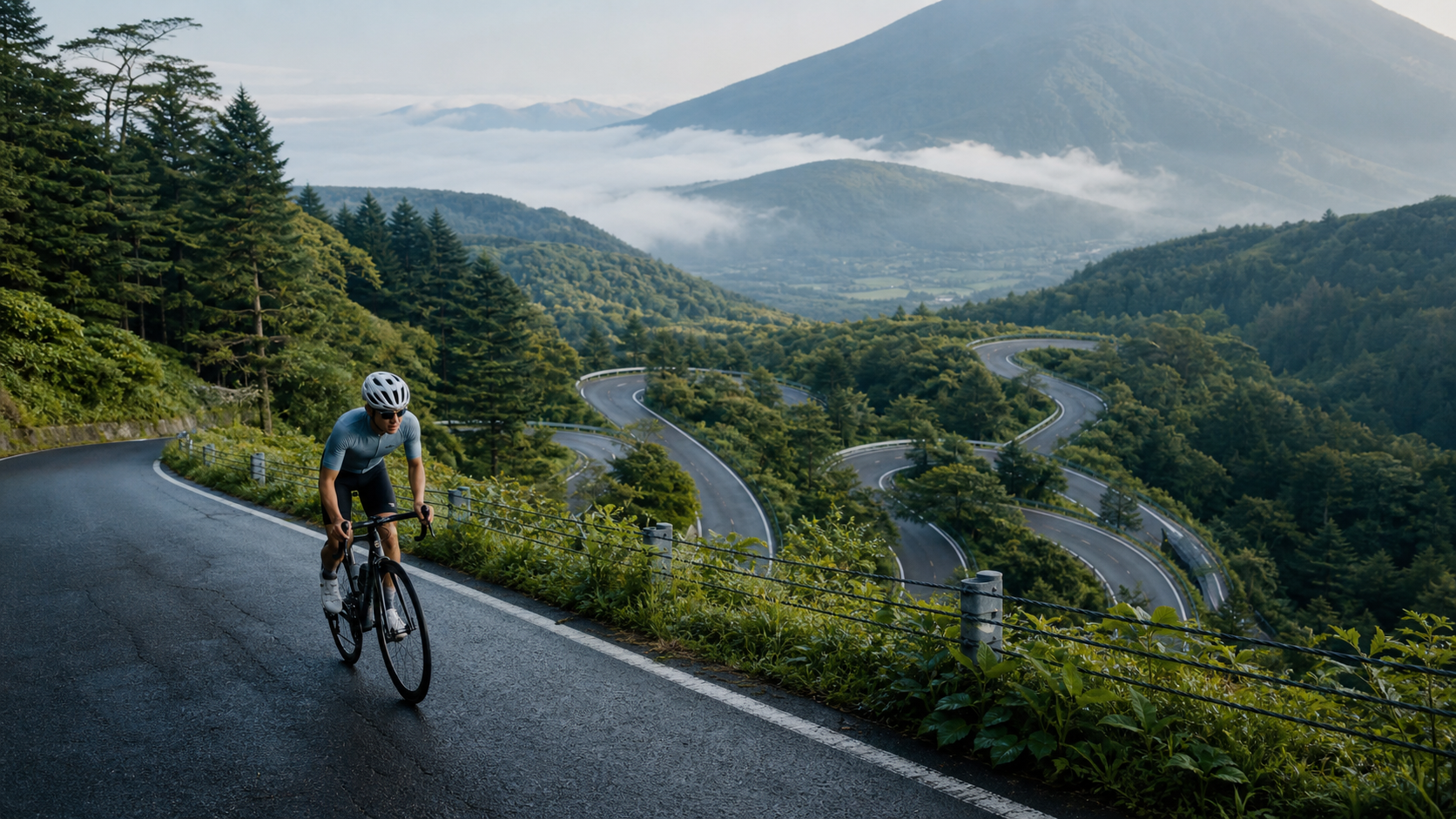
Climbing Toward the Sky Through Forty-Eight Curves: A Day of Riding the Irohazaka of Nikko
Distance 7.1 km, elevation gain 394 m, average 5.5%, 48 hairpin turns named after Japanese kana, winding up from Nikko Town to Akechidaira—this is not just a climb; it is a poem written in kana with your tires.
The morning air in Nikko still carried the dampness of the cedar forest. I parked my bike in front of Tōbu Nikko Station and looked up at the mountains wrapped in morning mist, knowing full well—today I was going to meet that legendary climb, the one the Japanese call “Irohazaka.”
Why “Iroha”
The first time I heard the name, I didn’t understand it. Only later did I learn that “i-ro-ha” is the ancient Japanese ordering of the kana syllabary, much like our “zhuyin” or the English ABC. And this slope, with its ascent and descent combined, has exactly 48 hairpin turns, corresponding precisely to the forty-eight sounds of the “iroha” system. So each turn has been given a kana name—the “i” turn, the “ro” turn, the “ha” turn… written all the way to the summit.
What a romantic naming. When you’re gasping for breath in a turn, you are, in fact, riding through an ancient kana poem, character by character. With that thought, even my breathing seemed to find a rhythm.
The ascent uses the Second Irohazaka, with 20 turns; the descent is the First Irohazaka, with 28 turns. The two roads are separated, a rare courtesy in Japanese mountain routes—you don’t have to worry about oncoming traffic while climbing.
From Nikko Town to the Base: An Underrated Warm-Up
From the station to the actual start of the climb, there’s about 10 km of gentle uphill. This stretch passes through the streets of Nikko, past those World Heritage shrines and temples—the atmosphere of Tōshō-gū and Futarasan Shrine lingers subtly in the air. I deliberately rode slowly, partly to warm up, partly to savor the morning of this ancient town.
Nikko is a place with weight. Tokugawa Ieyasu rests here, and for centuries, this has been the gateway to what the Japanese consider a “sacred mountain.” And this slope I was about to climb has, since ancient times, been the essential route to Lake Chūzenji, to the holy precincts in the mountains. I suddenly realized that this seemingly ordinary asphalt road beneath my wheels has carried the footsteps of pilgrims, travelers, and horses for hundreds of years.
Into the Turns: Writing Upward, One Character at a Time
Turning past the start of the climb, the world fell silent. The dedicated ascent lane separated the cars from me, leaving only the sound of the chain and my own breathing.
The first turn came quickly. The inside of the curve was steep enough to startle me, so I quickly moved to the outside line, “stealing” a bit of easier gradient. So this was the trick the veterans talked about—the outside of a hairpin is always kinder than the inside.
The gradient undulated between about 6% and 10%. To be honest, the first half was tough. My heart rate kept climbing, and I told myself: don’t rush, there are still over forty turns to go, save your strength. Every time I passed a turn, I silently counted, like counting prayer beads. “I,” “ro,” “ha”… as I counted, the pain seemed to dilute.
The trees along the way burn into a sea of red in autumn—Nikko’s autumn foliage is one of the finest sights in all of Japan. Unfortunately, the season I came was lush with green, but that feeling of being enveloped by the forest, as if riding into a ukiyo-e painting, was no less impressive.
Akechidaira: At the Foot of Mount Nantai
When the gradient finally eased from steep back down to 5–7%, I knew I was close. For the last few turns, I raised my cadence and rolled through them one by one with rhythm.
Akechidaira, at an elevation of about 1,274 meters, was here.
At the summit there were vending machines and a shop. I bought a hot drink and held it in my chilled, reddened hands. From the observation deck, Mount Nantai stood imposingly, and the First Irohazaka below snaked down the valley like a silver ribbon. At that moment, all the gasping was worth it.
The wind was cool. The jersey, soaked through from the climb, now clung to my back, a reminder that the temperature up here was a world apart from down below. I put on the windbreaker I’d brought—a small piece of wisdom every long-climb rider understands.
Beyond the Mountain, There’s More
If you think Akechidaira is the end, you’re underestimating this road. Past the summit lies the azure of Lake Chūzenji, the rush of Ryūzu Falls, and further in, the vast marshland of Senjōgahara, as well as Kongō-tōge leading to Gunma. The scenery here unfolds layer by layer, like a gift.
I sat at Akechidaira for a long time, watching clouds drift past Mount Nantai one by one. For me, Irohazaka was not just a climbing achievement, but a conversation with this sacred mountain. Forty-eight turns, forty-eight kana, written all the way to the sky, finally drawing to a close under the gaze of the mountain god.
Nikko: A Mountain Chosen by Gods and Shōguns
To truly understand Irohazaka, you must first understand the Nikko at its base.
Nikko has been a sacred site of mountain worship since ancient times. In the Nara period, the monk Shōdō Shōnin opened this mountain, venerating peaks like Mount Nantai and Mount Nyohō as divine bodies, beginning a tradition of ascetic practice that has lasted over a thousand years. In the Edo period, the mausoleum of Tokugawa Ieyasu—Nikkō Tōshō-gū—was established here, elevating Nikko from a religious sanctuary to the spiritual symbol of the shogunate. The Japanese proverb “Don’t say ‘kekkō’ (magnificent) until you’ve seen Nikkō” refers precisely to the breathtakingly ornate carvings of Tōshō-gū.
And Irohazaka is the staircase leading into the depths of this sacred realm. Lake Chūzenji, Kegon Falls, Senjōgahara—these hidden wonders in the mountains have long been the aspiration of ascetics and travelers alike. As I pedaled up, turn after turn, I was, in fact, retracing a pilgrimage route that countless people have walked on foot for a thousand years. This weight of history lent an extra layer of meaning to every pedal stroke.
The Rhythm of Forty-Eight Turns Is a Form of Practice
I’ve climbed many slopes, but the density of hairpins on Irohazaka still left a deep impression on me. Forty-eight turns means there’s hardly a single straight stretch—just as you catch your breath from one turn, the next one comes right at you.
At first I found it irritating, but gradually I came to love this rhythm. Because hairpins actually help you: the outside of the turn is less steep, and by taking the outside line through the curve, you can “steal” a fraction of a second of relief in the hardest part of the climb. So each turn became a small rest note, giving the long ascent breath and rhythm.
I began to treat it as a form of practice. Not thinking about how far the summit was, only focusing on the turn right in front of me—after passing the “i,” think of “ro”; after passing the “ro,” think of “ha.” When your attention narrows to “the next turn,” the pain is cut into swallowable pieces. This is what Irohazaka taught me: when faced with too great a challenge, break it down, and solve only the one right in front of you.
That Hot Drink at Akechidaira
That hot drink at the summit of Akechidaira—I still remember it.
The wind at 1,274 meters was cold, and the jersey soaked through from the climb had become a heat sink, drawing warmth from my body bit by bit. I held the hot can from the vending machine in both hands, letting the warmth seep back into my frozen fingertips. Before the observation deck, Mount Nantai stood imposingly, and the First Irohazaka below hung like a silver ribbon dropping into the valley.
At that moment, I suddenly understood why so many riders can’t forget Irohazaka. Not because it’s so hard—as climbs go, it’s actually moderate—but because it lays out “effort” and “reward” so clearly. Every drop of sweat you shed, every turn you counted, is finally exchanged at this observation deck for a view that makes it all worthwhile.
The Dilemma of the Autumn Foliage Season
If I were to give advice to those who want to come, it would be about the dilemma of “season.”
The autumn foliage of Irohazaka is one of the finest sights in all of Japan. In mid-to-late October, the entire mountain burns into a blaze of red and yellow, so beautiful it seems unreal. But precisely because of that, the traffic jams during foliage season are notorious—on holidays, cars may be stuck motionless on the slope, forming a long line of metal.
Ironically, this congestion actually gives cyclists an advantage—when cars can barely move, a bike can weave through the gaps in the traffic. But it also means sharing the road with a huge number of people and vehicles, raising the safety risk. So my advice is: if you want to see the autumn leaves, be sure to start early in the morning, reaching the summit before the rush of cars; if you simply want to enjoy the climb, the greenery of spring and summer is actually more refreshing and more carefree.
Downhill: Trading Effort for Freedom
On the descent, I took the downhill-only First Irohazaka, its 28 curves unfolding one by one beneath my wheels.
This is the fairest thing about climbing—every meter you suffer to gain on the way up becomes an equal measure of freedom on the way down. Wind poured into my collar, speed flowing smoothly between one curve and the next, my eyes locked on the exit of each turn, my body leaning with the line, straightening, then leaning again. That exhilaration of dancing with the terrain is the climber’s exclusive reward.
But I reminded myself: descending is not relaxation—it’s another kind of focus. With hairpin turns packed tightly and tourist traffic around, braking had to be feather-light, vision kept far ahead, and speed held in reserve. A time can be attempted again; safety only comes once.
After finishing Irohazaka, I sat down to a bowl of hot soba in the streets of Nikko, savoring the day. It wasn’t the hardest climb I’ve ever done, but it was the one with the most “story.” Forty-eight curves, a poem in kana, a thousand-year-old sacred mountain—Nikko Irohazaka is worth reading for yourself, for anyone who loves to ride.
The Body’s Memory Behind Those Numbers
Back to the numbers: 7.1 kilometers, 394 meters of elevation gain, 5.5% average. On paper, they look fairly gentle—compared to mountain passes that routinely top a thousand meters, Irohazaka doesn’t even qualify as “hard.” But anyone who has actually ridden it knows that numbers never tell the whole story.
Behind that 5.5% average lies the opening stretch, a slope that feels like 6–10%, quietly grinding you down. It’s the 48 hairpins constantly breaking your rhythm, forcing you to accelerate and brake again and again. It’s the chilly wind at Akechidaira, reminding you that you’ve climbed to a different altitude. These bodily memories are things a bike computer can’t measure. Perhaps this is exactly what makes climbing so captivating—it translates cold numbers into the most real, most intimate experience your body can have.
I especially love looking back at the elevation curve on my computer after a climb. That line climbing steadily upward, cut off abruptly at Akechidaira—it isn’t just data. It’s the physical embodiment of my breathing, my heartbeat, my sweat that day. Every upward jag corresponds to a hairpin I gritted my teeth through.
Lake Chuzenji: Another World Beyond the Summit
If your legs allow it, I strongly suggest not turning back at Akechidaira. Because once you cross the summit, Irohazaka opens up an entirely new world.
Follow the road further in, and you’ll soon reach Lake Chuzenji—a highland lake formed when Mount Nantai’s volcanic eruption dammed the valley, sitting at roughly 1,269 meters above sea level. The lake’s surface lies still as a mirror, reflecting the majestic form of Mount Nantai, surrounded by primeval forest. In summer, Lake Chuzenji is a beloved escape from the heat; in autumn, it’s a famous spot for fall foliage. During the Meiji era, several foreign embassies even built summer villas here—a testament to its serenity and prestige.
Just beside the lake stands Kegon Falls, one of Japan’s three great waterfalls. Nearly a hundred meters of water thunders off the cliff, overwhelming in its power, shrouded in mist. That raw force of nature delivers a completely different kind of awe on top of your climbing fatigue. Further in, you’ll find the vast Senjogahara marshland and Kongo-toge pass leading toward Gunma—the scenery unfolds layer by layer, like gifts nature has prepared for every hardworking rider.
A Bowl of Yuba, a Taste of Nikko
After finishing Irohazaka, don’t rush to leave Nikko—its flavors deserve equal attention.
Nikko’s most iconic local dish is yuba (湯波)—the thin skin that forms on the surface of boiling soy milk, similar to the tofu skin we know. But because Nikko flourished as a sacred site of temples and shrines, where vegetarian cuisine thrived among monks, yuba here was refined into an art form. Whether it’s refreshing yuba sashimi or a warm yuba hot pot, the flavor is light yet profound—exactly what an empty stomach needs after a climb. (Please confirm actual shops and opening hours on site.)
Sitting in Nikko’s old town, holding a bowl of hot food, watching travelers pass by the window, I often think—this mountain, this road, this food are all different chapters of the same story. Nikko is a place that weaves together faith, nature, history, and taste, and riding lets me read that story in the most profound way possible.
Honest Words for First-Timers
If you’re considering adding Irohazaka to your riding list, let me offer a few honest words as someone who’s been there.
First, don’t be fooled by that “5.5% average.” It isn’t hard, but it’s far from easy—especially the opening stretch. Pace yourself slower, relax your mindset, and you’ll enjoy it far more.
Second, make sure to leave time for what lies beyond the summit. Many riders set their goal at Akechidaira and call it done, missing the deeper scenery of Lake Chuzenji and Kegon Falls. Irohazaka’s true value is half on the climb, half beyond it.
Third, bring a windbreaker and a heart willing to slow down. This road deserves to be savored, not rushed through just to log a time. It’s a poem, and it deserves to be read word by word.
Nikko Irohazaka is a road that will make you want to come back again and again. The first time, you come to conquer it; every time after, you come to relive that peace and beauty.
The Complete Memory of That Day
I want to record that day in full, because it deserves it.
At six in the morning, the air in Nikko still carried the damp chill of the cedar forest. I assembled my bike in front of Tobu Nikko Station, took a sip of warm coffee, and watched the mountain silhouettes wrapped in thin mist in the distance. The streets were nearly empty, only early-rising crows cawing in the direction of the shrines. That quiet made the coming challenge feel especially solemn.
On the 10-kilometer gentle climb from town to the mountain’s foot, I deliberately rode slowly. Passing the approach to Toshogu Shrine, I even stopped, gazing at the forest lit by slanting morning light. I thought—hundreds of years ago, pilgrims must have approached this sacred mountain with the same mix of reverence and anticipation.
The moment I turned onto the uphill-only lane, the world suddenly became just me. Cars were separated onto another road; all around was only forest, the sound of my chain, and my own gradually heavier breathing. The first hairpin came sharp and steep, startling me into moving wide. “I,” I recited in my mind. Then “ro,” “ha,” “ni”… I began counting up the curves like prayer beads, one character per turn.
The opening stretch was genuinely tough. There were moments when my heart rate neared its limit, my legs burning, the thought flashing through my mind—“am I going too fast?” I forced myself to shift down, slow the pace, and even out my breathing. That’s when I learned Irohazaka’s most important lesson—don’t fight the forty-eight curves head-on; dance with them.
Around the two-thirds mark, the gradient miraculously eased. As if the mountain knew you were about to crack and gave you a stretch to catch your breath. I seized it, spun up the cadence, and found my rhythm again. When the “Akechidaira” sign finally appeared, I nearly shouted out loud.
The wind at the summit was cool. I bought a hot drink, leaned against the railing of the observation deck, watching clouds drift past Mount Nantai one by one, watching the First Irohazaka’s nine bends and eighteen turns below cascade down like a silver ribbon. Sweat cooled on my back; I slipped on my windbreaker, but inside, I was burning. In that moment, I suddenly understood why someone would return to a single mountain pass again and again—because what waits for you at the summit is never just the view. It’s a better version of yourself that says, “You did it.”
In Closing: The Wisdom of Slowness
On the road from Akechidaira toward Lake Chuzenji, one thought kept circling in my mind—what Irohazaka truly taught me is the wisdom of slowness.
In an age that chases speed in everything, we’re used to sprinting, used to efficiency, used to staring at numbers. But Irohazaka tells me some things can’t be rushed. Forty-eight curves—you can’t hurry through them. The steep opening—charge it and you’ll blow up early. The summit view—glance and leave, and you might as well not have come. It forces you to slow down, to ride one curve at a time, to breathe one breath at a time, to feel the mountain’s pulse second by second.
And when you truly slow down, you discover that slowness is when you see the most. You see the layers of the forest, hear the birdsong, feel the temperature shift as altitude rises, and in the most painful stretches of the climb, hear your own inner voice more clearly. This “abundance of slowness” is the gift Irohazaka—and every great road—wants to give to every rider willing to stop and listen.
For Those Who Want to Come
- Season: The autumn foliage (mid-to-late October) offers the most spectacular scenery, but traffic is heavy—set out early in the morning; spring and summer bring pleasant greenery, better suited for pure training.
- Gear: The summit is high and the descent is cool—a windbreaker is both survival and pleasure.
- Mindset: Don’t fight the forty-eight curves head-on. Treat it like a poem, read it word by word, and you’ll find that the most beautiful scenery often lies just past the most painful stretch.
On the descent, I took the downhill First Irohazaka, its 28 curves unfolding beneath my wheels. Wind poured into my collar, and I couldn’t help but laugh—every bit of effort you climb with turns into an equal measure of freedom on the way down.
Nikko Irohazaka, until we meet again.
Traveler Q&A: Practical Planning for This Ride
How much time should I set aside?
If you’re only tackling Irohazaka and coming back, half a day is more than enough. But I strongly recommend setting aside a full day to include Lake Chuzenji, Kegon Falls, and Senjogahara—that’s the complete Irohazaka experience. Nikko’s own shrines and temples (Toshogu Shrine, Futarasan Shrine) are also worth half a day, so combining everything into a two-day, one-night trip is ideal.
What level of rider is it suitable for?
With an average gradient of 5.5% and less than 400 meters of climbing, it’s not particularly difficult for riders with a solid foundation—it’s a great “advanced beginner” route. Complete novices can also finish it as long as they have low enough gearing, a relaxed mindset, and allow themselves to stop and rest along the way. The slightly steeper early section is the only part you need to mentally prepare for.
How do I get there?
From Tokyo, take the Tobu Nikko Line or JR to Nikko Station. It’s convenient, making this a classic route for “rin-kou” (bringing your bike on public transit). That’s also one of the reasons it’s become a popular climb in the Kanto region.
Final Thoughts
For me, Irohazaka has long ceased to be just a climb—it’s a symbol of a certain state of mind. The forty-eight curves taught me to break big challenges into small goals; the steep early section taught me restraint and pacing; the view at the top taught me that effort is always rewarded; and Lake Chuzenji and Kegon Falls beyond the summit taught me not to stop at the first goal—the deeper, more beautiful scenery is often further ahead.
If you love riding, and if you long for a road with stories, scenery, and warmth, then put Nikko Irohazaka on your list. Go count those forty-eight curves, go read that poem of kana written in tire tracks, and go meet a better version of yourself in the wind at Akechidaira. This stairway of a thousand-year-old sacred mountain is waiting for you to ride it up to the sky, one word at a time.
Related Reading
- Nikko Irohazaka Practical Guide: Segment-by-Segment Pacing and Gear Ratio Breakdown for 7.1km and 394m of Climbing
- A Climb Open Only Once a Year: Mt. Ibuki, the Pilgrimage Road Beneath One of Japan’s 100 Famous Mountains
- The Weight of Nine Bends and Eighteen Turns: A Memory of the Beiyi Highway, from Spirit Money to Pedals
- Meeting the Sky Above the Peaks: The UFO Line’s Flying Saucer Legend, the Ishizuchi Mountain Range, and a Once-in-a-Lifetime Scenic Ride
台北闊瀨陡坡 騎旅 / 日本單車雜誌編輯車友臨時加入!/ 髮香才是最強的 / feat. 北迴歸線小隊 / 公路車 CT Yeh
6 個月前
2025 乘鞍 KOM 登山賽挑戰實錄 / 日本公路最高 ! 賽前探路篇 / 比富士山厲害,無敵絕景!/ 40週年 / 中文YT首發 / 公路車 / CT Yeh #乘鞍ヒルクライム
10 個月前
嘉義大埔、阿婆灣挑戰賽,美到以為在日本!ft. 環騎5 Cool 西拉雅188 / 公路車 / CT Yeh
7 個月前
日本公路最高登山賽,台灣首位YT挑戰實錄,乘鞍登山賽40週年,賽前篇完整版,請到我的YT收看 #公路車 #cycling
10 個月前
日本島波海道 EP1 / 五大絕景路線之一! / 私房溫泉 x 豪華單車客棧 / 今治 to 大三島 / 公路車 / CT Yeh
2 年前
宇老大滿貫(改)/ UBike神人 / 太離譜了!出大景 差點被擊落 / feat. 神秘密境單車團 / 公路車 / CT Yeh
2 年前
大武山後門26%歡樂陡坡!JJSC南台灣單車行Day2 / 被颱風追著跑 / 公路車 / CT Yeh
2 年前
雙十節的溫腥感人約騎,升旗到升天一次滿足 | 公路車 | 鳳山寺 | 米粉坡
6 年前