Riding to the Land Where the Grandson of Heaven Descended: A Cycling Story at Takachiho-gawara, from the National Treasure Shrine to the Sacred Mythic Mountain
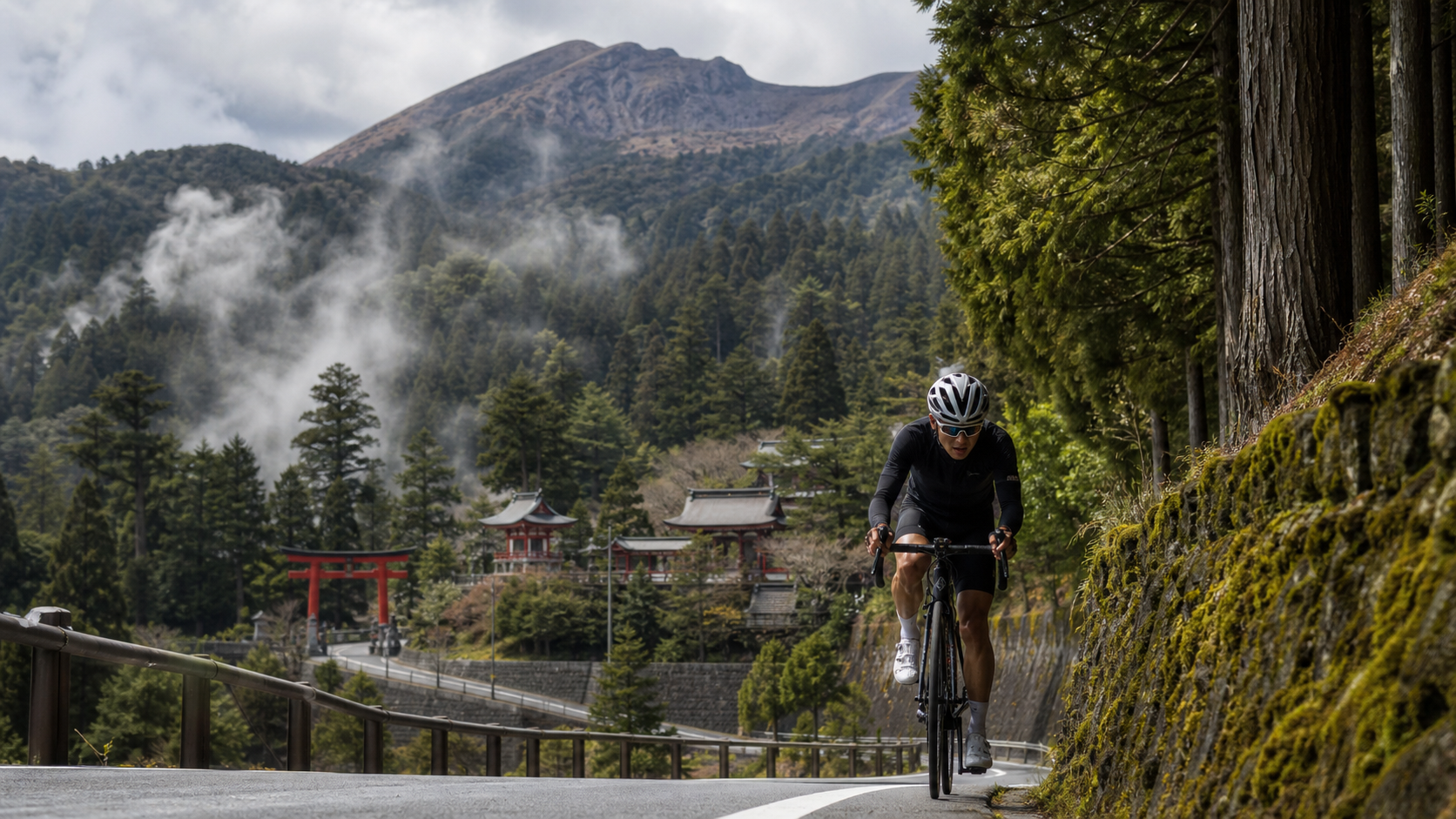
Climbing to Where Myth Touched the Earth: The Takachiho-gawara Cycling Story
In Kirishima City, Kagoshima Prefecture, Japan, there is a climb of only 5.43 kilometers—yet one you will remember for a lifetime. It starts beside a shrine designated as a National Treasure, and it ends at the trailhead of a sacred mountain where, according to legend, “the gods descended to earth.” This road is the Takachiho-gawara Hill Climb.
If you have read the ride guides, you know how brutal it is—an average gradient of 9.5%, the most direct and unforgiving short, steep wall in Kirishima. But this article wants to show you the other side of this road: the land beneath it steeped in myth, the volcanic breath rising from the forests along the way, and that indescribable feeling when you grind your way up to Takachiho-gawara, gasping for air.
Because riding here, you are never conquering just a slope. You are spinning your wheels, climbing all the way to the place in Japanese mythology where the “Descent of the Heavenly Grandson” took place.
Some climbs make you stronger, and some climbs make you feel awe. Takachiho-gawara is both—it forges your legs with its steepness and moves your heart with its mythology.
The Descent of the Heavenly Grandson: A Sacred Mountain Carrying Myth
To understand this road, you first need to know the mountain its summit points toward—Mount Takachiho.
In Japanese mythology, Mount Takachiho is the stage for the legend of the “Descent of the Heavenly Grandson.” According to the tale, Ninigi-no-Mikoto, grandson of the sun goddess Amaterasu, was commanded to descend from the heavenly realm of Takamagahara to earth, and the place where he landed was this very Mount Takachiho. This myth gave the mountain an extraordinarily exalted status—it is not merely a geographical peak, but a sacred place in the Japanese heart where “heaven and earth meet.”
At the summit, a sacred weapon called the “Ame-no-Sakahoko” is said to be planted, adding even deeper legendary color to the mountain. Countless climbers and pilgrims come here, drawn by the desire to scale this mythic mountain and stand in person where the legend touched down.
And you, as a rider, will follow that 5.43-kilometer steep slope all the way up to the trailhead of this sacred mountain—the Takachiho-gawara Visitor Center. When you arrive, you have not just completed a climb; you have reached the threshold of a myth a thousand years old. From here, hikers continue on foot toward the 1,574-meter summit of Mount Takachiho. You have delivered yourself by bike to the gates of myth; the rest of the way is left to those who wish to get closer to the sky.
This sense of “riding toward myth” is the most unique charm of Takachiho-gawara. It turns a simple climb into an ascent with ritual meaning.
A National Treasure Starting Point: Kirishima Shrine
The start of this road lies near Kirishima Shrine—and this shrine was designated a Japanese National Treasure in 2022.
Kirishima Shrine enshrines none other than Ninigi-no-Mikoto, the deity who descended here in myth. The vermilion shrine hall, set against towering ancient trees and the thin mountain mist, radiates a solemn and mysterious air. As the spiritual heart directly tied to the “Descent of the Heavenly Grandson” myth, its status speaks for itself, and the “National Treasure” title is the highest recognition of its historical, artistic, and cultural value.
Picture this scene: you mount your bike beside a National Treasure shrine, take a deep breath, and begin climbing toward the mythic mountain. A starting point like this would be hard to find a second time among all the climbing routes in the world. It immerses your ride in a rich atmosphere of history and faith from the very first pedal stroke.
Many riders make a point of stepping into Kirishima Shrine before the challenge, bowing before the torii gate, pressing their palms together in front of the shrine hall, and praying for a safe and smooth journey up the steep slope ahead. This is not superstition—it is a sign of respect for this land and a ritual to quiet the mind. When you set out with that reverence, the pain of those 5.43 kilometers seems to carry an extra layer of meaning.
Departing from a National Treasure shrine, climbing toward a mythic mountain—Takachiho-gawara stitches “cultural depth” and “athletic challenge” into a single journey.
Riding on a Living Mountain: Forest, Steam, and the Smell of Sulfur
The most vivid impressions of the Takachiho-gawara riding experience are “green” and “alive.”
The entire road is wrapped in dense forest. As you grind up the steep grades, towering trees layer on both sides, blocking out the sky, and sunlight filters through the gaps in the branches, casting dappled light on the pavement. This forest makes the whole road feel deep and tranquil, and in summer it offers rare shade to riders drenched in sweat. You can hear your own breathing, the turning of the chain, and the calls of unknown birds in the woods. It is a sense of focus as if cut off from the world.
And on certain sections, you will encounter this road’s most distinctive mark—volcanic steam and the smell of sulfur. Thin white vapor rises from the roadside, and the familiar sulfur scent drifts through the air, reminding you: you are riding on a living mountain. The feeling is remarkable. Your legs are fighting the gradient, while your nose reminds you that the ground beneath you is still breathing, still moving. It is a thrill of “standing shoulder to shoulder with the vitality of nature” that flat-road riding can never give you.
This is also the perfect footnote to Kirishima’s status as a volcanic geopark. You are not riding on an ordinary mountain road; you are on land that is still an active volcanic landscape, measuring its slopes with your wheels and feeling its breath. Every pedal stroke is a conversation with this ancient, living earth.
The Sweet Reward at the Top: Matcha Ice Cream
After climbing that 5.43-kilometer steep slope, your body will desperately crave a reward. And Takachiho-gawara happens to have a sweet gift ready.
At Takachiho-gawara, there is a shop called “Jingū-mae Chaya,” and its specialty is matcha ice cream made with Kirishima tea. Imagine this: you have just given everything to conquer this hardcore climb, legs burning, drenched in sweat, and then you sit down and hold a matcha ice cream made from local Kirishima tea—that slightly bitter, sweetly lingering tea aroma, that cold, sweet relief, melts through your exhausted body in an instant. The satisfaction of that moment is something no dessert casually bought on flat ground can match.
Because this sweetness is earned with a 515-meter elevation gain. After exercise, your sense of taste is always sharper; and enjoying an ice cream made from local tea at the trailhead of a mythic mountain—that sense of occasion is simply irreplaceable.
(Of course, the shop’s opening hours may vary by season and time of day; please check the actual situation when you visit. Part of the joy of travel is sometimes hidden in these “you’ll only know when you get there” surprises.)
| Experience Along the Way | Details | Meaning for Riders |
|---|---|---|
| Kirishima Shrine | Designated National Treasure in 2022, enshrines Ninigi-no-Mikoto | A National Treasure starting point, praying for safety |
| Dense Forest | Towering, deep, and tranquil | A focused riding atmosphere and summer shade |
| Volcanic Steam | Sulfur smell and white vapor at the roadside | The thrill of riding on a “living mountain” |
| Mount Takachiho | Stage of the Descent of the Heavenly Grandson myth, 1,574 meters | The mythic sacred mountain the summit points toward |
| Matcha Ice Cream | Made with Kirishima tea, specialty of Jingū-mae Chaya | The sweet reward after the steep climb |
A First-Person Climbing Narrative
Let me take you through this road in the first person.
Before setting off, I first stepped into Kirishima Shrine. The vermilion shrine hall appeared faintly through the morning mist, ancient trees towered overhead, and the air was so still I could hear my own heartbeat. I pressed my palms together before the shrine hall, praying for a safe journey. At that moment, I suddenly felt I wasn’t just there to ride a bike—I was there to visit a sacred place.
Swinging a leg over the bike, I felt the pressure of the gradient with the very first pedal stroke. This road doesn’t make small talk, doesn’t stand on ceremony—it slams a 9% grade straight into your legs from the start. I quickly dropped into my bailout gear, steadied my cadence, and told myself: don’t rush, there’s a long way to go.
The forest quickly swallowed me whole. The trees on both sides blotted out the sky, sunlight shattering into specks of light on the ground. I listened to my own heavy breathing and the whir of the chain, pushing upward inch by inch through the deep green. Steep walls came one after another, and I didn’t think about the summit—I focused only on the few dozen meters ahead, one switchback, then another.
At a certain point, the smell of sulfur drifted through the air, and thin white smoke rose from the roadside. That’s when goosebumps broke out on my skin—I was riding on a living volcano. My legs were burning, yet my mind was eerily clear. I thought of the myth of the deity descending from heaven, of the people who had gazed up at this mountain for millennia, and now I was here, climbing step by step toward their sacred ground on two wheels.
The moment I finally pushed over the top at Takachiho-kawara, I was nearly spent—but I laughed out loud. I leaned my bike against the wall, walked to the teahouse, and picked up a matcha soft-serve. The bittersweet tea aroma melted across my tongue, the cold seeping into my overheated body. I looked up toward the direction of Mount Takachiho—the mountain where the myth landed, there above the clouds.
In that moment, I understood: The more real the pain this road gives you, the deeper the emotion it gives you in return.
The Kindness of Arrival: From Airport to the Gate of Myth
For riders coming from afar, the accessibility of this road is reassuring. Kagoshima Airport is only about 25 kilometers from the start at Takachiho-kawara, and it is quite bike-friendly with excellent facilities.
This means you don’t need complicated long-distance transfers—you can leave the airport and, after a short shuttle or warm-up ride, arrive at the gateway to this mythical mountain. This convenience makes Takachiho-kawara a highly attractive stop on any international rider’s Kyushu itinerary—you can reach a place steeped in a thousand years of myth with relative ease, then conquer it on two wheels.
Of course, don’t forget that this road is steep and wrapped in forest. Before heading up, be sure to check volcanic conditions and road access (Kirishima is an active volcanic zone, and certain periods can be affected), and bring plenty of bailout gear. Do your preparation, and this gate of myth will open for you.
The Meaning of This Route: Riding Toward a Living Legend
Back to the beginning: why ride Takachiho-kawara?
Because it fuses “challenge” and “meaning” so completely. On the challenge side, its 5.43 kilometers at a 9.5% average grade is a hardcore steep climb that gets any climbing enthusiast’s blood pumping; on the meaning side, it starts from the national treasure Kirishima Shrine, passes through the steam of an active volcano and dense forest, and climbs all the way to Mount Takachiho—the stage of the “Tenson Korin” (Descent of the Heavenly Grandson) myth. A route like this is rare anywhere in the world.
What you conquer is a real, steep slope; what you arrive at is a living legend. When you’re at the summit holding a matcha soft-serve, gazing at the mythical mountain in the mist, you’ll feel a satisfaction that’s hard to put into words—the moment where physical limits and spiritual awe converge in the same place.
Takachiho-kawara is not a long road, but it is a “deep” road. Its depth comes from the thousand years of myth, faith, and volcanic vitality accumulated in the land beneath your wheels.
So, if you ever find yourself in Kyushu, don’t let this road be just a name on a checklist. Bring your bike, bring plenty of bailout gear, and bring a heart willing to revere. Set out from Kirishima Shrine and climb toward the mountain of myth. When you push over the top at Takachiho-kawara, gasping for breath, and look back at that steep slope wrapped in forest and steam, you’ll thank yourself for every pedal stroke you took.
This isn’t just a climbing route. It’s a journey riding toward myth, toward a volcano, and toward the deepest part of yourself. And you’ll remember it forever.
What the Steep Slope Taught Me
Riding a short, steep wall like Takachiho-kawara gives you new insights into what “climbing” really means. These insights often transcend cycling itself and become metaphors for facing life.
The steep slope taught me that pain has an end. On the steepest stretch, you feel like you can’t go on—your legs feel like lead, your breathing like a bellows. But as long as you don’t put a foot down, pedal after pedal, that steep wall will eventually be behind you. When you look back, you’ll be amazed that you actually made it. Many seemingly insurmountable hurdles in life are the same—in the moment, it feels like the sky is falling, but once you endure and look back, it’s just a steep slope.
The steep slope taught me that preparation matters more than brute force. Those who bring enough bailout gear, hold back at the start, and steady their mindset often ride farther than those who charge ahead on pure grit alone. This road doesn’t reward recklessness; it rewards wisdom. Many of life’s challenges work the same way—rather than burning yourself out head-on, prepare smartly and advance with strategy.
The steep slope taught me to enjoy the process itself. If you only stare at the finish line, those 5.43 kilometers will feel endlessly long and despairing. But if you learn to appreciate the journey—the depth of the forest, the mystery of the steam, the dialogue between body and earth—then even in the pain, you can find a strange kind of calm and satisfaction. This ability to “find meaning in the process” is a precious gift endurance sports gives to everyone.
The steep slope taught me that the sweetness of arrival is earned through bitterness. The matcha soft-serve at the summit tasted so good precisely because it was earned with 515 meters of climbing. The sweetest fruits in life often grow on the hardest-to-reach branches. Without that steep slope, there would be no sweetness.
You may have heard these lessons before, but only when you’re gasping and sweating on the steep slopes of Takachiho-kawara, and still choosing not to put a foot down, will you truly “understand.” That’s why some people travel great distances just to climb a 5.43-kilometer slope—because they know this slope will give them far more than a Strava record.
Final Words for Those Preparing to Come
If you’ve read this far and your heart is already stirring, already plotting to fit Takachiho-kawara into your itinerary, then allow me, as someone who’s been there, to leave you with a few final words.
Come with reverence. This is a land embraced by myth, a national treasure shrine, and an active volcano—it deserves to be visited with the utmost respect. Respect the volcano’s warnings, respect local regulations, respect the status this sacred mountain has held for millennia. You are a brief passerby; this land is the eternal host.
Come prepared. Don’t underestimate these 5.43 kilometers—its 9.5% average grade will test you honestly. Bring plenty of bailout gear, make sure your brakes are in order, keep your bike weight as lean as possible, and check the volcanic conditions thoroughly. Take control of all the variables you can, and leave the rest to your legs and your will.
Come with a heart willing to be moved. The most precious thing about this road isn’t its difficulty—it’s its depth. When you’re riding through the forest, smelling the sulfur, thinking about the legend of the heavenly descent, let yourself be open to everything this land wants to give you. Don’t rush the itinerary, don’t rush to post on social media—first, take the awe of the moment deep into your heart.
Then, go ride. Set out from Kirishima Shrine, pass through the deep forest and the rising volcanic breath, and climb all the way to that sacred mountain where the myth landed. When you arrive at Takachiho-kawara, hold up that matcha soft-serve, and gaze at Mount Takachiho in the mist, you’ll be deeply glad you came.
Because some places, you have to ride up to yourself to understand why they’re worth it. And Takachiho-kawara is exactly such a place—a living legend, waiting for you to read it to the end on two wheels.
A Side Trip to Kirishima: Weaving the Ride into a Complete Journey
Takachiho-kawara doesn’t have to be a “single-point blitz” trip. In fact, the rich cultural and natural resources surrounding it are more than enough to stretch this ride into a refined and complete Kirishima journey.
First, the hot springs. One of the most famous pleasures of the Kirishima area is the volcanic hot springs bestowed by nature. The Kirishima Onsen district is not far from Takachiho-kawara, making it the perfect place to soothe your body and mind after a ride. Imagine exhausting your legs on that 9.5% gradient, then soaking in a steaming volcanic hot spring in the evening, letting your tight, aching muscles slowly unwind in the sulfurous waters—this experience of stringing together “intense exercise” and “deep healing” is precisely what makes Kirishima so captivating. For cyclists, this is almost an unmissable closing ritual.
Next, the shrine visits. Besides the national-treasure Kirishima Shrine that serves as the starting point, the Kirishima area is home to many other cultural and spiritual spaces worth exploring at a leisurely pace. This land has been the core stage of the “Tenson Korin” (Descent of the Heavenly Grandson) myth since ancient times, and a sacred, tranquil atmosphere permeates the air everywhere. Slow down, walk among the ancient trees and thin mist, and feel this land steeped in mythology for a thousand years—it will add a rich layer of depth to your cycling journey.
And then, the flavors. Kyushu is renowned as a food paradise, and Kirishima is no exception. Whether it’s the matcha ice cream made with Kirishima tea at the summit, or the local cuisine in the hot spring town below, both can replenish energy and comfort your palate after a tiring ride. Rewarding your hard-working legs with local flavors is itself one of the most grounded joys of travel. (For specific shops and dishes, it’s best to go by the actual conditions at the time of your visit, letting serendipitous local encounters become the surprises of your trip.)
String these elements together, and your trip to Takachiho-kawara becomes more than just a climbing record—it becomes a complete journey blending challenge, faith, healing, and taste. This is the most generous thing about the Kirishima land: after you conquer its steep slopes, it’s willing to embrace your weary self with hot springs, mythology, and good food.
And when you look back on this journey years later, what you remember may not just be the pain of that steep climb, but also the warmth of the hot springs, the fragrance of the matcha, the stillness of the shrine, and the version of yourself standing at the trailhead of the Mythical Mountain with a satisfied smile. This is what cycling looks like at its finest when woven into travel.
The Mythical Mountain Through the Four Seasons
This forest-clad steep slope at Takachiho-kawara changes its expression with each season, and every season has its own charm.
Spring brings fresh greenery to the forest, and the entire road feels washed clean. As you climb, the tender leaves glow with light on both sides, and the air carries the moist breath of new life—a very comfortable season. After the stillness of winter, this Mythical Mountain awakens anew in spring, full of vitality.
Summer turns the dense forest into the best natural shade. Although the climb itself remains demanding, being surrounded by greenery and sheltered from the scorching sun of the open plains actually lends this steep slope a touch of cool comfort. Summer is when the forest is at its most vibrant, with cicadas and birdsong interweaving—the most rustic and wild season of all. That said, mountain weather tends to change in the afternoon, so an early start is the safer bet.
Autumn sees the autumn foliage of the Kirishima area paint this forest in intense colors. Layers of red and yellow spread out along both sides of the steep slope, adding a touch of gorgeous poetry to this hardcore climb. For cyclists seeking visual splendor, autumn is unquestionably the golden season to visit.
Winter lends this Mythical Mountain an especially solemn air. Low temperatures, possible frost, and slippery roads raise the risks of riding, requiring more careful preparation and judgment. But the quiet, vast beauty of the winter forest carries an indescribable character of its own. Whenever you go, safety must always come first when heading up the mountain in winter.
No matter which season you choose to visit, this sacred mountain bearing the “Tenson Korin” myth will welcome you in its own unique way. All you need to do is come well-prepared, keep a steady mindset, and surrender yourself to the road. As you climb all the way toward the mist-shrouded trailhead of Mount Takachiho, you’ll feel it deeply: being able to ride on land embraced by myth and volcano is itself a kind of fortune.
May you one day set foot on this road yourself and experience its steepness, its depth, and its beauty firsthand. Then you’ll understand why some people are willing to travel a thousand miles just to ride toward this living legend.
Related Reading
- Riding into Myth and Volcano: A Cycling Chronicle of Ebino-kogen, a Highland Pilgrimage Across the Kirishima Peaks
- Takachiho-kawara Hardcore Climb Guide: A 5.43km Short, Steep Wall at 9.5% Average Gradient, with Full Analysis of Bailout Gears and Pacing
- The Sky Road to a Sacred Mountain: A Journey Across the Roof of Shikoku via the Ishizuchi-san Skyline, Shugendo Faith, and Menagawa Blue
- Sea of Clouds, Cattle, and Sculptures on the Grasslands: A One-Day Poem Riding Up the Utsukushigahara Plateau
台北闊瀨陡坡 騎旅 / 日本單車雜誌編輯車友臨時加入!/ 髮香才是最強的 / feat. 北迴歸線小隊 / 公路車 CT Yeh
6 個月前
嘉義大埔、阿婆灣挑戰賽,美到以為在日本!ft. 環騎5 Cool 西拉雅188 / 公路車 / CT Yeh
7 個月前
2025 乘鞍 KOM 登山賽挑戰實錄 / 日本公路最高 ! 賽前探路篇 / 比富士山厲害,無敵絕景!/ 40週年 / 中文YT首發 / 公路車 / CT Yeh #乘鞍ヒルクライム
10 個月前
新竹羅平 x 天湖部落 大禹嶺級變態陡坡! 4K超高畫質 空拍 | 公路車
5 年前
2025 乘鞍岳登山賽 比賽全紀錄篇 / 完整路線攻略介紹 / 日本版武嶺 公路最高點 / 高山空拍絕景 / 明年會開團! / 公路車 / CT Yeh
10 個月前
宇老大滿貫(改)/ UBike神人 / 太離譜了!出大景 差點被擊落 / feat. 神秘密境單車團 / 公路車 / CT Yeh
2 年前
大武山20%魔王陡坡【JJSC南台灣遊騎Day2】!屁股真的要裂開了...凡士林抹滿也沒用?神秘金教堂還有超便宜夜市
3 個月前
京都!99%人不知道的秘境玩法!租 E-Bike 騎進探訪宇治抹茶原鄉 刺激好玩絕美的山林古道 鬼滅之刃的場景探訪 / CT Yeh
13 天前