Tannan: A Bunun Tribe Hidden Away, with Its Slate Houses, Elementary School, and the Legend of Shooting the Sun
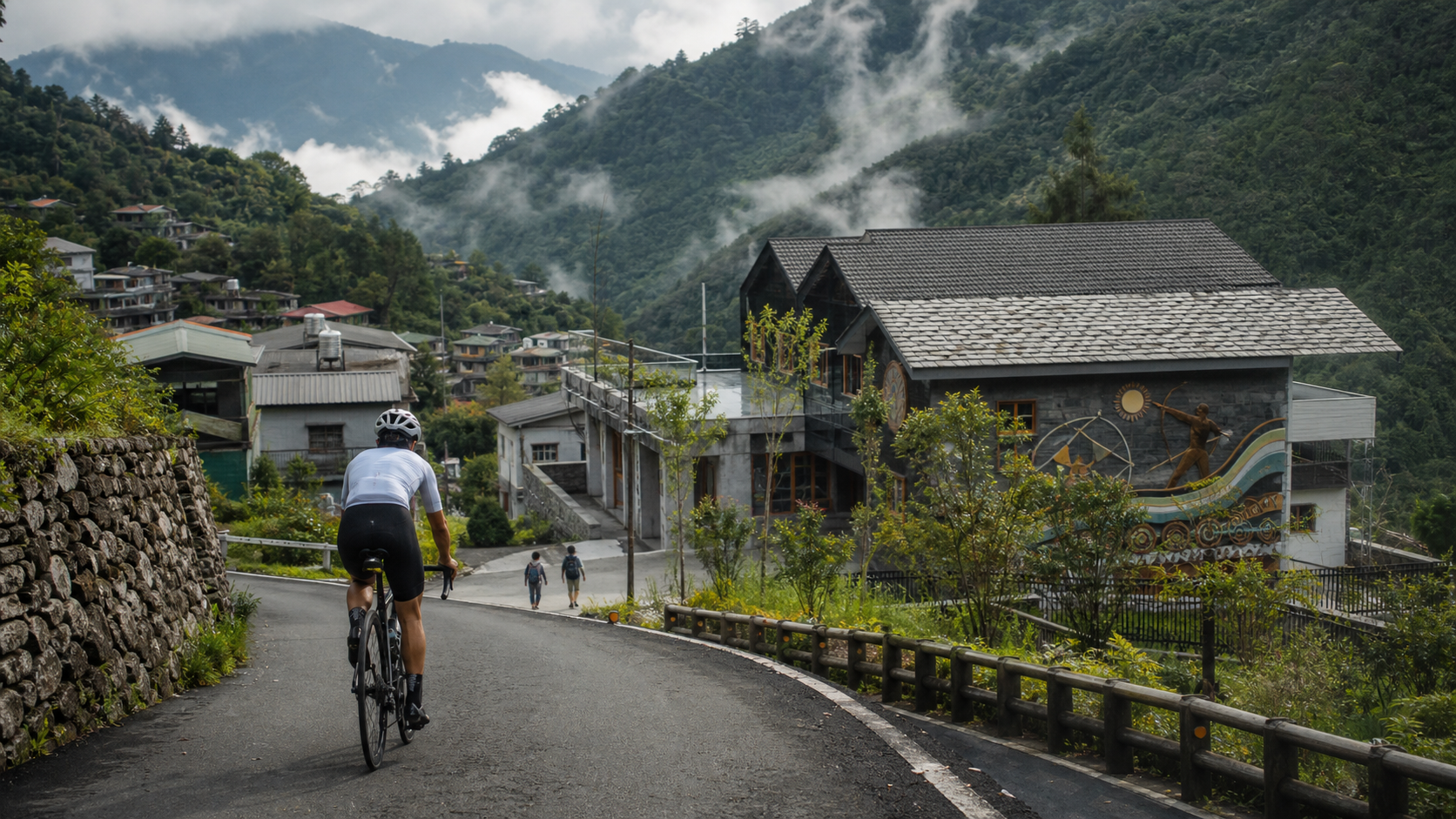
Many people, upon first hearing the name “Tannan” (潭南), pause for a moment: where is that? It’s not like Sun Moon Lake, which sits at the top of every travel itinerary, nor is it famous for seas of clouds like Wujie. Tannan Village quietly rests on the mountainside at the northwestern edge of Xinyi Township, Nantou County, at an elevation of about 800 meters. Its name comes from being located “south” of Sun Moon Lake—Tan refers to that lake everyone knows, and Nan is the distance, cut off by mountains, between the village and that fame.
The road climbing into Tannan is about 5.2 kilometers long, with an elevation gain of roughly 466 meters and an average gradient of 6.3%. It’s short—short enough that you could ride it as a side trip in an afternoon. But what it holds is deep enough to make you want to slow down every single pedal stroke. This article isn’t about gear ratios or pacing; I want to introduce you to a tribe that was reborn through slate houses after a major earthquake, and to the legend of shooting the sun, painted on its walls, that belongs to the Bunun people.
In Taiwan, many routes compete for your attention—the highest, the steepest, the most classic, the most Instagram-worthy. Tannan never joins that contest. It’s like an old friend who isn’t good at self-promotion, but once they start talking, you never want them to stop. You have to be willing to take a detour, to turn one extra corner south at the Sun Moon Lake junction, before you’ll meet it. And once you do, you’ll likely come back a second and third time. Because what it gives you isn’t a one-time thrill, but a long-lasting, grounded feeling that grows richer the more familiar you become with it.
A Village Misplaced on the Administrative Map
First, let’s set the record straight for Tannan. Because it’s often approached from Shuili or the Sun Moon Lake direction, many people assume Tannan belongs to Shuili Township. But in fact, Tannan Village was established in 1963, split off from Dili Village, and is under Xinyi Township. This small geographical mix-up is, in a way, a microcosm of Tannan itself—it has always lived quietly in the shadow of major attractions, not often seen, and not particularly caring whether it is seen.
The village’s residents are primarily from the Takitudu (Ka) group of the Bunun people, formed from the merging of three tribes during the Japanese colonial era: the Ka社群, Kalimuan, and Alusan. In recent years, the village has had a population of around seven hundred people across roughly two hundred households. It’s a small village, so small that every household you ride past might know each other; and so small that when it suffers a natural disaster, the pain cuts especially deep.
The first time I rode up to Tannan was on a morning when the mist had yet to fully clear. The climb in the early section had my breathing ragged, but when the view suddenly opened up and the village rooftops unfolded one by one across the mountainside, I forgot to catch my breath. It wasn’t a majestic scene that takes your breath away, but a quiet one, like a gentle greeting. A few children on their way to school walked past with backpacks, and one of them turned to look at me and smiled. That smile had no reason behind it, yet it was the best fuel of my ride that day. Later, I came to understand that what Tannan offers is never the sense of accomplishment from “conquering a mountain,” but the grounded feeling of “being gently embraced by a place.”
The Bunun People and Their Relationship with the Mountains
To understand Tannan, you first need to understand the Bunun people’s relationship with the mountains. The Bunun are one of the indigenous peoples of Taiwan living at the highest elevations, having long inhabited the heights of the Central Mountain Range—truly a people who “live above the clouds.” Their society is centered on patrilineal clans, with a strong emphasis on sharing and mutual aid; when a hunter brings back game, it’s never the achievement of one person alone, but a shared asset of the entire group. This underlying ethos of “sharing” is still written into the way Tannan people treat their guests—you’ll find that when people here give, they don’t fuss over amounts; it’s a generosity etched into their culture.
What the Bunun are most renowned for is their “Pasibutbut” (the Prayer for Bumper Millet Harvest), a form of polyphonic choral singing with no conductor and no musical score, built up slowly as tribe members listen to one another. It once astonished international music scholars. When you stand in the valley at Tannan and imagine such voices echoing through these mountains, you suddenly understand: the aesthetic of this people has always been about “listening to each other and drawing closer, slowly.” And isn’t that exactly the attitude you should have when riding up a mountain?
After 921: A School Reborn Through Slate
If Tannan could tell only one story, it would be the story of Tannan Elementary School.
This mountain school, founded in 1958, was severely damaged in the 921 Earthquake of 1999. After the quake, the Hao Ran Foundation adopted the school for reconstruction, with architect Chiang Lo-ching (姜樂靜) leading the design. She didn’t build a standard concrete schoolhouse; instead, she combined the concept of the Bunun’s traditional “slate house” with steel construction, allowing the school to grow from the ruins into something that looked like the Bunun people themselves.
As a result, Tannan Elementary has become one of Taiwan’s most distinctive tribal schools. It’s not just a school; it’s a monument that “built culture into architecture”—telling everyone who comes here: reconstruction isn’t just about propping up what fell, but about taking the chance to rebuild “who you are” from the ground up. The school also has a samba drum team, and the children’s drumbeats are among the most vibrant sounds in this valley.
When you finish that 6.3% climb and arrive at the village, breathless, the first thing you see is this school, and you’ll feel that all the effort was worth it.
I stood outside the school gate for a long time. The slate walls glowed with a warm gray in the morning light, with steel lines weaving through them—both ancient and contemporary. At that moment, I thought back to 1999—the collapsed houses on TV, the cracked roads, the countless people who lost their homes in the rubble. For Tannan, that earthquake wasn’t just a number in the news; it was the day the school was literally shaken to the ground. And the way they chose to rebuild wasn’t to turn the clock back to before the disaster, but to use that wound as an opportunity to rebuild “we are Bunun” back into the land. Architect Chiang Lo-ching once said she didn’t want to create just a building, but to let children grow up within their own culture. I think of that every time I ride up to Tannan.
A school can be just a school, or it can be an entire people’s promise to themselves. Tannan Elementary chose the latter. It stands there, quietly telling every passerby: true reconstruction is about planting the “roots” back as well.
The Legend of Shooting the Sun on the Walls: World-Class Tribal Murals
Another stunning aspect of Tannan is its tribal murals. This small village once collaborated with the international street art group “POW! WOW! TAIWAN,” inviting artists from around the world to paint the Bunun people’s stories onto the walls—hundred-pacer snakes, tribal elders, owls, hunters drawing their bows, and the Bunun’s famous “Legend of Shooting the Sun.”
Imagine this: in a mountain tribe at 800 meters elevation with a population of under a thousand, the walls feature world-class street art, and the content isn’t abstract graffiti but myths passed down orally for centuries by this people. This contrast is, in itself, the most fascinating thing about Tannan. It lets ancient legends come alive in the most contemporary way, and it allows a quiet tribe to be gently seen by the world through art.
Ride slowly through the village, looking at the stories wall by wall—the hero who shot the sun, the protective hundred-pacer snake, the wise owl—and you’ll realize that the rewards of this ride go far beyond “climbing 466 meters.”
The wall that made me pause the longest was the one depicting the legend of shooting the sun. The Bunun story goes like this: in ancient times, there were two suns in the sky, shining in turns, leaving the earth with no night. Vegetation withered, and life struggled to survive. A father and son decided to set out to shoot down the sun. The father carried his young child on his back, and they walked for so many years that the child had grown to adulthood by the time they arrived. They shot one of the suns with an arrow, and the wounded sun turned into the moon, bringing day and night, the four seasons, and rest. What makes this story moving is that it speaks not just of courage, but of “one generation willing to walk a road with no visible end for the sake of the next.” Painted on Tannan’s walls, it feels especially fitting—isn’t this exactly the road this tribe walked after 921?
I touched that wall, weathered by countless mountain winds, and suddenly felt that the scales of the hundred-pacer snake, the hunter’s drawn bow, and the sun brought down were more than just paint. They are a people’s way of leaving their memory in the sunlight, stories told to anyone willing to stop and listen.
The Hunter’s Home: Serving Culture at the Table
Tannan also preserves the living culture of the Bunun people. The village is home to the “Hunter’s Home,” which offers hunting culture experiences, allowing visitors not just to “look” but to “participate”—to understand the Bunun people’s relationship with the mountains and forests, and to grasp the hunting wisdom behind a meal of local flavors. As for the dishes and details, I recommend experiencing them in person, because those flavors and stories are things no guidebook can capture.
For the Bunun, hunting has never been merely about “obtaining food”—it is an entire ethic of dialogue with nature. They believe the mountains have their own masters; before entering the mountains, hunters must observe taboos, perform dream divination, and take only with restraint—never greedily, never to the point of extinction. This concept of “borrowing from the mountain, and giving back to the mountain” is, in fact, far closer to modern notions of sustainability than we might imagine. Sitting by the fire pit at the Hunter’s Home, listening to the elders speak of these mountain rules, you suddenly feel a recalibrated humility about “how humans coexist with nature”—this is wisdom that grows from the land itself, something no hiking app or environmental slogan can provide.
Beyond the dining table, Tannan also preserves cultural memories such as the Baby Festival and traditional weddings, some of which are kept alive through ceramic murals. These details make Tannan not just “scenic,” but “soulful.”
I particularly love that the “Baby Festival” has been preserved. The Bunun believe that the arrival of a new life deserves to be solemnly blessed and named; elders place necklaces on infants and pray for their safe growth. In an age when technology accelerates everything, there is still a tribe willing to take the time to hold a solemn ceremony for a newborn—this kind of “slowness” is itself a luxurious tenderness. When these memories are painted onto ceramic murals and mounted on Tannan’s walls, roadsides, and schools, they cease to be museum exhibits and become a breathing part of everyday life.
Tannan Through the Seasons: A Quiet That Is Season-Limited
Tannan’s beauty changes its attire with the seasons. In spring, mountain cherry blossoms and various wildflowers bloom sporadically on the village slopes, and the mist carries a moist floral fragrance; in summer, the coolness at 800 meters above sea level makes this a small paradise away from the lowland heat, with cicadas and streams weaving their sounds together; in autumn, the sky stretches high and blue—the season of best visibility, perfect for taking in the entire village and the distant mountains at a glance; in winter, the valley is often shrouded in thick fog and drizzle, and the village falls so quiet that only roosters and the sound of children’s drums remain, carrying a cool, solemn dignity.
My top recommendation is early morning. When the first light crosses the mountain ridge and spills into the village, the slate walls, the murals, and the curling cooking smoke are all gilded in gold—a warmth no camera can fully capture. And if you’re lucky enough to catch the samba drum team of Tannan Elementary School practicing on the field, that vibrant drumbeat will travel along the valley all the way to you—and you’ll suddenly understand that this tribe, which rose from the earthquake disaster, has long since beaten its pain into rhythm and turned its days into song.
Weaving Tannan into a Journey of Mountains and Water
Tannan’s location makes it naturally suited to being woven into a half-day or even full-day excursion. Heading down the mountain, you’ll find the lively towns of Shuili and Checheng:
- Checheng: The terminus of the Jiji Line railway and a former timber industry hub. The Wood Industry Exhibition Hall tells the story of its past prosperity, and today it is a beloved nostalgic station.
- Jiji Branch Line: From Checheng, you can transfer to the Taiwan Railways and continue toward Jiji, Longquan, and Ershui—one of the few preserved scenic railways in Taiwan.
- Shuili Snake Kiln: Built in 1927, it is the oldest surviving wood-fired snake kiln in Taiwan. Its long kiln body winds along the hillside like a sleeping serpent, telling the century-long story of Taiwan’s ceramics industry.
- Shuili Creek Bicycle Path: A gentle riverside route, perfect for cooling down after climbing Tannan’s steep slopes, and suitable for family rides.
On a single trip, you can first feel the warmth of kiln fire at Shuili Snake Kiln, then climb up to Tannan to see the Bunun murals and the slate elementary school, and finally wind down with a cup of coffee in front of Checheng’s old timber station—mountains and water, steep and gentle, ancient and modern, all within a single day.
I often feel that this connecting route is itself a metaphor for Taiwan. The firewood of Shuili Snake Kiln burns with the century-old ceramic heritage of Han immigrants; Checheng’s Wood Industry Hall records the rise, fall, and transformation of the logging era; and Tannan’s slate walls tell of the Bunun people’s presence on these highlands for a thousand years. In a single day, your wheels roll over a Taiwan where multiple ethnic groups and multiple generations are layered together. When you stand before Checheng’s old station, watching the sunset paint the railway tracks gold, you’ll feel a hard-to-articulate emotion—turns out a single ride can be such a gentle lesson in history.
What This Road Means to Riders
What Tannan teaches riders is to “see what is unseen.” It lacks Sun Moon Lake’s fame, lacks Wujie’s sea of clouds, and even its administrative district is often mistaken. But precisely because of this, it preserves a rare quietness and sincerity—its slopes are for those willing to take the detour, and its stories are for those willing to stop and listen.
When you lean your bike against the slate wall of Tannan Elementary, watching the children’s drum team and the hunter shooting the sun on the wall, you’ll understand: the value of some routes has never been on Strava leaderboards, but in how they teach you to “slow down and truly see a place.”
I know an old cycling friend who has ridden every hundred-peak-grade climb in Taiwan, his Strava decorated with records from all the iconic routes. Once I brought him to Tannan, and he was initially unimpressed—“So short, so gentle—is it worth a special trip?” But after the ride, he sat by the wall of Tannan Elementary for a long time, and finally said just one thing: “Turns out I’ve been riding for years, chasing gradients, but rarely truly arriving anywhere.” That day he didn’t start his Strava timer. He said this road doesn’t need to be timed; it needs to be remembered.
I think that is Tannan’s most precious quality. In an era where everything must be quantified and compared, it stubbornly reminds you: the original joy of cycling is not numbers, but the fact that your wheels carried you to a place you never would have gone—yet one that warms your heart.
A Slope, and a Metaphor for Life
Ride long enough and you’ll discover that Tannan’s road is much like a certain stage of life. It isn’t long, yet it isn’t easy; it isn’t famous, yet it is sincere. You think 5.2 kilometers will be over quickly, but once you truly enter it, you find that every section has something it wants you to learn—the start requires patience, the steep sections require the humility to downshift, and upon arrival you must know how to slow down and show respect. It rewards no brute force, only those willing to adjust themselves and treat a place with care.
And Tannan itself is a metaphor for “rebirth.” It was struck down by an earthquake, mislabeled by administrative districts, and overshadowed by the brilliance of major attractions—yet it never became angry or dimmed. Instead, through its slate houses, its murals of the sun-shooting hunter, and the sound of children’s drums, it has lived itself into a place that knows more clearly than ever “who I am.” Isn’t that what all of us long for? After falling, not just getting back up, but standing more like ourselves than before. Tannan’s slope teaches this, quietly, to everyone who climbs it.
Slate Houses: A People’s Wisdom Carved into Architecture
Many cyclists who ride past Tannan Elementary School are drawn to its slate wall, yet few realize that for the Bunun people, the “slate house” was never merely a building material choice—it represents an entire philosophy of living in harmony with these mountains.
Traditional Bunun houses were built from locally sourced materials, with walls stacked layer upon layer from shale and slate quarried from the mountains, and roofs covered in the same stone. The heavy stone provides excellent insulation and heat retention—blocking the high-mountain sun’s heat in summer and trapping warmth indoors in winter. This architectural logic actually aligns remarkably with what we now call “passive energy-efficient design,” except that the Bunun ancestors, long before the era of electricity and air conditioning, had already carved this wisdom into their walls through hands-on experience. The slates are not bonded with cement but interlock through precise stacking angles and weight distribution. A wall can stand for decades not because of chemical adhesives, but because of an almost intuitive understanding of structural mechanics.
When Tannan Elementary School was rebuilt, incorporating this concept was not mere aesthetic nostalgia but a continuation of cultural language—so that every wall the children pass on their way to and from class each day silently tells them: your ancestors once lived so wisely with this mountain. Architect Chiang Lo-ching chose slate as the primary vocabulary, elevating the building beyond its function as a “schoolhouse” into a living cultural textbook. When afternoon sunlight sweeps diagonally across the slate wall, those varying shades of gray, those irregular textures left by hand-stacking, all tell one story: this is not a template building copied and pasted by anyone, but an entire people’s reaffirmation of their own roots.
I once met an elder from the tribe walking with his grandson outside the school gate. Pointing at the wall, he said that when he was young, his family’s house was also built by stacking slates one by one—“no nails, it all depends on the angle each stone is placed.” He said this in a flat tone, as if stating something utterly ordinary, but to this outsider cyclist’s ears, it was like a lesson in “patience”—no quick methods, only a hands-on understanding of materials and the land passed down from generation to generation. That day I stood by the wall holding my bike for a long time, and it suddenly struck me: we always think “progress” means charging forward, moving toward faster, lighter, more effortless directions. But Tannan’s slate wall reminds you that some wisdom never needs to be replaced—it simply waits quietly there, for someone willing to stop and look at it.
Side Trips & Reminders
- Tannan Elementary School: A distinctive elementary school rebuilt after the 921 earthquake using the slate house concept; the spiritual landmark of Tannan.
- Tribal Murals: Bunun story murals created in collaboration with POW! WOW!—take your time wandering and looking.
- Hunter’s House: Bunun hunting culture and local cuisine experience (inquire locally for arrangements).
- Checheng, Snake Kiln, Jiji Line: A nostalgic sightseeing belt at the foot of the mountain, ideal for a half-day itinerary.
- Tribal Etiquette: Slowing down, yielding, and showing respect are the most fundamental courtesies when entering any tribe.
- Samba Drumbeats: If you’re fortunate enough to catch the Tannan Elementary School drum team practicing, stop and listen for a while—it’s the most vibrant sound in this valley.
- Morning Light: After sunrise, the tribe is bathed in gold—the scene most worth waking up early for, and the best way to feel Tannan’s tranquility.
Conclusion
These 5.2 kilometers of Tannan are as short as an unremarkable crease on a map, yet they hold a tribe’s resilience reborn from earthquake disaster, an entire wall of the Sun-Shooting myth, and a composure of “living well even when unseen.” It reminds every hurried cyclist: the roads truly worth riding are sometimes not the most famous ones, but the ones with the most stories. Next time you pass Sun Moon Lake, don’t rush off—climb a little farther south and visit the tribe named “South of the Lake.” It has been there all along, quietly, waiting for someone willing to slow down.
And when you do make the climb, do stop by that slate wall, do look up at the sun-shooting hunter on it, you’ll descend with a satisfaction that’s hard to describe. It’s not the thrill of conquering a mountain, but the warmth of having been well received by a place. Tannan won’t appear on most people’s itineraries, but for those cyclists willing to take the detour, willing to listen, willing to slow down, it will repay your 5.2 kilometers of effort with an entire tribe’s story. A road like that is worth remembering for a lifetime.
Related Reading
- Shuili Tannan Climb Guide: A 5.2 km, 6.3% Tribal Hidden-Gem Steep Climb
- Sun Moon Lake Loop Ride Notes: Four Temples, Black Tea, and Morning Mist Around a Lake
- The Sacred Mountain Steep Climb of a Hakka Hill Town: Riding into Shitan, Encountering Xianshan
- Riding into Xindian’s Mountains and Waters: The South Side of Shitou Mountain, a Climb Memory Alongside the Xindian River
虎豹潭!日本老師來台一日約騎 台灣車友熱情招待私房路線 / CT Yeh
19 天前
一定要騎一次!阿里山最深處:里佳部落!單車旅行 | 2800m爬升 | 深度部落體驗:嗨翻晚會、螢火蟲、銀河 | feat. JJSC & 廢物伙伴 | 公路車 CT Yeh
9 個月前
大武山20%魔王陡坡【JJSC南台灣遊騎Day2】!屁股真的要裂開了...凡士林抹滿也沒用?神秘金教堂還有超便宜夜市
3 個月前
嘉義大埔、阿婆灣挑戰賽,美到以為在日本!ft. 環騎5 Cool 西拉雅188 / 公路車 / CT Yeh
7 個月前
藤枝二集團 單車行 Day1 | 南部小武嶺 | 爬坡爬到罵罵叫 | JJSC | 公路車 | CT Yeh
3 年前
台北闊瀨陡坡 騎旅 / 日本單車雜誌編輯車友臨時加入!/ 髮香才是最強的 / feat. 北迴歸線小隊 / 公路車 CT Yeh
6 個月前
嘉義布袋&台南北門 / 好美里、井仔腳鹽田 鮮蚵吃到飽 / CT Yeh / 公路車
4 個月前
新竹白蘭部落! 爬陡坡還能講笑話...? 廢物伙伴の約騎 | 公路車 | CT Yeh
4 年前