Guanhai Ping: If the Mountain Is High Enough, You Can See the Sea — Bagua Tea Garden and Bamboo Sea on Route 49
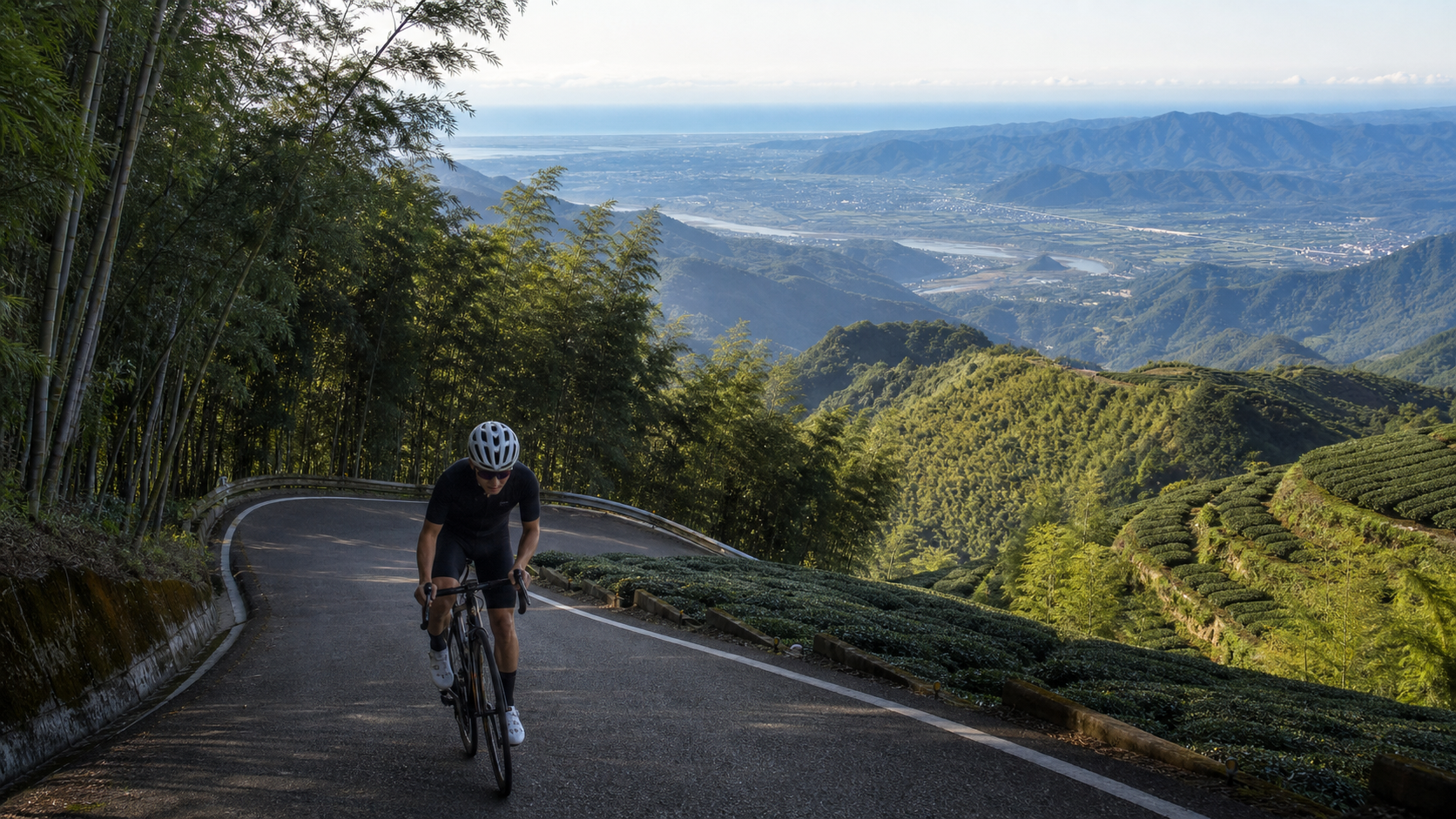
The first time I heard the name “Guanhaiping” (Sea-Viewing Terrace), I assumed it was by the coast. Only later did I learn it sits deep in the mountains of Zhushan, Nantou, at an elevation of over a thousand meters—far, far away from any actual sea. But when I finally gasped my way up to that viewpoint and saw the Zhushan Basin, the Zhuoshui River, and the Bagua Mountain Range spread out beneath my feet—and on clear days, at the far edge of the Yunlin Plain, a faint hint of sea color—I understood the romance of the name: it turns out that if the mountain is high enough, you can see the sea.
The road climbing toward Guanhaiping belongs to Route 49, known in the cycling world as the “Great Demon Township Road.” The section covered here is roughly 11.6 kilometers with about 1,015 meters of elevation gain and an average gradient of 6.1%. Guides are full of numbers; this article isn’t about pacing. What I want to introduce you to is the tea garden shaped into a bagua (eight-trigram) pattern along the mountainside, the sky ladder spanning a deep gorge, the towering Moso bamboo sea, and the story of transformation from bamboo to tea hidden in the place name “Da’an.”
I still remember the morning I set out. The streets of Zhushan hadn’t fully woken up yet; breakfast shop roller doors were only half-raised, and the air carried the scent of sweet potatoes and bamboo shoots—this is, after all, the “Hometown of Bamboo,” where even the air holds a hint of bamboo-leaf freshness. I filled my water bottles, glanced at the winding route on my handlebar, and felt a knot of apprehension in my stomach. In the cycling community, the words “Great Demon” aren’t thrown around lightly: it’s a road you’ll hear mentioned again and again, yet rarely hear anyone say they “rode it easily.” But precisely because of that, it acts like a magnet, drawing one person after another up the mountain who wants to prove themselves. That morning, I was one of them.
From Zhushan’s streets into the mountains: a slow farewell
Leaving downtown Zhushan, the road first climbs gently along the river valley, with familiar betel nut palms, vegetable plots, and scattered houses on both sides. You might get the illusion that this road is nothing special. But keep riding, and the settlements thin out, the gradient grows more stubborn, and cracks of age begin to appear in the asphalt—then you know that the gentle stretch just now was only the mountain’s way of giving you a buffer—like a slow farewell, giving you time to say goodbye to the version of yourself on flat ground.
When the real climbing begins, it’s honest. No flashy switchbacks as a warning—just one stretch after another of straight-up climbing with no end in sight. I shifted all the way down to my easiest gear, dropped my cadence to just barely “not stalling,” and felt sweat dripping one drop at a time onto my top tube. Looking up, the road ahead stretched like a pulled rope, driven stubbornly into the mountainside. In that moment I understood the first layer of the “Great Demon”: it doesn’t play tricks on you—it simply, steadily, and mercilessly goes up.
Da’an: a place named after its mountain shape
The area where Guanhaiping sits is called “Da’an.” The origin of the name is straightforward—the local mountain, viewed from a distance, resembles a giant saddle (“an” in Chinese), hence “Da’an” (Great Saddle).
Da’an’s story is a history of economic transformation in a Taiwanese mountain village. As early as the Daoguang era of the Qing Dynasty, Moso bamboo was already being cultivated here; later, as bamboo prices fell, residents gradually switched to growing tea. So today, riding this road, you’ll see two landscapes coexisting—towering Moso bamboo groves that block out the sky, and tea gardens spreading in layers along the contours. Bamboo and tea—one is this land’s past, the other its present—quietly overlapping on the same hillside.
I particularly love the imagination hidden in the name “Da’an.” A saddle is something people ride; and this saddle-shaped mountain has now truly become a place countless riders want to “ride.” As if by some unseen design, this mountain was waiting all along for a group of people on two wheels to come keep an appointment. When I was gasping for breath on the steep slopes, barely able to speak, I’d occasionally think of this coincidence and can’t help but laugh—yes, I’m riding on a giant saddle, except this “horse” is an entire silent mountain.
From bamboo to tea, it may seem like a simple crop change, but behind it lies the trade-offs and resilience of several generations. Bamboo once sustained livelihoods here—scaffolding, woven bamboo crafts, furniture—and Moso bamboo shoots were a delicacy on the dinner table. But when bamboo prices collapsed, the mountain people didn’t leave; instead, they bowed their heads and learned anew how to live with this land, terracing impossibly steep slopes, step by step, into land suitable for tea. Every ring of tea bushes you see on the slope is, in fact, proof of a refusal to give up. Understanding this, when you look up at the Bagua Tea Garden, you see not just beauty, but a nearly stubborn vitality.
Bagua Tea Garden: a taiji painted on the hillside
The most breathtaking landscape in Da’an is the Ruan’an Bagua Tea Garden. It sits on a mountaintop at about 1,300 meters above sea level. The tea farmers planted along the rounded contours of the hill, ring after ring, so that from a distance it resembles a giant taiji/bagua pattern spread across the summit.
This is a dream scene for Taiwanese photographers. In the early morning when the mist hasn’t yet lifted, the Bagua Tea Garden appears and disappears through the clouds and fog—that image of “human effort yielding to heaven and earth, turning farming into art” is so beautiful it hardly seems real. When you pass by on your climb, be sure to stop and take a good look—it’s not just a tea garden; it’s a painting that generations of tea farmers have drawn on the hillside with their sweat.
When I arrived, the fog happened to be half-lifting. The concentric rings of the bagua rippled outward, the outermost tea bushes still soaked in milky white mist, showing only vague outlines—like an ink painting not yet finished. I leaned my bike against the roadside and stood there for a long time, long enough for my breathing to settle and my sweat to dry. That kind of quiet carries weight—you suddenly feel that the suffering you endured wrestling with the slope just moments ago is utterly insignificant compared to the painting before you.
It’s worth noting that the reason this tea garden forms such perfectly regular concentric circles isn’t deliberate landscaping—it’s the natural result of tea farmers planting along the contour lines of the rounded hilltop—each ring corresponds to a specific elevation, making harvesting and management easier. In other words, this “taiji” is beauty that grew out of practicality—an accidental order born from years of labor and terrain working together. Many of Taiwan’s most moving landscapes are like this: not made to be beautiful, but because they were done long enough and carefully enough, they end up breathtaking.
The colors of the tea garden actually shift quietly through the four seasons. In spring, new buds first emerge, and the entire hillside is a tender, almost translucent light green; by summer, the tea bushes grow thick and lush, the green deepens, and the layering of rings becomes more distinct; in autumn and winter, the tea bushes enter a slower growth phase, the color turns deep and restrained, and paired with the frequent mountain mist, it becomes another kind of desolate beauty. The same bagua pattern changes its attire with each season—no wonder it keeps drawing photographers back again and again, each time hoping to capture different light and shadow.
As for the saying “if the mountain is high enough, you can see the sea,” it’s less a verified conclusion than a collective account built up by every rider who has stood on Guanhaiping on a clear day. At that moment when the elevation is high enough, the view far enough, and the atmosphere clear enough, whether that blue-gray streak at the far edge of the Yunlin Plain is truly the sea or an illusion of sky and water merging—no one can draw a precise line. But precisely because it can’t be confirmed, it becomes precious: you have to climb up yourself, stand there yourself, and confirm with your own eyes whether that distant expanse is really the sea. This romance of “seeing is believing” might be the most enchanting thing about the name Guanhaiping.
I later thought, perhaps there’s no need to obsess over whether that blue-gray streak is truly the sea. The point was never the sea—it’s the road you personally pedaled to earn those three words, “the mountain is high enough.”
The Bagua Tea Garden wears different faces at different times
| Time / Season | General Appearance |
|---|---|
| Early morning mist | Tea garden appears and disappears through clouds and fog; concentric rings emerge and fade—most dreamlike |
| Clear morning | Light makes the ring patterns of the tea bushes stand out in sharp relief; bagua outline clearest |
| Afternoon fog | Mountain moisture rises, visibility worsens; also the most likely time for weather to turn |
| Tea-picking season | Farmers move among the rings; people and landscape captured together—full of life |
Note: The above is a general description of typical mountain conditions; actual weather and harvest seasons vary each year. Please confirm for yourself before setting out—don’t treat it as a guarantee.
Bamboo sea and bamboo tunnel: entering a green cathedral
The signature attraction along Route 49 is the seemingly endless Moso bamboo sea. In the Da’an Bamboo Sea Scenic Area, towering Moso bamboo lines both sides of the road, and on certain stretches it even forms a “bamboo tunnel”—riding through it, straight green bamboo rises to the sky on both sides, sunlight filters through the gaps between leaves in scattered specks, and when the wind blows, the entire grove rustles like waves, or like whispers.
It’s a stillness and solemnity that’s hard to describe. You’ll unconsciously slow down, or even stop, just to stand in the bamboo tunnel and listen to the wind passing through the leaves. The pain from that brutal near-10% climb moments ago suddenly feels soothed in this green cathedral. This is the gentle side of the “Great Demon Township Road”—it tests you with its harshest slopes, then heals you with its most beautiful bamboo sea.
Moso bamboo is the protagonist of this mountain. It grows tall and straight, shooting up from the ground one stalk at a time, often fifteen to twenty meters or more, standing densely in rows and cutting the sky into a thin strip of blue. Riding through the bamboo tunnel, the light is filtered into a very special green—not a harsh emerald, but a gentle, moisture-laden green that seems to breathe. When the wind picks up, the entire grove emits a deep, continuous sound that the older generation calls “bamboo waves”—like the sea, or like some ancient chant.
There I met a local uncle who had stopped to cool off. Fanning himself with his bamboo hat, he told me that these bamboos look hard, but they actually know how to bend—when a typhoon comes, trees that hold rigid will snap, while bamboos that bend survive. He probably just said it offhand, but as I kept pedaling upward, I kept thinking about those words. This slope is like that—it forces you to let go of rigidity and learn to move like bamboo, using the most efficient, softest, least stubborn rhythm to carry yourself up the mountain inch by inch. The demon’s slope teaches you humility; the bamboo sea teaches you flexibility—they’re really saying the same thing.
Moso bamboo has another identity: a delicacy on the dinner table. The “winter shoots” dug in winter and the spring shoots that emerge after rain are among Zhushan’s proudest products. So when you ride through this bamboo sea, you’re passing through not just a landscape, but the very foundation that has sustained countless families on this mountain. Beauty and livelihood were never two separate things here.
Sky Ladder and Taiji Gorge: suspended above the deep valley
Another awe-inspiring landmark in the Da’an area is Taiji Gorge and the Sky Ladder (Titi Suspension Bridge) spanning across it. The Sky Ladder is a cable-stayed stepped suspension bridge, about 136 meters long with 208 steps, with an elevation difference of about 20 meters between its two ends, allowing pedestrians to cross the Taiji Gorge—over a hundred meters deep—one step at a time.
Standing on the Sky Ladder and looking down, the gorge is deep and dark, with sheer cliffs rising on both sides. That feeling of being suspended between heaven and earth can make your legs go weak, and also fill you with awe at nature’s master craftsmanship. Taiji Gorge was carved by centuries of stream erosion through the rock layers, winding like a taiji symbol—a testament to the geological forces of this mountain region. This is an attraction that requires a separate walk to reach, best suited as a side trip within a cycling itinerary, using your own two feet to experience the gorge’s grandeur.
Standing on that staircase suspended over the deep gorge, I suddenly had a strange feeling: all morning, I had been battling against “up,” using all my strength to fight gravity; and now, beneath my feet was a bottomless “down.” Up and down, high and low, kept alternating throughout this mountain, as if reminding you—the height you struggled so hard to climb means nothing against nature’s true scale. This sense of humility, “corrected” by nature, is precisely one of the most precious gifts of mountain routes.
The gorge is water’s work. The stream spent who knows how many tens of thousands of years cutting through the hard rock layers, one stroke at a time, to carve out this winding, taiji-shaped chasm. A human life is too short—too short to see it cut even a fraction deeper; but the mountain remembers, and the water remembers. When you set aside the speed of the bicycle and walk the Sky Ladder at the slowest pace, you’re truly pulled into the mountain’s timescale—where a ride, a struggle, a journey, are all just a single moment.
A piece of history hidden in the slope: the Lin Shuangwen Battlefield
Along Route 49, there’s also a mark of Taiwanese history—near the 17-kilometer mark, there are remains of the Lin Shuangwen Battlefield. The Lin Shuangwen Incident during the Qianlong era of the Qing Dynasty was one of the largest uprisings in Taiwanese history, and this deep mountain was once a land of war.
Today the battlefield is silent, leaving only bamboo sea and tea gardens. But when you know that this peaceful mountain forest beneath your feet once echoed with the clash of blades, the scenery before you suddenly gains an extra layer of historical depth. This is also the charm of mountain routes—they contain not just nature, but human stories stacked layer upon layer.
I often think the most fascinating thing about riding mountain roads isn’t conquering a certain number of meters of elevation gain, but those moments when “the landscape speaks.” The same bamboo grove—if you know nothing about it, it’s just a bamboo grove; but once you know it was once a battlefield of a Qing Dynasty uprising, know the trade-offs of generations behind bamboo and tea, know that every ring of tea bushes was planted along contour lines—the same landscape suddenly becomes thicker, deeper. The best thing about cycling is that its speed is just right: slow enough to read each of these stories one by one, yet fast enough to string the mountain’s layers into a single journey.
Guanhaiping: if the mountain is high enough, you can see the sea
Finally, after a series of steep slopes, bamboo seas, and tea gardens, I pushed my bike up to the Guanhaiping viewpoint. The view at that moment was worth every bit of suffering.
The Zhushan Basin spread out beneath my feet, the Zhuoshui River winding through like a silver ribbon, and beyond it the long ridgeline of the Bagua Mountain Range. On a clear day, your gaze can extend all the way to the edge of the Yunlin Plain, and where the plain meets the sky, a faint, blue-gray hint of sea truly appears. It’s not an illusion—it’s this mountain, using its thousand-plus meters of elevation, borrowing a sea for you.
I stood there as the wind dried my sweat and scattered all my earlier gasping and cursing. Looking back at the road I’d just climbed, it had already disappeared into the bamboo sea and clouds, as if it had never been that hard. Humans are forgetful like that—and that’s exactly why we keep giving ourselves to the mountains, again and again.
What this road means to riders
What Guanhaiping and Route 49 teach riders is “reverence.” This “Great Demon Township Road” doesn’t flatter you—its slopes are steep, its road narrow, its pavement aged, and any bravado born of insufficient preparation will be mercilessly rejected. It forces you to shift to your easiest gear, lower your posture, and grind up inch by inch at the most humble pace.
But precisely because it’s hard, the moment you reach Guanhaiping is especially moving. When you stand on the ridgeline and see the Zhushan Basin, the Zhuoshui River, and the Bagua Mountain Range spread out beneath you, with even the sea in the distance—you understand that this view isn’t free. It’s something you earned with sweat, with reverence, with thorough preparation. The “Great Demon” never disappoints those who truly respect it.
Weaving this road into a full-day story
Guanhaiping doesn’t have to be a single-point goal of “summit and descend.” The mountains of Zhushan deserve a full day, or even a short trip, to savor slowly.
- Before the climb: Have breakfast in the streets of Zhushan, soak in the everyday atmosphere of this “Hometown of Bamboo,” stock up on water and supplies, and shift your mindset into slow-travel mode.
- During the climb: Let the Ruan’an Bagua Tea Garden and the bamboo tunnel be your rest stops, not just background scenery. Stop, watch the fog, listen to the bamboo waves—these pauses aren’t wasted time; they’re the real content of the journey.
- Side trip on foot: Park the bike, walk the Sky Ladder, and feel the depth of Taiji Gorge—a page that wheels can’t reach and can only be read on foot.
- After the descent: Back on flat ground, bring home a pack of winter bamboo shoots or a jar of Da’an high-mountain tea, letting the flavors of this journey continue into the days ahead.
String these points together, and you’ll find that Guanhaiping isn’t just a “Great Demon Township Road”—it’s a road that stitches together geography, history, local products, and scenery. The bicycle is simply the thread that carries you through reading it all.
Side trips and reminders
- Ruan’an Bagua Tea Garden: A taiji painted on the hillside; most beautiful in early morning mist.
- Bamboo Tunnel: A green cathedral lined with Moso bamboo; remember to stop and listen to the wind.
- Sky Ladder and Taiji Gorge: A stepped suspension bridge suspended over a deep gorge; requires walking, pace yourself.
- Lin Shuangwen Battlefield: Historical remains near the 17-kilometer mark, adding a layer of historical depth to the scenery.
- Guanhaiping Viewpoint: On clear days, overlook Zhushan, the Zhuoshui River, and the distant plains and coastline.
- Safety first: Mountain roads are narrow with poor pavement, few supplies, and weak signal—ride with companions, carry tools, and share your itinerary.
This road is also a metaphor for life
On the day I descended, I kept thinking about why people would willingly ride this “Great Demon” again and again. It’s painful, exhausting, short on supplies, and rough on the road—rationally, it makes no sense at all. But everyone who’s ridden it understands—what this road teaches you is exactly what flat ground can’t.
It teaches you “slowness.” On the steepest slopes, you can’t go fast; you can only drop your rhythm to the lowest, one stroke, one stroke, one more stroke, moving forward with almost clumsy persistence. Many truly important things in life work the same way: not through bursts of power, but through whether you’re willing to pedal one more time when you can’t see the end.
It teaches you “reverence.” This mountain won’t be gentle with you just because you’re having a good day, and it won’t go easy on you because you’re unprepared. It simply and honestly presents itself as it is, forcing you to recognize your own limits, forcing you to set aside your bravado. Learning to revere something greater than yourself is the first lesson the mountain gives every rider.
It also teaches you “worth it.” When you finally stand on Guanhaiping and see Zhushan, the Zhuoshui River, and the Bagua Mountain Range spread out beneath you, with a hint of sea emerging in the distance—you suddenly understand that the suffering wasn’t in vain. The best scenery is never placed somewhere easy to reach. That saying is true on the mountain, and probably true in life as well.
Conclusion
The road to Guanhaiping in Zhushan trades the “Great Demon’s” slopes for a “sea-viewing” vista. On one side, it’s the cruelest climbing—narrow roads, steep gradients, aged pavement; on the other, the gentlest scenery—the Bagua Tea Garden, the bamboo tunnel, the sky ladder over the deep gorge, and the endless plains and sea from the ridgeline. For riders willing to prepare thoroughly and carry reverence in their hearts, this demon of the deep mountains is, in fact, a strict yet generous teacher: it makes you learn humility through pain, then repays every pedal stroke with the grandeur of an entire mountain-and-sea panorama.
If you ever decide to come, remember to bring enough water, your easiest gear, and a heart willing to slow down and look up at the scenery. This road won’t give you a smooth ride, but it will stay with you long after you return. Because what it gives is never speed—it’s the weight of an entire mountain, and that sweat-soaked realization: if the mountain is high enough, you can see the sea. That is Guanhaiping.
Related Reading
- Zhushan Guanhaiping Guide: The Gear-Ratio Lifeline of Route 49, the “Great Demon Township Road”
- A Road into the Sea of Clouds: Shibi Yunling Hill, a Journey of 1,400 Meters of Climbing and a Conversation with the Sky
- What Wangfeng Pavilion Sees Is More Than the Jianan Plain: Cycling Reflections on the Meishan Hills
- A Six-Kilometer Journey Through Time: The 921 Earthquake Memory of Caoling Road, Tea Garden Light and Shadow, and Zhushan Hospitality
觀霧 變好騎了! | 北高車友爆笑大會師 | 公路車 | 單車旅遊 Taiwan Cycling Route GuanWu
6 年前
嘉義大埔、阿婆灣挑戰賽,美到以為在日本!ft. 環騎5 Cool 西拉雅188 / 公路車 / CT Yeh
7 個月前
大武山後門26%歡樂陡坡!JJSC南台灣單車行Day2 / 被颱風追著跑 / 公路車 / CT Yeh
2 年前
大武山20%魔王陡坡【JJSC南台灣遊騎Day2】!屁股真的要裂開了...凡士林抹滿也沒用?神秘金教堂還有超便宜夜市
3 個月前
那瑪夏x茶山 阿里山系深山單車行 Day2 累積爬升6000M | 🥶超陡連續下坡 整路看隊友刷 | 爬升一座西進武嶺 | JJSC | 公路車 | CT Yeh
3 年前
密境!雙灣自行車道 / 環法日月潭 x YAKIMA 百人大約騎 / 公路車 / CT Yeh
11 個月前
#北橫 + #北進武嶺 最硬的員工旅遊 EP1 | #公路車 #拉拉山 | 明池 | 武嶺 | 武陵農場 | 雲海 | Taiwan Cycling Route Wulin
6 年前
新竹羅平 x 天湖部落 大禹嶺級變態陡坡! 4K超高畫質 空拍 | 公路車
5 年前