Sacred Trees and the Heavenly Pond in the Mist: A Cycling Pilgrimage up Daxue Mountain, Turning Altitude into a Spiritual Practice
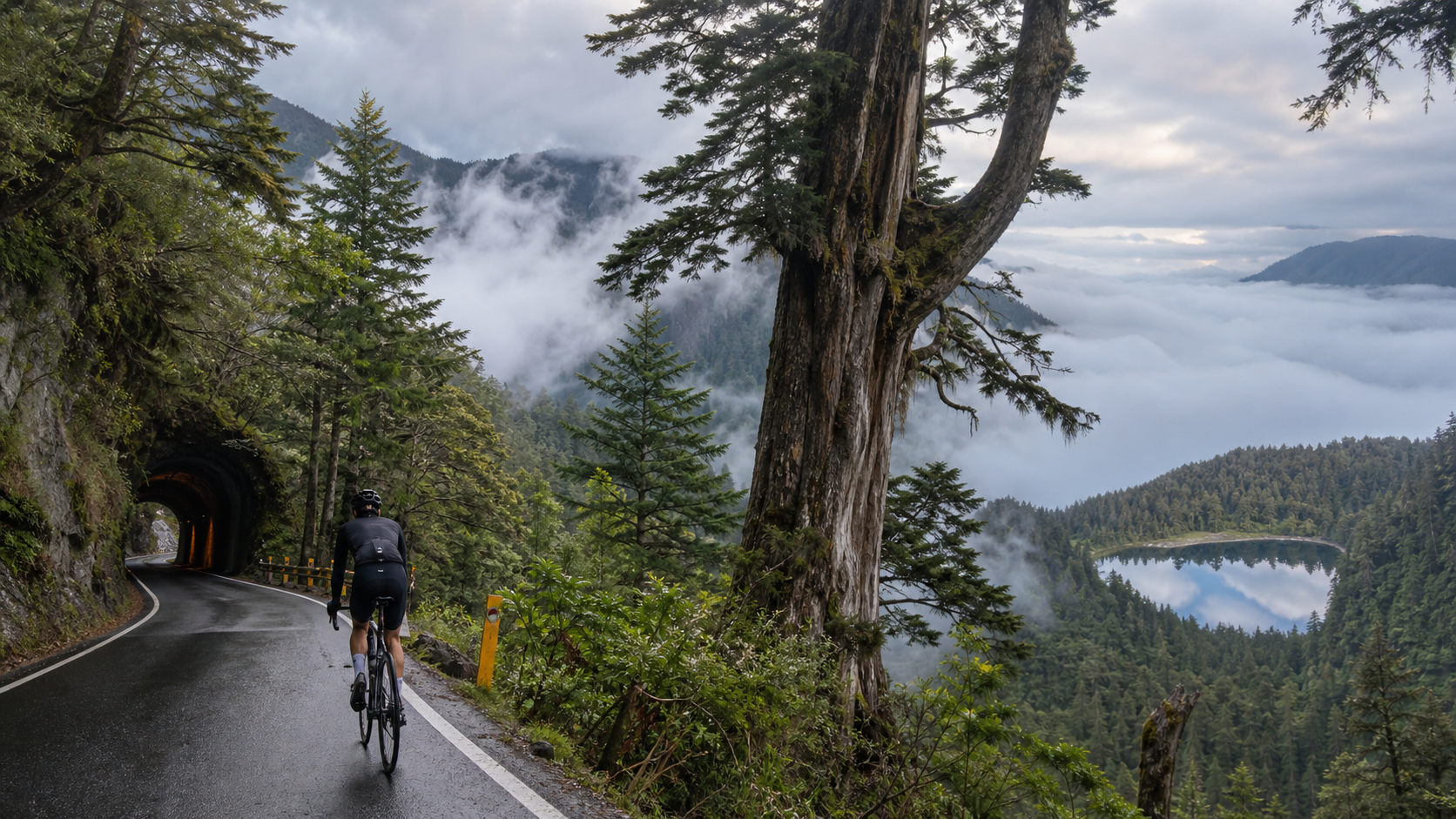
Some roads, after you ride them, you want to show off your results; others, after you ride them, you just want to be quiet. Daxueshan belongs to the latter. This long climb, starting from Dongshi and stretching 32.43 kilometers with an elevation gain of 1,557 meters and an average gradient of 4.7%, carries you from the sweltering heat of broadleaf forests up to the Xiaoxueshan Heavenly Pond at an elevation of about 2,600 meters, a lake that never runs dry year-round. It doesn’t torment you with steep grades; instead, it uses long stretches of time and gradually thinning air to push you into a state of focus that borders on meditation. In this article, I want to set aside the bike computer and show you the true soul of Daxueshan—that mist, those sacred trees, and that heavenly pond.
From Broadleaf to Coniferous Forest: A Journey Through Altitude
The most captivating thing about Daxueshan is that it lets you “flip through” Taiwan’s forests with your wheels.
Starting from Dongshi, you’re in the low-elevation broadleaf forest belt. The air is warm and humid, and you’re surrounded by the dense greenery of broadleaf trees, cicadas, and birdsong. Sweat pours down—this is summer at the edge of the basin.
As the elevation climbs kilometer by kilometer, the forest begins to change. Past Dadong Police Station, the broadleaf forest gradually gives way to a mixed coniferous-broadleaf forest, and the air carries a hint of coolness and the fresh scent of resin. Higher up, past the Henglingshan Tunnel, the world transforms completely—you enter the natural coniferous forest belt, the realm of Taiwan red cypress, yellow cypress, and hemlock. The air is cold and pure, and every breath is filled with the phytoncides unique to coniferous forests.
This experience of “riding through three types of forest in a single ride” is rare among Taiwan’s climbing routes. Daxueshan is like a three-dimensional botanical geography textbook, using your legs as bookmarks as you turn page after page through a microcosm of Taiwan’s mid-to-high elevation forests.
Millennia-Old Sacred Trees: Awe in Thin Air
Daxueshan National Forest Recreation Area is renowned for its pristine forests, home to breathtaking groves of sacred trees that are thousands of years old. When you’re gasping for breath in the thin air and reach the higher elevations, looking up at those colossal trunks—many over a thousand years old and requiring several people to embrace—you feel something peculiar. You just pushed hard up a steep slope, feeling accomplished and capable, yet before these ancient trees that have witnessed a thousand years of wind and frost, your sense of achievement and your fatigue suddenly seem trivial.
This feeling of smallness isn’t defeat; it’s a cleansing. Urban life inflates our egos, and the sacred trees of Daxueshan gently remind you: before the scale of time and nature, be humble. This is probably why many cyclists say that climbing Daxueshan “makes you cry as you ride”—not because of exhaustion, but because in that forest, a person is stripped back to their most authentic self.
Xiaoxueshan Heavenly Pond: A Highland Mirror Hidden on the Southern Ridge
The endpoint of Daxueshan is the Xiaoxueshan Heavenly Pond. Located on the southern ridge of Xiaoxueshan at an elevation of about 2,600 meters, covering roughly 0.4 hectares, it’s a small yet perennial high-mountain lake.
When you’ve endured 32 kilometers of climbing and finally reach the Heavenly Pond, the tranquility takes your breath away. At 2,600 meters, the pond is often shrouded in mist, its surface like a mirror hidden deep in the forest, reflecting the coniferous trees and drifting clouds. If you’re lucky enough to catch a windless morning, the water is so still it mirrors the entire sky—a peace that no urban landscape can offer.
The pond isn’t large, but it carries a weight that says “worth every hardship to see.” It’s the destination of this pilgrimage and the gentlest reward for everyone who pedaled their way up.
The Sea of Clouds Beyond Henglingshan Tunnel
If the Heavenly Pond is the reward at the end, then the sea of clouds beyond the Henglingshan Tunnel is the surprise along the way.
At Daxueshan’s mid-to-high elevations, magnificent seas of clouds often form in the afternoon or early morning. As you ride along the ridge, clouds churn like waves beneath your wheels, and distant peaks rise like islands floating on a sea of clouds. Sunlight pierces through the cloud layers, casting beams of light—a sight that instantly makes all the pain of the steep climbs worthwhile.
The sea of clouds is the mountain’s breath, a gift from Daxueshan to riders who rise early and can endure solitude. To capture the most beautiful sea of clouds, you usually need to be there at dawn—which means setting off in the dark and enduring the cold, but the moment the sea of clouds unfolds before you, you’ll know it was all worth it.
A Solitary Practice: Loneliness and Vastness
Daxueshan is a “lonely” road. It’s not bustling like Dakeng or Wanggaoliao; the forest road sees few people and vehicles, and often it’s just you, your breathing, the sound of your pedals, and the wind through the forest.
This solitude may feel unsettling at first, but as you ride on, you gradually come to love it. In the thin air, your thoughts become remarkably clear. Work worries and life’s distractions are filtered away bit by bit by the long climb and the pure forest, until only the simplest rhythm remains: pedal, breathe, look at the scenery, pedal again. This is moving meditation, a practice carried out on the pedals.
Many people climb big mountains seeking the thrill of conquest; but what Daxueshan teaches you is precisely the opposite—not conquest, but surrender. Surrender to the vastness of the forest, the depth of time, and the majesty of nature. When you learn to surrender, the mountain rewards you with the most expansive views and the deepest peace.
What This Road Means to Cyclists
Daxueshan isn’t a road everyone will love. It’s too long, too lonely, with too few supply points and too much unpredictable weather. But for a certain type of cyclist, it’s a sacred place—those who aren’t satisfied with “fast” and “strong” and want to find deeper meaning in riding.
It’s a mirror that reflects your endurance, your discipline, and your heart. It’s a bridge connecting the urban you with the most authentic you in the forest. After riding Daxueshan, your understanding of what it means to “ride a bike” will be forever changed.
Side Trips and Reminders
- Forest Recreation Area: Daxueshan National Forest Recreation Area offers hiking trails such as the Sacred Tree Trail and the Heavenly Pond Trail. If time and energy permit, park your bike and walk a trail to get closer to the forest. (Entry regulations, opening hours, and fees are subject to change; please always refer to the latest official announcements.)
- Warmth and Supplies: This is a serious high-altitude ride—bring ample warm clothing, supplies, and lighting. Don’t treat it like an easy outing such as Dakeng.
- Ride with Others: Cell signal is unreliable on the forest road and traffic is sparse; it’s recommended to ride with companions and put safety before scenery.
- Respect Nature: Take your trash with you, respect the forest, and don’t disturb wildlife. This thousand-year-old forest deserves our gentlest care.
The Layers of the Forest: A Natural Lesson on Wheels
One of Daxueshan’s most precious experiences is that it lets you traverse the vertical layers of Taiwan’s forests in the slowest, most intimate way. People who drive through in cars can’t perceive this transformation; only cyclists who climb inch by inch with their legs can truly read each layer of the forest.
The low-elevation broadleaf forest is a warm, humid world. Banyan, camphor, and acacia trees interweave, cicadas clamor, and the air carries the scent of soil and decaying leaves. This is the forest at the edge of the basin.
As elevation rises, you enter the mixed coniferous-broadleaf forest. This is a transition zone where broadleaf and coniferous trees coexist; the forest becomes more open, and the air begins to carry the fragrance of resin. The temperature drops, and you feel that chill.
Higher still, past the Henglingshan Tunnel, lies the realm of the natural coniferous forest. Towering conifers—Taiwan red cypress, yellow cypress, and hemlock—form a deep, solemn forest. The air is cold and pure, and every breath is laden with phytoncides. Sunlight filters through gaps in the needles, casting dappled light and shadow, as if you’ve stepped into a cathedral.
This experience of “riding through three types of forest in a single ride” is rare among Taiwan’s cycling routes. Daxueshan is like a three-dimensional botanical geography textbook—and your legs are the fingers turning its pages.
Sacred Trees: Giants of Time
Daxueshan National Forest Recreation Area is famous for its thousand-year-old sacred trees. When you’re panting in the thin air and reach the higher elevations, looking up at those Taiwan red cypress and yellow cypress trees—many over a thousand years old and requiring several people to embrace—you feel a peculiar awe.
These sacred trees stood here a thousand years before you were born, witnessing countless sunrises and sunsets, wind, frost, rain, and snow. They are silent, immense, and ancient, radiating a solemnity that instinctively makes you lower your voice. Standing before them, the sense of accomplishment you felt from pushing hard up the slope suddenly seems trivial.
But this smallness isn’t defeat; it’s a cleansing. Urban life inflates our egos, and the sacred trees of Daxueshan gently remind you: before the scale of time and nature, be humble. Many cyclists say that climbing Daxueshan “makes you cry as you ride”—not because of exhaustion, but because in that thousand-year-old forest, a person is stripped back to their most authentic, most humble self.
The Heavenly Pond: A Mirror Deep in the Forest
The endpoint of Daxueshan is the Xiaoxueshan Heavenly Pond—a high-mountain lake on the southern ridge of Xiaoxueshan at an elevation of about 2,600 meters, covering roughly 0.4 hectares. It never runs dry, lying quietly hidden deep within the coniferous forest.
When you’ve endured 32 kilometers of climbing and finally reach the Heavenly Pond, the tranquility makes you hold your breath. At 2,600 meters, the pond is often shrouded in mist, its surface like a mirror hidden deep in the forest, reflecting the coniferous trees and drifting clouds. If you’re lucky enough to catch a windless morning, the water is so still it mirrors the entire sky—a peace that no urban landscape can offer.
The pond isn’t large, but it carries a weight that says “worth every hardship to see.” It’s the destination of this pilgrimage, the gentlest reward for everyone who pedaled their way up. Sitting by the shore, watching the mist drift across the water, you’ll feel that all the pain of the climb is redeemed in this moment.
The Sea of Clouds: The Mountain’s Breath
At Daxueshan’s mid-to-high elevations, magnificent seas of clouds often form in the early morning or afternoon. As you ride along the ridge, clouds churn like waves beneath your wheels, and distant peaks rise like islands floating on a sea of clouds. Sunlight pierces through the cloud layers, casting beams of light—a sight that instantly makes all the pain of the steep climbs worthwhile.
The sea of clouds is the mountain’s breath, a gift from Daxueshan to riders who rise early and can endure solitude. To capture the most beautiful sea of clouds, you usually need to be there at dawn—which means setting off in the dark and enduring the cold, but the moment the sea of clouds unfolds before you, you’ll understand: some beauty is only rewarded to those willing to pay the price.
Moving Meditation
Daxueshan is a “lonely” road. The forest road sees few people and vehicles, and often it’s just you, your breathing, the sound of your pedals, and the wind through the forest. This solitude may feel unsettling at first, but as you ride on, you gradually come to love it.
In the thin air, your thoughts become remarkably clear. Work worries and life’s distractions are filtered away bit by bit by the long climb and the pure forest, until only the simplest rhythm remains: pedal, breathe, look at the scenery, pedal again. This is moving meditation, a practice carried out on the pedals. Many people climb big mountains seeking the thrill of conquest; but what Daxueshan teaches you is precisely the opposite—not conquest, but surrender. Surrender to the vastness of the forest, the depth of time, and the majesty of nature. When you learn to surrender, the mountain rewards you with the most expansive views and the deepest peace.
Forest Road 200: A Name Steeped in Legend
When talking about Daxueshan, one cannot overlook the legendary name “Daxueshan Forest Road 200.”
The Daxueshan Forest Road was one of Taiwan’s important early logging roads, stretching dozens of kilometers deep into the pristine forests of the Central Mountain Range. The name “Forest Road 200” derives from its long mileage. During the heyday of the logging industry, this road was the artery for transporting precious cypress timber down the mountain; today, with logging halted, it has become a route of exploration leading to pristine forests, sacred trees, and the Heavenly Pond.
For cyclists, “pushing into Daxueshan Forest Road 200” is a phrase full of adventurous spirit. It means leaving the bustling tourist roads behind and venturing deep into rarely visited mountain forests to explore that primeval wilderness forgotten by time. This romantic sense of exploration is Daxueshan’s unique charm—it’s not just a climbing route, but a time tunnel leading into the depths of Taiwan’s mountains.
The Homeland of Cypress: A History with the Forest
The region where Daxueshan lies is the homeland of Taiwan’s precious cypress trees. Taiwan red cypress and yellow cypress—these colossal trees, often over a thousand years old and emitting a distinctive fragrance—once stood layer upon layer in these mountains, their canopies blocking out the sun.
From the Japanese colonial period through the post-war era, Taiwan’s cypress, prized for its excellent quality and pleasant aroma, became a major forestry resource. The Daxueshan Forest Road was built precisely to transport these precious timbers. However, excessive logging came at a cost to this pristine forest. Today, logging has ceased, and the surviving groves of sacred trees are protected treasures, reminding us of this history of love and conflict with the forest.
Riding through this forest and gazing at the surviving thousand-year-old sacred trees, you gain a deeper appreciation for the word “protection.” These giants took a thousand years to grow, yet could be felled in a matter of days. Their existence is a gift of nature and a responsibility we must guard for generations to come.
The Silence of the Highlands: An Experience of Purification
Daxueshan’s most profound experience is its “silence.”
When you ride into the high-elevation coniferous forest belt, with few people and vehicles around, all you hear is the sound of the forest—the rustle of wind through the needles, the calls of distant birds, the occasional cry of an unknown animal. This near-pure silence is almost a luxury in modern life, surrounded as we are by noise.
Riding in such silence, your inner world gradually quiets as well. The anxieties, distractions, and entanglements that usually linger are absorbed and purified by the forest’s silence, bit by bit. Eventually, you enter a state close to meditation—your mind clear, leaving only the simplest rhythm of pedaling and breathing. This experience of being purified by high-mountain silence is the most precious gift Daxueshan offers to every rider willing to go deep.
Leaving with Awe
Every time I finish riding Daxueshan, the feeling I leave with is not the pride of “conquest,” but the humility of “awe.”
This forest is too vast, these sacred trees too ancient, this mountain too majestic. Before them, a person’s physical abilities and achievements are truly insignificant. And it is precisely this recognition of insignificance that gives the Daxueshan journey meaning beyond sport—it not only trains your body, but also cleanses your spirit and recalibrates your relationship with nature.
When you leave Daxueshan, please take all your trash with you and leave no trace in the forest; respect the mountain, don’t make noise, and don’t disturb wildlife. Treat this mountain with the gentlest, most humble attitude, so that its majesty and beauty can be preserved for every pilgrim who comes after. This is the responsibility of every cyclist who loves the mountains.
A Baptism of Phytoncides: A Forest Bath for Body and Mind
Riding Daxueshan is a true “forest bath.”
As you enter the mid-to-high elevation coniferous forest belt, the air is filled with the distinctive fragrance of coniferous forests—phytoncides and negative ions released by the trees. Research indicates that phytoncides in forests help relax the body and mind and relieve stress, while negative ions make the air exceptionally fresh and pleasant. Riding in such an environment, every breath feels like a deep cleanse for your weary body and mind.
In urban life, our lungs are accustomed to exhaust fumes and air conditioning, and our nerves to tension and anxiety. But Daxueshan’s coniferous forest washes all of that away, bit by bit, with the purest air and the freshest phytoncides. When you reach the higher elevations and take a deep breath, that cool, fragrant air reaches deep into your lungs, invigorating you. This baptism of forest bathing is the most healing gift Daxueshan offers riders, beyond the physical challenge.
Chance Encounters with Wildlife
Daxueshan National Forest Recreation Area is ecologically rich and home to many wild animals. While riding through, you may have some wonderful chance encounters.
In the early morning or at dusk, with luck, you might catch a glimpse of Formosan macaques by the roadside, the alert leaps of Reeves’ muntjac, or various mountain birds singing and darting among the branches. Daxueshan is also a renowned birdwatching destination, home to many endemic bird species of mid-to-high elevations. These encounters with wildlife add surprise and emotion to the ride—they remind you that this forest is not just your cycling route, but a shared home for countless lives.
When you encounter wildlife, keep your distance, slow down, don’t feed them, and don’t disturb them. You are merely a passerby in this forest; they are the true residents. Treat these mountain dwellers with respect and gentleness, so that every chance encounter becomes a beautiful, harmless connection.
A Journey That Changes You
I know many cyclists who say Daxueshan “changed them.”
This change isn’t just physical—though after riding Daxueshan, your endurance and willpower do indeed reach a new level. The deeper change happens within. When you climb alone in thin air, feel small before thousand-year-old sacred trees, find peace by the tranquil Heavenly Pond, and are cleansed by phytoncides in the pure forest, your understanding of “cycling,” of “nature,” and even of “life” quietly shifts.
You become more humble—because before the thousand-year-old forest and the vast mountains, you see your own insignificance. You become more composed—because in the long solitude and pure silence, you learn to be with yourself. You become more appreciative—because you’ve personally experienced the beauty and fragility of this mountain forest, and thus better understand the importance of protecting it.
This is the power of Daxueshan. It’s not just a climbing route; it’s a journey that can change a person. If one day you tire of the city’s clamor and the exhaustion of the chase, come to Daxueshan. Let this forest, this great mountain, use its thousand-year stillness and vastness to polish your heart anew. You ride up as one person, and you ride down as a better version of yourself.
The Mountain Taught Me Humility
Every time I come down from Daxueshan, the deepest feeling in my heart is not the pride of conquest, but humility. This mountain, this forest, these thousand-year-old sacred trees—with their vastness and antiquity, they remind me again and again: how small we humans are.
In urban life, it’s easy to inflate our egos. A small achievement makes us smug; a small setback makes us blame fate, as if the whole world should revolve around us. But standing before Daxueshan’s thousand-year-old sacred trees, beside the vast sea of clouds, by the tranquil Heavenly Pond, that inflated self suddenly deflates. You realize that before the scale of time and nature, a person’s achievements and worries are truly insignificant.
This humility isn’t self-deprecation; it’s clarity. It places you back in your proper position—neither arrogant nor self-effacing; able to appreciate your own efforts while also revering something greater than yourself. This humility makes you a more peaceful, more tolerant, more grateful person. Perhaps Daxueshan’s most precious gift is not physical training or magnificent scenery, but this humility that serves you for a lifetime. It taught me: true strength is not conquering the mountain, but learning, in the mountain’s presence, to bow your head, to revere, and to be a small yet striving person.
Conclusion
Daxueshan—a pilgrimage road from the broadleaf forests of Dongshi to the coniferous forests of the Heavenly Pond. With 32 kilometers of length and 1,557 meters of climbing, it turns altitude into a spiritual practice. Here you’ll find thousand-year-old sacred trees, churning seas of clouds, a tranquil heavenly pond, and the most honest conversation you’ll have with the forest and with yourself in the thin air. It doesn’t clamor or dazzle; it simply stands there quietly, waiting for riders willing to slow down and endure solitude. If one day you tire of chasing faster and stronger, come to Daxueshan—let this forest polish your soul anew. Remember to take your trash with you, respect this thousand-year-old forest, and leave its majesty for every pilgrim who comes after.
Related Reading
- Daxueshan 32km Long Climb Practical Guide: An Endurance Mountain from Dongshi’s Gentle 1,557m Ascent
- Daxueshan Forest Road Cycling Challenge: A Pristine Forest Climb in Taichung’s Hidden Gem
- Southern Cross-Island Highway Westbound: From Meishankou to Tianchi, A Cycling Memory of Resilience, Bunun Mountain Forests, and a Cloudtop Lake
- Taichung’s Daxueshan Road: Forest Road 200 vs. Dongmao Mountain Road Complete Comparison
台北闊瀨陡坡 騎旅 / 日本單車雜誌編輯車友臨時加入!/ 髮香才是最強的 / feat. 北迴歸線小隊 / 公路車 CT Yeh
6 個月前
觀霧 變好騎了! | 北高車友爆笑大會師 | 公路車 | 單車旅遊 Taiwan Cycling Route GuanWu
6 年前
大武山後門26%歡樂陡坡!JJSC南台灣單車行Day2 / 被颱風追著跑 / 公路車 / CT Yeh
2 年前
台中大雪山 膏王領騎 震到都沒畫面了 公路車
5 年前
大武山20%魔王陡坡【JJSC南台灣遊騎Day2】!屁股真的要裂開了...凡士林抹滿也沒用?神秘金教堂還有超便宜夜市
3 個月前
爬坡ITT實境)台中 魔王 松鼠坡 首航 6:12 大肚山 大三元 科福路
8 年前
騎單車去大屯山賞雪! 助航台滑冰 全記錄 | 台北R友大集合 | 下雪打雪仗囉 | 4K超高畫質
5 年前
2024 如來神掌 百人約騎挑戰!feat. 秘境單車社團 / 神人們太可怕 / 全程錄影 x 完整坡度解析 / 公路車 / CT Yeh
2 年前