20 Kilometers of Dialogue with the Wall: The Full Climb of Dasyueshan Forest Road, a Battle of Will Between One Man and a Mountain
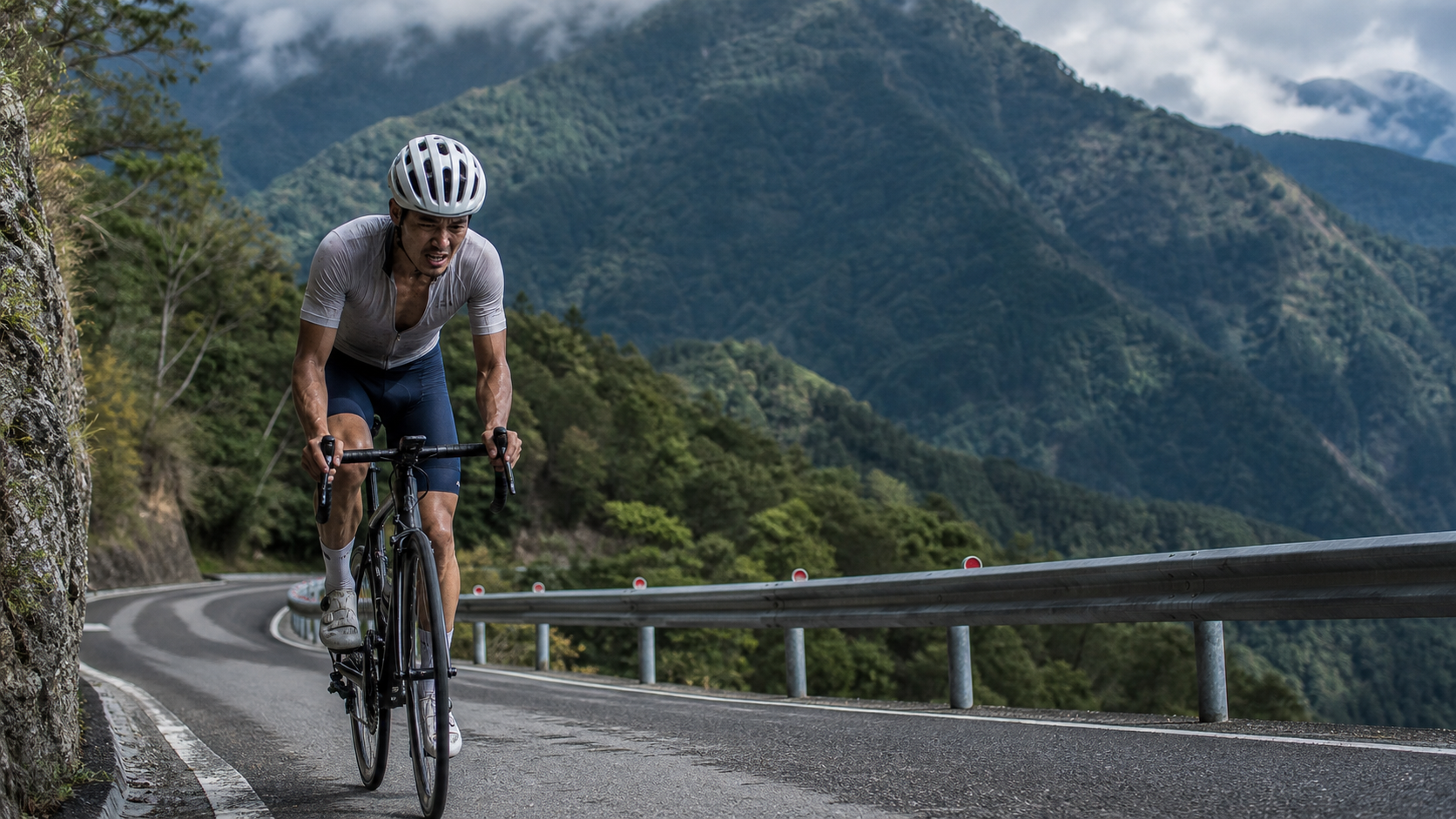
Every serious cyclist has a “wall” in their heart. That wall is the threshold where the body cries stop, but the will refuses to give up. And in Taichung, the place most likely to make you hit that wall is the full climb of Dasyueshan Forest Road—20.12 kilometers, 1,243 meters of elevation gain, an average gradient of 6.2%, with no descent to recover and no flat stretch to rest your legs. It is a long, drawn-out tug-of-war between you, a mountain, and your own will. This article isn’t about how to ride faster; it’s about the mindset of conversing with the wall during a relentless climb.
The Cruelty of No Respite
The most brutal thing about the full climb of Dasyueshan Forest Road isn’t how steep it is (6.2% isn’t actually insane)—it’s the “continuity.” For 20 kilometers, there’s almost no proper descent or flat section to let you relax. On a typical climbing route, you can always look forward to a turn or a small hill, followed by a gentle descent to catch your breath and shake out your legs. But the full climb has none of that. It just goes up, up, and further up, like an opponent who won’t give you a way out, forcing you to keep applying pressure.
This “unrelenting” nature will, in the middle to late stages of the ride, bring you to a very subtle psychological state. The early part is still exciting; the middle part makes you realize, “Does this road really have no end?”; and by the later part, the pain in your legs becomes a dull background hum, the noise in your head gradually clears, and only one thought echoes—just one more bend.
Hitting the Wall: The Split Between Body and Will
“Hitting the wall” is a term every long-distance rider understands. It can be physiological—glycogen depletion—or psychological—a collapse of will. And the full climb of Dasyueshan Forest Road is one of the best places to experience it.
I still remember my first serious attempt at the full climb. Around the 14-kilometer mark, the wall appeared without warning. My legs felt like they were filled with lead; every pedal stroke required every ounce of willpower to push down. My breathing became rapid and shallow, and the thinning air at higher altitude made everything worse. A voice in my head kept urging: “Stop, take a break, no one’s watching anyway.”
At that moment, body and will seemed to split into two people. The body was pleading; the will was roaring. And this is the most fascinating—and most cruel—part of cycling: you must make a choice in this tug-of-war.
Breaking the Goal Down: Hold On to the Next Bend
To fight this wall, the method I’ve learned is crude but highly effective: break the goal down to the smallest piece.
Don’t think about “6 kilometers to go,” because 6 kilometers at that moment is a number that can crush you. Instead, think—“just hold on to that bend ahead.” Once you make it, look for the next goal: “make it to that big tree,” “make it to that kilometer marker,” “pedal 100 more strokes.”
When you break an unbearable mountain into one “bearable” segment after another, the wall begins to crumble. You’ll discover that so-called limits are often just barriers set by the mind. The body’s potential runs far deeper than you think. Bite off one bend at a time, and before you know it, you’ve ridden straight through the wall.
The Loneliness of the Forest Road Is a Luxury
The full climb of Dasyueshan Forest Road is a lonely road. There’s no bustle like Dakeng or Wanggaoliao; people and cars are scarce, and often the entire road is yours alone. You can hear your own breathing, the turning of the chain, the rustle of tires over fallen leaves, and the occasional birdsong from deep in the forest.
At first, this loneliness is a little unsettling. But as you ride on, you realize it’s a luxury. In an era constantly flooded with messages, notifications, and voices, having 20 kilometers to be alone with just yourself and a mountain is rare. The things you never have time to think about properly will surface one by one during the long climb, then be smoothed away one by one by the rhythm of your pedaling. This road is a forced conversation with yourself.
Arrival: Release and Emptiness
When you finally finish those 20 kilometers and unclip your feet from the pedals, you’ll feel something peculiar—not euphoria, but a profound “release” and “emptiness.”
The wall, the pain, the battle of wills from moments ago suddenly vanish. In their place is a calm that comes from being completely hollowed out. You might even be speechless for a moment, wanting only to sit quietly, watching the forest and mist before you, letting your pounding heart gradually settle. This sense of release is something flat riding can never give you. It’s earned through 20 full kilometers of suffering, which makes it especially pure, especially profound.
Why We Come Back
After finishing the full climb, many people swear, “I’m never coming back.” But weeks or months later, the mountain starts calling again from within. Why is that?
Because once you’ve ridden through that wall, it becomes an addictive experience. You start to wonder: this time I hit the wall at 14 kilometers—can I hold out to 17 next time? This time it took two and a half hours—can I shave off ten minutes next time? The full climb of Dasyueshan Forest Road becomes a mirror for measuring your growth—not just physical growth, but growth of the will.
On a deeper level, we return to this mountain for the “stronger self.” Every conversation with the wall, every time you break the impossible into the possible, tells you: you are more resilient than you think. This self-awareness seeps into every corner of life—when facing work challenges or life’s low points, you’ll remember those 20 kilometers, remember how you rode through a mountain one bend at a time.
For Those Who Want to Take on the Challenge
- Respect it: This isn’t an easy road; don’t treat it like a sightseeing trip. Bring ample supplies, warm clothing, and lighting. Put safety before performance.
- Accept hitting the wall: Hitting the wall isn’t failure; it’s an inevitable part of this road. Learn to coexist with it, and you’ve already won half the battle.
- Enjoy the solitude: Don’t rush to seek company. Let these 20 kilometers of alone time become precious moments of dialogue with yourself.
- Reward yourself after the ride: After descending, find a place to have a good meal and a hot drink, to treat the self that just gritted through it.
The Layers of Pain: A Journey from Body to Soul
The pain of 20 kilometers of continuous climbing on the full climb actually has “layers.” Understanding these layers lets you coexist with it more calmly.
The first layer is muscle pain. This is the most direct—your thighs and calves begin to burn and stiffen under sustained effort. This layer comes earliest but is also the easiest to endure, because it’s the body’s normal response.
The second layer is the breathlessness of heart and lungs. As altitude rises and intensity accumulates, your breathing becomes rapid and heavy, and your heart feels like it’s about to leap out of your chest. This layer of pain forces you to slow down, to adjust your pace.
The third layer is the wavering of will. This is the hardest layer. When muscle pain and breathlessness persist long enough, a voice emerges in your mind: “Stop, take a rest.” This layer of pain isn’t in the body; it’s in the mind. It’s the true deciding factor in whether you can finish.
And curiously, when you push through these three layers of pain and enter a state of near-numb focus, you arrive at the fourth layer—tranquility. At this point, stray thoughts are cleared away, leaving only the simplest rhythm: pedal, breathe, pedal again. This tranquility that emerges after extreme suffering is the most profound gift the full climb offers to those who persevere.
Things Figured Out on the Slope
Long-distance climbing is forced solitude. For 20 kilometers, an hour or two of time, with no phone and no noise, it’s just you and your thoughts. Many riders have had this experience—things they can’t figure out in daily life often become clear on the slope.
Maybe it’s a work problem, an interpersonal tangle, or life’s confusion. These things are always postponed and drowned out in the busyness of everyday life. But during a long climb, when the body enters a rhythmic, almost meditative state, thoughts become clearer instead. In the rhythm of your pedaling, you slowly peel the problem apart layer by layer, and then at some bend or kilometer marker, it suddenly all clicks.
This is why some people, knowing full well the pain of the full climb, keep coming back. They return not just for the physical challenge, but for that time of deep dialogue with themselves. This mountain is a vast, quiet space for thought.
After Hitting the Wall: Getting to Know Your True Self
“Hitting the wall” is a required course on any full-climb segment. When you’re in the middle-to-late stages of the ride and that wall appears without warning—your legs feel like lead, every pedal stroke demands every ounce of willpower—you’re forced to confront a question: Who am I, really?
In front of the wall, people reveal their truest selves. Some choose to give up; others choose to grit their teeth. And the you who chooses to grit your teeth, who breaks the goal down into “just one more bend,” who rides through the wall inch by inch—that is the more resilient version of yourself you never knew existed.
After you ride through that wall, your understanding of yourself will be different. You’ll know that so-called limits are, more often than not, just barriers set by the mind; that your potential runs far deeper than you ever imagined. This self-knowledge will seep into every corner of your life—when facing work challenges or life’s low points, you’ll remember those 20 kilometers, remember how you rode through a mountain and through your own wall, one bend at a time.
Why Pain Becomes Addictive
After finishing a full-climb segment, many people swear “I’m never coming back.” But weeks or months later, that mountain starts calling to them again. Why is that?
Because once you’ve ridden through that wall, it becomes an addictive experience. You start to wonder: this time I hit the wall at kilometer 14—can I hold out to kilometer 17 next time? This time it took two and a half hours—can I shave off ten minutes next time? The full-climb segment becomes a mirror for measuring your growth—not just physically, but in willpower.
On a deeper level, we return to that mountain for the “stronger self.” Every conversation with the wall, every time you break the impossible down into the possible, tells you: you are more resilient than you think. This satisfaction of self-transcendence is something no easy pleasure can provide. Pain becomes addictive because on the other side of pain lies the purest growth and the deepest self-affirmation.
The Value of Solitude: Being with Yourself on a Continuous Climb
The 20 kilometers of continuous climbing on a full-climb segment is a forced solitude. This loneliness is unsettling at first, but over time, you discover its value.
In an age flooded with messages, notifications, social media, and voices, “being alone in quiet” has become a rare experience. The full-climb segment gives you that opportunity—20 kilometers, an hour or two, no phone, no noise, just you, your breath, the sound of your pedals, and a silent mountain.
In such solitude, you’re forced to be with yourself. The emotions usually buried by busyness, the thoughts drowned out by noise, all surface one by one. In the rhythm of your pedaling, you come to know yourself anew—your endurance, your will, your fragility, your strength. This deep self-companionship is the most precious gift of the full-climb segment. It turns a climb into an inward journey.
After the Finish: The Hollowed-Out Calm
When you finally finish those 20 kilometers and release your feet from the pedals, you feel something peculiar—not euphoria, but a vast sense of “hollowed-out calm.”
The wall, the pain, the tug-of-war of willpower—all of it suddenly vanishes. In its place is a near-exhausted tranquility. You might not be able to speak for a moment; you just want to sit quietly, looking at the forest and mist before you, letting your pounding heart gradually settle.
This calm is earned with 20 full kilometers of pain, which makes it exceptionally pure, exceptionally profound. It’s not the shallow relaxation of scrolling your phone or watching videos; it’s a complete peace welling up from the deepest part of your body. In that moment, you lack nothing, want nothing—you’re simply, wholly, quietly present. This calm is the deepest reward the full-climb segment gives to those who persevere.
The Reason for Coming Back Again and Again
After finishing a full-climb segment, many people swear “I’m never coming back.” But weeks or months later, that mountain starts calling to them again. Why is that?
Because once you’ve ridden through that wall, it becomes an addictive experience. You start to wonder: this time I hit the wall at kilometer 14—can I hold out to kilometer 17 next time? This time it took two and a half hours—can I shave off ten minutes next time? The full-climb segment becomes a mirror for measuring your growth—not just physically, but in willpower.
On a deeper level, we return to that mountain for the “stronger self.” Every conversation with the wall, every time you break the impossible down into the possible, tells you: you are more resilient than you think. This satisfaction of self-transcendence seeps into every corner of your life. When you hit a wall at work or a low point in life, you’ll remember the full-climb segment—remember how you rode through a mountain and through your own wall, one bend at a time. That belief of “I can do it” becomes the foundation of your confidence in facing any difficulty.
For Those Attempting It for the First Time
If you’re planning your first full-climb challenge, here are a few words from the heart:
Accept the wall. Hitting the wall isn’t failure; it’s an inevitable part of this road. Completing it on your first attempt is already a victory—don’t compare yourself to others’ times. Respect the mountain. Bring ample supplies, warm clothing, and repair tools; put safety before performance. Enjoy the solitude. Don’t rush toward the crowds—let these 20 kilometers of alone time become precious moments of dialogue with yourself. Be kind to yourself. After descending, find a place to have a good meal and a hot drink, rewarding the self that just gritted through it all. When you finish safely, what you’ll take away isn’t just a time—it’s a self more resilient than you ever imagined.
Self-Awareness in the Sweat
The 20 kilometers of continuous climbing on a full-climb segment is a mirror reflecting who you are. In extreme fatigue and pain, people reveal their truest selves—and that is precisely the moment of deepest self-awareness.
When you ride to exhaustion, when that wall looms near, you see clearly your first reaction to adversity—do you want to quit, or do you grit your teeth? Do you wallow in self-pity, or focus on solving the problem? Are you ruled by fear, or driven by will? These reactions are often masked by the comfort of daily life, but in the extremes of a full-climb segment, they surface in stark nakedness.
And seeing is the beginning of change. When you realize “I tend to want to give up when I face difficulty,” you have the chance to choose a different response next time. The full-climb segment is like a magnifying glass, enlarging your patterns of facing adversity and presenting them before you, giving you the chance to recognize them and transcend them. This self-awareness in the sweat is the deep value of this road beyond sport—it doesn’t just train your legs; it tempers your mind.
The People You’ve Ridden With
Although a full-climb segment is often a solitary journey, there’s a unique warmth in the days spent riding with others.
If you’ve tackled a full-climb segment with riding buddies, you’ll remember those scenes—the mutual encouragement at the start, the backs of each person buried in their own struggle on the climbs, the unspoken默契 of waiting for each other at key points, the energy gel handed over when someone hits the wall, and that knowing, exhausted yet radiant smile exchanged after finishing.
Suffering together, hitting the wall together, riding through a merciless mountain together—that bond of shared struggle is something no casual gathering can match. You’ve shared the pain, and so you jointly own the memory of overcoming it. Those who’ve ridden a full-climb segment with you often become the most precious companions in your cycling life—because you’ve seen each other at your most ragged and your strongest.
The Mountain Will Wait for You, But You Must Be Ready
The full-climb segment is a road that demands respect. It won’t go easy on you because you’re having an off day, nor will it let you off the hook for being unprepared. It simply stands there, objectively and mercilessly, testing everyone who sets foot on it with 20 kilometers of continuous climbing.
For this reason, before challenging a full-climb segment, you must be prepared—build up your fitness gradually, pack ample warm clothing and supplies, and mentally prepare for hitting the wall. Don’t treat it as a spur-of-the-moment adventure; treat it as an exam that demands serious preparation.
But don’t let its difficulty scare you off either. The mountain will wait for you—as long as you’re willing to accumulate step by step, improve ride by ride, one day you’ll be ready to face it and ride through it. And when that day comes, when you safely finish that merciless climb, what you’ll gain isn’t just a time—it’s a self that is “more resilient and more complete than you imagined.” That reward is worth all your preparation and effort.
The Gift at the End of the Pain
This road of love and hate, the full-climb segment, holds a profound truth about “pain.” Our instinct is always to avoid pain and seek comfort. But the full-climb segment taught me: some of the most precious things lie precisely at the end of pain, and only those willing to traverse the pain can claim them.
When you grit your teeth and push through the extreme fatigue of continuous climbing, when you suppress one “I can’t go on” thought after another and keep moving forward, you are undergoing a process of refinement. And when you finally endure through the most painful stretch and reach the finish line, the release, the calm, and the satisfaction of “I did it” that surge through you are things no comfort or pleasure can provide. This gift is earned through pain, which makes it all the more pure and profound.
This made me re-examine the pain and difficulties in life. They are certainly unpleasant, but they are also often the moments of fastest growth and the places of greatest harvest. Avoiding pain might buy temporary comfort, but it also means missing the precious gift at the end of the pain. Those willing to face pain head-on and traverse through it can refine and surpass themselves time and again, ultimately becoming stronger and more complete individuals. Through its cruelty, the full-climb segment taught me not to fear pain, but to learn to coexist with it, traverse it, and at its end, claim the gift reserved exclusively for the brave. This is the gentlest lesson from this merciless long climb.
Conclusion
The full climb of Daxueshan Forest Road—20 kilometers of relentless climbing without respite—is a tug-of-war between you, a mountain, and your own will. It has layers of pain, from muscles, to lungs and heart, to willpower, and finally to the tranquility that follows the extreme; it is a vast space for thought, allowing you to figure out on the slope the things you normally can’t; it will make you hit the wall, and it will also teach you how to ride through that wall, discovering your true self on the other side. It is painful, yet addictive, because what it gives you is “a self more resilient than you ever imagined.” If one day you want to know where your limits are—don’t ask others. Go to Daxueshan Forest Road and ride out the answer, one bend at a time. Remember to respect the mountain, prepare thoroughly for safety, and let every conversation with yourself end safely.
Related Reading
- Daxueshan Forest Road Full-Climb Guide: 20km of Uninterrupted 6.2% Ascent, an Endurance Threshold Test
- Daxueshan Forest Road Cycling Challenge: A Primitive Forest Climb in Taichung’s Hidden Gem
- Daxueshan 32km Long-Climb Practical Guide: An Endurance Mountain from Dongshi Climbing 1,557 Meters
- That Wall, Called Zihe Road: A One-on-One Dialogue with 2.87 Kilometers of Limits
半日 小台灣 極限單車路線挑戰實錄
7 年前
台北闊瀨陡坡 騎旅 / 日本單車雜誌編輯車友臨時加入!/ 髮香才是最強的 / feat. 北迴歸線小隊 / 公路車 CT Yeh
6 個月前
台中大雪山 膏王領騎 震到都沒畫面了 公路車
5 年前
萬年峽谷! 30% 超激陡坡 里佳部落DAY2 還是很硬! | 公路車 | CT Yeh
3 年前
大武山20%魔王陡坡【JJSC南台灣遊騎Day2】!屁股真的要裂開了...凡士林抹滿也沒用?神秘金教堂還有超便宜夜市
3 個月前
大武山後門26%歡樂陡坡!JJSC南台灣單車行Day2 / 被颱風追著跑 / 公路車 / CT Yeh
2 年前
#北橫 + #北進武嶺 最硬的員工旅遊 EP1 | #公路車 #拉拉山 | 明池 | 武嶺 | 武陵農場 | 雲海 | Taiwan Cycling Route Wulin
6 年前
藤枝二集團 單車行 Day1 | 南部小武嶺 | 爬坡爬到罵罵叫 | JJSC | 公路車 | CT Yeh
3 年前