The Midpoint of Taichung's "Big Three": Mount Baimao, a Journey of Legacy and Continuation Hidden in Xinshe's Forests
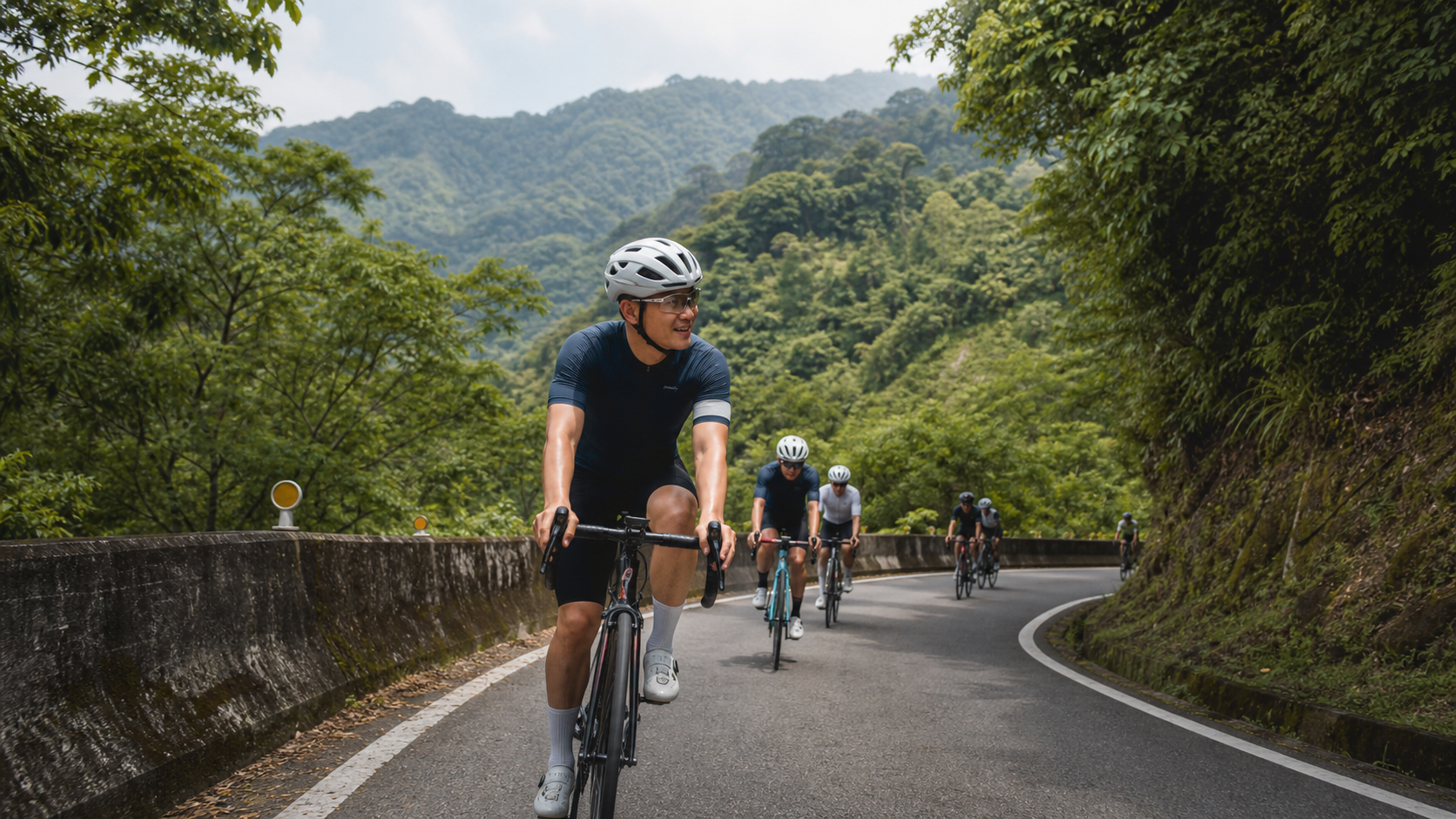
In Taichung’s cycling world, the words “Big Three” (Da San Yuan) are a badge of experience. Zhongxing Ridge, Baimao Mountain, and Chikanding—three peaks strung together in a loop of about 89 kilometers with roughly 1,552 meters of climbing—form a route that central Taiwan riders tacitly acknowledge as the litmus test. Complete the Big Three, and you’ve earned your ticket to Taichung’s mountain roads. And the protagonist of this article, Baimao Mountain, is the “second leg” of the Big Three, sandwiched between Zhongxing Ridge and Chikanding like the midpoint of a hard-fought battle. In this piece, I want to talk not about gradients, but about the gritty camaraderie of the Big Three, the mountain forests along Baimao, and that state of mind of carrying what came before while paving the way for what lies ahead.
The Big Three: The Origin of a Taichung Signature Dish
The name “Big Three” is cleverly coined. It borrows the mahjong concept of “Chung, Fa, Pai” (Red, Green, White Dragons) forming a Big Three Dragons hand, likening the three peaks—Zhongxing Ridge, Baimao Mountain, and Chikanding—to three tiles. Complete the loop, and it’s a beautiful winning hand.
This route became a Taichung classic not just because its distance and elevation gain are just right—89 kilometers, 1,552 meters, doable in a day yet tiring in a meaningful way—but also because it strings together the most characterful landscape of Taichung’s mountain region: from the acacia forests of Dakeng, the hub of Zhongxing Ridge, to the terraces of Xinshe, the woodlands of Guoxing, and finally the challenge of Chikanding in Taiping. Ride a full loop of the Big Three, and you’ve truly gotten to know Taichung’s backcountry, wheel by wheel.
The Big Three has its “unwritten rules of the road.” Veterans will tell you: ride it clockwise, from easy to hard—Zhongxing Ridge first, then Baimao Mountain, and Chikanding last. This order isn’t arbitrary; it’s the pacing philosophy distilled by predecessors through countless bouts of exhaustion and hard-earned experience.
The 7-Eleven at the Roundabout: Where Every Story Begins
To talk about the Big Three, you can’t avoid that 7-Eleven at the Dakeng roundabout.
This convenience store is the wayside inn of Taichung’s cycling community. Teams heading to Xinshe, Guguan, or taking on the Big Three almost all gather here. In the early morning under the arcade, a group of riders refills water, uses the restroom, and ribs each other: “You’re looking pretty good today,” “Did you drink too much again last night?” “Let’s see who cracks first at Chikanding.” That liveliness, that human warmth, is an inseparable part of the Big Three.
After gathering here, the group sets off in full force, tackling Zhongxing Ridge first. And when you’ve conquered the first leg, coasting toward Xinshe and bracing for Baimao Mountain, the laughter from the roundabout still seems to echo in your ears. That sense of “suffering together as a crew” is a warmth that solo training can never provide.
Baimao Mountain: The Midpoint in Xinshe’s Mountain Forests
Baimao Mountain is the midpoint of the Big Three. By the time you climb here, the fatigue from Zhongxing Ridge is already in your legs, while the big boss of Chikanding still looms ahead. This “neither here nor there” position gives Baimao Mountain a unique state of mind.
Along the way are the mountain forests of the Xinshe and Guoxing area. The scenery here isn’t as close to the city as Dakeng, nor as towering and isolated as Daxueshan; it’s something in between—a tranquil mid-elevation mountain landscape. Bamboo groves, orchards, winding country roads, occasionally a farm dog barking or chickens crowing in the distance. Riding through it, you feel gently wrapped by the mountains.
Baimao’s climb isn’t brutal, but precisely because of its “midpoint” role, it forces you to confront a very life-like question—how, in the middle of a long haul, do you neither slack off nor burn out? The excitement of the early stage has faded, the challenge of the later stage hasn’t arrived, and you must find a smart, steady rhythm on this road of continuity. Isn’t this a metaphor for life? In many things, the decisive moment isn’t the sprint at the start or the burst at the finish, but the seemingly mundane yet crucial persistence in the middle.
Carrying Forward: A Practice of the Mind
The most captivating thing about riding Baimao Mountain is that practice of the mind.
On Zhongxing Ridge, you’re fresh, excited, prone to impulsiveness; at Chikanding, you’re all-out, gritting your teeth, prone to cracking. But at Baimao Mountain, this midpoint, what you need is calm. You have to suppress the complacency of “I’ve already done one leg and feel pretty good,” while also saving reserves for the hardest leg still to come. This restraint between excitement and all-out effort is the most precious lesson the Big Three teaches every rider.
I often feel that Baimao Mountain is like the middle age of life—you’ve passed the recklessness of youth (Zhongxing Ridge), haven’t yet reached the exhaustion of old age (Chikanding), and you’re in a stage that demands wisdom, moderation, and paving the way for the future. Riding Baimao well is, in a sense, practicing how to live the middle chapter of life well.
What This Stretch Means to Riders
Baimao Mountain isn’t the most famous leg of the Big Three—Zhongxing Ridge holds the status of a hub, Chikanding has the toughest challenge, and Baimao is always squeezed in between, easy to overlook. But it’s precisely this “midpoint” role that gives it unique weight.
It teaches you discipline, teaches you restraint, teaches you to stay clear-headed in the middle of a long haul. It’s the pivotal hinge of completing the Big Three—how many riders push too hard on Zhongxing Ridge, lose their rhythm on Baimao, and end up crumbling at Chikanding. But those who know how to hold steady on Baimao are the ones who can finish the full Big Three loop with a smile.
Side Trips and Reminders
- Xinshe/Guoxing Scenery: The Xinshe terrace around Baimao Mountain is famous for flower seas and mushrooms, while the Guoxing area features simple mountain villages. If time allows, they’re worth a detour.
- Know Your Limits: The full Big Three is an 89-kilometer, 1,552-meter expedition, possibly taking 5–6 hours including rest stops. If your fitness isn’t there yet, you can start by riding Baimao or Zhongxing Ridge alone and build up gradually.
- Ride Together: The most flavorful way to ride the Big Three is with a group of fellow cyclists. From gathering at the roundabout to cheering each other on along the way, that bond of brotherhood is the best part of this route.
- Respect the Mountains: Take your trash with you, respect the farms and communities along the way, and keep these mountain forests as tranquil as they are.
Three Peaks, One Badge of Experience
In Taichung’s cycling world, being able to say “I’ve ridden the Big Three” is a mark of standing. Zhongxing Ridge, Baimao Mountain, Chikanding—the loop these three peaks form is the unspoken litmus test for central Taiwan riders.
Why these three? Because their combination is just right—the distance is moderate (about 89 kilometers, doable in a day), the climbing has substance (about 1,552 meters, tiring in a meaningful way), and the difficulty escalates progressively (from easy to hard, testing your pacing wisdom). More importantly, they string together the most characterful landscape of Taichung’s mountain region: from the acacia forests of Dakeng, the hub of Zhongxing Ridge, to the terraces of Xinshe, the woodlands of Guoxing, and finally the challenge of Chikanding in Taiping. Ride a full loop of the Big Three, and you’ve truly gotten to know Taichung’s backcountry, wheel by wheel.
The Big Three isn’t the hardest route, but it’s the most “Taichung” route. It carries the collective memory of this city’s cyclists—those early mornings gathering at the roundabout, those moments of competing on the climbs while cheering each other on, those evenings celebrating together over a meal after finishing. Being able to ride the Big Three isn’t just proof of fitness; it’s a rite of passage into Taichung’s cycling community.
The Wisdom of Mahjong: Chung, Fa, Pai
The name “Big Three” borrows the mahjong imagery of “Chung, Fa, Pai” forming the Big Three Dragons yaku. This naming carries a distinctly Taiwanese wit and wisdom.
In mahjong, a Big Three Dragons hand requires collecting three specific tiles to win; in cycling, the Big Three requires riding three specific peaks to complete. This metaphor isn’t just apt—it also implies a life philosophy—some achievements aren’t built on a single burst, but on patiently assembling each piece of the puzzle. You can’t ride only Zhongxing Ridge and claim you’ve done the Big Three, nor can you skip Baimao and go straight for Chikanding. You must complete them one by one, in order, to put together that full “winning hand.”
Baimao Mountain is an indispensable tile in that hand. It may not hold the hub status of Zhongxing Ridge, nor the toughest reputation of Chikanding, but without it, the hand can’t be completed. Isn’t this a reminder that the seemingly ordinary, unremarkable parts of life are often the indispensable pieces that complete the whole?
The Brotherhood of the Roundabout: Suffering Together
The most flavorful way to ride the Big Three is with a group of fellow cyclists. And it all typically starts at that 7-Eleven at the Dakeng roundabout.
In the early morning under the roundabout’s arcade, a group of people in cycling kits gathers—refilling water, using the restroom, checking gear, and ribbing each other: “You’re looking pretty good today,” “Did you drink too much again last night?” “Let’s see who cracks first at Chikanding.” That liveliness, that human warmth, is the inseparable soul of the Big Three.
Then, the group sets off in full force, tackling Zhongxing Ridge first, coasting toward Xinshe, and welcoming Baimao Mountain. Along the way, someone leads, someone sweeps the back, and when a rider slows down, others ease up to wait; when someone cramps, they stop to help. That bond of “suffering together as a crew” is a warmth that solo training can never provide. When you feel tired at the midpoint of Baimao and look back to see your companions still there, hearing their encouragement, that strength pushes you forward.
The Metaphor of Life in the Middle
Baimao Mountain sits between Zhongxingling and Chikanding, serving as the middle segment of the “Big Three.” This position of being “neither here nor there” gives it a unique weight that borders on a metaphor for life.
At Zhongxingling, you’re fresh, excited, and prone to impulsive efforts; by Chikanding, you’re pushing desperately, gritting your teeth, and on the verge of breaking down. But at Baimao Mountain—this middle segment—what you need is composure: suppressing the complacency of “I’ve already climbed one peak and feel pretty good,” while also saving reserves for the hardest peak still ahead.
I often feel that Baimao Mountain is like middle age in life. You’ve already passed the recklessness of youth (Zhongxingling), and you haven’t yet reached the exhaustion of old age (Chikanding). You’re in a phase that demands wisdom, restraint, and laying the groundwork for the future. In many things in life, the decisive point isn’t the sprint at the start or the burst at the finish—it’s the seemingly uneventful yet crucial persistence in the middle. Riding Baimao Mountain well is, in a sense, practicing how to navigate life’s middle chapters well—without letting up, without overextending, steadily building strength for the road ahead.
Chikanding: The Ultimate Final Boss of the Big Three
When discussing Baimao Mountain as the middle segment, we can’t avoid mentioning the ultimate final boss that follows it—Chikanding.
Chikanding is the third peak of Taichung’s Big Three, located in the Taiping area. The climb spans approximately 12.3 kilometers with an elevation gain of about 576 meters, making it the longest and hardest of the three segments. After you finish Zhongxingling and cross the middle segment of Baimao Mountain, Chikanding stands as the final major hurdle before completing the ride.
Precisely because Chikanding exists, the middle segment of Baimao Mountain has its meaning. How you exercise restraint and conserve strength at Baimao Mountain is entirely for the purpose of surviving Chikanding without falling apart. It’s like an exam: Baimao Mountain is the steady answering of the middle section, and Chikanding is the final, climactic big question—if you stay steady in the front, you’ll have the strength to conquer the hard part at the end.
The existence of Chikanding makes the Big Three a true test of endurance and willpower. Only those who know how to calmly strategize in the middle segment of Baimao Mountain can conquer Chikanding with a smile and complete the entire Big Three loop.
The Coming-of-Age Ritual for Taichung Riders
In Taichung’s cycling community, completing the Big Three is, to some extent, a “coming-of-age ritual.”
It’s not the hardest route—compared to Wuling or Daxueshan, the scale of the Big Three isn’t truly top-tier. But it’s the most “entry-level hardcore challenge”—its distance and elevation gain sit precisely at the threshold where “casual riders need serious preparation to finish.” Therefore, being able to complete the Big Three means you’ve officially stepped from being a leisurely weekend rider into the world of “taking road cycling seriously.”
Many Taichung riders only truly fell in love with road cycling after completing their first Big Three, and only then began pursuing longer and higher challenges. The Big Three is a major turning point in their cycling careers. And Baimao Mountain, as an indispensable segment of the Big Three, becomes a meaningful mark within this coming-of-age ritual.
The Changing Seasons in the Mountains
The Xinshe and Guoxing mountain areas surrounding Baimao Mountain offer different scenery as the seasons turn.
In spring, the mountains are fresh with new greenery, fruit trees are in bloom, and it’s the most comfortable season for riding. In summer, dense shade shields the mountain roads from the sun, but afternoon thunderstorms are common, so you need to watch your timing. In autumn, the heat gradually fades, the skies are high and the air is crisp—it’s the golden season for tackling the Big Three. In winter, Taichung’s mountain areas are dry, cool, and relatively rain-free, making it a decent season for riding, but mornings are chilly and descents bring wind chill, so staying warm is essential.
Riding through the forests of Baimao Mountain, these seasonal changes give every ride a different flavor. The same road has flowers in spring, shade in summer, crispness in autumn, and stillness in winter. This layering of seasonal transitions makes Baimao Mountain more than just a training climb—it’s a road that lets you savor the beauty of Taichung’s mountain forests through all four seasons.
The Wisdom of the Middle, the Wisdom of Life
I’ve always felt that Baimao Mountain’s role as the “middle segment” holds a life wisdom that transcends cycling.
In many things in life, the decisive point isn’t the sprint at the start or the burst at the finish—it’s the seemingly uneventful yet crucial persistence in the middle. The middle years of a career, the middle phase of a project, the everyday routine of a relationship—these “middle” moments are often where success or failure is truly determined. They don’t have the fresh momentum of a beginning or the passionate surge of an ending; they test your discipline in monotony, your persistence in fatigue, and your composure in uncertainty.
What Baimao Mountain teaches us is precisely how to navigate such “middle” periods well—not becoming complacent from early success, nor shrinking from later challenges; steadily, with discipline, preserving reserves for the future, moving forward step by step. Ride Baimao Mountain well, and you master not just the wisdom of completing the Big Three, but the wisdom of living well through every middle chapter of life. And perhaps that is the most precious gift this unassuming middle mountain can offer us.
From One Person to Many: The Community Warmth of the Big Three
What’s most captivating about riding the Big Three isn’t just the route itself—it’s the warmth of community it brings together.
In Taichung, countless cycling teams and rider communities treat the Big Three as a shared challenge and topic. Beginners complete their first Big Three under the guidance of experienced riders; veterans keep improving their personal records or bring more newcomers to experience it together. The Big Three has become an invisible bond within Taichung’s cycling community—it connects riders of different ages, skill levels, and backgrounds, bringing everyone together through the same road.
From gathering at the roundabout, looking out for each other on the climbs, to celebrating with meals after finishing—every aspect of the Big Three is filled with community warmth. On this road, you’ll meet like-minded companions, hear wisdom passed down from veterans, and feel the cohesion of “accomplishing something difficult together.” And Baimao Mountain, this middle segment, is the crucial stretch where everyone grits their teeth and perseveres together on this shared journey. This community warmth makes the Big Three more than a personal challenge—it’s a collective memory.
After the Ride: That Grounded Sense of Fulfillment
Completing the full Big Three loop, riding all three peaks including Baimao Mountain, brings a sense of fulfillment that is grounded and profound.
It’s not fleeting excitement; it’s the solid feeling of “I prepared seriously, executed seriously, and completed something difficult.” The 89 kilometers of distance, the 1,552 meters of elevation gain, the 5 to 6 hours of persistence—none of these came easily. When you finally return to the starting point and unclip your feet from the pedals, reflecting on the journey—the warm-up at Zhongxingling, the measured restraint at Baimao Mountain, the gritted-teeth battle at Chikanding—you’ll feel proud of yourself.
This grounded fulfillment transforms into confidence you carry into life. When you face challenges at work or in life that require long-term persistence and pacing wisdom, you’ll remember the Big Three—how you once steadied your rhythm on a long road, conserved your strength, and completed it segment by segment. This belief that “I can do it” is the most precious life asset that the Big Three, and Baimao Mountain’s middle segment, gives you.
Baimao Mountain: A Middle Segment Worth Remembering
Among the three peaks of the Big Three, Baimao Mountain may be the most unassuming—it lacks Zhongxingling’s status as a hub and doesn’t have Chikanding’s reputation as the hardest. It’s always sandwiched in between, easily overlooked and forgotten.
But it’s precisely this unassuming middle mountain that holds the deepest wisdom. It teaches you to stay calm between excitement and desperation, to preserve reserves for future challenges, and to navigate the middle stretch of a long journey—or of life itself—steadily and with discipline. It reminds us that those seemingly ordinary, unremarkable segments are often the indispensable keys to the success of the whole.
So, the next time you ride the Big Three, don’t underestimate Baimao Mountain as just the middle. Give it the respect it deserves, ride it with intention, and appreciate its role as the bridge between what came before and what lies ahead. When you learn to appreciate the value of Baimao Mountain, you become not just a smarter rider, but a person who better appreciates the ordinary and better manages the middle chapters of life. This middle mountain, worth remembering, will, in its own way, help you become a better version of yourself.
Seeing the Truth in the Ordinary
Among the “Big Three” climbs, Baimao Mountain is the easiest to overlook. It has no resounding reputation, no extreme difficulty, and it sits quietly between Zhongxingling and Chikanding, like a supporting character with no presence. But anyone who has ridden the Big Three knows—it is precisely this unremarkable middle segment that often determines the success or failure of the entire journey.
This reminds me of the “ordinary keys” in life. We always direct our gaze toward the dazzling, the prominent, the eye-catching, while ignoring the ordinary links that silently support the whole. But in fact, whether something succeeds often depends not on those highlight moments, but on how solid these ordinary parts are. Like a house—people admire the ornate exterior, but what truly holds it up are the invisible foundations and beams.
Baimao Mountain taught me: don’t underestimate the ordinary, don’t ignore the middle, don’t look down on those unremarkable yet crucial links. True wisdom and skill are often revealed in how you treat these “ordinary places”—do you gloss over them, or manage them with care? Do you turn a blind eye, or give them the respect they deserve? When you learn to see the truth in the ordinary and put effort into the unremarkable links, you grasp the secret to accomplishing great things. This mountain of the ordinary middle, with its weight of bridging what came before and what follows, taught me: greatness is always built up, bit by bit, from countless ordinary moments that were taken seriously.
Conclusion
Baimao Mountain—the second leg of Taichung’s Big Three, a journey of continuity hidden in the mountain forests of Xinshe. It is neither the most famous nor the fiercest leg, yet it is the middle segment that decides the success of the entire long ride. It is an indispensable tile in a game of mahjong, a link in the brotherhood of the Roundabout, and above all, a life metaphor about composure and restraint. It teaches you to stay clear-headed between excitement and all-out effort, to hold back strength for future challenges, and to ride the middle of a long journey steadily. Next time you gather with fellow riders at the 7-11 at the Roundabout and set out in force to conquer the Big Three, don’t underestimate this middle segment—ride Baimao Mountain smart, ride it with ease, and you will master the wisdom of completing the Big Three, and indeed, of navigating the middle of life well.
Related Reading
- Baimao Mountain Practical Guide: The Second Leg of Taichung’s Big Three, an 8km Xinshe Climb at Nearly 5%
- “What’s Your 136 Time?”: Taichung Riders’ Exam Ground, the Big Three, and a Shared Language
- 136 Chikanding Guide: How to Crack Taichung Riders’ Fitness Exam with Its Gentle Start and Steep Finish
- Dakeng to Xinshe Practical Guide: An 8.5km Gentle Climb Linking Zhongxingling, the Main Artery of Taichung Training Rides
爬坡ITT實境)台中 魔王 松鼠坡 首航 6:12 大肚山 大三元 科福路
8 年前
台中大三元 計時賽 爆笑關主ALL IN 拚了 | NEKO'S FUN | 公路車 | Taiwan Cycling Route
6 年前
台中大雪山 膏王領騎 震到都沒畫面了 公路車
5 年前
大武山20%魔王陡坡【JJSC南台灣遊騎Day2】!屁股真的要裂開了...凡士林抹滿也沒用?神秘金教堂還有超便宜夜市
3 個月前
台北闊瀨陡坡 騎旅 / 日本單車雜誌編輯車友臨時加入!/ 髮香才是最強的 / feat. 北迴歸線小隊 / 公路車 CT Yeh
6 個月前
太平山單車員工旅遊 | 這樣玩CP值最高!| 公路車
5 年前
2023 彰化經典百K 多視角臨場版! Remix 第一集團視角 | 美利達兆豐盃|公路車 | CT Yeh
3 年前
藤枝二集團 單車行 Day1 | 南部小武嶺 | 爬坡爬到罵罵叫 | JJSC | 公路車 | CT Yeh
3 年前