From Puli to the 3,275-Meter Rooftop: Westward to Wuling, the Mountain in Every Taiwanese Cyclist's Heart
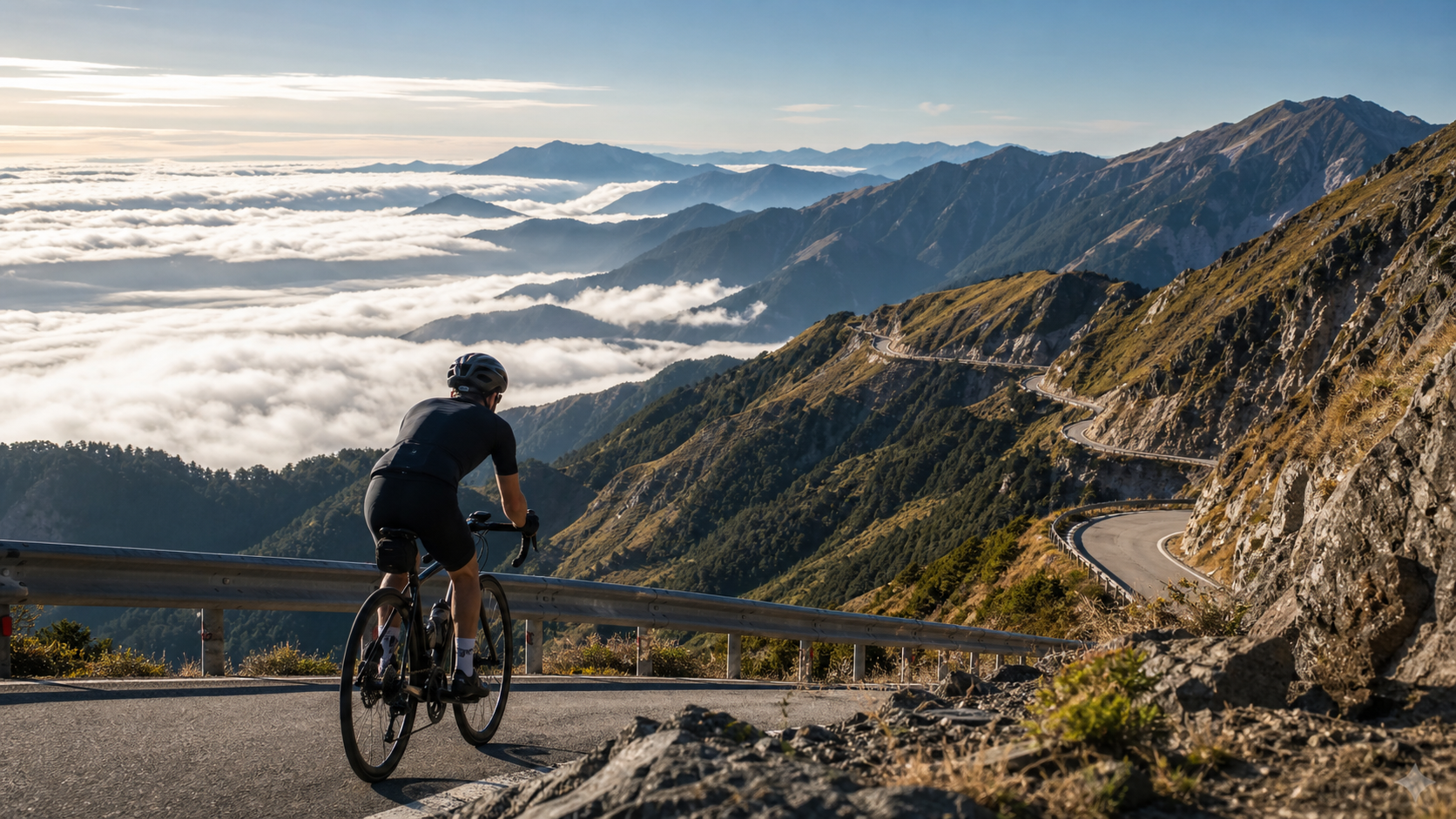
In the heart of every Taiwanese road cyclist, there is a Wuling.
It stands at 3,275 meters above sea level, the highest point reachable by road in Taiwan, the rooftop of our island. And the “West Approach to Wuling,” starting from Puli in Nantou, following Provincial Highway 14 and 14A, passing through Renzhiguan, Wushe, and Cingjing, finally reaching that road above the clouds—53 kilometers with nearly 2,900 meters of climbing—is how countless people first meet Wuling.
This article is not about power output or gear ratios. What I want to talk about is the clouds along this road, the people on it, and the version of yourself that, even in the most painful moments, still chooses to keep pedaling upward.
From Basin to Rooftop: A Vertical Journey
The West Approach to Wuling begins in Puli—Taiwan’s geographic center, a small basin town embraced by mountains, at about 450 meters above sea level. The finish is Wuling at 3,275 meters. The nearly 2,900 meters of vertical difference between these two numbers means that on the same day, you will ride from a warm basin town all the way up above the clouds.
This is a road that lets you “see Taiwan’s elevation profile.” You will pass through, in order: the cooking smoke of Puli’s streets, the steep gorges of Renzhiguan, the historical memories of Wushe, the European-style grasslands of Cingjing Farm, the arrow bamboo slopes of Cuifeng and Yuanfeng, and finally the high-mountain wilderness of Kunyang and Wuling that seems to belong to another world. One single road, yet it feels like crossing several climate zones—this vertical journey is a romance unique to Taiwan.
Renzhiguan: A Gate of History
Climbing up from Puli, the first breathtaking landmark is Renzhiguan. This is a magnificent gorge section on Highway 14A, with towering rock walls on both sides and the road cutting through the middle. The name “Renzhiguan” itself carries a story—historically, this was a natural boundary between indigenous territories and the outside world, a pass where “people” came to a “stop.”
Riding through Renzhiguan, you feel like you are passing through a gate. On one side is the familiar lowland life; on the other, the world of high mountains. This sense of ritual is the first gift the West Approach to Wuling gives to every cyclist.
Wushe and Cingjing: Between History and a Sea of Clouds
Further up is Wushe. For Taiwanese people, this name carries a heavy historical memory. As you pass through here, gasping for breath on the climb, every inch of asphalt beneath your wheels is layered with the thickness of time. Riding through a site of history is a feeling hard to put into words—you are not just challenging altitude; you are brushing past the memories of this island.
Past Wushe, you arrive at Cingjing Farm. At elevations between nearly 1,700 and 2,000 meters, Cingjing is the most “vacation-like” stretch of the entire route. Sheep wander across the green meadows, European-style guesthouses dot the hillsides, and seas of clouds often churn right below your feet. Many riders pause here to resupply, take photos, and give themselves a mental preparation—because after Cingjing is where the West Approach to Wuling truly begins.
The Solitude of High Altitude: Cuifeng, Yuanfeng, Kunyang
Past Cingjing, signs of human habitation grow sparse, but the scenery becomes ever more magnificent. Cuifeng, Yuanfeng, Kunyang—this string of place names are keywords in the memory of every summit seeker.
Once you break past 2,000 meters, your body will honestly tell you, “the air here is different.” You push with all your might, yet feel like you can never get a full breath; power output drops, speed falls. This is altitude sickness, an honest dialogue between body and elevation. But it is precisely in this almost solitary effort that you encounter a strange tranquility—around you, only the sound of wind, your breathing, and the rhythm of your own heartbeat.
The arrow bamboo slopes shimmer gold-green in the sunlight, and the Hehuan mountain peaks layer into the distance. There will be a moment when you forget you are climbing, simply stunned by the view before you. This is what makes the West Approach to Wuling addictive.
The Last Few Hundred Meters
From Kunyang to Wuling is the final sprint, and the thinnest air of the whole ride. That short, steep section before the Wuling archway is, in the memory of countless riders, “the longest few hundred meters in the world.”
You see the archway ahead, yet no matter how hard you pedal, it never seems to get closer. Your legs are numb, your lungs are burning, and only one thought remains in your mind: one more pedal, one more pedal. Then—you round the last corner, and Wuling is right before you.
The emotion at that moment is hard to describe. Some people cry, some collapse on the ground laughing, some just quietly gaze at the sea of clouds below. Regardless, you will understand: you have just stood, on your own two legs, at the highest point of Taiwan’s roads. This sense of achievement is something no other means can give you.
What This Road Means to Riders
For Taiwanese cyclists, the West Approach to Wuling has long surpassed being just a “route.” It is a rite of passage, a milestone, an appointment that every road cyclist must eventually keep.
What it teaches you is how to be with yourself. In 53 kilometers of solitary climbing, no one can pedal for you; you must face your own limits, your own weaknesses, your own will. At the moment when you still choose to pedal upward in the thin air of Kunyang, you are proving to yourself: the version of you that thought it couldn’t be done, actually can.
Many people say after completing the West Approach to Wuling that what changed was not their leg strength, but the way they view difficulties. Because once you have conquered Wuling, many of life’s “unclimbable slopes” no longer seem so daunting.
Seasonal Scenery
- Spring (April–May): Mountain cherries and alpine rhododendrons dot the trails, with pleasant weather.
- Summer: The lowlands are scorching, but the summit is cool—peak season for escaping the heat and summiting, though you should avoid afternoon thunderstorms.
- Autumn (September–October): Clear skies, the best visibility, and a high chance of seas of clouds—the golden season for photography and riding.
- Winter: Possible snow and ice, road closures; not recommended for those without extensive experience.
Suggested Side Trips
The ideal arrangement for the West Approach to Wuling is a two-day, one-night trip:
- Day One: Start from Puli or Cingjing, using Cingjing as a midway stop. Ride slowly, take in the sights, stay overnight in Cingjing, and enjoy the mountain night views and starry sky.
- Day Two: Summit Wuling in the early morning while the weather is stable, completing it before noon to avoid afternoon weather changes. After summiting, you can explore the trails around Hehuan Mountain.
- Wrap-up: Descend back to Puli, soak in a hot spring, enjoy some local snacks, and slowly savor the afterglow of this high-mountain expedition.
Some say everyone should do the West Approach to Wuling at least once in their life. I would add: do it once, and you will want to do it again. Because once you have seen the world above the sea of clouds, you can never forget it. Ready your bike, your legs, and a heart willing to take it slow—Wuling, at 3,275 meters, is waiting for you.
The Hehuan Peaks: The High-Mountain Stage Behind Wuling
What makes Wuling so moving is not just that it is the highest point on the road, but that it sits in the embrace of the Hehuan mountain range. As you ride past Kunyang and approach Wuling, you are surrounded by the Hehuan peaks—Hehuan Main Peak, East Peak, North Peak, and Shimen Mountain. These names are legendary among hikers, and for cyclists, they form the most magnificent backdrop to this high-mountain expedition.
The Hehuan area is one of the few high-mountain regions in Taiwan that can be reached without a long trek—just a drive or a ride. The arrow bamboo slopes shimmer gold-green in the sunlight, and in winter they may even be covered in snow, making this one of the easiest places for Taiwan’s lowland residents to see snow. When you are on the West Approach to Wuling and see this high-mountain grassland spreading out beneath your feet and into the distance, you will feel a nearly surreal emotion—that on your own two legs, you can arrive at a place that seems to belong to another world.
This high-mountain region has a different face in each season. In spring, alpine rhododendrons bloom across the slopes, pink accents against the verdant green; in summer, the slopes are lush and vibrant, with seas of clouds churning frequently; in autumn, the sky is high and clear with excellent visibility, the golden season for photography; in winter, if a cold front strikes, the area may be blanketed in white snow, but that also means the risk of ice and road closures. In every season, the Hehuan peaks bear witness, in their majestic form, to the efforts and emotions of one summit seeker after another.
Starry Skies and Sunrises: Why You Should Stay Overnight in the Mountains
Many cyclists choose the two-day, one-night West Approach to Wuling, and beyond physical considerations, there’s a romantic reason—the mountain’s starry skies and sunrises.
Around Cingjing and Hehuan Mountain, the high altitude, minimal light pollution, and clear air make it one of Taiwan’s premier stargazing spots. If you stay overnight in the Cingjing or Hehuan area, look up after dark and you’ll see a breathtaking sea of stars—the Milky Way stretching across the sky, countless stars too numerous to count. This sight, never visible in the city, is the mountains’ exclusive gift to those who stay the night.
And the dawn sunrise is not to be missed. Watching the sunrise from Kunyang or Wuling, you’ll see the sun slowly rise from behind the distant ridges, golden light spilling across the sea of clouds, as if the entire world is being re-illuminated. Many cyclists deliberately set off before daybreak, hoping to encounter this mountain sunrise on the way to the summit. That moment of light will etch itself into your memory, becoming an unforgettable image for a lifetime.
Cyclists and Hikers: Two Romances with the Same Mountain
On the West Approach to Wuling, you’ll encounter two kinds of people—those on bikes, and those on foot. They approach the same mountain in different ways, yet share the same love for the high peaks.
Hikers carry heavy gear, step by step heading deeper into the Hehuan mountain range; cyclists push their pedals, climbing inch by inch along the highway. The methods differ, but the longing to “get a little closer to the sky” is the same. When cyclists and hikers meet at Wuling, there’s a mutual understanding in each other’s eyes—we are all people summoned by this mountain.
These encounters in the high mountains are especially moving. Everyone is gasping for breath, all tormented by the altitude, yet all awed by the grandeur before them. In that moment, occupation, status, and age don’t matter—what matters is that you and this mountain, these clouds, this sky, are sharing an utterly pure moment. Perhaps this is the mountains’ most enchanting magic—it returns every person who arrives to their most simple, most authentic self.
The Tears Shed at Wuling
Ask anyone who has completed the West Approach to Wuling, and they’ll tell you how complex the emotions are at the moment of summiting. Some cry, some laugh, some just stand quietly, unable to speak.
What are those tears for? For the nearly 2,900 meters of climbing finally coming to an end, for the relief from the torment of high-altitude oxygen deprivation, and for the proof—that the person who once thought they couldn’t do it, truly did. The West Approach to Wuling is a mirror; it reflects your weakness, and it reflects your strength. When you’re still willing to push upward in the thin air at Kunyang, you’re really telling yourself: “I can.” And when you finally stand on the rooftop, that “I can” turns into tears, turns into smiles, turns into a confidence that can never be taken away.
This is why so many people say the West Approach to Wuling changed them. What changed isn’t leg strength, but the way they view hardship. Once you’ve conquered Wuling, many of life’s “unclimbable slopes” don’t seem so daunting anymore. Because you know that as long as you keep going up, one step at a time, one pedal at a time, no matter how high the mountain, there will come a day you reach the summit.
To You, First-Time Challenger: A Letter
If you’re preparing for your first West Approach to Wuling, let me speak to you as someone who’s been there.
Don’t be afraid of being slow. This road doesn’t reward impulsiveness; it rewards discipline. You can ride slowly—seven hours, eight hours, it doesn’t matter. As long as you don’t give up, you’ll make it. Please hold back on the gentle slopes in the early section, saving your strength for the real challenge after Cingjing.
Don’t compare yourself to others. Some will whoosh past you—don’t mind them. This is your journey with yourself; the only one you need to converse with is the self struggling through oxygen debt and fatigue. Ride your own pace, complete your own path.
Don’t forget to look up. Climbing is tough, and you’ll be tempted to keep your head down staring at the bike computer. But remember to occasionally lift your head—look at the gorge at Renzhiguan, the sea of clouds at Cingjing, the grassy slopes of the Hehuan peaks. These landscapes are the reason you traveled all this way.
Finally, don’t forget to stay warm. After the joy of summiting, a long descent awaits you. Put on your windbreaker, wear your gloves, and get home safely—that’s what makes a complete West Approach to Wuling.
Conclusion: The Mountain Within
Every Taiwanese cyclist has a Wuling in their heart. It’s a rite of passage, a milestone, a rendezvous that must eventually be kept.
Some say everyone should do the West Approach to Wuling once in their life. I’d add: do it once, and you’ll want to do it again. Because once you’ve seen the world above the sea of clouds, you can never forget it. There’s the thin yet crisp air, the landscapes so vast they bring tears, and that bravest version of yourself who chose to keep climbing even at the limit. Ready your bike, your legs, and a heart willing to take it slow—Wuling awaits you quietly at 3,275 meters. And when you finally arrive, you’ll understand: this mountain you rode up has always been within you.
Puli: Where It All Begins
The story of the West Approach to Wuling begins in Puli. This basin town at Taiwan’s geographic center, surrounded by mountains and blessed with a pleasant climate, has been the gateway to the Central Mountain Range since ancient times. Puli is renowned for its fine mountains and waters—its pure water quality nurtures the famous Shaoxing wine and a variety of delicacies; its fresh air makes you want to take a deep breath the moment you arrive.
For cyclists, Puli is the starting point of the West Approach to Wuling, and a place full of ritual significance. Many people stay in Puli the night before, conserving their energy, then set off in the morning light at dawn. As you ride through Puli’s streets, watching the town wake from slumber—breakfast shops steaming, the market growing lively, residents beginning their day—you feel a thrill of “about to embark on a great journey.” Puli’s everyday bustle is the warmest prelude to this high-mountain expedition.
After riding Wuling and returning to Puli, this town transforms into the most healing finish line. Soak in a hot spring, enjoy a steaming bowl of local snacks, sip a local drink, and let your mountain-battered body slowly recover in Puli’s gentleness. Depart from Puli, return to Puli—this basin town, with its fine mountains and waters, embraces every dream-chasing cyclist.
Cingjing Farm: European Charm in the South
Along the West Approach to Wuling, Cingjing Farm is the most “vacation-like” stretch. This high-mountain farm, at an elevation of about 1,700 to 2,000 meters, is famous for its green meadows, sheep, and European-style lodgings, earning it the nickname “the Peach Blossom Land above the Mist.”
Riding into Cingjing, you feel as if you’ve been transported from Taiwan’s high mountains straight to the European countryside. On the emerald meadows, sheep wander leisurely; on the slopes, European-style lodgings are scattered about; clouds and mist often churn right at your feet, making the entire farm feel like a fairyland. This is a rare “dessert” on the West Approach to Wuling—between continuous climbs, it offers you a feast for the eyes and the soul.
Many cyclists pause at Cingjing to resupply, take photos, and catch their breath. This isn’t just physical recovery; it’s also mental preparation—because past Cingjing, the real challenge of the West Approach begins. Take a deep breath on Cingjing’s meadows, gaze at the sea of clouds before you, give yourself a smile, and then keep climbing—this is Cingjing’s moment of carrying the past into the future.
Riding Through the Cracks of History
Along the West Approach to Wuling, history is everywhere. The name Renzhiguan speaks of a place that was once the boundary between indigenous territory and the outside world; the name Wushe carries a heavy memory from Taiwan’s modern history. As you pass these places, gasping on the climbs, every inch of asphalt beneath you is layered with the thickness of time.
This is one of cycling’s most profound experiences—you’re not just exercising; you’re conversing with the memory of this island. You recall stories from textbooks, imagine what these forests looked like a century ago, and feel a connection that transcends time. This sense of “riding alongside history” makes the West Approach to Wuling not just a physical challenge, but a journey through Taiwan’s time and space.
It is precisely for this reason that riding the West Approach to Wuling is something to be done with reverence. Reverence for the mountain’s grandeur, for the blood and sweat of those who opened the road, for the memories this land carries. When you ride upward with this reverence, you’ll find that this road gives you far more, and far deeper, than a summit photo.
The West Approach to Wuling Through the Four Seasons
The West Approach to Wuling is a completely different experience in each season:
Spring (April–May) is the most romantic season. Alpine rhododendrons bloom across the grassy slopes, mountain cherries dot the roadside, and the climate is mild and pleasant. This is one of the golden seasons for summiting—good weather and blossoms alike.
Summer is peak season. The plains are scorching, but the high mountains are as cool as spring, drawing countless cyclists up to escape the heat. However, summer afternoons often bring thunderstorms—be sure to start at dawn and summit before noon to avoid the risk of changing weather.
Autumn (September–October) is the season of best visibility. The sky is high and clear, the chance of seas of clouds is high, making it the golden period for photography and riding. The cool air makes climbing a bit more comfortable too.
Winter is full of challenges. The Hehuan area may see snow, ice, and road closures; it’s not recommended for anyone without extensive experience. But if the weather is stable, winter’s crisp air and possible snowscapes are rare sights. Regardless of when you go, be sure to check real-time road conditions and weather before setting out.
Conclusion: The Mountain Within
Every Taiwanese cyclist has a Wuling in their heart. It is a rite of passage, a milestone, a rendezvous that must eventually be kept.
Some say you must climb Wuling from the west at least once in your life. I would add: climb Wuling from the west once, and you will want to do it again. Because once you have seen the world above the sea of clouds, you can never forget it. There is thin yet crisp air, scenery so magnificent it brings tears to your eyes, and the bravest version of yourself—the one who still chooses to push upward at the limit.
Prepare your bike, your legs, and a heart willing to take it slow—Wuling, at 3,275 meters, waits for you in silence. And when you finally arrive, you will understand: this mountain you rode up has always been inside you. It will remind you that in life, there are no slopes that cannot be climbed—only pedals that have yet to be turned.
For Those Who Think “I Could Never Ride Up”
If you are reading this article while thinking, “Climbing Wuling from the west is so hard—how could an ordinary person like me ever make it up?” then this passage is written especially for you.
The truth is: climbing Wuling from the west is not a challenge reserved only for professional riders or superhumans. Every year, countless “ordinary people”—office workers, students, retired seniors, newcomers who just picked up road cycling—climb Wuling step by step on their own legs. They have no extraordinary talent, no exceptional fitness. What they have is thorough preparation, enough patience, and the courage to say, “I want to try.”
Being slow has never been the problem. This road does not rush you. You can ride for seven hours, eight hours—as long as you do not give up, you will make it. What truly matters is not how fast you ride, but whether you take that first step, and whether you hold on just a little longer when you feel like quitting. When you stand atop Wuling and look back at the 53 kilometers behind you, you will understand—what has always limited you was never your legs, but the thought in your mind that says, “I can’t.” And once you break through it, you will discover that so many things in life you thought were “impossible” are actually waiting for you to prove that you can. So stop saying “I can’t.” Get your bike ready and go. Wuling is waiting for you to write your own story.
Related Reading
- Full 52.2km Wuling Pacing Strategy: A Rhythm Map from Puli to the Ridge
- Wuling Single Ascent: Complete Comparison of the North, South, and East Routes
- The Art of Pacing in Climbing Races: Perfect Strategy for the Wuling Cup and Eastbound Wuling
- Wuling Guide: Pacing Strategy and Aid Station Planning from Puli
#北橫 + #北進武嶺 最硬的員工旅遊 EP1 | #公路車 #拉拉山 | 明池 | 武嶺 | 武陵農場 | 雲海 | Taiwan Cycling Route Wulin
6 年前
西進武嶺 世界紀錄挑戰!破2:30 ?!一群人推著一個夢上山 直播精華版 / ft. 張翰允 & 台視主播魏于恬 & KPLUS / #cycling 公路車 CT Yeh
2 個月前
台灣登山王之路 KOM 全程參賽4K臨空錄影 PART1 穿越峽谷地形! #東進武嶺 太魯閣 / 燕子口 / 天祥 / 西寶 PART1 (公路車 / CT Yeh)
3 年前
西進武嶺最新路況場勘,台14到清境,還適合騎單車上去嗎?/ 居然有這優勢!?/請開啟字幕/當天現剪/公路車/CT Yeh
2 年前
2023 夏季KOM 參賽實況 / 穿越空拍視角 / 整車都凸台 / 太魯閣峽谷x合歡山絕美大景 / 東進武嶺 / Taiwan KOM Challenge / 公路車 / CT Yeh
3 年前
大禹嶺 到 武嶺牌樓 全程前後實況錄影 | 北進武嶺 | 東進武嶺 | KOM | 訓練台 | 坡度分析 | Taiwan KOM Last 10 km HARD | 公路車
6 年前
大武山20%魔王陡坡【JJSC南台灣遊騎Day2】!屁股真的要裂開了...凡士林抹滿也沒用?神秘金教堂還有超便宜夜市
3 個月前
風櫃嘴時間 預測西進武嶺時間?13000名車友統計數據分析告訴你 !
5 年前