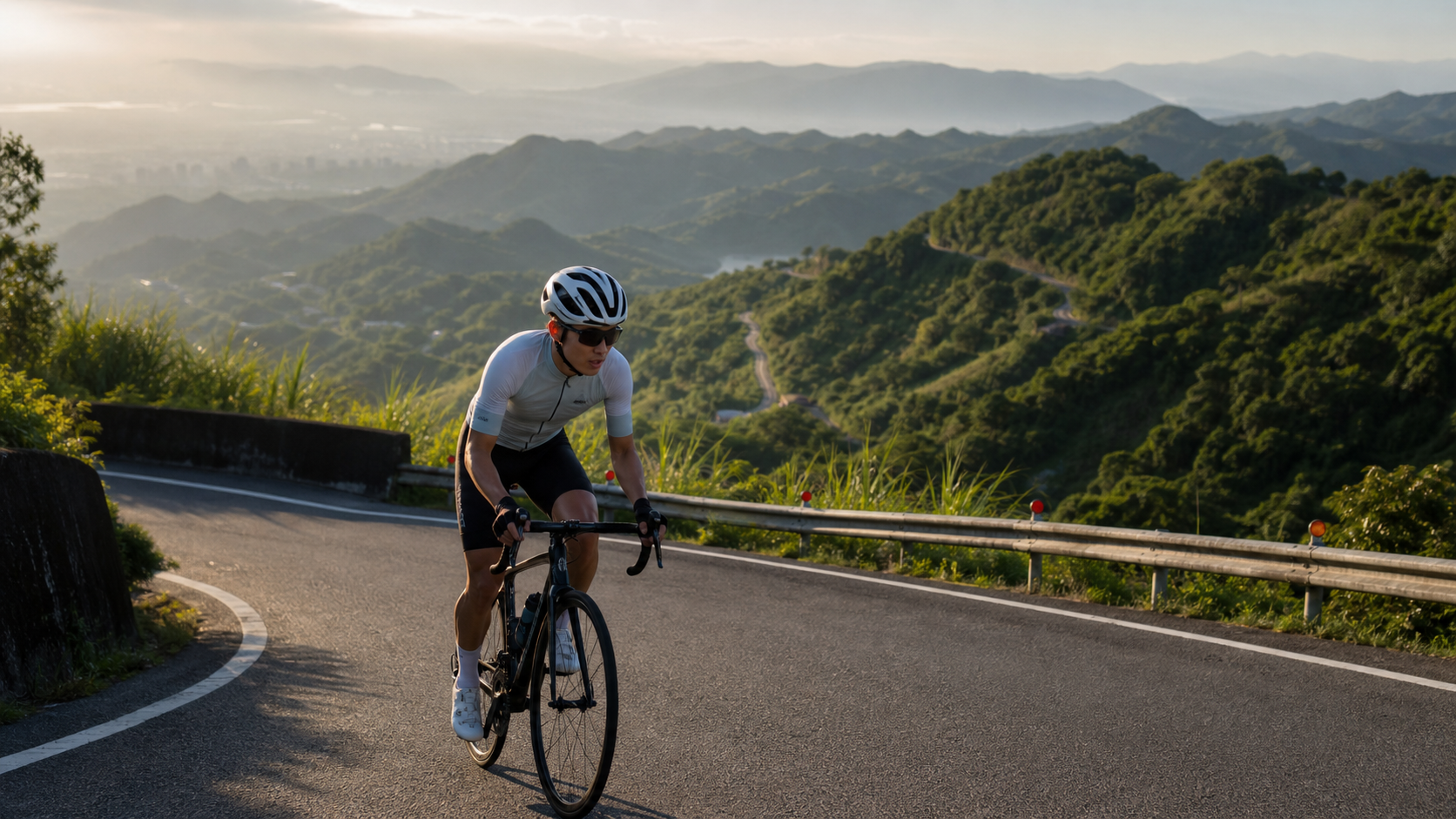
“What’s your 136 time?”
Among Taichung’s cycling community, this phrase is almost a secret handshake. It’s not asking for directions—it’s asking about your ability, your training, your season’s effort. Route 136—the county road in Taiping District leading to Chikanding—has long surpassed being just an ordinary climb. It’s the shared “exam ground” for Taichung riders, a unique symbol within the city’s cycling culture.
This piece isn’t about times or pacing. What I want to discuss is why this road—14.46 kilometers long with an average gradient of just 3.7%—holds such a special place in the hearts of Taichung cyclists.
“The Place Where Taichung Residents Take the Most Exams”
Route 136 earned the nickname “the place where Taichung residents take the most exams” because it’s simply too perfect for comparing strength.
It sits on the outskirts of Taichung, easy to reach—nothing like the two-day, one-night ordeal of Wuling. On any given morning, you can ride to Taiping’s Yijiang Bridge, head toward Chikanding, and give yourself an “exam.” From Yijiang Bridge to Chikanding is about 15 kilometers with nearly 600 meters of climbing. Every second of that stretch has been logged on Strava by countless riders, used to compare against their own past, against fellow riders, and against those legendary fast guys.
The most famous “perfect score” here is the roughly 34 minutes 53 seconds set by pro rider Feng Chun-kai. He came from the Merida Lampre team, and to amateur riders, that number is almost mythical. But precisely because of that benchmark, Route 136 became a universally recognized yardstick—your progress, your regression, neither escapes this road’s scrutiny.
The Grand Slam: The Legend of Three Peaks
The Chikanding section of Route 136 is actually part of a bigger picture—the “Taichung Grand Slam.”
The so-called Grand Slam refers to Zhongxingling, Baimaoshan (Lingding), and Chikanding, three well-known peaks in central Taiwan. String them together and you get a classic central Taiwan training route that loops around the map, roughly 90 kilometers with about 1,600 meters of climbing. Each of the three peaks has its own character:
- First leg, Zhongxingling: Toward Dakeng, about 8.4 kilometers of climbing with 327 meters of elevation gain—the warm-up opener.
- Second leg, Baimaoshan: Toward Xinshe, about 6.8 kilometers of climbing with 349 meters of elevation gain—the mid-course test.
- Third leg, Chikanding: Toward Taiping, about 12.3 kilometers of climbing with 576 meters of elevation gain—the main course finale, which is the Route 136 stretch.
Completing the Grand Slam—conquering all three peaks in a single day—is a badge of honor for many Taichung riders. And among the three, Chikanding (Route 136) is undoubtedly the most iconic and the most love-hate segment of all.
First Person: A Morning Exam
I remember every ride up 136; my mood feels like walking into an exam hall.
Early morning, I buy a bottle of water at the convenience store by Yijiang Bridge and take a deep breath. The first 9 kilometers are gently rolling uphill, the gradient is seductive—my body feels strong, my legs feel light, and I can’t help but want to accelerate. But that’s exactly where 136 is most cunning: it uses the easy early section to lure you into burning your energy too soon. Experienced riders know you have to “hold back” here, like a bow being drawn, keeping your strength in reserve.
Past the gentle section, the steep grades rise up without mercy. About 1 kilometer of climbing, then a brief flat stretch, then steep again—“easy, steep, easy, steep,” as if the road is probing your limits over and over. My heart rate starts to spike, my legs feel like lead, and only one thought remains in my head: hold the pace, don’t crack.
Reaching Chikanding, I stop the computer and look at the number—that moment is the most honest one. Sometimes I’m a bit faster than last time, and that joy is enough to make the whole day shine; sometimes I’m slower, and amid the frustration, I know I need to work harder next season. Route 136 never lies; it writes your effort and your laziness clearly into the record.
What This Road Means to Riders
Route 136’s significance to Taichung riders goes far beyond being just a climb. It’s a culture, a shared language, an unspoken understanding.
When two Taichung riders meet for the first time and talk about their 136 times, their abilities, efforts, and passion instantly find a common frame of reference. This road connects riders scattered across the city, forming an invisible yet very real community. Everyone sweats on the same road, competes on the same Strava leaderboard, and catches their breath at the same Chikanding—this shared experience is the most precious part of Taichung’s cycling culture.
What it teaches us is “honesty with yourself.” Route 136 won’t go easy on you just because you’re in a good mood today, and it won’t give you bonus points for having excuses. It forces you to confront your true state—whether you’ve trained enough, whether you can hold back, whether you can push through or not. That honesty is something every serious rider needs.
Seasonal Scenery
- Spring: Fresh greenery lines the mountain road, the weather is pleasant—a great season for setting times.
- Summer: The mountains are muggy, but early mornings are cool—prime time for “morning sessions.”
- Autumn: Crisp, clear skies and excellent visibility; the views from Chikanding are at their most expansive.
- Winter: Cold, dry mornings test your warm-up routine, yet it’s also the season when many chase personal bests.
Suggested Itinerary
To fit Route 136 into a full day, here’s how you could arrange it:
- Early morning: Start from Taiping’s Yijiang Bridge, take the Chikanding “exam” first to gauge your condition.
- Late morning: If you’ve got energy to spare, extend into the full Grand Slam and conquer all three peaks in one day.
- Afternoon: Head back toward Taiping and Dali, ride the gentle Toubiankeng Creek bike path to cool down, or treat yourself to a meal in the city.
- Evening: Find a café, chat with fellow riders about the day’s times, and relive the exam on Strava.
Route 136 is both a mirror and a bridge for Taichung riders. It reflects everyone’s true ability and binds them into a community. Next time someone asks, “What’s your 136 time?” don’t rush to answer with a number—behind it lies every drop of sweat you’ve shed, every impulse you held back on the easy early stretch, and the version of yourself at Chikanding, gasping for air, who refused to give up. That’s what 136 is truly testing.
First Person: A Morning Exam
I remember every ride up 136; my mood feels like walking into an exam hall. Early morning, I buy a bottle of water at the convenience store by Yijiang Bridge and take a deep breath. The first 9 kilometers are gently rolling uphill, the gradient is seductive—my body feels strong, my legs feel light, and I can’t help but want to accelerate. But that’s exactly where 136 is most cunning: it uses the easy early section to lure you into burning your energy too soon. Experienced riders know you have to hold back here, like a bow being drawn, keeping your strength in reserve.
Past the gentle section, the steep grades rise up without mercy. About 1 kilometer of climbing, then a brief flat stretch, then steep again—easy, steep, easy, steep, as if the road is probing your limits over and over. My heart rate starts to spike, my legs feel like lead, and only one thought remains: hold the pace, don’t crack. Reaching Chikanding, I stop the computer and look at the number—that moment is the most honest one. Sometimes I’m a bit faster than last time, and that joy is enough to make the whole day shine; sometimes I’m slower, and amid the frustration, I know I need to work harder next season. Route 136 never lies; it writes your effort and your laziness clearly into the record. That honesty is something every serious rider needs.
The Grand Slam: The Legend of Three Peaks and a Shared Language
The Chikanding section of Route 136 is part of the Taichung Grand Slam. The so-called Grand Slam refers to Zhongxingling, Baimaoshan, and Chikanding, three well-known peaks in central Taiwan; string them together and you get a classic central Taiwan training route of roughly 90 kilometers with about 1,600 meters of climbing. Completing the Grand Slam—conquering all three peaks in a single day—is a badge of honor for many Taichung riders. And among the three, Chikanding is undoubtedly the most iconic and the most love-hate segment of all. The most famous perfect score here is the roughly 34 minutes 53 seconds set by pro rider Feng Chun-kai—a number that is almost mythical to amateur riders.
Route 136’s significance to Taichung riders goes far beyond being just a climb. It’s a culture, a shared language, an unspoken understanding. When two Taichung riders meet for the first time and talk about their 136 times, their abilities, efforts, and passion instantly find a common frame of reference. This road connects riders scattered across the city, forming an invisible yet very real community. Everyone sweats on the same road, competes on the same leaderboard, and catches their breath at the same Chikanding—this shared experience is the most precious part of Taichung’s cycling culture. What it teaches us is honesty with yourself: Route 136 won’t go easy on you just because you’re in a good mood today, and it won’t give you bonus points for having excuses. It forces you to confront your true state—whether you’ve trained enough, whether you can hold back, whether you can push through or not. Next time someone asks your 136 time, don’t rush to answer with a number—behind it lies every drop of sweat you’ve shed, every impulse you held back on the easy early stretch, and the version of yourself at Chikanding, gasping for air, who refused to give up.
“The Place Where Taichung Residents Take the Most Exams”
Route 136 earned the nickname “the place where Taichung residents take the most exams” because it’s simply too perfect for comparing strength. It sits on the outskirts of Taichung, easy to reach—nothing like the two-day, one-night ordeal of Wuling. On any given morning, you can ride to Taiping’s Yijiang Bridge, head toward Chikanding, and give yourself an exam. From Yijiang Bridge to Chikanding is about 15 kilometers with nearly 600 meters of climbing. Every second of that stretch has been logged on Strava by countless riders, used to compare against their own past, against fellow riders, and against those legendary fast guys.
The most famous perfect score here is the roughly 34 minutes 53 seconds set by pro rider Feng Chun-kai. He came from the Merida Lampre team, and to amateur riders, that number is almost mythical. But precisely because of that benchmark, Route 136 became a universally recognized yardstick—your progress, your regression, neither escapes this road’s scrutiny. This quantifiable, comparable nature makes Route 136 Taichung riders’ favorite self-assessment station. Every ride feels like walking into an exam hall, receiving this road’s most honest grading. And it’s this ritualistic sense of pressure and anticipation that gives Route 136 its unique place in Taichung riders’ hearts.
Seasons, Itinerary, and the Weight of This Road
Route 136 has its own character in every season: in spring, fresh greenery lines the mountain road and the climate is pleasant—a great season for setting times; in summer, the mountains are muggy but early mornings are cool—prime time for morning sessions; in autumn, the sky is crisp and visibility is excellent, with the most expansive views from Chikanding; in winter, cold, dry mornings test your warm-up routine, yet it’s also the season when many chase personal bests.
To fit Route 136 into a full day, here’s how you could arrange it: start from Taiping’s Yijiang Bridge in the early morning, take the Chikanding exam first to gauge your condition; if you’ve got energy to spare, extend into the full Grand Slam and conquer all three peaks in one day; in the afternoon, head back toward Taiping and Dali, ride the gentle Toubiankeng Creek bike path to cool down, or treat yourself to a meal in the city; in the evening, find a café, chat with fellow riders about the day’s times, and relive the exam on Strava. Route 136 is both a mirror and a bridge for Taichung riders. It reflects everyone’s true ability and binds them into a community. Next time someone asks your 136 time, don’t rush to answer with a number—behind it lies every drop of sweat you’ve shed, every impulse you held back on the easy early stretch, and the version of yourself at Chikanding, gasping for air, who refused to give up. That’s what 136 is truly testing.
The Grand Slam: The Legend of Three Peaks
The Chikanding section of Route 136 is actually part of a bigger picture—the Taichung Grand Slam. The so-called Grand Slam refers to Zhongxingling, Baimaoshan (Lingding), and Chikanding, three well-known peaks in central Taiwan. String them together and you get a classic central Taiwan training route that loops around the map, roughly 90 kilometers with about 1,600 meters of climbing. Each of the three peaks has its own character: the first leg, Zhongxingling, is toward Dakeng, about 8.4 kilometers of climbing with 327 meters of elevation gain—the warm-up opener; the second leg, Baimaoshan, is toward Xinshe, about 6.8 kilometers of climbing with 349 meters of elevation gain—the mid-course test; the third leg, Chikanding, is toward Taiping, about 12.3 kilometers of climbing with 576 meters of elevation gain—the main course finale, which is the Route 136 stretch.
Completing the Grand Slam—conquering all three peaks in a single day—is a badge of honor for many Taichung riders. And among the three, Chikanding (Route 136) is undoubtedly the most iconic and the most love-hate segment of all. The Grand Slam strings together the essence of Taichung’s climbs into one route, and it also condenses Taichung riders’ passion for challenge into a shared goal. When you complete the Grand Slam, you haven’t just ridden 90 kilometers—you’ve joined an invisible yet very real community of countless challengers. That sense of belonging and achievement is one of the most precious things the Grand Slam—and Route 136—gives to Taichung riders.
What This Road Means to Riders: Honesty and Connection
Route 136’s significance to Taichung riders goes far beyond being just a climb. It’s a culture, a shared language, an unspoken understanding. When two Taichung riders meet for the first time and talk about their 136 times, their abilities, efforts, and passion instantly find a common frame of reference. This road connects riders scattered across the city, forming an invisible yet very real community. Everyone sweats on the same road, competes on the same Strava leaderboard, and catches their breath at the same Chikanding—this shared experience is the most precious part of Taichung’s cycling culture.
What it teaches us is honesty with yourself. Route 136 won’t go easy on you just because you’re in a good mood today, and it won’t give you bonus points for having excuses. It forces you to confront your true state—whether you’ve trained enough, whether you can hold back, whether you can push through or not. That honesty is something every serious rider needs. Perhaps that’s why so many Taichung riders have a love-hate relationship with 136 yet keep coming back—because in a world full of packaging and filters, having a road that tells you so nakedly and fairly, “This is exactly where you stand,” is itself a rare clarity. With its easy-then-steep grades, Route 136 writes honesty and connection into every Taichung rider’s cycling life.
Itinerary and Wrapping Up: After the Exam
When fitting Route 136 into a full day, beyond the exam itself, don’t forget the relaxation and rewards that come after. Start from Taiping’s Yijiang Bridge in the early morning, take the Chikanding exam first to gauge your condition; if you’ve got energy to spare, extend into the full Grand Slam and conquer Zhongxingling, Baimaoshan, and Chikanding in a single day. In the afternoon, head back toward Taiping and Dali, ride the gentle Toubiankeng Creek bike path to cool down, or treat yourself to a meal in the city. In the evening, find a café, chat with fellow riders about the day’s times, and relive the exam on Strava.
This rhythm of “exam first, reward after” is the most complete form of a Route 136 outing. It turns a ride into more than just a gritted-teeth extreme challenge—it becomes a full experience of effort, reward, and sharing. And that moment in the café, talking times with fellow riders, is often the warmest ending to the whole trip—everyone shares their struggles and breakthroughs, cheering each other on and competing with each other. The camaraderie forged by Route 136 is the most moving part of Taichung’s cycling culture. Route 136 doesn’t just test your ability; it connects you with the city’s riders. It’s an exam ground, and a bridge; it’s pressure, and it’s friendship. That’s why this county road, easy at first and steep later, carries so much weight in Taichung riders’ hearts.
The Self Gasping for Air at Chikanding
Having ridden 136 so many times, I’ve gradually come to understand that what this road truly tests isn’t speed—it’s how a person faces themselves. The gentle first 9 kilometers test whether you can resist the urge to push and hold your strength in reserve; the steep later section tests whether you can hold your pace through the pain and refuse to give up easily. These are, in fact, metaphors for life—those who know restraint go farther, and those who endure pain climb higher.
Every time I reach Chikanding and stop the computer, what I see isn’t just a time—it’s the version of myself that struggled on the climb yet didn’t quit. Sometimes fast, sometimes slow, but as long as I’ve honestly given my all, that number is something to be proud of. What 136 has taught me is to be honest with myself—no deception, no excuses, no comparing with others, only comparing with yesterday’s me. That honesty is more precious than any impressive time. Perhaps that’s why so many Taichung riders treat 136 as part of their lives—because on this county road, easy at first and steep later, we aren’t just riding; we’re repeatedly encountering the most real, most hardworking, and most courageous version of ourselves.
Route 136 and Taichung’s Cycling Culture
To understand why Route 136 carries so much weight in Taichung riders’ hearts, you need to understand Taichung’s thriving cycling culture. Taichung is a hub of Taiwan’s bicycle industry and home to numerous teams, shops, and rider communities. In such an atmosphere, there needs to be a road everyone recognizes as a common platform for sparring and exchange. And Route 136, with its moderate difficulty, convenient access, and clear benchmark, naturally became that platform.
In Taichung, Route 136 is practically a required course for every serious rider. Team training, group rides, personal self-assessments—none of them can do without it. Over time, Route 136 has accumulated countless stories, countless times, countless memories, becoming an important symbol of Taichung’s cycling culture. When you ride 136, you’re actually joining a legacy written collectively by countless Taichung riders across decades. Every time you set becomes part of this road’s story; and this road’s legend continues to be passed down through you. This cultural depth and continuity is the fundamental reason Route 136 transcends being an ordinary climb and becomes Taichung riders’ shared language. It connects not just the riders of today, but generation after generation of people who hold passion for this road.
Conclusion: Every Drop of Sweat Behind It
Route 136 is both a mirror and a bridge for Taichung riders. It reflects everyone’s true ability and binds them into a community. When someone asks your 136 time, don’t rush to answer with a number—behind it lies every drop of sweat you’ve shed, every impulse you held back on the easy early stretch, and the version of yourself at Chikanding, gasping for air, who refused to give up.
That’s what 136 is truly testing. It doesn’t test how fast you ride, but your attitude when facing difficulty, the way you relate to yourself, and your will to not give up through pain. These are the most important lessons in cycling—and in life. Next time you ride 136, don’t just stare at the number on your computer—feel the rhythm of easy-then-steep, experience the art of restraint and explosion, and encounter the self that struggles on the climb yet keeps pushing upward. When you learn to appreciate all of this, you’ll understand that 136 gives you far more than a time. It gives you a riding memory deeply connected to yourself, to fellow riders, and to this city—and that is the warmest, most moving core of Taichung’s cycling culture.
About the Morning at Yijiang Bridge
Every Route 136 story begins with the morning at Yijiang Bridge. Before the sky is fully light, the convenience store’s glow feels especially warm in the morning mist. Riders arrive one by one, refilling water, warming up, and encouraging each other. There’s a pre-exam tension in the air, mixed with the excitement of an impending departure. This small starting point has witnessed countless Taichung riders’ challenges and breakthroughs, and it carries decades of this road’s legacy and camaraderie.
When you too stand at Yijiang Bridge in the morning, ready to head for Chikanding, you’re actually joining this cross-generational riding tradition. Every challenge you take on becomes part of this road’s story. And no matter today’s result, the self who was willing to get up early, willing to face the easy-then-steep test, willing to grit through to the end at Chikanding—that self deserves pride. That’s the charm of 136: it’s not just a road, but a place where Taichung riders repeatedly encounter themselves and each other. Next morning, if you see those familiar yet unfamiliar riders at Yijiang Bridge, don’t forget to share a smile—because you’re all people summoned by the same road, carrying the same passion.
Related Reading
- Route 136 Chikanding Guide: How to Crack the Easy-Then-Steep Taichung Rider Exam Ground
- The Middle Leg of the Taichung Grand Slam: Baimaoshan, a Journey of Continuity Hidden in Xinshe’s Mountains
- 36 Curves, 36 Conversations with Yourself: The Road Spectacle and Riding Philosophy of Meishan 36 Curves
- A Sub-13 226: A Citizen Triathlete’s Full-Distance Finish Plan
台中大三元 計時賽 爆笑關主ALL IN 拚了 | NEKO'S FUN | 公路車 | Taiwan Cycling Route
6 年前
單車實況) 車測中心高速賽道 96 彰化讚 挑戰組一圈實錄 | ARTC
6 年前
台北闊瀨陡坡 騎旅 / 日本單車雜誌編輯車友臨時加入!/ 髮香才是最強的 / feat. 北迴歸線小隊 / 公路車 CT Yeh
6 個月前
台中大雪山 膏王領騎 震到都沒畫面了 公路車
5 年前
彰化經典百K 多視角衝刺實錄 | 范老師高鐵 NEKO's Fun Eva | 公路車
5 年前
大武山20%魔王陡坡【JJSC南台灣遊騎Day2】!屁股真的要裂開了...凡士林抹滿也沒用?神秘金教堂還有超便宜夜市
3 個月前
嘉義大埔、阿婆灣挑戰賽,美到以為在日本!ft. 環騎5 Cool 西拉雅188 / 公路車 / CT Yeh
7 個月前
小野田真的存在!日本赤城山爬坡公路賽 台灣首發團完全實錄 | 頭文字D真實賽道! | 看完東奧自行車賽後好想再去騎一次啊! | 公路車 | CT Yeh
4 年前