Pilgrimage Beneath the Towering Wall: Fuji Azami Line, Subashiri Trailhead, and the Trial of Will on One Brutal Climb
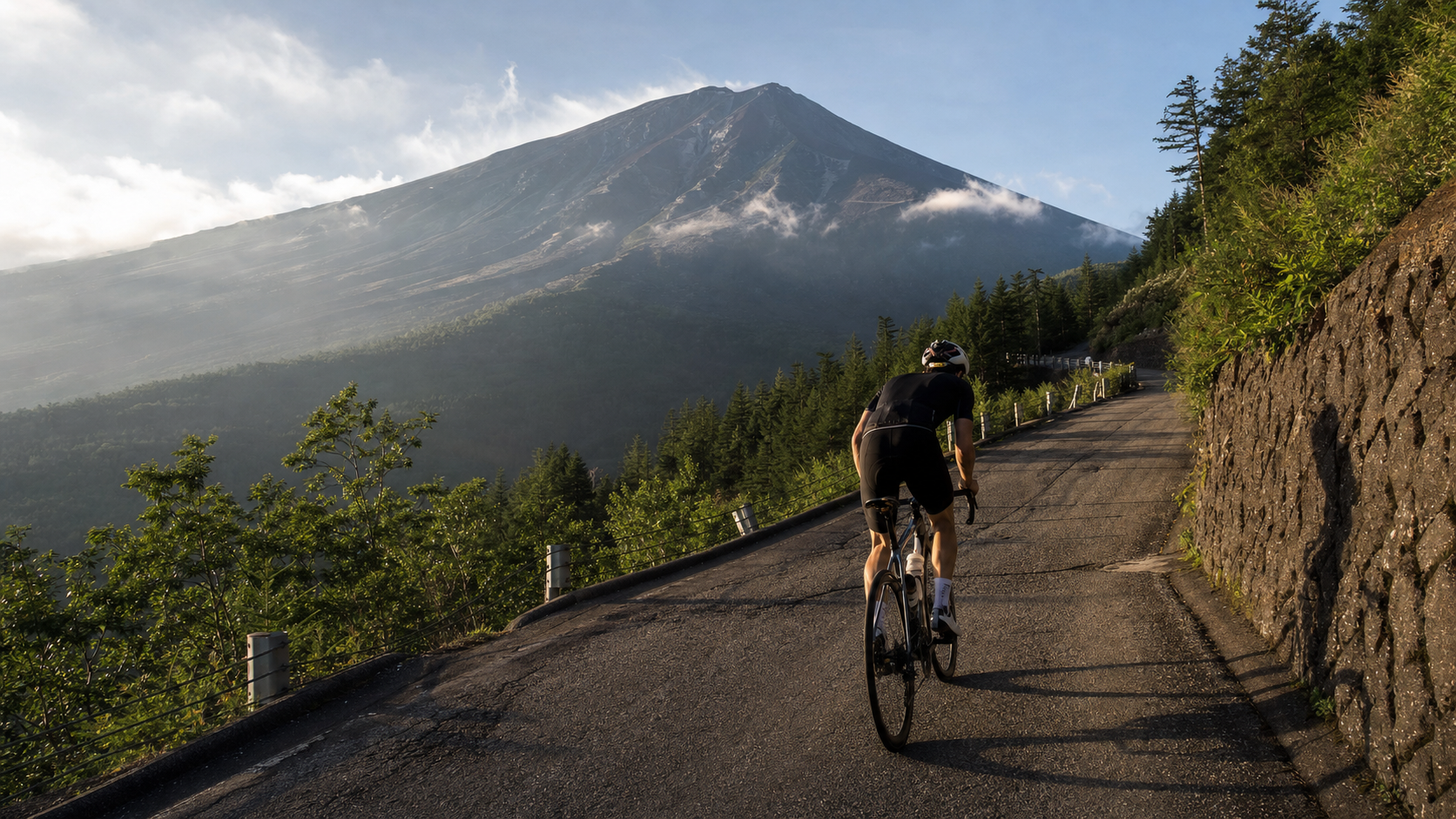
Some roads tempt you with scenery, others move you with stories, but the Fuji Azami Line—it uses a nearly vertical wall to force you to confront your own limits. This is a road of will, a road that will leave a deep scar on your heart.
When people talk about the Fuji Azami Line, the first things that come to mind are usually those daunting numbers: a maximum gradient approaching 22%, comparisons to Italy’s Zoncolan, and the title of “Japan’s steepest climb.” But if you only see it as a string of gradient figures, you’ll miss what truly makes this road special. It leads to the Subashiri Fifth Station on Mount Fuji—a gateway that has carried centuries of pilgrimage memories. In this article, we set aside the cycling computer and step into the faith, the place names, and the human stories behind this brutal climb.
For those unfamiliar with this road, here’s a picture: it’s located in Oyama Town, Shizuoka Prefecture, starting in the Subashiri area and climbing steeply toward the Subashiri Fifth Station on the eastern side of Mount Fuji, ending at an elevation of about 1,980 meters. The total distance is roughly 11 kilometers, yet it gains over 1,100 meters in elevation, with an average gradient approaching 10%. In the latter section, there’s a continuous stretch nearing 15%, with the steepest part hitting 22%—the “Wall of Eminence.” Add these numbers together, and it becomes the “synonym for brutal climbs” in the minds of Japanese cyclists. But the numbers are just the ticket; what truly makes this road worth writing about are the stories behind it—about a sacred mountain, about pilgrimage, and about how people face their limits.
A Gateway to the Sacred Mountain
To understand the Fuji Azami Line, you first need to understand where it leads—Mount Fuji’s Subashiri Fifth Station.
Mount Fuji is not just Japan’s highest peak; it’s the spiritual symbol of the nation, a recurring protagonist in ukiyo-e and poetry, and the deepest landscape in the collective memory of its people. Since ancient times, climbing Fuji has been regarded as a form of ascetic practice and pilgrimage, and there are several routes to the summit. The Subashiri entrance is one of them, located on the eastern side of Mount Fuji in Oyama Town, Shizuoka Prefecture. The Fuji Azami Line is, in essence, the access road for modern travelers driving or cycling to the Subashiri trailhead.
Among Fuji’s several climbing routes, the Subashiri trail has its own distinct character. Situated on the eastern side, its starting elevation is relatively low, and the path traverses a longer forest zone, preserving more of the area’s natural wildness. Historically, this route was one of the main passages for residents of the eastern region and pilgrims making their ascent of Fuji, carrying the region’s religious memories. As you climb the Fuji Azami Line toward the Subashiri Fifth Station, you’re not just riding a modern paved road—you’re following a path layered with the memory of ancient trails. This mountainside beneath your wheels has been a place where people, carrying their wishes, have marched toward the sacred mountain for centuries.
In other words, when you ride this brutal climb, you’re treading on a modern version of a “pilgrimage road.” The ancients walked up on foot, expressing their reverence for the sacred mountain through physical austerity; and you, with your bicycle and your legs, gasping for breath before that Wall of Eminence, are in a sense continuing the same spirit of “measuring the sacred mountain with your body.” This connection to faith gives the suffering of the Fuji Azami Line a meaning that transcends sport.
To the Japanese, Mount Fuji is far more than just a mountain. It’s a recurring protagonist in ukiyo-e, the inspiration for countless poems and paintings, and the deepest landscape in the nation’s collective memory. During the Edo period, “Fuji-ko” even emerged—a folk religious organization centered on worshipping Mount Fuji, whose followers formed groups and walked here to make their pilgrimage, treating the ascent of Fuji as a lifelong wish. The Subashiri entrance was one of the gateways these pilgrims used to step onto the sacred mountain. As you pedal laboriously up this road, every inch of pavement beneath you is imprinted with the footsteps of countless pilgrims over the centuries. You are not the first person to suffer in order to reach this mountain, and you won’t be the last. This resonance with history is the unique weight of the Fuji Azami Line.
Magaeshi: A Place Name Carrying Climbing History
There’s a famous landmark on this road called “Magaeshi (Old Magaeshi)”—the true brutal climb begins after this point.
The place name “Magae” carries deep meaning in Japan’s mountain-climbing culture. It refers to a place where “horses can only go this far; from here on, you must walk.” In ancient times, people coming to worship Mount Fuji would ride horses or be carried in palanquins to the mountain’s base, but at a certain point where the slope became too steep and the terrain too treacherous, the horses could go no further. So they would “turn the horses back” here—leaving the horses behind and continuing to the summit on foot.
When you ride to Magaeshi and look at the “Wall of Eminence” before you, the place name suddenly becomes incredibly apt: a slope that even horses can’t ascend, and you’re going to ride it on a bicycle. This resonance across time makes Magaeshi more than just a signpost—it’s a reminder. A reminder that you’re stepping into a treacherous stretch where even the ancients’ mounts had to turn back. And you choose to keep going.
Almost every famous mountain in Japan has a place called “Magae”—it’s a vivid coordinate in mountain-climbing culture. Imagine, hundreds of years ago, a traveler coming to worship Mount Fuji, riding a horse all the way here, then dismounting, rearranging their gear, changing into straw sandals, and beginning the ascetic walk. The two characters “Magae” mark precisely the dividing line where “comfortable transport ends here, and the true trial begins from here.”
And today, you arrive at the same place on the most sophisticated modern bicycle, yet you must face the harshest test of the entire journey after this dividing line. From a certain perspective, this is a curious inversion—the ancients’ mounts stopped here, but your “mount” is about to challenge its limits here. When you pass Magaeshi and step onto that slope where even horses refused to go, you’re actually reenacting a very ancient pilgrimage in a very modern way: surrendering yourself to that wall, using the limits of your body to earn the right to reach the sacred mountain.
The Wall of Eminence: A Dialogue with Yourself
The most legendary part of the Fuji Azami Line is the brutal climb after Magaeshi, known as the “sosoritatsu kabe (Wall of Eminence)”—about 3 kilometers, with an average gradient approaching 15% and the steepest section hitting 22%.
Riding on this wall is a very unique experience. Your world shrinks down to just: the next breath, the next pedal stroke, keeping the front wheel from lifting. Your speed drops to almost walking pace, and time seems to stretch. At this point, the road is no longer truly testing your legs—it’s testing your mind. Can you, amid extreme pain and slowness, convince yourself to “push one more stroke, just one more”?
In this state of extremity, a person enters a peculiar kind of focus. Everything around you fades into the background, and your consciousness narrows to only the most essential things: the rhythm of your breathing, the rotation of the pedals, the balance of the bike. Some say it’s very much like meditation—when the body is pushed to its limit, stray thoughts disappear, leaving only the purest present moment. You’re no longer thinking about work, no longer thinking about your worries, not even thinking about how far the summit is. You’re just “here, pushing this one stroke.” This extreme focus, forced out by pain, is a nearly sacred experience that many cyclists repeatedly mention when describing the Fuji Azami Line.
It’s precisely in such moments that you encounter a version of yourself you rarely see. The self that, in comfortable life, always wants to give up and take shortcuts—that self has nowhere to hide on this wall. And the self hidden deep within, more resilient than you ever thought—that self is also forced out on this wall. You’ll be amazed to discover: when there’s no room to retreat, your body and will can hold out far longer than you imagined.
Many cyclists recall afterward that the Wall of Eminence was the moment in their cycling career closest to “pure will.” No scenery to distract you, no shortcuts to exploit—just a naked confrontation between you and the gradient. And precisely because of that, when you finally crest that wall and reach the Subashiri Fifth Station, the sense of accomplishment is so pure and intense—you didn’t beat anyone else; you beat the self that wanted to give up.
This kind of “pure confrontation” is actually rare in modern life. Our daily existence is filled with ambiguous successes and failures, excuses we can make, and difficulties we can circumvent. But on that wall, everything becomes crystal clear: you either keep turning the pedals, or you get off the bike. There’s no middle ground, no excuses, no one who can pedal for you. This naked simplicity is strangely captivating—it pulls you out of the chaos of daily life and forces you to face the most primal question: how far can you actually go?
And every cyclist who has gritted their teeth through that wall will carry away their own answer. That answer may be more precious than any finisher’s certificate. Because it’s not a judgment given by others—it’s a definition you wrote for yourself in your most painful moment. This is the deepest charm of the Fuji Azami Line—it doesn’t sell scenery; it sells a mirror in which to see yourself.
When Cars Are Banned, the Road Belongs to Cyclists
The Fuji Azami Line has another secret that’s especially kind to cyclists.
Every year during Mount Fuji’s climbing season (roughly early July to mid-September), to manage the overwhelming crowds of climbers, this road implements vehicle restrictions—regular cars must stop at the perimeter and transfer to shuttle buses to go up. But bicycles and other non-motorized vehicles are not subject to these restrictions. This means that during the busiest season of the year for climbing, when all cars are blocked at the foot of the mountain, this brutal climb instead becomes a stage exclusively for cyclists.
Imagine: midsummer on Mount Fuji, climbers streaming in endlessly, but on this steep road to the Subashiri entrance, not a single car competes with you for space. You face the Wall of Eminence alone, the road surface clean, the air quiet, with only the sounds of your breathing and your pedals. This “serene brutal climb in the midst of the sacred mountain’s peak season” is a hidden gift the Fuji Azami Line gives to serious cyclists.
The preciousness of this gift lies in the fact that it reserves the best riding conditions for those willing to go up on their own legs. Drivers are stopped at the foot, crammed into shuttle buses, while you—in the busiest season—get to enjoy a quiet road to the sky all to yourself. No engine roar, no exhaust fumes, no pressure of being overtaken—just the mountain, the road, and you. This is a very pure riding experience, and also a subtle kind of fairness: the sacred mountain gives its most serene side back to those willing to give the most.
Of course, this also means you must be completely self-sufficient—no cars means no easy way to call for help at any moment. So pre-ride preparation, spare tubes and tools, ample supplies and warm clothing all need to be more thorough. But for serious cyclists, this sense of independence—of relying on yourself—is precisely one of the most captivating aspects of this road. Between you and this sacred mountain, there are no buffers and no dependencies, only the most direct confrontation—this primal relationship is exactly what climbing and cycling looked like in their earliest forms.
The Warmth of the World Below: Gotemba’s Hot Springs and Yakisoba
After climbing a road this brutally hard, what you need most is gentle healing at the bottom. And the area around Oyama Town and Gotemba, where the Fuji Azami Line is located, offers exactly that kind of finish.
Gotemba is the liveliest town in the area, with its most famous landmark being the sprawling Gotemba Premium Outlets—around two hundred stores, with views of Mount Fuji. For cyclists who’ve just conquered a brutal climb, the real highlight is the day-use hot spring “Konohana no Yu” within the outlet complex: a natural hot spring from its own source, with open-air baths overlooking Mount Fuji. Soaking your cold, exhausted body into the hot spring, looking up at the sacred mountain you just conquered—this kind of finish is simply perfect.
Japan’s hot spring culture and cycling share a natural affinity. Long climbs against gravity leave muscles tense and lactic acid accumulated, and a hot bath is exactly what soothes all of that. What’s more, being able to soak while gazing up at the Mount Fuji you conquered with your own legs—this dual satisfaction of body and mind is hard to match with any other kind of finish. You’ll look at that sacred mountain glowing gold in the evening light, and silently think: I was just on you, on that wall, climbing step by step. That intimacy with the mountain will slowly settle, in the steam of the hot spring, into an unforgettable memory.
For food, the Gotemba soba (Mikuriya soba) in the Gotemba area has a distinctive flavor—the noodles use yam to add a sticky, chewy texture, while the broth is made with local soy sauce and the underground water flowing from Mount Fuji. What makes this bowl of soba special is that it uses precisely the subsurface water that seeps down from Mount Fuji—when you eat it, you’re also tasting the blessing this sacred mountain bestows upon the land. From the snow at the summit, to the underground flow, to the broth in your bowl—Mount Fuji returns to your body in another form.
Not far away, Fujinomiya is the birthplace of Fujinomiya yakisoba—this springy, hearty B-grade gourmet has won national championships multiple times and is an excellent choice for replenishing carbs and rewarding yourself. A steaming plate of yakisoba, a hot spring with a view of Mount Fuji—the bitterness of the brutal climb dissolves into satisfaction at the foot of the mountain. These local flavors aren’t just about filling your stomach; they’re a way for this journey to connect with the land. You don’t just pass by Mount Fuji—you taste it, you remember it.
What This Road Means to Cyclists
The meaning of the Fuji Azami Line to cyclists is different from most famous scenic climbs. It’s not a road to “enjoy”—it’s a road to be “tested” on.
It strips away all ornamentation—no breathtaking views to distract you, no gentle slopes to let you slack off—leaving only the most essential things: gradient, gravity, and your will. It forces you to confront a question: when the pain is so great that you want to give up, can you still push one more stroke?
And it’s precisely this purity that makes conquering it so significant. When you stand at the Subashiri Fifth Station and look back at that Wall of Eminence you just climbed, what you gain isn’t just a completed ride—it’s a renewed understanding of your own limits. You’ll carry the belief of “so I really can” down the mountain, and that belief will extend to every other moment in your life that requires you to grit your teeth and endure.
I’ve always felt that people occasionally need a road like this. A road that doesn’t reason with you, offers no shortcuts, and forces you to back yourself into a corner. Because in daily life, we’re too accustomed to avoiding discomfort, circumventing difficulties, and seeking the path of least resistance. The Fuji Azami Line takes all of that away, leaving you only with the most primal choice: endure, or don’t. When you choose to endure—and actually do it—that trust in yourself is something no comfortable success can give you.
Who Should Take On This Challenge
To be honest, the Fuji Azami Line is not a road for everyone. It’s demanding, unforgiving, and places high requirements on both equipment and fitness. But precisely because of that, it’s especially suited to certain kinds of cyclists.
It suits those who want to break through their own limits—if you’ve already ridden plenty of climbs and feel you need a harsher challenge to rediscover yourself, this road will give you an answer without mercy. It suits those who enjoy pure trials—if you don’t care whether there’s scenery along the way and just want the most naked confrontation between you and the gradient, this road is the perfect stage. It also suits those who want to collect the achievement of “Japan’s steepest climb”—that resounding title alone is worth a serious cyclist making a special trip to personally verify the legend.
But if you’re a beginner, or if this trip is about enjoying scenery at a leisurely pace, there are plenty of friendlier options around Mount Fuji—no need to force yourself against this wall. Knowing what you want is the first step in planning any cycling trip. After all, the joy of cycling comes in a thousand forms, and brutal climb trials are just one of them; finding the road that suits your current state and mood is what matters most. And when the day comes that you feel ready and crave a true trial, the Fuji Azami Line will always be there, that wall quietly waiting for you.
Set Out with Reverence
If you decide to take on the Fuji Azami Line, my final word is this: go with full reverence.
Reverence for this sacred mountain—you’re riding a pilgrimage road that has carried the memories of countless worshippers for centuries. Reverence for this brutal climb—bring your lightest gear ratio, prepare ample supplies and warm clothing, and never underestimate its difficulty. And reverence for yourself—allow yourself to dismount and catch your breath on the steepest short section, put safety before performance, because going up safely and coming down safely is the true completion of this challenge.
When you crest that wall where even horses turned back and stand at the Subashiri Fifth Station, you’ll understand: what the Fuji Azami Line gives is never just a climbing time, but the most profound dialogue with yourself, and an intimate connection with this national sacred mountain, earned through sweat and will. This connection will stay with you for a long, long time—whenever you later encounter an unbridgeable gap in life, you’ll remember that wall, remember that self who chose to push one more stroke at the limit, and tell yourself: I climbed that wall, so I can get through this too. This is the most precious gift a great brutal climb can leave a cyclist.
Suggested Side Trips
- Gotemba Premium Outlets and Konohana no Yu: The perfect finish of soaking in a hot spring and gazing at Mount Fuji after the ride, with the chance to stock up on supplies and souvenirs.
- Subashiri Fifth Station: The starting point of the climbing trail, with expansive views on clear days—the reward at the end of the brutal climb.
- Fujinomiya: Taste authentic Fujinomiya yakisoba to replenish carbs, and visit Fujisan Hongū Sengen Taisha.
- Around Mount Fuji: Extend your trip to the Fuji Five Lakes, Fujinomiya entrance, and other spots to experience the entire Fuji area more fully.
- Subashiri Area, Oyama Town: The starting point of the climb, where you can feel the gateway atmosphere of the sacred mountain’s eastern trailhead.
A Road Worth Putting on Your Life List
In the world of cyclists, some roads are for enjoying, some are for showing off, and the Fuji Azami Line is for “proving”—proving that you once stood at the start, faced that legendary wall, and did not turn away.
It may not be the most beautiful road; there are no dazzling vistas along the way. It’s certainly not the easiest road; that Wall of Eminence will make even the strongest cyclists wince. But precisely this “not beautiful, not easy” quality makes it a road so pure it’s nearly sacred. It strips away all decoration, leaving you only with the most essential challenge, and then, at the Subashiri Fifth Station at the finish, waits for you to claim the reward that belongs exclusively to those who persevere.
If you’re a serious cyclist, if you believe cycling is not just a sport but a way of knowing yourself, then the Fuji Azami Line deserves a place on your life list. Not because it’s easy—precisely because it’s hard.
Pre-ride reminder: this road is closed in winter, and the open period is announced annually; during the climbing season, cars are restricted but bicycles are allowed. The endpoint is near 2,000 meters and feels cold, so be sure to bring ample warm clothing. Go with reverence for the sacred mountain and preparation for the brutal climb, and attend this pilgrimage of will. When you crest that wall where even horses turned back, you’ll understand that what the Fuji Azami Line gives is never just a climbing time, but the most profound dialogue with yourself.
Related Reading
- Fuji Azami Line Brutal Climb Guide: The Lightest Gear Ratio Survival Guide for Japan’s Steepest Climb
- Riding to the Highest Reachable Point on Mount Fuji: Fuji Skyline, Hōei Crater, and a Cloud-Level Journey Through the Forest Belt
- Fuji Subaru Line Practical Guide: 24 Kilometers, 1,210 Meters of Climbing, a Purest Interrogation of Your Aerobic Threshold
- Fuji Skyline Guide: A 26-Kilometer Expedition to the Highest Rideable Point on Mount Fuji, the Fifth Station at 2,400 Meters
台北闊瀨陡坡 騎旅 / 日本單車雜誌編輯車友臨時加入!/ 髮香才是最強的 / feat. 北迴歸線小隊 / 公路車 CT Yeh
6 個月前
半日 小台灣 極限單車路線挑戰實錄
7 年前
西進武嶺 世界紀錄挑戰!破2:30 ?!一群人推著一個夢上山 直播精華版 / ft. 張翰允 & 台視主播魏于恬 & KPLUS / #cycling 公路車 CT Yeh
2 個月前
2025 乘鞍岳登山賽 比賽全紀錄篇 / 完整路線攻略介紹 / 日本版武嶺 公路最高點 / 高山空拍絕景 / 明年會開團! / 公路車 / CT Yeh
10 個月前
大武山後門26%歡樂陡坡!JJSC南台灣單車行Day2 / 被颱風追著跑 / 公路車 / CT Yeh
2 年前
小野田真的存在!日本赤城山爬坡公路賽 台灣首發團完全實錄 | 頭文字D真實賽道! | 看完東奧自行車賽後好想再去騎一次啊! | 公路車 | CT Yeh
4 年前
大武山20%魔王陡坡【JJSC南台灣遊騎Day2】!屁股真的要裂開了...凡士林抹滿也沒用?神秘金教堂還有超便宜夜市
3 個月前
萬年峽谷! 30% 超激陡坡 里佳部落DAY2 還是很硬! | 公路車 | CT Yeh
3 年前