Riding to the Highest Reachable Point on Mount Fuji: The Fuji Subaru Line, Hoei Crater, and a Long Cloud-Level Journey Through the Forest Belt
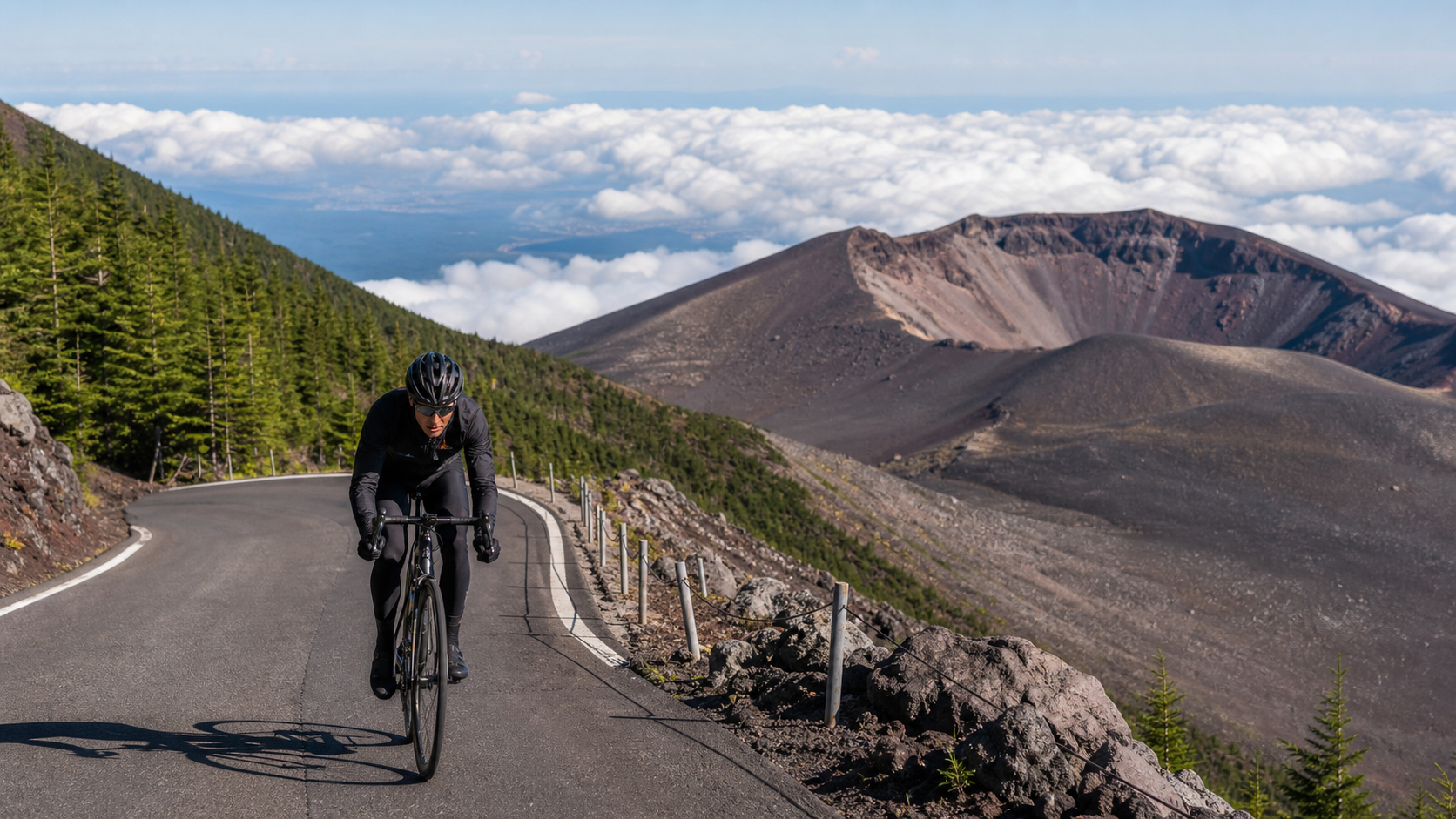
There are many mountains in the world, but few are like Mount Fuji—simultaneously a nation’s highest peak, its deepest faith, and its most recognizable symbol of landscape. And the Fujisan Skyline is the road that brings you closest to its summit by bicycle—a road that transforms you from an admirer into one who ascends.
This road leads to Fujinomiya Fifth Station, at 2,400 meters above sea level—the highest of all Mount Fuji’s trailheads, and the highest point reachable by car or bicycle on this sacred mountain. When you ride up here, you’re not just completing a nearly 27-kilometer climb with almost 1,800 meters of elevation gain; you’re delivering yourself to the cloud-level threshold of Japan’s highest sacred mountain. In this piece, we put away the cycling computer and look, through a traveler’s eyes, at the forests, the crater, and the human warmth along this sky road.
Before we formally step into the scenery along the way, let us first understand where this road sits within the grand theme of “Mount Fuji.” Mount Fuji has several climbing routes and access roads, each with its own character: there’s the Fuji Subaru Line on the Yamanashi side (the stage of the renowned hill-climb race Mt. Fuji Hill Climb), the brutal Fuji Azami Line steep slopes on the eastern side in Oyama-chō, and the Fujisan Skyline—a long, elegant sky road on the Shizuoka Fujinomiya side, leading to the highest fifth station on the entire mountain. If the Azami Line shocks you with its steepness, the Skyline moves you with its height and length. It doesn’t chase momentary thrills; instead, it lets you connect with this sacred mountain slowly and deeply over a long ascent.
From Forest to Sky
The most enchanting aspect of the Fujisan Skyline is that it lets you personally experience a “vertical journey through vegetation.”
At the start, you ride through dense coniferous forest. The road is wide, the trees cast dappled shadows, and sunlight filters through gaps in the canopy, scattering patches of light. This is the forest belt on the southern foothills of Mount Fuji—a quiet, enclosed, verdant world. You can hear the wind rustling through the treetops, birdsong, and occasionally the scent of resin and soil. This stretch is unhurried, as if the sacred mountain is first leading you through a green buffer zone before you formally ascend.
This forest has a soothing power. When you’ve just set off, still carrying tension about the high altitude ahead, this greenery gradually settles you down. There are no distracting grand vistas, no slopes steep enough to break you—only trees, only the road, only your own breathing and cadence. This is a stretch suited for “looking inward”—you can sort out your thoughts, find your rhythm, and converse with yourself here. The Japanese have a concept called “shinrin-yoku” (forest bathing), believing that walking in a forest heals body and mind; riding through this forest on Fuji’s southern foothills is, in a sense, a moving forest bath. Let this greenery store up energy for you, because next, the sacred mountain is about to lead you out of the forest and into the sky.
Then, as altitude rises, the trees grow shorter and sparser. In the latter half of the climbing section, the forest finally recedes below your line of sight, and the view opens up before you—you see clouds, distant ridgelines, and the entire sky. This transition of “emerging from the forest and stepping into the sky” is the most dramatic moment on the Fujisan Skyline. You’ll clearly feel yourself, inch by inch, leaving the human world and heading into the clouds.
This phenomenon of vegetation changing with altitude is called “altitudinal zonation” in ecology. From broadleaf and coniferous forests at the base, to stunted woods and shrubs at higher elevations, and then to the barren wasteland near the summit—a single climbing road condenses vegetation changes you’d normally have to cross several degrees of latitude to witness. This is the magic of high mountains: with two or three hours of climbing, you traverse a journey from temperate to frigid zones. When you notice the trees around you growing shorter and sparser, you are witnessing firsthand how altitude sculpts the shape of life. This kind of fine-grained observation turns your climb from a mere battle against gradient into a deeper dialogue with nature.
For riders from subtropical Taiwan, this vertical change in vegetation is especially novel. You set out from a damp, lush coniferous forest and finally arrive at a high-altitude wasteland with almost no tall vegetation, only volcanic gravel and sparse plants—this dramatic transformation of landscape is itself a visual feast and a rare lesson in natural history.
Mizugatsuka Park: Gazing at the Hōei Crater
Near the boundary between the forest belt and the climbing zone, there’s a place worth stopping at—Mizugatsuka Park.
Here you’ll find parking, a cafeteria, and shops—a rare supply and rest point on this long climb. For riders, this is a must-stop way station: fill your water bottles, replenish energy, rest briefly, and prepare for the core climbing section ahead. But the true charm of Mizugatsuka Park lies in the view. The park’s observation deck offers an up-close view of Mount Fuji and the Hōei Crater, a deep gash carved into the mountainside—the enormous scar left by Mount Fuji’s most recent major eruption (the Hōei Great Eruption), and proof that this sacred mountain is “alive.”
Standing at Mizugatsuka Park and gazing at the Hōei Crater, you gain a whole new understanding of Mount Fuji. From a distance, Mount Fuji appears so perfectly symmetrical, so serene; but up close, you see the massive gap torn open by volcanic activity on its flank. This duality of “perfection and scar coexisting” makes Mount Fuji no longer just a symbol on postcards, but a living volcano with stories, with power, still breathing. For a rider, pausing mid-climb to face this crater is a moment that quiets you.
The Hōei Crater is a remnant of Mount Fuji’s “Hōei Great Eruption”—one of the largest recorded eruptions of this volcano. The ash it spewed drifted as far as distant Edo (present-day Tokyo), disrupting daily life there for a considerable time. Today, this vast crater hangs silently on the mountainside, a mute witness reminding people that this seemingly eternally tranquil sacred mountain actually possesses thunderous power—it is merely sleeping for now.
When you stop at Mizugatsuka Park mid-climb and gaze at this crater, a peculiar awe wells up within you. You realize you are riding on the body of a living volcano—its perfect symmetry is beauty, its crater scar is power, and you, a tiny rider, move slowly up its slopes on your own legs. This contrast between human and natural force instills in you a greater humility toward the climb ahead, and a greater appreciation.
A Serene Sky Road During Climbing Season
The Fujisan Skyline holds one more hidden gift for riders.
Every year during Mount Fuji’s climbing season (roughly early July to mid-September), to manage the overwhelming crowds of climbers, vehicle restrictions are imposed on the Fujinomiya route of this road—private cars must stop at the periphery and transfer to shuttle buses. But bicycles are not subject to these restrictions. This means that during the busiest peak of the year’s climbing season, when cars are all held back at the foot of the mountain, this sky road to the fifth station becomes a stage relatively exclusive to riders. This is a secret many don’t know: if you want to ride up Mount Fuji in peace, the climbing peak season is actually the best time, because all the cars are kept down below.
Imagine midsummer on Mount Fuji: climbers stream endlessly along the summit trails, yet on this long Skyline, the clamor of cars is absent. You ride alone through the forest, emerge above the treeline, and pedal toward the clouds—the road surface clean, the air quiet. This “serene long climb during the sacred mountain’s peak season” is the most generous hospitality the Fujisan Skyline offers to earnest riders.
Behind this hospitality lies a beautiful philosophy. Through vehicle restrictions, the sacred mountain reserves the finest riding conditions for those willing to ascend on their own legs. Drivers are stopped at the base, packed into shuttle buses, missing the details of the forest and vegetation changes along the way; while you, in the busiest season, can experience every turn of this road inch by inch, in the slowest and most earth-hugging way. It’s a subtle fairness—the sacred mountain repays its most serene and moving side to those willing to put in the greatest effort.
Of course, the absence of cars also means you must be entirely self-sufficient. This long climb has no convenience stores, no passersby to call for help; if you have mechanical trouble or feel unwell, you have to handle it yourself. So pre-ride preparation must be more thorough: spare tubes, tools, a pump, ample supplies, and warm clothing—none can be omitted. But for serious riders, this sense of independence in “completing a long expedition on your own” is precisely one of the most captivating parts of this road. Between you and this sacred mountain, there is no buffer—only the most direct encounter.
Standing at 2,400 Meters: The Highest Point on Fuji a Cyclist Can Reach
When you finally ride up to Fujinomiya Fifth Station, at 2,400 meters above sea level, you are standing at the highest point on Mount Fuji that a cyclist can reach.
On a clear day, the view here takes your breath away—beneath your feet rolls a sea of clouds, and in the distance stretch the Southern Alps, the Izu Peninsula, and the glistening waters of Suruga Bay. This is also the trailhead for the Hōei-san hike, where many climbers set off to continue toward higher ground. And you—you brought yourself to this altitude by bicycle. That in itself is a remarkable achievement.
Standing at the Fifth Station and looking down, you experience a strange sense of “inversion.” Just a while ago, down at the base, Fuji was something you looked up to—towering, distant, unreachable. Now you are standing on its very body, and it is the land that spreads out beneath your feet. Clouds become the carpet underfoot, and distant mountain ranges become silhouettes on the horizon. This shift in perspective can only be felt by those who have truly climbed to the heights. It leaves a deep imprint on your heart—that those heights which once seemed so unreachable can, in the end, be reached, as long as you are willing to climb step by step. This realization is far more worth taking home than the scenery itself.
Standing here, you gain a physical understanding of the name “Mount Fuji.” You are not seeing it on a postcard, nor from a distant observation deck—you have truly climbed onto its body, stood on its shoulder, and looked down upon the land together with it. This kind of intimate contact is something no sightseeing can offer. This is the meaning of reaching the highest point of a sacred mountain on your own two legs.
Think about it—how many people have seen countless photographs of Mount Fuji in their lifetime, yet never truly “touched” it? They take photos by distant lakes, gasp from the windows of a Shinkansen, and encounter it again and again on postcards and calendars—but that is always a relationship of distant observation, separated by space. You, however, chose the most demanding and most honest way, carrying yourself inch by inch up its body. When you stand at the 2,400-meter Fifth Station, with the volcanic gravel of this sacred mountain beneath your feet, the connection you feel with Mount Fuji is something those distant observers will never understand.
This is also the most moving aspect of bicycle travel: it doesn’t merely let you “pass through” a place—it forces you to “experience” it with your body. Every drop of sweat you shed, every breath you gasp, every slope you conquer becomes a real connection between you and this land. Mount Fuji, then, transforms from a distant symbol into a journey you have lived through personally, etched into your body’s memory. And this memory will be more vivid and more enduring than any photograph—because it was earned inch by inch, with your entire body.
Healing at the Base: Fujinomiya Yakisoba
After climbing such a long and lofty road, the town of Fujinomiya at the base is ready to catch you with a steaming plate of yakisoba.
Fujinomiya Yakisoba (富士宮やきそば) is this city’s signature B-grade gourmet dish—the noodles are exceptionally springy and chewy, and it has won the national B-grade gourmet championship two consecutive times. It is a flavor Fujinomiya takes great pride in. For a cyclist who has just descended a long downhill from 2,400 meters, cold and hungry, a plate of wok-fried, savory, and chewy Fujinomiya yakisoba is practically the taste of heaven.
Food has a magical power—it can transform an entire day’s exhaustion into satisfaction and fulfillment. When you sit in a small shop in Fujinomiya, wolfing down yakisoba while recalling that moment above the clouds, you feel: all this hardship has found its warmest reward in this plate of noodles.
What makes Fujinomiya yakisoba special, beyond its chewy texture, is that it is a microcosm of this city’s everyday life. It is not haute cuisine, but a daily staple enjoyed in every household and every street corner—and it is precisely this down-to-earth quality that gives it such warmth. When a cyclist who has just descended from 2,400 meters, cold and weary, walks into an unassuming little shop and orders a plate of sizzling yakisoba, at that moment you are no longer just a tourist—you have briefly blended into the daily rhythm of this city. This connection with local life is the most precious part of any journey.
And the bond between the city of Fujinomiya and Mount Fuji is especially close—here stands Fujisan Hongū Sengen Taisha, the head shrine of all Sengen shrines nationwide, which has been the center of Mount Fuji worship since ancient times. If time permits, after finishing the long climb and the yakisoba, a visit to Sengen Taisha to feel the centuries-old spiritual bond between this city and the sacred mountain will make your Fuji journey more complete and substantial. From the sea of clouds at the summit, to the crater on the mountainside, to the shrine and yakisoba at the base—this road strings together the full picture of a sacred mountain, from nature to human culture.
What This Road Means to Cyclists
The significance of the Fuji Subaru Line to cyclists lies in the fact that it lets you approach a nation’s sacred mountain in the most honest and most demanding way, step by step.
It does not test you with the sudden steepness of a brutal climb, but rather with long mileage, gradually thinning air, and the changing vegetation from forest to sky, allowing you to “slowly” draw closer to Mount Fuji. This gradual, patient approach itself feels like a form of spiritual practice—there are no shortcuts; you can only climb inch by inch, until you reach the clouds.
Modern life values efficiency and speed; we are accustomed to taking cars, cable cars, and the fastest means to reach our destinations. But the Fuji Subaru Line forces you to slow down, to approach a mountain in the most primitive and most laborious way. And it is precisely this “slowness” that lets you see details those who drive will never notice: how vegetation changes with altitude, how light flows through the forest, how clouds creep up from below. This “depth earned through time and sweat” is the road’s most precious gift. It reminds us: some beauty is simply not meant to be fast-forwarded; some arrivals only have meaning when you reach them step by step, on your own.
And when you finally stand at the 2,400-meter Fifth Station, what you gain is not just a completed ride, but an intimate connection with a sacred mountain. You will carry this connection down the mountain—with the image of the sea of clouds beneath your feet, the awe of the Hōei crater, and the warmth of Fujinomiya yakisoba—and tuck this entire day into your most treasured cycling memories. Mount Fuji, then, is no longer just a mountain in the distance, but a journey you have measured with your legs and remembered with your body.
Seasons and Timing: When Is the Best Time to Go
The climbing section of the Fuji Subaru Line is closed in winter, with the opening period running roughly from late spring to autumn, announced annually with slight variations. Within the limited opening period, different seasons offer different scenery and conditions.
Early summer (shortly after opening): the base is already lush and green, while the higher elevations may still carry a hint of spring chill. The air is fresh, crowds have not yet peaked, and the road is relatively quiet—making it a comfortable and pleasant time to ride. Midsummer climbing season (roughly July to mid-September) is the most special period—vehicle restrictions keep the road clear, allowing you to enjoy a quiet road in the sky all to yourself; however, be mindful of the climbing-season crowds and possible afternoon thunderstorms. This is also the only time you can experience the unique atmosphere of “riding a car-free sky road during the sacred mountain’s peak season,” which is worth a dedicated trip for those who value riding quality. Autumn: the base gradually cools, the air at higher elevations becomes even clearer, and visibility on clear days is often the best of the year—the sea of clouds below and Suruga Bay in the distance are especially crisp and moving, making it an excellent season for photography and panoramic views.
Regardless of the season, a few principles remain constant: depart in the morning and avoid afternoon weather changes; bring ample warm layers, because the Fifth Station is always far colder than the base; and check the weather and road opening status before setting out. Choose your timing well, and this road in the sky will reward you with its most beautiful side.
A Word to Those Who Dream of It
If you have always carried a dream of “riding up Mount Fuji,” then the Fuji Subaru Line is the road that can best fulfill that dream. It carries you all the way to Fujinomiya Fifth Station—the highest of all Mount Fuji trailheads—which is the highest point a cyclist can reach on this nation’s sacred mountain.
This is not an easy road. A nearly 27-kilometer journey, nearly 1,800 meters of elevation gain, and oxygen-thin air at 2,400 meters are all real challenges not to be underestimated. But precisely because it is not easy, the moment you stand at the Fifth Station is so unforgettable, so precious. You will come to understand that some scenery can only be seen by those willing to pay with their sweat, and some connections with the land can only be truly possessed by those who experience and climb it with their bodies.
Carry respect for the sacred mountain, thorough preparation for the long climb, and patience and trust in yourself—and set out on this long Fuji journey that leads straight to the clouds. When you stand at that highest point on Fuji a cyclist can reach, looking down at the rolling sea of clouds beneath your feet, you will sincerely thank the version of yourself that decided to set out and persevered to the very end. This is the most precious and unforgettable gift that the Fuji Subaru Line leaves to every cyclist.
Suggested Side Trips
- Mizugatsuka Park: An excellent vantage point for viewing the Hoei Crater, and a rare rest stop with supplies along this long climb.
- Fujinomiya Fifth Station: The highest point on Mount Fuji reachable by bicycle; on clear days you can look out over the sea of clouds, the Southern Alps, and Suruga Bay.
- Fujisan Hongu Sengen Taisha: The head shrine of all Sengen shrines nationwide, where you can experience the heart of Mount Fuji worship.
- Fujinomiya City: Savor authentic Fujinomiya yakisoba, refuel on carbs, and reward yourself.
- Shiraito Falls: A famous scenic spot near Fujinomiya, a silky waterfall formed by the spring water of Mount Fuji.
- Around Mount Fuji: Extend your trip to classic spots like the Fuji Five Lakes to make your Mount Fuji journey even more complete.
Pre-trip reminder: The climbing section of this route is closed in winter, with the opening period announced each year; during climbing season, cars are restricted but bicycles are allowed, which actually leaves the road pleasantly clear. The endpoint sits at 2,400 meters and feels cold, so be sure to bring plenty of warm layers and supplies. With respect for the sacred mountain, set out on this long Fuji journey that climbs straight into the clouds. When you stand at the highest point on Fuji that a cyclist can reach, you’ll understand that this 26-kilometer epic climb buys you a moment above the clouds you’ll never forget.
Related Reading
- Fuji Skyline Guide: The 26 km Epic Climb to the Highest Reachable Point on Mount Fuji, Fifth Station at 2,400 m
- Riding a World Cultural Heritage Site: The Pilgrimage Road of Fuji Subaru Line and the Sea of Clouds That Awaits Those Who Effort
- Fuji Subaru Line Practical Guide: 24 km, 1,210 m of Climbing, a Pure Test of Your Aerobic Threshold
- Pilgrimage Beneath the Towering Wall: Fuji Azami Line, Subashiri Entrance, and a Test of Will on One Brutal Slope
2025 乘鞍 KOM 登山賽挑戰實錄 / 日本公路最高 ! 賽前探路篇 / 比富士山厲害,無敵絕景!/ 40週年 / 中文YT首發 / 公路車 / CT Yeh #乘鞍ヒルクライム
10 個月前
2025 乘鞍岳登山賽 比賽全紀錄篇 / 完整路線攻略介紹 / 日本版武嶺 公路最高點 / 高山空拍絕景 / 明年會開團! / 公路車 / CT Yeh
10 個月前
2025富士山登山賽團,預約報名中! #cycling #公路車
2 年前
富士山KOM 賽事篇 VLOG!/ 小野田出沒!/ 完整路段分析 / 武嶺要騎多快才能拿環?/ 台灣選手 第20回Mt.富士ヒルクライム 参加!/ 公路車 / CT Yeh
2 年前
2024富士山KOM!兩萬人規模參賽!報到篇 / 台灣車友擠爆機場/超震撼會場!/ 公路車 / CT Yeh
2 年前
台北闊瀨陡坡 騎旅 / 日本單車雜誌編輯車友臨時加入!/ 髮香才是最強的 / feat. 北迴歸線小隊 / 公路車 CT Yeh
6 個月前
半日 小台灣 極限單車路線挑戰實錄
7 年前
阿里山塔塔加 兩倍特濃版!全新隧道開通! 進喔!公路車 | CT Yeh
3 年前