From Mituo Mountain to Zhongzheng Mountain: A Taipei Story Riding into the Edge of Yangmingshan National Park
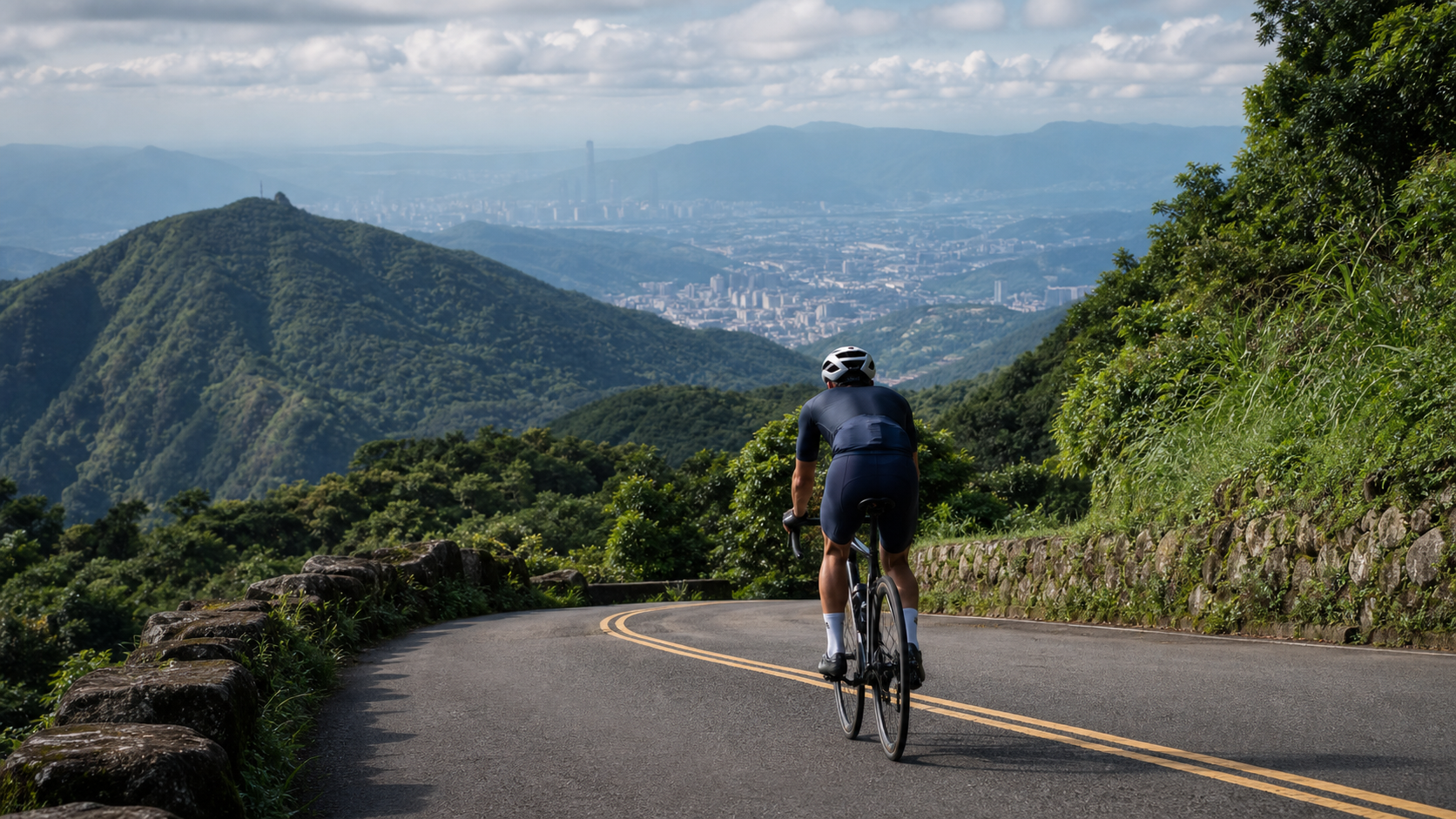
Zhongzheng Mountain was once called Mituo Mountain. A mountain with two names often conceals the traces of an entire era. Riding this 3.12-kilometer mountain road is not just a climb in elevation—it is also like flipping through a page of modern history on the edge of Taipei.
One Mountain, Two Names: The Story of Mituo and Zhongzheng
Zhongzheng Mountain, originally named Mituo Mountain, stands at approximately 646 meters above sea level and was renamed to its current designation in commemoration of the late President Chiang Kai-shek. This phenomenon of renaming places after political figures is not uncommon in Taiwan’s postwar toponymic history—many mountains, roads, and schools have undergone similar naming transitions. Interestingly, however, the old name “Mituo Mountain” has not completely disappeared. To this day, many local elders and hiking enthusiasts still habitually use this ancient appellation with its Buddhist connotations, as if reminding later generations that this mountain had stood silently on this land for countless generations long before it was given a new name.
The origin of the name Mituo Mountain is believed to be linked to past religious activities in the area—Buddhist sites such as Fayu Temple once existed around the mountain, which is why one of Zhongzheng Mountain’s trailhead routes is still called the “Fayu Temple Route” today. This interweaving of place names and religious landscapes is actually a common naming pattern for many suburban mountains in Taiwan. A single mountain often carries multiple cultural layers: indigenous-era appellations, religious imprints from the Han reclamation period, administrative divisions from the Japanese colonial era, and the overlay of postwar political symbols—Zhongzheng Mountain’s dual naming history is precisely a microcosm of this multi-layered toponymic memory.
From a geographical standpoint, Zhongzheng Mountain sits on the southwestern edge of Yangmingshan National Park, precisely in the transitional zone where Beitou District meets the Datun Mountain range. This location endows Zhongzheng Mountain with a special dual identity: it is both part of the natural ecosystem of Yangmingshan National Park, enjoying national park-level landscape protection, and at the same time closely adjacent to Taipei’s most active hot spring settlement—Beitou—keeping the mountain perpetually connected to urban life, never as remote and inaccessible as deep mountain peaks.
Seven Trailheads to Choose From: The Many Faces of One Mountain
Zhongzheng Mountain has seven different trailheads, and this feature alone is quite telling—why would a single mountain develop such a diverse array of access routes? The answer may lie in its tightly interwoven geographical relationship with surrounding settlements. The “First Trailhead” approached from the Zhuzihu direction features a relatively gentle gradient and is the top choice for families and hiking beginners; meanwhile, the route cutting in from Beitou’s urban area, with its steep terrain and solid gradient, has become a popular choice for road cyclists seeking climbing practice.
This multi-entrance characteristic reflects, to a certain extent, the different positions Zhongzheng Mountain holds in the minds of different user groups across different eras: for hikers, it is a trail system with complete infrastructure and diverse difficulty options; for road cyclists, it is a training segment that can be arranged at any time with solid climbing benefits; for local residents, it may simply be the backyard hill for daily strolls and fresh air. With seven different entrances, this mountain simultaneously serves these vastly different yet coexisting needs—this itself is a distinctly Taiwanese style of mountain-use culture: rather than emphasizing a single “correct route,” it allows everyone to find the path that suits them best.
When riding Zhongzheng Mountain, choosing which entrance to take also determines, to some extent, the character of the journey. Choosing the Zhuzihu direction means first passing through Yangmingshan’s famous calla lily and hydrangea fields, with scenic views and a leisurely atmosphere along the way; choosing the Beitou direction means first traversing the sulfur-scented, steam-filled hot spring area, carrying a dramatic sense of transition that cuts directly from the烟火 of human life into the tranquility of the mountains.
From Hot Springs to the Summit: The Riding Narrative from the Beitou End
If you choose to start from Beitou, the opening of this journey often carries a powerful sensory impact. As Taipei’s most famous hot spring settlement, Beitou’s air is perpetually tinged with a faint sulfur scent. The white steam rising from the Thermal Valley, the streetscape where old-style hot spring inns and modern spa hotels coexist—all of this forms a unique portrait of the urban fringe. Setting off from such a culturally rich hot spring town, pedaling steadily toward the mountain area, you can clearly feel the city’s clamor gradually falling behind while the mountain’s tranquility gradually envelops you.
Riding past the edge of Beitou’s urban area, the road begins to climb, buildings gradually thin out, and are replaced by layered hillside landscapes. The gradient changes along this stretch are themselves a narrative—as the body ascends in elevation, it gradually switches from an urban rhythm to a mountain rhythm, with breathing sounds replacing traffic noise and birdsong replacing engine sounds. The sustained climb at an average gradient of 7.5% makes this transition a solid physical experience—not the kind of gentle slope that can be brushed off lightly, but a genuine challenge requiring full concentration and a head-on battle against gravity.
As elevation continues to rise, the view gradually shifts from narrow streetscapes blocked by buildings to an expansive, far-reaching basin panorama. The Taipei Basin skyline appears intermittently through gaps in the trees, and the ridgeline silhouette of Guanyin Mountain in the distance becomes increasingly discernible—this visual reward of “the higher you climb, the farther you see” is precisely what makes mountain riding so captivating, and it is also the key psychological motivation that keeps the legs turning.
Summit Views: A Panoramic Feast of the Taipei Basin, Guanyin Mountain, and the Tamsui River
On the section near the summit of Zhongzheng Mountain, clear weather affords a magnificent view overlooking the entire Taipei Basin. The city’s skyline unfolds beneath your feet, with Taipei 101 and other landmark buildings appearing faintly in the distance; turning to look in another direction, the Tamsui River winds its way toward the estuary, its waters echoing the gently undulating ridgeline of Guanyin Mountain across the river, composing a landscape painting of interwoven motion and stillness.
Such views are rare among climbing routes in Taipei’s suburbs—most mountain routes this close to the city are limited by terrain or vegetation cover and struggle to offer such an expansive panoramic vista. That Zhongzheng Mountain can provide this visual reward is largely thanks to its geographical advantage of being situated on the southwestern edge of Yangmingshan National Park at a commanding elevation. Every time one stands at this viewpoint, it is a fresh realization that the Taipei Basin is a valley gently cradled by surrounding mountains, and that one is currently standing at the high point of this valley’s edge, reacquainting oneself with this familiar yet unfamiliar city from a perspective entirely different from daily life.
Weather conditions significantly affect the quality of this summit view. On clear, cloudless days, visibility is excellent, and one can even see details of the Keelung River and Shezi Island area in the distance; however, weather within Yangmingshan National Park changes rapidly, and fog or cloud cover is quite common—although this sacrifices the distant views, it brings another kind of misty, ethereal mountain atmosphere, as if immersed in an ink-wash painting, offering a charm of its own.
Green Maple, Charcoal Kilns, and the Trail System: Ecological and Cultural Layers on the Edge of Yangmingshan
The trail system around Zhongzheng Mountain, besides serving as a road cycling climbing route, is also a well-known hiking route with rich ecological and cultural landscapes along the way. The Green Maple Trail is one of its most representative sections—every autumn and winter when the maple leaves turn red, it attracts large numbers of hiking enthusiasts to enjoy the foliage, adding a touch of seasonally limited splendor to this mountain area. For road cyclists passing through, if time permits, it is worth pausing briefly along the way to experience this mountain scenery that transforms with the changing seasons.
Along the trail, a historically significant charcoal kiln relic is preserved, serving as an important testament to the area’s early industrial activities. In the era before electricity and gas were widespread, charcoal production was a vital economic activity and fuel source for mountain residents. This charcoal kiln silently tells of the lifestyles and industrial transformations that once existed on this land. If you take a few extra minutes to stop and learn about this history while riding through, it will make the entire Zhongzheng Mountain journey richer and more dimensional—not just a physical workout, but also a miniature journey into the industrial and living history of Taipei’s outskirts.
Seasonal Zhongzheng Mountain: The Changing Faces of the Mountain Through the Seasons
The scenery around Zhongzheng Mountain presents distinctly different faces as the seasons change. In spring, ink-stained cherry blossoms and other flowers bloom along certain sections of the road, adding a touch of romance to the climb; in summer, the lush green forests provide precious shade that offers some relief during the hot ascent; in autumn and winter, the maple leaves along the Qingfeng Trail turning red become the most iconic seasonal scenery of this mountain area, attracting countless visitors and cyclists who make special trips to see it; and when the northeast monsoon strengthens in winter, the mist-shrouded mountain takes on yet another kind of bleak, hazy beauty.
This distinct seasonal transformation makes Zhongzheng Mountain more than just a route you “climb once and you’re done”—it’s a route worth revisiting in different seasons, one where riders can discover different scenery and experiences each time. Beyond the solid gradient and well-proportioned distance that make it a staple in many Taipei cyclists’ regular training menus, the ever-changing seasonal scenery is also a major source of its appeal.
Suggested Side Trips: Beitou Hot Springs and the Zhuzihu Area
After completing the riding challenge of Zhongzheng Mountain, if you started from the Beitou direction, stopping for a hot spring soak on the way back is almost the most natural itinerary imaginable. Beitou’s hot springs have a long history, having been well-developed since the Japanese colonial era, with a wide variety of hot spring hotels and public baths to choose from. For legs that have just finished an intense climbing workout, the soothing effects of a hot spring are an excellent way to recover.
If you choose to approach or finish from the Zhuzihu direction, the surrounding calla lily fields and hydrangea fields (depending on the season) offer another leisurely side-trip option—perfect for winding down after a ride and appreciating the pastoral scenery unique to this highland vegetable and flower-producing area at a more relaxed pace. There are also plenty of restaurants serving local cuisine around Zhuzihu, making it an ideal spot to refuel and enjoy a good meal after riding.
A First-Person Memory of a Solo Dawn Ride
It was an early morning on a weekday, just as dawn was breaking. I set off on my bike from my place near Beitou MRT Station. The streets still carried the lingering chill of the night, breakfast shops were just beginning their day’s business, and the air was filled with the mixed aroma of egg pancakes and soy milk. Pedaling through the streets of Beitou, I could soon catch that familiar smell of sulfur—the steam from the Thermal Valley generously releasing itself into the surrounding air even in the early morning. This is Beitou’s unique olfactory memory, and every time I ride through here, it’s the scent signal reminding me that “I’m approaching the mountains.”
After leaving the hot spring district, the road began a gentle climb, with the buildings on either side gradually transitioning from continuous row houses to scattered mountain dwellings, and before long, the asphalt road was flanked by layers upon layers of forest. This transition doesn’t take long—perhaps just a kilometer or two—yet it makes you keenly aware that you’re shifting from the city’s rhythm into the mountain’s pace, as if even your breathing slows down in response to the changing surroundings.
As the gradient steepened, the familiar ache and burn began to creep into my legs. The mountain air in the early morning still carried the dampness of undried dew, and occasionally I could see water droplets condensed on spider webs glistening in the morning light. This kind of riding experience, surrounded by natural details, is something city roads can never offer—no traffic lights interrupting, no traffic disturbances, only the relentless gradient and a steadily rising heartbeat forming the most authentic rhythm of this journey.
On the section approaching the summit, the morning light finally broke fully through the clouds, spilling across the basin below. I stopped, looked back at the road I had climbed, and the entire Taipei Basin unfolded beneath me. The city had not yet fully awakened; traffic was sparse, and the skyline glowed with a faint golden halo in the morning light. At that moment, all the fatigue accumulated during the climb seemed to dissolve into the vastness of the view, leaving behind only pure satisfaction and tranquility.
Zhongzheng Mountain and the Collective Memory of Taipei Cyclists
For many cyclists who have ridden in Taipei for years, Zhongzheng Mountain is no longer just a training route—it has become something of a vessel for collective memory. How many holiday mornings have seen riding buddies gather in Beitou to take on this familiar climb together? How many post-work evenings have been spent riding up this road alone, using the rhythm of the pedals to digest the stress of a full day’s work? These repeated visits and accumulated riding memories have gradually transformed Zhongzheng Mountain from a mere geographical name into a symbol of emotional connection.
Among Taipei cyclists, countless “urban legends” about Zhongzheng Mountain circulate—who has set a new personal best time, which entrance has the most soul-crushing gradient, and where exactly the best viewpoint at the summit is hiding around which corner. These seemingly trivial topics of casual conversation among riders are precisely what has kept this route at the heart of the cycling community for so many years. Zhongzheng Mountain is not just a mountain; it is a shared landscape of collective memory owned by Taipei’s cycling community.
It is precisely because of this long-accumulated emotional connection that many veteran riders, even after conquering Zhongzheng Mountain countless times, are still willing to return to this route again and again. Each ride layers on top of all the memories of past rides, while also recording the subtle differences in one’s physical condition and state of mind—this is the most precious gift a “familiar route” can give a rider: through repeated visits, you come to see the changes in yourself over time.
A Landscape Dialogue with Other Famous Yangmingshan Routes
Although Zhongzheng Mountain is already a complete and rich route in its own right, if you broaden your perspective to the entire landscape of Yangmingshan National Park, you’ll discover that it maintains a subtle dialogue with the other famous routes in the area. Yangjin Highway is known for its long, gentle slopes and sulfur valley landscapes, making it a popular entry-level choice for cyclists looking to tackle long-distance climbs; Balaka Road is renowned for its sweeping silver grass vistas and cool high-altitude climate, making it a popular summer destination for escaping the heat. In contrast, Zhongzheng Mountain stands out with its short distance and high average gradient, playing the role of a “quick, high-efficiency training station” within the broader Yangmingshan road network.
This diversity within the landscape system makes Yangmingshan National Park almost like a natural training ground that Taipei cyclists can visit at any time—whether you want to challenge long-distance endurance or short, high-intensity intervals, you can find a corresponding route in this mountain area. The reason Zhongzheng Mountain has risen above the many options to become a top choice is precisely because it fills the gap in the training demand for “short time, high efficiency, and convenient access.”
Zhongzheng Mountain After Rain: Another Kind of Moist Poetry
Not every visit to Zhongzheng Mountain happens under ideal, cloudless skies. Once, on an afternoon just after a light rain had stopped, I decided to take on this familiar route. I hesitated at first, wondering whether to cancel the ride, but in the end, I was drawn by that distinctive post-rain mountain air and decided to head out and see for myself.
The wet asphalt glistened with a moist sheen, and the air was filled with the fresh scent unique to rain-washed soil and vegetation—a smell known as “petrichor,” the most captivating yet hardest-to-describe olfactory memory of the mountains after rain. Water droplets still clung to the leaves, and every now and then a mountain breeze would send fine droplets scattering onto me, bringing a refreshing coolness.
The slippery road surface made handling slightly more demanding, requiring more careful control of body weight and pedaling force to avoid the rear wheel slipping. But it was precisely this slightly challenging weather condition that gave the entire ride a tension and focus completely different from a sunny day. The summit, still wrapped in lingering mist, was shrouded in a hazy white veil. While the view was not as vast and clear as on a sunny day, it possessed a freehand-ink-painting quality, as if riding into a flowing landscape scroll.
On the section approaching the summit, sunlight occasionally broke through gaps in the clouds, casting light onto the wet road surface and leaves, refracting into countless glistening points. This play of light and shadow was a scene that a sunny-day ride could never replicate. At that moment, I suddenly understood why so many veteran riders say that visiting the same route under different weather conditions often brings completely different feelings and insights—Zhongzheng Mountain has never been a route with just a single face. Depending on the weather, the season, and the hour, it reveals to every visitor a unique landscape belonging to that very moment.
To the Next Rider Who Climbs This Road
Whether you’re preparing to take on Zhongzheng Mountain for the first time, or you’ve already visited this familiar climb countless times, I hope this article adds a different perspective to your journey. This mountain carries not just the challenge of a 7.5% average gradient, but a rich story woven from place-name changes, urban boundaries, the changing seasons, and the collective memories of countless cyclists.
The next time you pedal up this slope, try slowing down a little. Notice when the maple trees along the roadside begin to turn red. Notice when the sulfur scent of the Beitou hot spring district gradually gives way to the fresh fragrance of mountain vegetation. Notice how the panoramic view of the Taipei Basin changes its play of light and shadow at different hours. These details may never appear in any training data report, but they are precisely what makes a route truly take root in the heart.
Another Side of Zhongzheng Mountain at Dusk
If Zhongzheng Mountain in the early morning carries a crisp, poised-for-action character, then visiting this route at dusk reveals a distinctly gentler face. Setting out after work before the sun fully sets, the sky gradually takes on an orange-red hue as you climb through Beitou’s streets. The last rays of sunlight spill across the slopes and treetops, creating a layering of light and shadow with an almost oil-painting texture.
During the evening hours, visitors and fellow cyclists on Zhongzheng Mountain are relatively scarce, and the entire mountain road often feels exceptionally quiet—only your own breathing and the sound of the chain turning accompany you upward as the sun sinks westward. When you reach the open sections with expansive views, if the timing is right, you can witness the entire Taipei Basin being bathed in a magnificent golden-orange glow—the city’s countless lights beginning to flicker on one by one, interweaving with the lingering twilight on the horizon, composing an extraordinarily moving urban dusk tableau.
This experience of riding at dusk, in a way, echoes the real-life rhythm of many Taipei commuter cyclists—after finishing a full day of work, using a short yet solid climbing session to revive the body from the fatigue of desk-bound labor, then descending slowly with the sunset’s afterglow, returning to the everyday orbit of the city. The reason Zhongzheng Mountain has been able to sustain such a stable cycling community base for years goes beyond its training value and cultural scenery—this geographic convenience that allows it to seamlessly integrate into daily life rhythms is an equally important factor that cannot be overlooked.
Conclusion: A Gift of Mountain Forest at the City’s Edge
With the historical layers carried by its two names, the diverse usage patterns connected by its seven entry points, and the expansive view of the Taipei Basin from its summit, Zhongzheng Mountain proves that even a short climbing route so close to the city can still bear rich cultural depth and natural charm. For Taipei cyclists, Zhongzheng Mountain is not just a conveniently arranged training route—it is more like an old friend who can be visited at any time. Every time you pedal up this familiar slope, beyond the solid physical challenge, you can rediscover the different expressions of this mountain forest at the city’s edge. The next time you’re looking for a route that combines training value with cultural scenery, consider adding Zhongzheng Mountain back to your itinerary.
Related Reading
- Zhongzheng Mountain Practical Guide: Data Analysis and Pacing Strategies for the 3.12km Yangmingshan Climbing Route
- Rolling Hills in the Aroma of Coffee: A Cyclist’s Private Memories of Dongshan Coffee Road
- Three Kilometers of Guanzihlin: A Short Ride Chronicle of Tucheng’s Foothills and Breathing
- Riding into Taichung’s Backyard: The Mountain Forest, Fireflies, and a Cup of Coffee’s Warmth at Dakeng Zhongzheng Campground
爬坡ITT實境)台中 魔王 松鼠坡 首航 6:12 大肚山 大三元 科福路
8 年前
台北闊瀨陡坡 騎旅 / 日本單車雜誌編輯車友臨時加入!/ 髮香才是最強的 / feat. 北迴歸線小隊 / 公路車 CT Yeh
6 個月前
東進武嶺 空拍 自肥到分手篇
8 年前
#北橫 + #北進武嶺 最硬的員工旅遊 EP1 | #公路車 #拉拉山 | 明池 | 武嶺 | 武陵農場 | 雲海 | Taiwan Cycling Route Wulin
6 年前
一定要騎一次!阿里山最深處:里佳部落!單車旅行 | 2800m爬升 | 深度部落體驗:嗨翻晚會、螢火蟲、銀河 | feat. JJSC & 廢物伙伴 | 公路車 CT Yeh
9 個月前
藤枝二集團 單車行 Day1 | 南部小武嶺 | 爬坡爬到罵罵叫 | JJSC | 公路車 | CT Yeh
3 年前
台北大雁西飛 約騎挑戰 feat. Doris | 公路車 | CT Yeh
3 年前
大武山後門26%歡樂陡坡!JJSC南台灣單車行Day2 / 被颱風追著跑 / 公路車 / CT Yeh
2 年前