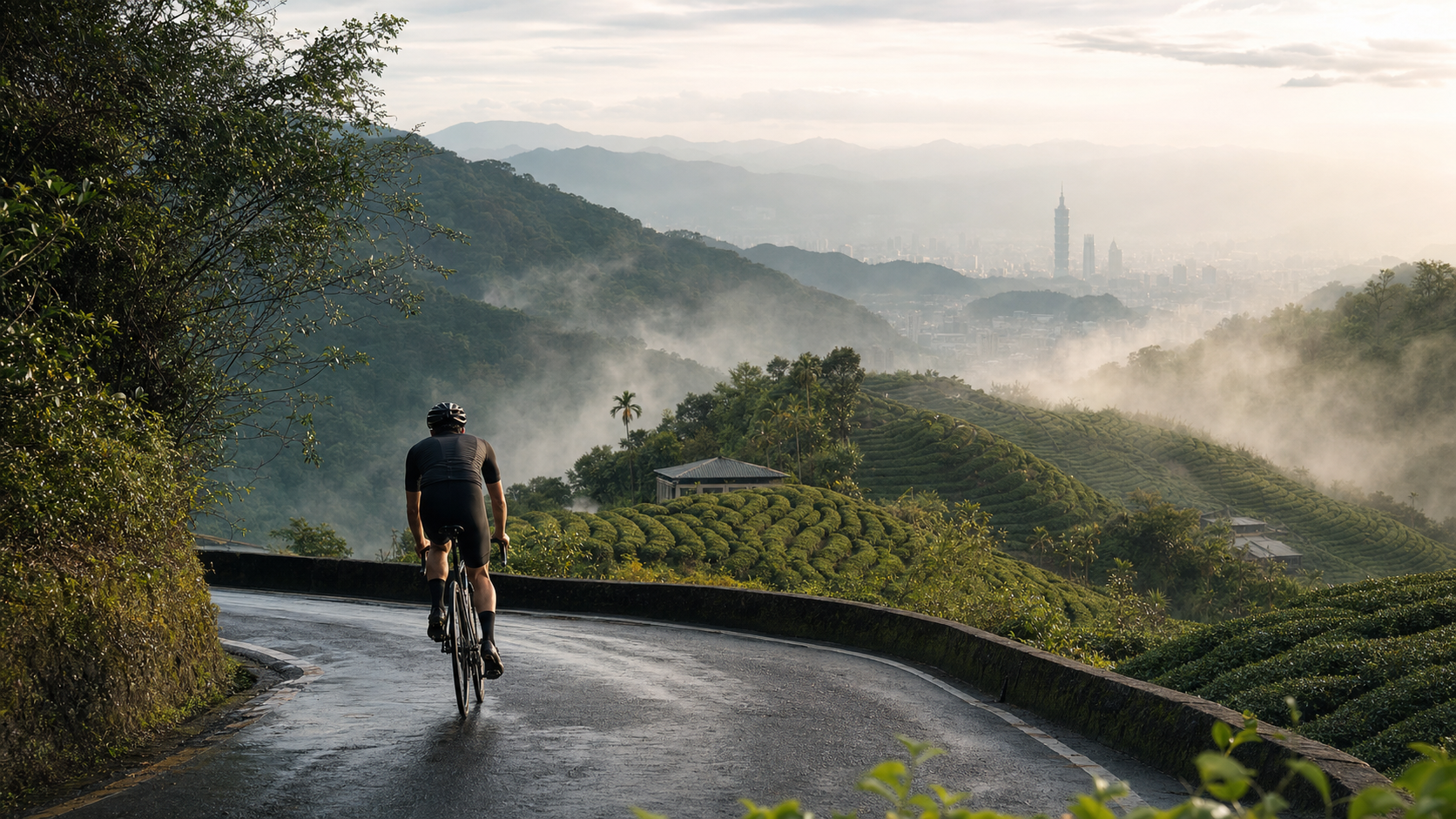
The lights of Taipei 101, the slow ascent of the gondola, and tea gardens sprawling across the hillsides—Maokong is one of the few places in this city where you can feel like you’ve stepped into “another world” within a half-hour ride. And Zhanghu Yue Ling is the route through which I’ve come to know Maokong most deeply.
1. Maokong, a Tea Mountain Hidden on the Edge of Taipei
For many visitors from outside Taipei, their first impression of Maokong comes from the Maokong Gondola—the aerial cable car that departs from the Taipei Zoo station and climbs slowly through the valley, with passengers watching the shrinking cityscape of Taipei below before finally arriving at the tea-growing area on the mountaintop. For tourists, Maokong is a romantic aerial journey; but for cyclists familiar with this mountain area, there’s another way to experience Maokong—using your own legs, pedal by pedal, to “ride” yourself up this tea mountain.
Maokong is located in Wenshan District, Taipei, right behind National Chengchi University. This mountain area has been renowned for growing Tieguanyin and Baozhong tea since the Qing Dynasty, and remains one of the few areas in the greater Taipei region that still preserves a complete tea-garden landscape. As for “Zhanghu,” it’s a poetic place name in the mountains surrounding Maokong. According to stories passed down by local elders, this area was once covered with vast camphor forests, hence the name. Although the camphor forests are no longer as extensive as they once were, this place name remains one of the important landmarks on the Maokong tea-area map.
The first time I rode the Zhanghu Yue Ling route, I was led by a veteran local cycling companion. He told me: “The beauty of Maokong isn’t on the gondola—you only see it when you pedal up yourself.” I was still half-doubting at the time, but it wasn’t until I actually rode into these tea-garden mountain paths that I understood the weight of those words.
2. A 4.17-Kilometer Mountain Road Holding the Breath of the Entire Tea Mountain
Zhanghu Yue Ling stretches 4.17 kilometers in total with an average gradient of 6.2%. The numbers don’t look particularly daunting, but when you’re actually riding it, you’ll find the rhythm of this road is quite unique—it’s not straight and monotonous like urban roads, but winds and undulates with the terrain. At every turn, the scenery before you shifts subtly. It starts as industrial-access roads interspersed among tea gardens, but as you keep riding, the flanks gradually become enveloped by denser vegetation, and the air begins to carry a faint aroma of tea blended with the moist breath of the forest.
The tea gardens of Maokong are mostly carved into the hillsides as tiered terraces—a landscape that is itself the most captivating scenery along the ride. On early-morning visits, you’ll often see tea farmers already busy in their fields, their bent figures picking leaves set against layers of verdant tea bushes, forming a scene quintessentially characteristic of Taiwan’s mountain regions. I often find myself stopping mid-ride to watch the farmers’ practiced hand movements, thinking to myself that on this land, the rhythm of agriculture and the rhythm of sport actually share the same faith in patience and perseverance.
In the middle section of the Zhanghu Yue Ling route, the terrain alternates between climbs and descents. This distinctive topographical rhythm of a “mountain crossing” adds a sense of exploration to the riding experience—you’re never quite sure whether the next turn will bring another climb or a brief chance to catch your breath. This uncertainty, in a way, echoes the overall feeling this mountain area gives you: it’s not a tourist thoroughfare planned out in neat squares, but a living road that preserves the original texture of a mountain settlement.
3. Mist, Gondolas, and the Moment of Gazing at Taipei 101 in the Distance
The most unforgettable visual memory of Maokong is undoubtedly the mist-shrouded mountain scenery. This mountain area has moderate elevation, and being adjacent to the Taipei Basin, it’s easily influenced by the northeast monsoon in autumn and winter, creating dreamlike scenes of clouds and fog blanketing the tea gardens. I’ve visited on several early mornings, riding to the middle section of Zhanghu Yue Ling and looking back at the road I’d come from—the entire valley covered in thin mist, with only the rooftops of tea farms and treetops peeking through. That scene makes you instantly forget you’re in the middle of a physical workout; instead, it feels like stepping into a Chinese ink-wash painting.
The cabins of the Maokong Gondola occasionally appear at the edge of your view mid-ride, gliding slowly across the valley overhead. That sight always gives me a curious sense of contrast—the passengers in the gondola are comfortably seated, enjoying the scenery outside their windows, while I’m conquering the same terrain step by step with my own legs. Two completely different ways of experiencing the same mountain view—this contrast is a romance unique to Maokong.
On clear days, if visibility is good enough, looking back toward the Taipei city area from the higher sections of Zhanghu Yue Ling, you can faintly make out the silhouette of Taipei 101 standing at the other end of the basin. At that moment, you feel very keenly the distance between yourself and the city—not far, less than an hour’s ride away; yet it feels as if an entire world separates you, from the bustling urban center into this quiet tea mountain.
4. Tea Houses and Scenic Restaurants: Maokong’s Unique Post-Ride Ritual
As a tourist tea-growing area, one of Maokong’s greatest features is the abundance of tea houses and scenic restaurants scattered along the route and its surroundings—a resource that few other mountain routes in the Taipei suburbs can offer. Almost every time I finish riding Zhanghu Yue Ling, I make it a point to schedule a “post-ride tea ceremony”—finding a tea house with a wide view, ordering a pot of locally grown Tieguanyin or Baozhong tea, sitting in the open-air seating, watching the Taipei city skyline below, and letting my body gradually shift from the high-intensity climbing state back into a relaxed, leisurely rhythm.
This combination of “exercise plus slow living” is the biggest difference between Maokong and other climbing routes known purely for their gradients and distances. You don’t need to rush back down as soon as you finish; instead, you can justifiably linger a while longer at the summit, chatting with the owner about this year’s tea harvest, or simply zoning out and watching the mist drift and change. This sense of spaciousness, in a way, echoes the “slow down” spirit inherent in tea culture itself—brewing tea is all about patience and savoring, and this mountain area of Maokong seems to remind every visitor through its winding, undulating roads: don’t rush, ride slowly, look slowly.
The memory that stands out most to me is an autumn evening when, after riding Zhanghu Yue Ling, I stopped at a long-established tea house to rest. The owner brewed tea while telling me about the changes Maokong has undergone over the past few decades—from its early days as a simple agricultural settlement, to the influx of tourists after the gondola opened, to the recent return of many young-generation tea farmers attempting to combine traditional tea-making craftsmanship with modern marketing. Listening to these stories, sipping the freshly brewed tea still carrying the aroma of roasting, watching the sky darken outside the window as the mountain lights flickered on one by one—that sense of tranquility and contentment is an added value of riding that’s hard to appreciate when you’re purely chasing pace and heart-rate data.
5. Maokong Through the Four Seasons: When Is the Best Time to Visit
The beauty of Maokong takes on completely different faces with each season, and it’s worth planning your visit according to the experience you’re after.
Spring—the tea gardens burst with fresh buds, the mountainsides covered in tender green. It’s one of the busiest tea-picking seasons, and riding past the gardens you’ll often see farmers rushing to harvest the spring tea. The air carries a subtle, elusive tea fragrance. This is my personal favorite time to visit.
Summer—although the Maokong mountain area is somewhat cooler than the city, afternoon convective showers are still the norm. An early-morning visit is recommended, both to avoid the muggy heat and to enjoy the sight of morning light spilling across the tea gardens. In the early evening of summer, if weather permits, it’s also an excellent time to watch the sunset and the city lights of Taipei beginning to glow.
Autumn and Winter—this is the most enchanting season for Maokong’s mist and cloud scenery. The moisture brought by the northeast monsoon easily creates interwoven scenes of cloud seas and thick fog in the mountains, making this the season that photography enthusiasts and cyclists alike are especially drawn to. However, do note that the damp, cold weather combined with heavy fog can reduce visibility—be sure to slow down when riding, and carry warm clothing to cope with the temperature difference between the mountains and the city.
No matter which season you visit, Maokong always has scenery unique to that time of year waiting for you. That’s why so many Taipei cyclists, even after riding Zhanghu Yue Ling countless times, are still willing to return to this tea mountain again and again.
6. Suggested Side Trips: Fitting Maokong into a Full-Day Itinerary
If you treat Zhanghu Yue Ling purely as a training route, the round trip can be completed in under an hour. But this mountain area of Maokong deserves a more complete day-trip plan. Besides Zhanghu Yue Ling, there are numerous tea-garden trails and observation platforms around Maokong, perfect for exploring on foot after your ride. The area around the Maokong Gondola station also has markets and souvenir shops where you can pick up some local tea products to take home as mementos of your cycling journey.
If your energy and schedule allow, you might also consider linking Maokong with the nearby Zhinan Temple and the NCCU campus into a more complete route, extending the riding experience from pure mountain training into a richer exploration of cultural and religious landmarks. Zhinan Temple, as a well-known Taoist temple in Taipei, is built into the mountainside with an imposing architectural presence. Even if you’re not visiting for religious purposes, it’s well worth a stop simply to appreciate its architecture and setting.
7. Final Thoughts: What Zhanghu Ridge Taught Me
Looking back on the riding memories I’ve accumulated on the Zhakao Zhanghu Ridge over the years, I’ve gradually come to understand that the true value of this route lies not just in the physical training effect of its 4.17 km length and 6.2% average gradient, but in the entire tea-hill culture it connects—the perseverance of generations of tea farmers, the slow-flowing time in the tea houses, and the indescribable serenity amid the swirling clouds and mist.
Every time I ride this stretch, I remind myself not to stare only at the numbers on the bike computer, but to look up, take in the tea gardens on both sides, smell the tea fragrance in the air, and feel the temperature changes as the wind moves through the valley. These details are what Zhakao truly wants to teach every visitor—that sport is not just about conquering numbers, but can also be a way of engaging in dialogue with the land and its culture.
If you haven’t ridden Zhakao Zhanghu Ridge yet, I sincerely suggest finding a misty morning, or an afternoon filled with tea fragrance, and experiencing for yourself what this route has to offer. After the ride, don’t rush off—find a tea house, sit down, and brew a pot of local tea. You’ll understand why so many Taipei cyclists, even though they live in the city, still regard Zhakao as their most treasured backyard garden.
8. A Conversation with a Tea Farmer: The Perseverance Behind a Cup of Tea
Once, midway up the Zhanghu Ridge section, I encountered an elderly man weeding in a tea garden. Curious, I struck up a conversation and learned that he had been growing tea in these hills for over forty years. He told me that tea cultivation in Zhakao can be traced back to the Qing Dynasty, when early settlers brought tea seedlings from Anxi in Fujian. Through generations of hard work and the passing down of techniques, the unique flavors of Zhakao’s Tieguanyin and Baozhong teas gradually developed. As he pulled weeds, he lamented that over the past few decades, with urbanization and the outflow of young people, fewer and fewer are willing to stay and continue growing tea. Maintaining the tea gardens at their current scale, he said, has not been easy.
Listening to his account, I looked at the terraced tea bushes before me and suddenly gained an entirely new understanding of “a cup of tea.” In the past, when I visited Zhakao, I always focused on the gradient and scenery of the ride, rarely stopping to truly consider how much effort and perseverance from generations of people lay behind this lush green tea garden. The old man said that tea farming is a trade that depends on the sky—weather, rain, and sunlight, every single factor can affect an entire year’s harvest. And with fewer young people willing to enter this industry, he treasures every traveler who stops to listen to his stories, even just a passing cyclist like me.
Before I left that day, the old man insisted on brewing a pot of freshly harvested tea for me to try. As the tea touched my lips, it carried a subtle floral aroma with a sweet aftertaste—a flavor that no beautifully packaged commercial tea could ever replicate. Because that cup of tea held not just the flavor of the leaves themselves, but also the old man’s forty years of dedication and affection for this land. Since that encounter, every time I ride Zhanghu Ridge, I make a point to pay attention to the tea farmers working by the roadside. If time permits, I always stop to say hello and listen to their stories. These conversations have gradually become the part of visiting Zhakao that I treasure most, even surpassing the physical sense of accomplishment from the ride itself.
9. Zhakao After Rain: Another Kind of Moist, Profound Beauty
Most descriptions of Zhakao’s scenery focus on the clouds and distant views under clear skies, but I’d especially like to share an experience of visiting after rain. It was an afternoon right after the plum rain season had ended; the hills were still heavy with moisture. I hesitated about whether to set out, but ultimately decided to ride up Zhanghu Ridge to see what the tea hills would look like after the rain.
Riding into the mountain path, I discovered that Zhakao after rain possesses a distinctly different kind of beauty—crystal water droplets still clung to the tea leaves, sparkling with fine glimmers as afternoon sunlight broke through gaps in the clouds; the air was filled with the unique moist scent of rain-washed soil and vegetation, mingled with the freshness of tea leaves, forming an indescribably complex aroma. The road surface was still somewhat slippery, requiring extra caution in controlling speed, but the visual and olfactory experience along the way was a layer entirely absent on clear-day visits.
Reaching the higher sections of the Zhanghu Ridge route, the clouds had not yet fully dispersed, and a thin veil of moisture still lingered in the valley, obscuring the distant city skyline in glimpses. That hazy quality made the entire tea hill seem draped in a thin gauze, adding even more poetry than a cloudless clear day. I found a relatively open spot by the roadside and paused for a while, quietly watching the clouds drift slowly through the valley. In that moment, I suddenly understood why so many photography enthusiasts are willing to make the trip up the mountain in cold, wet weather—just to capture that fleeting beauty of swirling clouds and mist.
Of course, riding after rain demands extra attention to safety. Wet surfaces and accumulated fallen leaves increase the risk of slipping, so it’s advisable to reduce speed and increase braking distance. If the rain hasn’t fully stopped, it’s better to postpone the ride than to take risks on the road. But if you time it well, Zhakao in the clearing after rain is absolutely worth a dedicated visit.
10. The Human Warmth Around Maokong Gondola Station
Near the end of the Zhanghu Ridge section, close to Maokong Gondola Station, beyond the bustling scene of tourists coming and going, there are actually many traces of local life hidden here. I know an auntie who runs a small food stall near the gondola station. Her stall serves simple home-style dishes and freshly cooked noodles at affordable prices, making it a well-kept favorite among local residents and cyclists familiar with these hills. Every time I finish riding Zhanghu Ridge and feel hungry, I often stop by her stall, order a steaming bowl of noodles, and pair it with her homemade pickled vegetables. That unpretentious yet sincere flavor always quickly restores my energy after I’ve pushed my body to its limits.
The auntie told me she has been running her stall here for over twenty years, witnessing Zhakao’s transformation from a relatively quiet tea-growing area into a bustling tourist hotspot after the gondola began operation. She said that although there are more visitors now and business is better than before, she still misses the earlier days when it was more peaceful and everyone knew each other. This complex feeling among locals—grateful for tourism development yet nostalgic for the past—can be felt around many tourist attractions in Taiwan, and Zhakao is certainly no exception.
These seemingly trivial human interactions, accumulated over time, form the deepest emotional connection I have with the Zhakao hills. It is no longer just a spot on the map labeled “famous tea region” and “cycling route,” but a place that carries the life stories of countless local people—a place worth returning to again and again, and experiencing with an open heart.
11. For First-Time Riders of Zhakao Zhanghu Ridge
If this is your first time planning to take on Zhakao Zhanghu Ridge, I’d like to offer a few sincere suggestions. First, don’t treat it merely as a physical challenge to be “completed.” Try to slow down, pay attention to the tea garden scenery along the way, smell the tea fragrance in the air, and even chat with the tea farmers and shopkeepers by the roadside. These details will make your riding experience far richer and more dimensional. Second, when planning your itinerary, be sure to set aside time after the ride to linger—whether it’s finding a tea house to savor some tea or browsing the market stalls around the gondola station. This hillside deserves more of your time to explore slowly, rather than rushing back the moment you finish.
Finally, approach this route with an open heart—Zhakao Zhanghu Ridge is not just a 4.17 km training stretch with a 6.2% average gradient; it’s a window into the tea culture and local life of Taipei’s mountain region. May you, like me, find your own rhythm and moments of inspiration on this road.
12. A Solo Ride on a Late Autumn Afternoon: A Moment of Dialogue with Myself
Beyond riding alongside my team members or striking up chance conversations with local residents, I also deeply cherish the times I visit Maokong alone. One late autumn afternoon, when the weather was slightly cool, I rode up the Zhanghu Ridge Crossing by myself with no set itinerary—just a simple desire to find a place to be still. During that period, I was facing some pressure and difficult decisions at work, and my mind was in a whirl of tangled thoughts. So I chose to ride, letting physical exhaustion dilute the anxiety in my heart.
As I pedaled along the winding mountain paths between tea plantations, the gradient gradually steepened and my breathing grew more rapid. That genuine physical soreness and gasping for air, paradoxically, pulled me away from the worries circling endlessly in my head. Climbing is, in itself, a form of forced focus—you have no spare mental energy for anything else; all your attention is compelled onto the road ahead, the rhythm of your breathing, and the distribution of power through your legs. When I reached a higher point on the Zhanghu Ridge Crossing, I stopped at a roadside clearing with an open view. Watching the clouds and mist drift slowly through the valley, and the faint, elusive skyline of Taipei in the distance, a long-missed sense of calm suddenly settled over me in that moment.
I often think that the reason Maokong can draw Taipei residents back again and again might not just be its tea fragrance and scenic beauty, but also because this mountain area offers a rare opportunity for “pausing” that urban life so desperately lacks—a reason to put down your phone, set aside work messages, and simply let your body experience the gradient, the breathing, and the scenery. For me, the Zhanghu Ridge Crossing route has long surpassed its meaning as a mere exercise route; it is a sanctuary for the soul that I instinctively gravitate toward whenever my spirits are low or my thoughts are in disarray.
If you, too, are going through some indescribable stress and troubles in life, why not try what I did—pick an ordinary afternoon, ride this road alone, and let the fatigue of your body temporarily lift the weight from your heart. You’ll discover that this mountain area of Maokong knows far better than you imagine how to soothe the mind of a weary city dweller.
Related Reading
- Maokong Zhanghu Ridge Crossing Practical Guide: 4.17 km at 6.2% Average Grade, a Complete Breakdown of the Tea District Climb
- Sanxia Xiongkong Ridge Crossing: Three Kilometers, Yet the Closest I’ve Ever Been to the Mountains
- Taipei Muzha, Shenkeng, Maokong Triangle Route: The Perfect Combination of Suburban Climbing and Coffee Refueling
- Riding into Tea Mountains and Immortal Traces: Maokong Zhinan Temple, a Cycling Road Written with 140 Years of Incense and Tea Fragrance
台北闊瀨陡坡 騎旅 / 日本單車雜誌編輯車友臨時加入!/ 髮香才是最強的 / feat. 北迴歸線小隊 / 公路車 CT Yeh
6 個月前
觀霧 變好騎了! | 北高車友爆笑大會師 | 公路車 | 單車旅遊 Taiwan Cycling Route GuanWu
6 年前
嘉義大埔、阿婆灣挑戰賽,美到以為在日本!ft. 環騎5 Cool 西拉雅188 / 公路車 / CT Yeh
7 個月前
爬坡ITT實境)台中 魔王 松鼠坡 首航 6:12 大肚山 大三元 科福路
8 年前
高雄綠園道鐵路自行車道 / 外地人能輕鬆駕馭 還是整路崩潰? / 2025 全線開通 春節實地探索一次!(附GPS連結)/ 公路車 / CT Yeh
1 年前
#北橫 + #北進武嶺 最硬的員工旅遊 EP1 | #公路車 #拉拉山 | 明池 | 武嶺 | 武陵農場 | 雲海 | Taiwan Cycling Route Wulin
6 年前
新竹羅平 x 天湖部落 大禹嶺級變態陡坡! 4K超高畫質 空拍 | 公路車
5 年前
大武山後門26%歡樂陡坡!JJSC南台灣單車行Day2 / 被颱風追著跑 / 公路車 / CT Yeh
2 年前