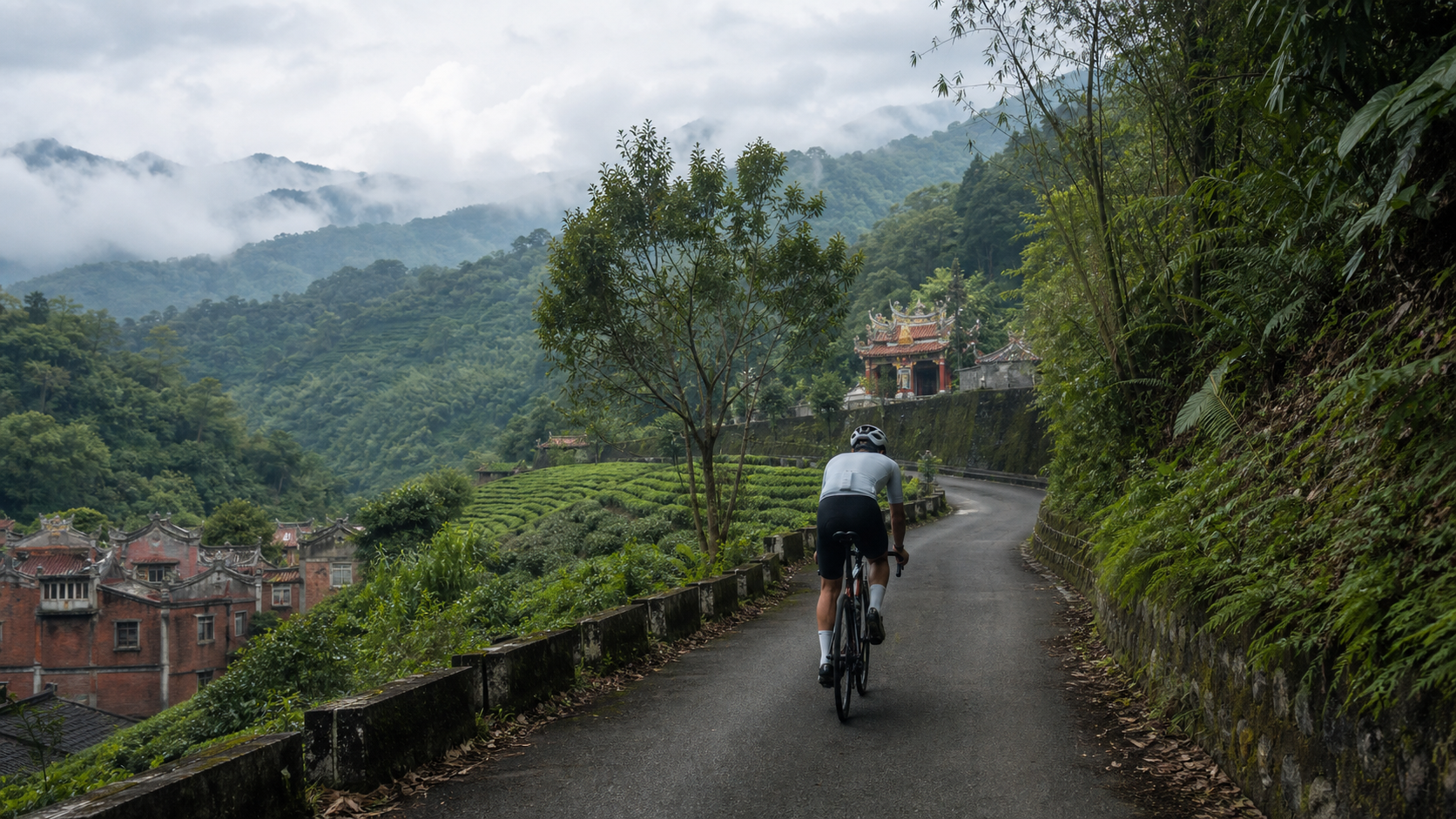
1. Sanxia, Where Mountains and Waters Meet
Speaking of Sanxia, the name alone already reveals its geographical character. Sanxia was formerly known as “Sanjiaoyong” (Triangular Surge), precisely because the Dahan River, Sanxia River, and Heng Creek converge here, forming a triangular alluvial terrain. This geographical condition has made Sanxia a transit hub between mountain produce and plains markets since ancient times—tea leaves were transported down from the mountains, dyeing materials were brought in from elsewhere, and people and goods were exchanged here, also settling into a character of their own.
I often feel that to understand a place’s cycling routes, one must first understand the place’s skeleton. Sanxia’s skeleton is half the red-brick arcades of the old street, and half the layered hills and mountains that surround it. The old street, Qingshui Zushi Temple, and indigo dyeing culture in the urban area are all familiar impressions of Sanxia to tourists; but once you get on a bike and head into the mountains, you’ll see another Sanxia—the mountainous Sanxia that once thrived on tea cultivation, took shape as a settlement through the dyeing industry, and now quietly scatters places of faith both large and small.
What this journal records is precisely such a route hidden in the Sanxia mountains: the one leading to Li Shan Shrine. The distance is not long, just over 6.3 kilometers, but the feeling of riding it far exceeds what the numbers can express.
2. The Transition from Urban Bustle to Mountain Trail Silence
The day of departure was an ordinary Taiwanese afternoon, the sky carrying a grayish white that hinted at impending rain but hadn’t yet committed. Setting off from downtown Sanxia, passing the familiar red-brick facades around the old street and shops selling ox horn pastries and pork skin jelly, the asphalt under the wheels still carried the bustling atmosphere of the market—scooter horns, vendors’ calls, tourists’ chatter—forming a kind of ambient noise that belongs to the old street.
But just turn a corner and head toward the mountains, and this clamor fades with astonishing speed. The asphalt narrows, and the buildings on both sides are gradually replaced by betel nut palms, acacia trees, and the occasional tea plantation. The smell in the air changes too—from the braised and fried aromas of the old street, slowly shifting to the scent of damp soil and vegetation. This sense of transition is what fascinates me most every time I ride into the Sanxia mountains: just a few minutes of riding, yet it feels like crossing between two eras.
The Sanxia mountains have been inseparable from tea since ancient times. From the Qing Dynasty through the Japanese colonial period, the hilly terrain of the Sanxia area, suited to tea plant growth and combined with a humid climate, made it one of northern Taiwan’s important tea-producing regions—Longjing tea and Baozhong tea both once grew on these slopes. As for the dyeing industry, particularly indigo dyeing, it used locally grown Strobilanthes cusia (Chinese indigo) as the dye material, paired with the abundant water of the Sanxia River for the dyeing process—this is why the Sanxia old street still preserves the legacy and experiential activities of indigo dyeing culture to this day. These industrial histories have shaped Sanxia’s distinctive texture of “industries in the mountains, faith connected to industry”—because the ancestors who lived off the mountains would always erect a small shrine or altar at key points along mountain trails and settlement entrances, praying for safe passage on the mountain roads and bountiful harvests.
3. Entering the Climb: A Dialogue Between Body and Will
Starting the ascent from the foot of the mountain, the gradient quickly gives the thigh muscles a clear signal. The route’s average gradient reaches 6.1%, which for the body is not the kind of gentle slope you can climb while chatting—it’s a climb that demands focused breathing rhythm and a serious conversation with yourself.
In the first few hundred meters of climbing, a familiar self-doubt always surfaces in the mind: “How much longer is this climb?” This is a psychological hurdle nearly every climbing enthusiast has experienced. But as the breathing gradually finds its rhythm and the heart rate stabilizes at a sustainable frequency, that anxiety slowly gives way to a more focused state—eyes fixed on the road texture ahead, ears listening to the subtle sounds of the chain and derailleur working, the body feeling every bit of feedback transmitted through the saddle and pedals.
Route estimates indicate the route is just over 6,300 meters in total length, with a vertical gain roughly estimated at around 380-plus meters (this figure is back-calculated from the average gradient and is not a precise measurement; please refer to your personal cycling computer for actual elevation gain). This density of climbing gives every kilometer substantial weight. Around one-third of the way up, the vegetation on both sides becomes denser, and sunlight filters through gaps in the leaves onto the asphalt, creating a dappled play of light and shadow—a visual language unique to Taiwan’s mountain roads: not grand panoramic vistas, but this fragmented, intimate layering that can only be felt by slowing down.
Midway through the climb, physical fatigue becomes clearly apparent. The psychological state at this moment is intriguing: on one hand, you know the end isn’t far; on the other, the soreness in your body reminds you “this isn’t over yet.” In moments like these, I often recall something a former coach once said: “Climbing is the most honest thing—it doesn’t deceive you. Whatever you put in, it returns to you in fatigue, and it also returns to you in a sense of accomplishment.” 6.3 kilometers isn’t long, but paired with this gradient, it’s indeed enough to make you feel that complex emotion mixing breathlessness and satisfaction upon reaching the end.
4. Li Shan Shrine: A Corner of Faith in the Mountains
As the gradient gradually eases and the view begins to open up, the location of Li Shan Shrine gradually comes into sight. Regarding the shrine’s exact founding date, the complete origins of the deity it enshrines, or its architectural details and historical evolution, I don’t have first-hand information I’m confident enough in to elaborate on here; for these details, I’d suggest readers interested in deeper understanding refer to on-site information or official announcements. But what I’d like to share is the emotional connection—indescribable yet genuinely felt—that arises when, as a cyclist, one catches sight of such a corner of faith in the mountains during a climb.
On Taiwan’s mountain roads, such corners of faith are actually not uncommon. Whether they’re Earth God temples, mountain deity altars, or slightly larger shrines, they tend to be situated at nodes where the gradient eases and the view opens up—as if the ancestors, when planning mountain trails, naturally chose these spots “worth stopping to catch one’s breath” as places to house their faith. This siting logic itself is full of wisdom: when you’re halfway up a climb, with both energy and willpower being worn down, catching sight of a temple’s eaves or red lanterns in the distance provides a visual signal that serves as a psychological anchor—“Almost there,” “There’s human presence here,” “You can rest a moment.”
Standing around Li Shan Shrine and looking back at the mountain road you’ve come up, that commanding view from above makes one re-understand “the meaning of climbing.” This isn’t just physical training, nor merely the accumulation of mileage numbers—it’s a way of physically “walking into” the historical fabric of a place. Throughout the Sanxia mountains, such corners of faith are scattered here and there. They may not have the thriving incense and throngs of tourists that Qingshui Zushi Temple enjoys, but precisely because of that, they preserve a tranquility closer to the essence of mountain life—a scenery that only local residents, cyclists, and those willing to expend the effort to climb this slope can personally experience.
5. Scenery Along the Way and Season-Limited Beauty
Although this route is short in distance, the natural landscape along the way is richly layered and changes noticeably with the seasons—which is also why Sanxia’s mountain routes are especially worth riding again and again.
Spring (March–April): The Sanxia mountains often feature misty, fog-wreathed mornings in spring, and the vegetation along some sections displays especially vivid greenery after rain—a great time for photography and enjoying fresh air. However, do watch out for slippery roads after spring showers.
Summer (June–September): Summer brings the densest, most luxuriant greenery to the Sanxia mountains, and the shade provided by trees is especially precious during climbs. At the same time, be mindful of the sudden afternoon thunderstorms typical of Taiwan’s summers; it’s advisable to schedule rides in the early morning or evening to avoid the hottest, most humid midday hours.
Autumn (October–November): Autumn weather in the Sanxia mountains is generally more stable with good visibility, making it the best season of the year for climbing high to take in panoramic views of the entire Sanxia basin. The slightly cool temperatures also make long climbs more comfortable.
Winter (December–February): Winter occasionally brings cloudy, misty scenery to the mountains, carrying a serene atmosphere reminiscent of an Eastern ink-wash painting. However, do pay attention to staying warm and the risk of slippery roads, especially in the early morning when dew or light fog can affect visibility.
No matter which season you visit, this route has its own unique expression—and this is what I find most charming about Taiwan’s short mountain routes: they don’t need grand alpine vistas to awe you, but instead use the subtle changes across the turning seasons to continually offer cyclists something fresh.
6. What This Route Means to Riders
After years of cycling, I’ve gradually come to realize that the “meaning” of a route often isn’t determined by its length or fame, but by whether it can offer riders a complete physical and mental experience within a limited riding time. The Li Mountain Temple route is precisely this kind of “small yet complete” representative.
Six point three kilometers—for many long-distance cycling enthusiasts, that might not even be enough for a warm-up. But if you place it within a more complete framework—departing from the bustle of the city streets, passing through the historical fabric of industrial transformation, enduring a solid climb that tests body and mind, and finally arriving at a quiet corner of faith—this is actually a condensed journey, a small-scale pilgrimage written with your legs.
For me, the significance of this route also lies in how it demonstrates a kind of “faraway place that’s right at your doorstep.” No need to drive all the way to the Central Cross-Island Highway or the Southern Cross-Island Highway, no need to plan multi-day long-distance rides—just by putting in an extra twenty to forty minutes of effort from Sanxia’s city center to ride into the mountains, you can reach a completely different world—a world of slow pace, of focus, of dialogue with your own body. This possibility of a “mini getaway” might be the most precious asset of Taiwan’s mountain route network: even in the densely populated New Taipei City, as long as you’re willing to get on your bike and head into the hills, a memorable journey could be hiding around any corner.
7. After the Descent: Exploring Sanxia’s Cultural Landscape
After completing this climbing challenge and descending slowly back to the city, I usually arrange a follow-up itinerary, converting the physical exertion of the ride into a more complete understanding of this land.
Sanxia Old Street: The red-brick arcade buildings are Sanxia’s most iconic historical landscape. These street-front facades, built during the Japanese colonial period, blend Baroque decorative styles with traditional Minnan construction techniques. Strolling through them feels like stepping into a time tunnel. The snack stalls and souvenir shops lining the old street are also great places to replenish calories and reward yourself after a ride.
Qingshui Zushi Temple: Also known as the “Oriental Art Palace,” the temple’s exquisite wood carvings, stone carvings, and cut-and-paste porcelain art rank among the finest examples of Taiwanese temple architecture. It is Sanxia’s most important center of faith, forming an interesting contrast with those quiet, small corners of faith in the mountains—one is a landmark temple with thriving incense and immense artistic value, the other consists of humble, unadorned corners scattered along mountain trails that equally carry the emotional weight of local religious devotion.
Indigo Dyeing Culture: Sanxia’s indigo dyeing industry originated from the once-thriving cultivation of Strobilanthes cusia and the cloth-dyeing process. Today, through the Sanxia Indigo Dyeing Park and related cultural experience venues, visitors can personally experience the joy of traditional fabric dyeing and appreciate this traditional craft that once sustained Sanxia’s economic lifeline.
Local Snacks: Golden ox-horn pastries, Sanjiaoyong tofu pudding, and Muzi Sheng Ren Dan are all local specialties—great choices for recovering your strength after a ride while soaking in the everyday atmosphere of Sanxia.
8. In Closing: The Weight Beyond Distance
Looking back on this ride, the number 6.3 kilometers sounds light, but the physical sensations and mental settling experienced after completing it far exceed what that number can express. This is precisely the charm of short mountain routes—they don’t intimidate with mileage, but instead accumulate a weight that is difficult to quantify yet genuinely real, through the honesty of the gradient, the layering of the scenery, and the quiet human corners along the way.
Sanxia—from its former name “Sanjiaoyong,” a place where waterways converged, to its current composite identity blending old-street tourism, indigo dyeing culture, and mountain faith—is itself a local chronicle worth reading carefully. And the Li Mountain Temple route is, in a sense, a small chapter within that chronicle—it allows riders to touch the geographical fabric and cultural depth of a place in the most primal way possible: through their legs and their breath.
If you too are tired of monotonous flatland riding and want to experience a journey that combines physical challenge with cultural depth in a limited amount of time, find a clear-weather day, point your handlebars toward the Sanxia mountains, and personally experience these 6.3 kilometers—from urban clamor to mountain stillness, from drenched in sweat to a settled state of mind.
As for the incense that may be burning at the end of the mountain trail, or the prayers that may be hanging there—those are for you to experience in person. Some scenery and some feelings, after all, only count once you’ve ridden there yourself.
9. A Conversation with a Fellow Rider: On “Why Climb Such a Small Hill”
That day after descending, I sat down to rest at a tofu pudding shop near the old street and happened to run into a fellow rider I knew well. He asked me: “Is a climb this short really worth riding all the way out for? Don’t long-distance climbs like the high mountain peaks give you a greater sense of achievement?”
I thought about this question for a long time. Long-distance mountain climbs—like Wuling or Hehuan Mountain, routes that stretch dozens of kilometers with over a thousand meters of elevation gain—do indeed have their unique grandeur and ceremonial quality. That’s a kind of achievement earned only by spending an entire day and exhausting both body and mind. But a short, steep climb like Li Mountain Temple offers a completely different kind of experiential value.
Its preciousness lies in the combination of “accessibility” and “repeatability.” Not everyone has the time, the fitness, or the equipment to challenge hundred-peak-level long climbs at any moment, but nearly every rider living in the Taipei metropolitan area can carve out one to two hours after work or on a weekend morning to ride this kind of short route round-trip. This quality of “ready to depart anytime, ready to re-challenge anytime” actually makes it an excellent tool for daily training and mental regulation—you can come back and ride it once every month, and through the improvement in your completion time, concretely feel the trajectory of your fitness growth.
Moreover, short-distance, high-intensity climbs actually stimulate the cardiorespiratory and muscular systems just as intensely as certain sections of long-distance climbs. The difference is that long-distance climbs test “endurance management,” while short, steep climbs test “instantaneous output and the concentration of willpower.” Both are abilities worth cultivating for any cyclist—they just differ in application scenarios and training purposes.
After hearing this, my fellow rider smiled and said: “So you’re trying to say, the mountain need not be high—if immortals dwell there, it becomes renowned; the climb need not be long—if gods reside there, it becomes sacred?” I think that joke, in a way, really does capture the core charm of this route—it may lack sweeping vistas and long mileage, but the quiet corners of faith along the way, the richly layered vegetation, and the inner dialogue during the climb all allow these mere 6.3 kilometers to carry a weight far beyond what the number itself suggests.
10. The Mental Settling Brought by a Quiet Mountain Trail
For me, cycling has never been merely a physical exercise—it’s also a way of settling the mind. Especially on a route like Li Mountain Temple, far from the city’s noise, where the gradient demands full concentration, the ride naturally leads you into a state of “flow”—all stray thoughts are replaced by immediate physical tasks like breathing rhythm, cadence control, and road surface observation, while the work worries and life’s trivialities that usually occupy your mind are temporarily pushed to the edge of consciousness.
This psychological effect is especially pronounced when the ride ends and you arrive at that quiet corner of mountain faith. Standing there for a moment, listening to the rustle of wind through leaves, the occasional birdsong, and your own heartbeat gradually slowing down, there’s a strange sense of groundedness—as if through this physical effort, you’ve purchased a moment of genuine peace that truly belongs to you.
I often feel that Taiwan’s mountain areas hide countless such corners. They don’t need grand reputations or tourism promotion—they’re simply there, quietly waiting for those willing to expend the effort to climb up. The Li Mountain Temple route in Sanxia is exactly such a place—one worth visiting repeatedly, each time offering a different state of mind and a different experience.
11. For Fellow Riders Planning This Route in the Future
If you’re also thinking about arranging a ride to Lishan Shrine, here are a few suggestions based on my personal experience: set out on a day with stable weather, avoiding the foggy periods or afternoon thunderstorms common in the Sanxia mountain area; warm up thoroughly before the ride so your body can gradually adapt to the high-intensity climbing ahead; bring an open mind—don’t treat this ride merely as a race against distance and time, but pay attention to the changes in vegetation along the way, the layers of light and shadow, and the quiet corners of faith standing along the mountain paths; after descending, consider a side trip to Sanxia Old Street, Qingshui Zushi Temple, or the Indigo Dyeing Cultural Park, extending the journey from a physical challenge into a complete cultural experience.
What this route taught me can perhaps be summed up in one sentence: the length of a distance has never been the sole measure of a journey’s value—what truly matters is how much focus you’re willing to invest while riding, how many details you notice, and what kind of mindset you carry as you take in everything along the way. Sanxia Lishan Shrine, 6.3 kilometers—a brief journey from the clamor of the streets to the tranquility of the mountain trails, yet it left a far deeper impression on me than any number ever could.
This article is a first-person account of the author’s riding experience. Route data (distance, gradient) is cited from database records, and the elevation gain figures are reference values estimated based on average gradient. The historical and cultural background mentioned in the article regarding Sanxia tea, the indigo dyeing industry, and Qingshui Zushi Temple is widely known local public information; the details concerning the beliefs associated with Lishan Shrine mentioned in the article have not been subjected to specific historical verification and are only described through on-site observation and general statements. For deeper understanding, it is recommended to refer to on-site or official information.
Related Reading
- The Hidden Mountain Trail of the Indigo Dyeing Homeland: Riding Up Sanxia North 113 Dongyan Bridge, I Finally Understood What “Numbers Don’t Lie, But They Stay Silent” Means
- Sanxia Xiongkong Traverse: Three Kilometers, Yet the Closest I’ve Ever Been to the Mountains
- Sanxia Lishan Shrine Practical Guide: A Technical Short-Climb Analysis of 6.3 km with 6.1% Average Gradient
- Wind and Aiyu Aroma Beneath Guchuan Bridge: A Paiwan Mountain Trail Ride to the Edge of Wutai
嘉義大埔、阿婆灣挑戰賽,美到以為在日本!ft. 環騎5 Cool 西拉雅188 / 公路車 / CT Yeh
7 個月前
觀霧 變好騎了! | 北高車友爆笑大會師 | 公路車 | 單車旅遊 Taiwan Cycling Route GuanWu
6 年前
鯉魚潭水庫 歡笑單車騎旅,季節限定大景 | 大湖/鯉魚潭水庫/龍騰斷橋/薑麻園 | 公路車 | CT Yeh
3 年前
2024 如來神掌 百人約騎挑戰!feat. 秘境單車社團 / 神人們太可怕 / 全程錄影 x 完整坡度解析 / 公路車 / CT Yeh
2 年前
[4K空拍] 三灣落羽松 秘境 與 神仙谷
7 年前
新竹羅平 x 天湖部落 大禹嶺級變態陡坡! 4K超高畫質 空拍 | 公路車
5 年前
一定要騎一次!阿里山最深處:里佳部落!單車旅行 | 2800m爬升 | 深度部落體驗:嗨翻晚會、螢火蟲、銀河 | feat. JJSC & 廢物伙伴 | 公路車 CT Yeh
9 個月前
虎豹潭!日本老師來台一日約騎 台灣車友熱情招待私房路線 / CT Yeh
19 天前