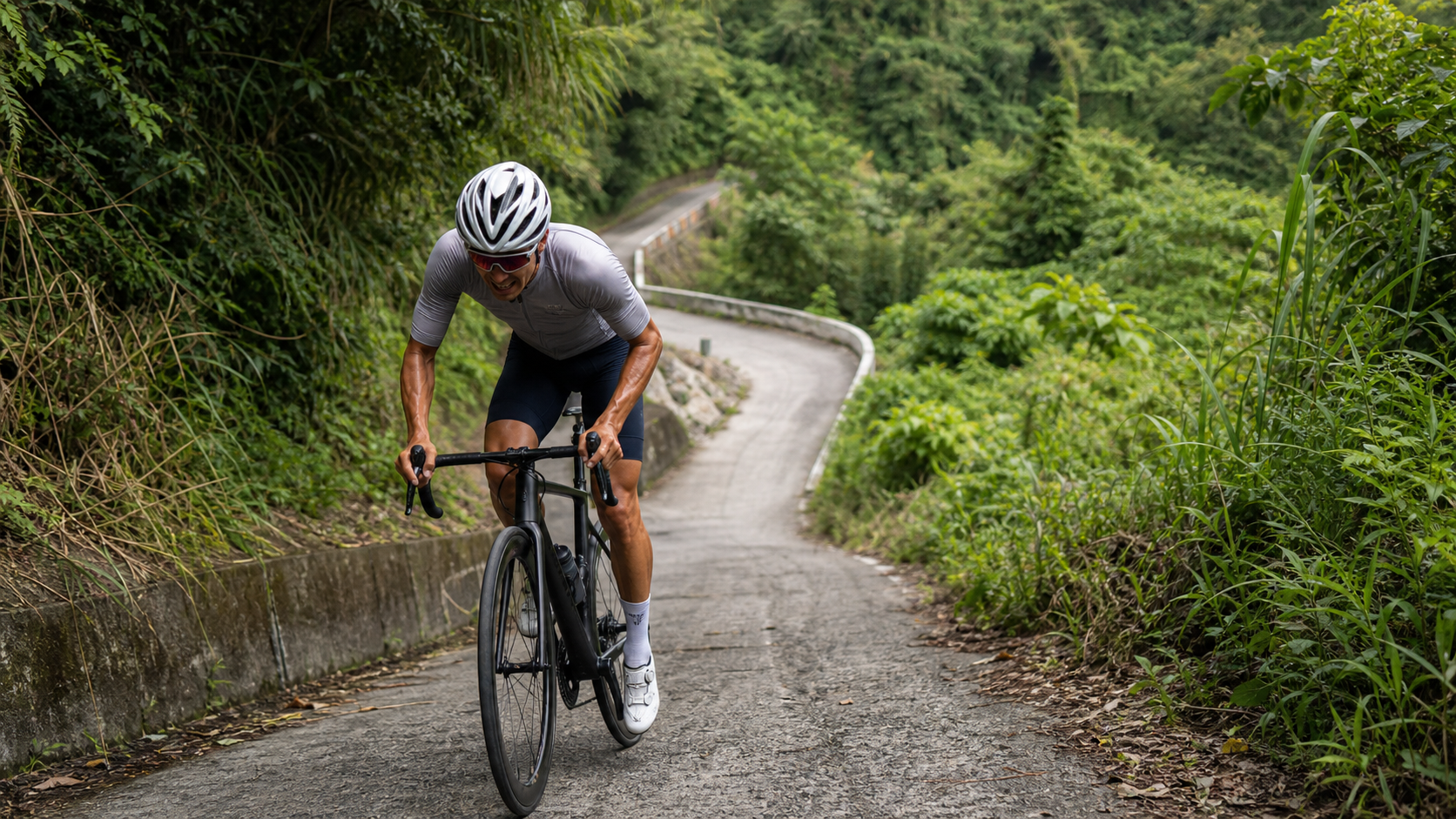
Some routes are meant for admiring the scenery; others are meant for getting to know yourself. Sanxia’s Zihe Road belongs to the latter.
1. The Geographic Character of the Sanxia Mountains: Steep, Winding, and Unforgiving
To understand why Sanxia’s Zihe Road has become this “hellish” beast, you first need to understand the geographic character of the Sanxia mountain area. Sanxia is located on the southwestern side of New Taipei City, nestled in the hilly terrain where the Dahan River meets the northern foothills of the Xueshan Range. The topography within its borders is dramatically undulating—from the gentle, flat streets of the old town in the urban area, pushing just a few kilometers into the mountains, the contour lines suddenly tighten, and the slopes become so steep that many of the industrial roads developed here are born with a certain “no detours, straight up” temperament.
This topographic character is reflected throughout the network of industrial roads, large and small, in the Sanxia mountains. Unlike some carefully planned scenic highways that use gentle switchbacks to reduce gradients, many of the connecting industrial roads in this area were originally built so local tea farmers, fruit growers, and mountain residents could travel the shortest distance between their settlements and farmland. Economic and practical considerations far outweighed riding comfort. As a result, these roads often choose the shortest path to climb directly, rather than stretching out the distance for a gentler slope. Zihe Road is a classic product of this “terrain dictates route character”—within a mere 2.87 kilometers, it crams in 498.3 meters of vertical ascent, with an average gradient soaring to 14.9%, and local sections estimated to spike above 20%.
For locals familiar with the Sanxia mountains, this kind of steep slope is nothing unusual. The area around Sanxia is naturally scattered with numerous “boss-level” short, steep climbs of similar character; Zihe Road is just one of the more famous and representative examples. But for riders from elsewhere tackling this mountain area for the first time, this gradient curve that completely disregards fair play often delivers a nearly absurd shock—you can hardly imagine that a road looking like an ordinary mountain industrial route could have a gradient meter that climbs so high it makes you question your very existence.
The mountains of Sanxia have never been the kind that gently, progressively coax you upward. They’re more like a wall placed directly in front of you, saying: “If you can climb it, that’s on you.”
2. First Encounter with the Wall: The Psychological Shift from Confidence to Doubt
I remember the moment I first turned onto the entrance of Zihe Road. The road surface ahead suddenly pitched upward after the bend, and that visual angle of inclination was unlike any “somewhat steep” route I’d ever ridden before—it wasn’t that gradual “oh, this section is a bit tough” feeling, but rather an absurd steepness that made you instinctively wonder, “Did they pave this road wrong?”
Before setting out, I had confidence in myself. After all, I’d ridden Beiyi and climbed Fengguizui in the past, and I considered myself no stranger to the words “steep climb.” But the first thing Zihe Road taught me was this: all my past climbing experience was almost completely reset to zero here.
For the first two or three hundred meters, buoyed by fresh legs and a bit of self-confidence, I managed to keep pedaling in the saddle. But soon, my gear ratios started running out. I heard the clacking sound of myself shifting down again and again, until I reached the easiest gear, yet my cadence was still crushed by that invisible wall—slower and slower, heavier and heavier, until my body instinctively wanted to stand up and sprint.
That moment of standing on the pedals was where the real psychological turning point began. When you stand up and press your full body weight into the pedals, only to feel the front wheel getting vaguely light and barely touching the ground; when you hear a faint, almost imperceptible slip from the rear wheel—that self-doubt about “can I even finish this road” rises without warning, just like the gradient itself.
This is not a battle of physical strength; this is a battle of the mind. Your body actually still has reserves, but the thoughts flooding your mind are: Should I just unclip and walk? This struggle is more tormenting than simply being out of breath.
3. The Physical Sensation of Sprinting to the Limit: A Three-Way Pull Between Muscles, Heart Rate, and Willpower
On those critical sections where the gradient approaches or even exceeds 20%, the body enters a strange state. The quadriceps and glutes bear a load far beyond normal with every pedal stroke. That soreness isn’t gradually accumulating fatigue—it’s an almost instantaneous burning sensation, as if every push of the pedal makes muscle fibers scream in protest.
The heart rate is even more extreme. Within mere tens of seconds to a minute or two, your heart rate rockets from a moderate riding intensity straight into a range near or at your personal maximum. That feeling of your chest heaving violently, your breathing completely unable to keep up with your body’s demands, is entirely different from the gradual gasping of a long climb. A long climb is like a marathon of suffering requiring carefully calculated pacing; a short-wall climb like Zihe Road is more like someone cracking a whip behind you, forcing your body to the edge of its limits in an extremely short time.
And the most interesting—and most honest—part is the role willpower plays in this process. In those few seconds when your muscles are burning, your heart is pounding, and your vision even darkens slightly from extreme exertion, what truly determines whether you can push that pedal one more revolution is often no longer pure physiological limits, but the voice in your head—the tug-of-war between “how much longer can I hold on” and “should I give up.” This experience of mind-body combat is what makes Zihe Road truly captivating (and truly tormenting). It takes a simple physical challenge and escalates it into an ultimate test of willpower.
4. Reaching the Top or Giving Up: The Weight of Two Real Emotions
I have to be honest: not every attempt at Zihe Road ends with “successfully riding the entire way.”
Once, near a particularly steep bend in the latter part of the route, I felt my legs completely lock up, my cadence nearly at zero, and the bike’s forward speed so slow it was almost coasting on momentum alone. In that instant, I made a decision—I unclipped, got off, and walked the bike through the remaining steepest section.
Walking those few dozen meters, my emotions were complicated. On one hand, there was a sense of frustration—“in the end, I still lost to the gradient.” On the other hand, there was a strange sense of relief—because at that moment, pushing on would likely have resulted in a loss of control and a crash, not a heroic summit. Giving up (or rather, choosing a safer way to complete the challenge) itself requires an honest courage to face your own limits.
On another attempt, when I finally rode the entire way and my feet were able to touch that slightly gentler stretch of road at the top, the sense of accomplishment was beyond words. It wasn’t the “easy and pleasant” kind of joy, but a nearly drained, complex emotion mixed with gasping and smiling—as if I’d just fought a hard battle with myself, and this time, I had won.
I’ve experienced both emotions, and I have to say, both are equally precious. Reaching the summit teaches you to believe your limits can be pushed further; the time I walked taught me to more honestly recognize my true state in the moment, and to know when to call it quits. This honest confrontation with your own limits may be the true gift these boss-level steep climbs give to riders.
5. The Significance of Extreme Steep Climbs to the Cycling Community: Check-ins, Competition, and Mutual Support
In the cycling community, short, ultra-steep climbs like Zihe Road often carry a special communal significance. Unlike long climbing routes that require extensive time and fitness planning for a single attempt, its length of under 3 kilometers makes it a relatively easy “revisitable” proving ground—you can ride over on a weekend morning specifically to challenge that wall again, to see if this time you can ride it better, smoother, and extend the standing-sprint sections a few more meters.
This characteristic of “repeated challenges, gradual improvement” naturally makes routes like Zihe Road a popular target for check-ins, sharing, and even friendly competition among riders. When you see someone on a social platform sharing their record of completing the full climb, the genuine admiration it evokes often resonates far more than a scenic group photo—because everyone who has ever gasped for breath on this road, or even been forced to dismount and walk, knows exactly the real weight behind that record.
The attitude among riders toward these boss-level climbs also carries a strange warmth. Sharing stories of failed attempts isn’t met with ridicule; instead, it more readily invites sincere exchanges like “I went through the same thing—here’s how I adjusted my gearing, here’s how I practiced my sprinting technique.” This mutual understanding and encouragement, built on facing shared difficulties, may be one of the deeper reasons these extreme challenge routes continue to draw wave after wave of riders. After all, compared to simply showing off success, honestly admitting that you too once walked your bike in shame up some section tends to resonate far more and forge stronger emotional connections within the cycling community.
6. Failure and Retrying: The Road Not Completed Always Calls You Back
I’ve thought about why a route like Zihe Road makes people want to come back and try again after a failed first attempt (or rather, not completing the entire ride on the bike), instead of giving up and staying away.
I think the answer may lie in the fact that for a short, high-intensity route like this, the cost of failure is relatively low—you don’t need to plan an entire day’s itinerary or travel long distances. You just need to find another clear weekend morning, set out again, and you have another chance to challenge it. This “low-cost opportunity to try again” actually takes some of the heavy psychological burden off failure, adding a lightness of “I’ll come back next time.”
And each retry carries the concrete adjustments accumulated from the previous failure. Maybe it’s switching to an easier gear ratio, maybe it’s adjusting the angle of your body’s center of gravity when sprinting, or maybe it’s simply telling yourself to be more patient this time and not burn all your energy in the first two hundred meters. This process of fine-tuning strategy again and again based on real failure experiences is actually very close to the essence of athletic training—progress is never achieved overnight, but built through honestly facing failure, adjusting strategy, and trying again, one repetition at a time.
For me, Zihe Road eventually became more than just a “ride it once and you’re done” challenge route. It became more like a mirror—returning to face it every so often lets me examine whether my fitness and technique have genuinely improved over that period. This ability to repeatedly verify your own growth may be exactly why routes like this are so addictive, drawing people back again and again.
7. The Impact of Seasons and Weather on the Challenge Experience
Challenging Zihe Road in different seasons feels like two completely different experiences. In summer, the humid, hot mountain climate piles onto an already near-limit cardiopulmonary load. Often before you’re even halfway up, your entire jersey is soaked through with sweat. That sensation of stifling heat intertwined with gasping amplifies the suffering of the entire challenge by another level. But the lush summer vegetation does offer some shade, providing brief relief from the direct sun on certain sections.
Winter challenges are a different story. The low morning temperatures in the mountains make warming up especially critical—attacking this kind of instantaneous high-intensity climb without properly activating your muscles significantly raises the risk of muscle strain. On the flip side, the drier, cooler winter climate is actually better suited for maintaining a steady breathing rhythm over a longer period. Many riders actually prefer challenging Zihe Road on winter mornings, enjoying the unique sensation of gasping for breath in the crisp, cold air without the discomfort of sticky sweat.
As for rainy days, the previous guide article has already clearly warned that the risk of wet, slippery surfaces at this gradient multiplies disproportionately. So when it’s raining or the road hasn’t dried, no matter how much you want to challenge it, it’s best to save that impulse for the next clear day. Afternoon thunderstorms are already fairly common in the Sanxia mountains, so checking the weather forecast before heading out is the most basic respect you can show for your own safety.
8. Suggested Side Trips: Reasons to Stay in Sanxia Beyond Zihe Road
After conquering that steep wall, it’s worth slowing down and leaving some time for the town of Sanxia itself. Sanxia Old Street is a must-visit staple—its red-brick arcades and Baroque-style facades bear witness to the town’s once-thriving history built on the dye and camphor industries. Strolling through it, you can feel a leisurely pace completely different from the all-out effort you just put into that climb.
Sanxia is also one of Taiwan’s important birthplaces of indigo dyeing culture. The local indigo craft has deep historical roots with the cultivation of the Strobilanthes cusia plant used for natural dye. Many cultural spaces around the old street offer exhibitions and hands-on activities related to indigo dyeing. For a rider who has just endured a dual trial of physical and mental endurance, sitting down to experience a quiet moment of handicraft might be the perfect balance and reward for body and mind.
Sanxia Zushi Temple is also worth a visit. Its exquisite wood and stone carvings have earned it the title “Oriental Art Palace.” Even those unfamiliar with architectural art will find, standing before the temple square and examining the details carved by years of craftsmanship, a spirit of artisanship that—while completely different from the steep climb—demands the same focus and perseverance. In a way, this ultimate pursuit of detail subtly echoes the attitude required to challenge Zihe Road, where every pedal stroke and every shift of weight must be measured with precision.
9. The Pre-Departure Ritual: A Moment of Preparing to Face the Wall Alone
Before every attempt at Zihe Road, I follow a nearly fixed preparation ritual. This ritual is less about the body and more about adjusting the psychological state. The night before, I’ll check the gear ratios and brakes early—not because I’m genuinely worried about equipment failure, but because this action helps me mentally enter the state of “about to face a hard battle.” This preparation process is somewhat similar to an athlete’s pre-competition mental ritual—through repeated, familiar fixed actions, you gather your restless emotions into a focused, manageable state.
On the day of departure, riding toward Sanxia, my mood is always conflicted. On one hand, there’s the subtle pressure of knowing the gradient ahead, a pressure that even makes my breathing unconsciously shallower. On the other hand, there’s a strange sense of anticipation, like heading to a date with myself. This conflicted feeling intensifies as the ride brings me closer to the entrance of Zihe Road, until I turn onto that familiar, heart-racing corner, and it instantly coalesces into a state of near-cold focus—all hesitation must yield to the road ahead in that moment.
Over time, I’ve come to understand that this pre-race (or pre-battle) emotional fluctuation is itself one of the precious experiences these extreme challenge routes offer. It’s not flat and uneventful like a daily commute or a leisurely outing; it stirs up a small storm in your heart before you even set off. This emotional tension is, in some ways, another reason people return to Zihe Road again and again—because that complex mix of nervousness and anticipation before departure is itself a unique experience hard to replicate in any other context.
10. Moments of Riding Alongside Other Cyclists: The Interplay of Solitude and Companionship
Although the core emotion of this article is first-person personal struggle and self-dialogue, to be honest, the challenge of Zihe Road isn’t always entirely solitary. On a few attempts, I happened to encounter other riders there as well. Those brief exchanges of glances on the steep slope often carried an unspoken understanding—both parties knew exactly what kind of physical and mental torment the other was enduring. No words were needed; a nod or a “keep going” squeezed out between gasps was enough to convey a considerable amount of support.
Interestingly, even when challenging Zihe Road alongside other riders, a route of this intensity ultimately pushes everyone back into a relatively solitary state—because in those tens of seconds to minutes when the gradient approaches its limit, no one can truly turn that pedal for you, and no one can bear that burning sensation in your muscles or that pounding heart for you. You can cheer each other on before starting, you can exchange wry smiles on the walking sections, but in the moment you truly face the wall, you ultimately have to carry it alone.
This “solitude within companionship” may be the shared essence of all extreme challenge routes—external encouragement and companionship can indeed provide psychological support, but what ultimately determines whether you make it through is always the outcome of the dialogue between you and your own inner self. That’s why, whenever I see other riders sprinting desperately on Zihe Road, or even ultimately choosing to dismount and walk, what wells up in me is never a sense of superiority or mockery, but a profound respect born of having experienced the same struggle.
11. Muscle Memory: The Traces Left in Your Muscles After the Climb
The day after challenging Zihe Road, the soreness in your thighs and glutes reminds you exactly what intensity you endured yesterday. This soreness is different from the diffuse, relatively even fatigue after a long ride. The soreness Zihe Road leaves behind is more concentrated, more acute—as if your body is translating the extreme output of those few minutes into a physical memory that lingers for a day or two, in the most direct way possible.
I’ve gradually discovered that this muscle memory has a strangely positive significance. Every time the soreness hits, it makes me recall more vividly the specific moments of the challenge—which bend my cadence nearly hit zero, which section of sprinting I felt the front wheel float slightly, and at which instant I finally gritted my teeth through the most painful stretch. These concrete, vivid physical sensations allow you to genuinely relive every detail of that challenge far better than simply staring at GPS records or power data.
It’s precisely because of this deep muscle memory that Zihe Road has gradually transformed in my mind from a mere “route” into something almost ritualistic—it’s not just a 2.87-kilometer path on a map, but a place to periodically return to, to test myself and remind myself to stay humble. Every time the soreness fades and strength returns, that urge to challenge again, to verify whether I’ve improved, inevitably surfaces on its own.
Conclusion: That Wall, in the End, Reflects Yourself
What Sanxia’s Zihe Road has taught me was never just how to conquer a 2.87-kilometer climb with an average gradient of 14.9% using easier gears and better sprinting technique. What it truly taught me is how to have an honest dialogue with yourself when facing a seemingly impossible challenge—when to grit your teeth and push through, when to safely choose to dismount and walk; how not to berate yourself in failure, and how not to become complacent in success.
This route is short—so short that many people might underestimate it. But its gradient is honest—so honest that there’s no room for luck. Every time I turn onto the entrance of Zihe Road and face that wall that suddenly pitches upward, it feels like making a new pact with myself: this time, I want to understand myself a little better.
And perhaps that is the deepest significance these extreme steep climbs hold for the sport of cycling—they are never just routes to be “conquered,” but mirrors for seeing yourself clearly. Whether you ride the entire way this time or dismount and walk a section, as long as you have honestly faced the struggle and pain that the limit brings, this journey has already earned its value.
Related Reading
- Sanxia Zihe Road Practical Guide: 2.87 Kilometers, 498 Meters of Climbing—Are You Ready for 14.9%?
- A 20-Kilometer Dialogue with the Wall: The Full Climb of Dashueshan Forest Road, a Battle of Will Between One Person and a Mountain
- Sanxia Xiongkong Yue Ling Practical Guide: A Hellish Slope Under 3 Kilometers—Are You Really Ready?
- On Xuewunao’s 10.2% Gradient, I Learned to Have a Dialogue with My Own Limits
台北闊瀨陡坡 騎旅 / 日本單車雜誌編輯車友臨時加入!/ 髮香才是最強的 / feat. 北迴歸線小隊 / 公路車 CT Yeh
6 個月前
半日 小台灣 極限單車路線挑戰實錄
7 年前
萬年峽谷! 30% 超激陡坡 里佳部落DAY2 還是很硬! | 公路車 | CT Yeh
3 年前
西進武嶺 世界紀錄挑戰!破2:30 ?!一群人推著一個夢上山 直播精華版 / ft. 張翰允 & 台視主播魏于恬 & KPLUS / #cycling 公路車 CT Yeh
2 個月前
大武山後門26%歡樂陡坡!JJSC南台灣單車行Day2 / 被颱風追著跑 / 公路車 / CT Yeh
2 年前
大武山20%魔王陡坡【JJSC南台灣遊騎Day2】!屁股真的要裂開了...凡士林抹滿也沒用?神秘金教堂還有超便宜夜市
3 個月前
2026紫南宮環線99.9K挑戰Vlog 多視角第一集團 跟看看.. / CT Yeh 公路車
1 個月前
2025 紫南宮99.9K環縣自行車挑戰賽 直播 / 第一集團跟了20K / CT動態數據直播系統 / 公路車 / CT Yeh
1 年前