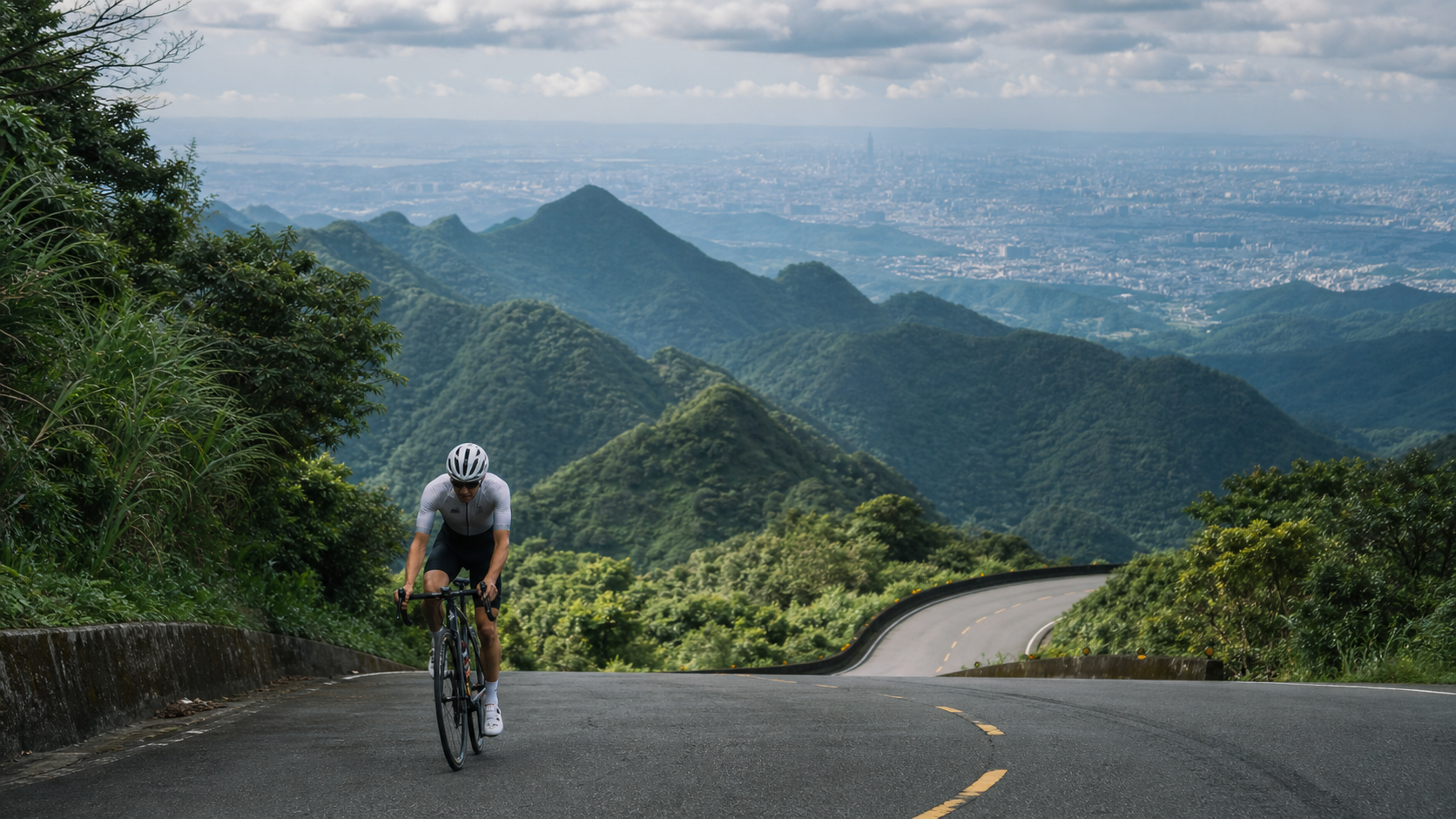
Some routes are meant for setting PRs; others are meant for having a conversation with yourself. For me, Wuzhi Mountain has always been the latter.
1. The Mountain with Outstretched Fingers: The Origin of the Name Wuzhi Mountain
The first time I heard the name “Wuzhi Mountain,” my instinct was to think of the mountain in martial arts novels that pinned down the Monkey King. But this Wuzhi Mountain in Xizhi, New Taipei City, has a story that’s actually much closer to the ground—because five peaks stand side by side, and when viewed from a certain angle in the distance, the ridgeline rises and falls like an open palm with five clearly defined fingers, hence the name. Place names born from such topographical silhouettes are not uncommon among Taiwan’s suburban mountain systems, yet few evoke a mental image as vividly from the name alone as Wuzhi Mountain does.
Wuzhi Mountain sits at the mountainous border between Xizhi and Qidu in New Taipei City, and it’s a fairly well-known peak among the suburban mountains of the greater Taipei area. It doesn’t hold the national-park-level administrative status or tourism infrastructure of Yangmingshan, nor is it the kind of “Instagram-worthy spot” that graces travel magazine covers. It’s more like a low-key local elder—not particularly imposing in stature, yet solidly standing at the edge of the Taipei Basin, welcoming anyone willing to put in the effort to climb, with an almost unassuming demeanor.
For cyclists, the significance of Wuzhi Mountain is even more concrete. With 10 kilometers of distance and 839 meters of elevation gain, this combination places it firmly in the “doesn’t take all day, but earns you a solid sweat” category within the greater Taipei suburban mountain system. It won’t consume your entire weekend, yet in just over an hour, it lets you experience a complete transition from the urban fringe to the depths of the forest.
2. Xizhi: A Town Shaped by the Keelung River Valley
To understand Wuzhi Mountain, you first need to understand the geographic character of Xizhi. Located in the Keelung River valley, Xizhi’s urban development has historically been tightly intertwined with the river, owing to early river transport and its low-lying terrain—this is also the origin of the name “Xizhi,” which is said to relate to topographical features associated with the ebb and flow of the tides.
Riding out from downtown Xizhi toward Wuzhi Mountain is, in essence, a lesson in topography as you gradually climb from the valley floor to the suburban ridgeline. The buildings and traffic of the city gradually thin out, replaced by layered mountain silhouettes and the occasional patch of light filtering through the treetops. This rhythmic transition from “a city of people” to “a city of mountains” is a charm I’ve felt on many suburban climbing routes near metropolitan areas, but Wuzhi Mountain compresses the process particularly tightly—in just 10 kilometers, the magnitude of environmental change you experience is far more dramatic than you’d imagine.
Within the greater Taipei metropolitan area, Xizhi has long played the role of a “transportation hub and residential hinterland,” sitting close to both Keelung and downtown Taipei with a large commuting population. Precisely because of this, for many cyclists living in Xizhi or nearby areas, Wuzhi Mountain isn’t a “far-flung expedition” requiring a long journey to reach—it’s more like a “backyard” where you roll out of your front door, turn a few corners, and start climbing. This kind of close-at-hand accessibility makes Wuzhi Mountain a regular destination for many local riders on weekends or even weekday evenings.
3. Departure: The Transition from City Heartbeat to Mountain Heartbeat
When I set out that afternoon, the sky was of the kind common on summer afternoons in the Taipei Basin—thick clouds that didn’t completely block the sun. I hadn’t checked the weather forecast in much detail, just relied on experience to judge that it probably wouldn’t rain, and so I rode onto the road toward Wuzhi Mountain.
The early part of the climb wasn’t particularly intimidating; the gradient was gentle enough that you could almost forget you were climbing a mountain. The houses on either side gradually thinned out, the asphalt began to show a shifting mosaic of fallen leaves and tree shadows, and the humidity in the air slowly shifted from the stuffy heat of the city to the fresh, vegetation-laden crispness unique to the mountains. I rode this section quite relaxed, even having the spare attention to notice the occasional bird calls darting from the roadside and the faint ridgeline contours in the distance.
But that relaxed mood began to shift subtly once I entered the middle section of the route.
4. Steep, Then Gentle: A Tug-of-War with Your Own Mental State
If you ask me what my most profound riding memory of Wuzhi Mountain is, I’d say it’s the recurring cycle of “thinking you’re almost there, only to hit another climb.”
The terrain’s undulations are perhaps best described in numbers—within 10 kilometers, there’s 839 meters of elevation gain. If you naively multiply the distance by the officially posted 5.7% average gradient, you’d expect roughly 570 meters of climbing. But the actual gain far exceeds that figure; converted, the route’s true equivalent gradient approaches 8.4%. This means the entire route is by no means a gentle “steady, gradual ascent”—rather, there are substantial stretches where the gradient is far steeper than the surface numbers suggest.
The psychological impact of this “discrepancy between numbers and feel” is actually harder to handle than the physical fatigue. Riding on the gentler sections, you get the illusion that “this route isn’t as hard as I thought,” and then the next turn might confront you with a steep pitch that makes your thighs burn instantly. That sense of being caught off guard is a lot like dealing with someone with unpredictable moods—you can never guess what kind of face it’ll show you next.
I remember a continuous steep section in the middle, where the gradient clearly ramped up, my cadence involuntarily dropped, and my breathing grew heavy. The thought that flashed through my mind at that moment wasn’t a fiery slogan like “push through it!” but something more honest, quieter—a self-dialogue: “Okay, so this is what this road really is. Accept it, and pedal through it one stroke at a time.”
This is often what makes climbing on a bike both the most captivating and the most tormenting. You can’t conjure strength out of thin air with willpower alone; all you can do is honestly face each gradient as it comes, adjust your breathing, adjust your cadence, and keep moving forward. The terrain that alternates between steep and gentle is, in a way, a mirror reflecting your true reaction to uncertainty—whether you panic and try to surge through it all at once, or whether you’re willing to slow down and properly spar with the mountain.
5. Forest Scenery and Vistas: The Visual Compensation Wuzhi Mountain Offers
Of course, the hardship of the climb isn’t all this route has to offer. The reason Wuzhi Mountain maintains a solid reputation in the greater Taipei cycling community isn’t just its “toughness,” but also the visual compensation the scenery along the way provides.
As elevation gradually increases, the forest composition along the roadside quietly changes. The broadleaf species common at lower elevations gradually intermingle with different layers of vegetation as you ascend; the mountain retains a rich natural forest cover. On sections riding through the shade of trees, sunlight gets fractured into fine specks of light scattered across the asphalt, creating an almost meditative visual rhythm—especially at moments when you’ve just pushed through a steep pitch and need this rhythm of sight and breath to rediscover your pedaling cadence.
But what truly makes people return to Wuzhi Mountain time and again are the several viewpoints along the way. When you ride to an open section and look back, the winding waterways of the Keelung River valley and the layered buildings of the Taipei Basin unfold before you without warning. That instant psychological shift from “battling the gradient” to “being awestruck by the scenery” is an intense sensation I’ve never experienced on gentler routes.
I’ll always remember that afternoon, at a certain viewpoint, when I stopped the bike, caught my breath, and turned to look back at the road I’d come up. The entire Taipei Basin spread out beneath my feet, the distant high-rises bathed in a faint grayish-blue tone in the afternoon light, and the Keelung River winding through the urban fabric like a silver ribbon. At that moment, all the soreness and frustration from the climb seemed to be diluted by more than half by that view. This is probably the fairest thing about suburban mountain routes—the effort they demand of you is often repaid with scenery that moves you just as much.
6. What This Road Means to Riders: The Closest Escape Route to the City
For those living in the greater Taipei metropolitan area—especially in commuter-dense towns like Xizhi—daily life can easily become a fixed cycle of “work, commute, go home.” The fact that a suburban mountain route like Wuzhi Mountain maintains a loyal following among cyclists and the broader outdoor community is, to some extent, precisely because it offers an “escape that’s right at your doorstep”—no need to take leave, no need to plan a long trip. Ride out of your front door, take a turn, and within a little over an hour, you experience a complete transition from urban clamor to mountain stillness.
For many commuter cyclists whose weekdays are filled with work, riding up Wuzhi Mountain on a holiday morning or evening becomes an almost ritualistic time of self-dialogue. The climb itself demands intense focus on breathing, cadence, and real-time judgment of gradient—this forced concentration paradoxically allows you to temporarily detach from the repetitive worries of work and life. As the sweat flows, it feels as though the week’s accumulated noise is being washed away along with it.
I see Wuzhi Mountain the same way myself. It’s not the kind of “major challenge” that requires dressing up and planning weeks in advance; it’s more like an old friend you can meet at any time—you know it will put you through hardship, but you also know that the feeling of being mentally and physically cleared and reset after the climb is worth coming back for, again and again.
7. The Seasonal Faces of the Mountain
The scenery of Wuzhi Mountain is never static. As the seasons shift, the mountain reveals distinctly different faces—one of the reasons local riders are willing to return repeatedly.
In the season of swirling clouds and mist, especially during periods of higher humidity, fog tends to form in the early morning or afternoon. The entire route becomes shrouded in a veil of moisture. While visibility is limited, it also lends the roadside forest a hazy, poetic quality—riding through it feels like passing through an ink-wash painting.
In the season of swaying silvergrass, on certain sun-exposed, open sections, the silvergrass sways with the wind, casting a silvery-white sheen under oblique sunlight. It’s a common sight in the suburban mountains of greater Taipei, yet one that never grows old—a seasonal scene worth savoring every time.
In the season of autumn foliage, as temperatures cool, certain higher-elevation sections with pronounced forest changes occasionally reveal layers of red and yellow leaves, adding warm tones to a mountain landscape otherwise dominated by green.
The exact timing and best viewing sections for these seasonal changes vary each year depending on climate and rainfall. Riders hoping to capture a particular seasonal scene are advised to rely on on-site conditions and the latest information shared by local communities before heading out, rather than fixating on specific months. What’s certain, however, is that Wuzhi Mountain never greets you with the same face twice—and that’s one more reason it’s worth riding again and again.
8. Suggested Side Trips: Extending Your Ride into a Full Holiday
If time and energy permit, there are plenty of worthwhile activities around Wuzhi Mountain to incorporate into your itinerary, turning a climb into something more than the monotonous loop of “up, down, go home.”
Xizhi itself offers a number of local comfort foods and traditional market snacks, making them excellent choices for replenishing energy and rewarding yourself after a ride—specific shops and items change over time, so it’s best to rely on actual visits or the latest recommendations from local communities rather than outdated lists.
The area around Wuzhi Mountain also features several hiking trails. For those who enjoy combining cycling with hiking as a multi-sport outdoor activity, if you still have energy left after the ride, consider checking on-site information about nearby trail systems and adding a short hike—a different way to once again connect with the mountain forest.
Whether it’s food or trail details, official announcements and actual on-site conditions should always be the final authority. The focus of this article, after all, remains that time spent on Wuzhi Mountain, in dialogue with yourself.
9. The Way of Dialogue with the Mountain: The Psychological Shift from Resistance to Acceptance
Looking back, I’ve experienced the psychological shift on Wuzhi Mountain more than once, and the pattern is almost always the same. At the start, it’s relaxed, carrying a hint of exploratory excitement; entering the mid-section’s steeper grades, a near-resistant emotion emerges—“Why is it steep again here?” “Didn’t they say the average gradient wasn’t that bad?”—and then, at some critical point where cadence nearly drops to the edge of losing balance, the emotion suddenly shifts into a near-surrender of calm—no longer competing with the gradient, but purely, turn after turn, pushing the pedals down.
This psychological shift is worth pondering. Over time, I came to understand that the most painful part of climbing is often not muscle soreness, but the psychological anxiety of “not knowing how much steeper it gets.” When you don’t know whether the next bend holds a gentle slope or a steep wall, that uncertainty constantly drains your mental energy—it can break you earlier than the actual physical load.
And Wuzhi Mountain is precisely a route that excels at creating this kind of uncertainty. It won’t honestly tell you, “the next two kilometers are all gentle slopes, feel free to accelerate.” It always throws an unexpected twist just when you think you’ve figured it out. Over time, what I learned wasn’t to “predict” the road, but to “accept” its unpredictability—treating every bend as unknown, responding to every gradient with the immediate feel of the moment, rather than mechanically continuing with the rhythm of the previous section.
This shift in mindset has, to some extent, quietly seeped into moments of my daily life. Work and life are full of variables that can’t be controlled in advance. Rather than anxiously trying to control every detail ahead of time, perhaps the more pragmatic approach is like facing Wuzhi Mountain’s steep grades—letting go of the obsession with certainty, focusing on each small action you can take in the present, and pedaling through the road ahead, turn by turn.
10. Descending at Dusk: A Completely Different Scenery
If the ascent of Wuzhi Mountain tests endurance and mental resilience, then the descent offers a completely different, almost healing experience.
I particularly enjoy timing my climb to finish near dusk before starting the descent. At this hour, the sunlight becomes low, oblique, and soft. The harsh midday glare transforms into a warm orange-toned light that spills across the forest and pavement, casting long, interwoven patterns of light and shadow. The speed of the descent, combined with the cool mountain breeze rushing past, carries away the sweat and heat accumulated during the climb—that exhilarating sensation can almost instantly wash away all memory of the pain from the ascent.
Descending from the viewpoints near the ridgeline, the Keelung River Valley and Taipei Basin’s evening scenery gradually draws closer as elevation drops. Streetlights and residential lights begin to flicker on one by one—a stark contrast to the gray-blue urban silhouette seen from above during the day, now imbued with a warm, lively sense of human habitation. This transition from mountain stillness back to the烟火气 of the city is itself like an emotional buffer—a quiet moment to sort through your feelings before formally returning to the rhythm of daily life.
Of course, the descent also demands proper vigilance. Mountain roads have many curves, visibility on some sections is obstructed by tree cover, and dusk light changes rapidly. Please be sure to control your speed and brake early. Safety is always the first priority when riding suburban mountain routes—no scenery is worth more than getting home safely.
11. To Those Who Haven’t Ridden Wuzhi Mountain Yet
If you’re a rider who hasn’t yet ridden Wuzhi Mountain, by this point you might be wondering whether the route is worth a dedicated trip. My answer is: if what you want is a route that lets you experience the complete transition from “city to mountain” in the most compact way possible within a short time, Wuzhi Mountain is an honest choice—so honest that it will even use its actual elevation gain figures to remind you not to be fooled by the deceptively gentle average gradient.
It won’t be the kind of route you finish and immediately want to post about, bragging about your average speed. But it very well might be the kind of route where, on some quiet evening, standing alone at a viewpoint looking back over the entire Taipei Basin, you suddenly feel, “this ride was truly worth it.” That kind of value isn’t easily measured by data or performance, yet it’s the real reason so many lifelong cycling enthusiasts are willing to return to the same familiar mountain road again and again.
I’ve also met friends who, before their first attempt at Wuzhi Mountain, looked up the route’s basic data online, saw the average gradient was only 5.7%, and set off with a relatively relaxed mindset—only to be caught off guard by the consecutive steep sections in the middle, complaining half-jokingly afterward that “this road is basically a scam.” In truth, the route never deceived anyone—the 839 meters of elevation gain is written there in black and white. It’s just that most people habitually look only at that friendly-looking average gradient number while overlooking the real conversion relationship between distance and elevation gain. That’s also why I particularly wanted to honestly clarify this gap between numbers and physical sensation in this article—not to scare off riders who want to take on the challenge, but to ensure that everyone setting out carries a mental preparation matching the actual difficulty, experiencing less disheartening surprise and more solid sense of accomplishment after conquering it.
12. The Meaning of Riding Solo: A Time to Be with Yourself
Most of the time, I choose to ride Wuzhi Mountain alone. It’s not that I reject the lively atmosphere of group rides, but rather that this route’s unique rhythm seems especially suited for quietly spending time with oneself. There’s no one else’s pace to accommodate, no conversation to distract you—every subtle adjustment between breathing and cadence only needs to answer to your own body.
During the solo climb, thoughts involuntarily drift toward corners usually buried under daily trivialities—unresolved problems at work, emotions in life not yet sorted out, even the recent news of friends you haven’t contacted in a long time. Curiously, these thoughts don’t stir the same anxiety they would at a desk; instead, within the steady rhythm of cadence and breath, they slowly get sorted into some semblance of order. Perhaps because the body is busy coping with the gradient ahead, the brain gains a rare luxury of processing, without pressure, those thoughts that are usually set aside.
This is probably another reason I keep returning to Wuzhi Mountain—it’s not just a route for building fitness, but more like a fixed place where I can converse with myself. Every time I finish the climb, what I bring home isn’t just sore legs, but also a little bit of freshly reorganized state of mind.
Conclusion: The Mountain Doesn’t Speak, but It Remembers How Many Times You’ve Come
On the afternoon I left Wuzhi Mountain, the wind roared past my ears during the descent, carrying away the sweat and heat accumulated on the way up. Back on flat ground, merging into the bustling city traffic, I suddenly realized that this short 10-kilometer route carried an experience far richer than its literal numbers suggest—the terrain’s sudden steepness and easing, the breathtaking views that unfold instantly at the lookout points, and those inner conversations with myself during the climbs that no one else could hear.
Wuzhi Mountain won’t remember how many times you’ve ridden it, but you’ll remember the different faces it shows you each time—sometimes gentle enough to make you think it’s overrated, sometimes steep enough to make you question your choice halfway up. This is probably the most charming thing about suburban mountain routes like this: they’re close enough that you can answer the call anytime, and they have enough personality that you’ll never truly figure them out.
If you also live in Greater Taipei and haven’t ridden Wuzhi Mountain yet, pick an afternoon when the weather is fairly stable and set out. Be guided by actual road conditions and the latest weather information on site, remember to bring enough water, and save some energy for the surprises in the latter half—it will reward all your hard work along the way with a sweeping view of the Keelung River Valley and the Taipei Basin.
Related Reading
- Wuzhi Mountain Practical Guide: 10 km, 839 m of Climbing—Don’t Be Fooled by the “5.7% Average”
- White May on the Tung Blossom Road: A Leisurely Ride Along Xiding Road and Its Local Scenery
- 793 Meters from Xizhi to Pingxi: A Tiny Time Trail Hidden in the Valley
- Wufen Mountain Guide: A 10.28 km, 577 m Climb—A Textbook in Rhythmic Riding
水金九不厭五分 10度寒流冷到不願停!feat. 卡卡 / 公路車 / CT Yeh
6 個月前
大武山後門26%歡樂陡坡!JJSC南台灣單車行Day2 / 被颱風追著跑 / 公路車 / CT Yeh
2 年前
台北闊瀨陡坡 騎旅 / 日本單車雜誌編輯車友臨時加入!/ 髮香才是最強的 / feat. 北迴歸線小隊 / 公路車 CT Yeh
6 個月前
2024 如來神掌 百人約騎挑戰!feat. 秘境單車社團 / 神人們太可怕 / 全程錄影 x 完整坡度解析 / 公路車 / CT Yeh
2 年前
太平山單車員工旅遊 | 這樣玩CP值最高!| 公路車
5 年前
虎豹潭!日本老師來台一日約騎 台灣車友熱情招待私房路線 / CT Yeh
20 天前
Q老師約騎烏來瀑布 / 該買樂透了!?/ 公路車 / CT Yeh
11 個月前
日本公路最高登山賽,台灣首位YT挑戰實錄,乘鞍登山賽40週年,賽前篇完整版,請到我的YT收看 #公路車 #cycling
10 個月前