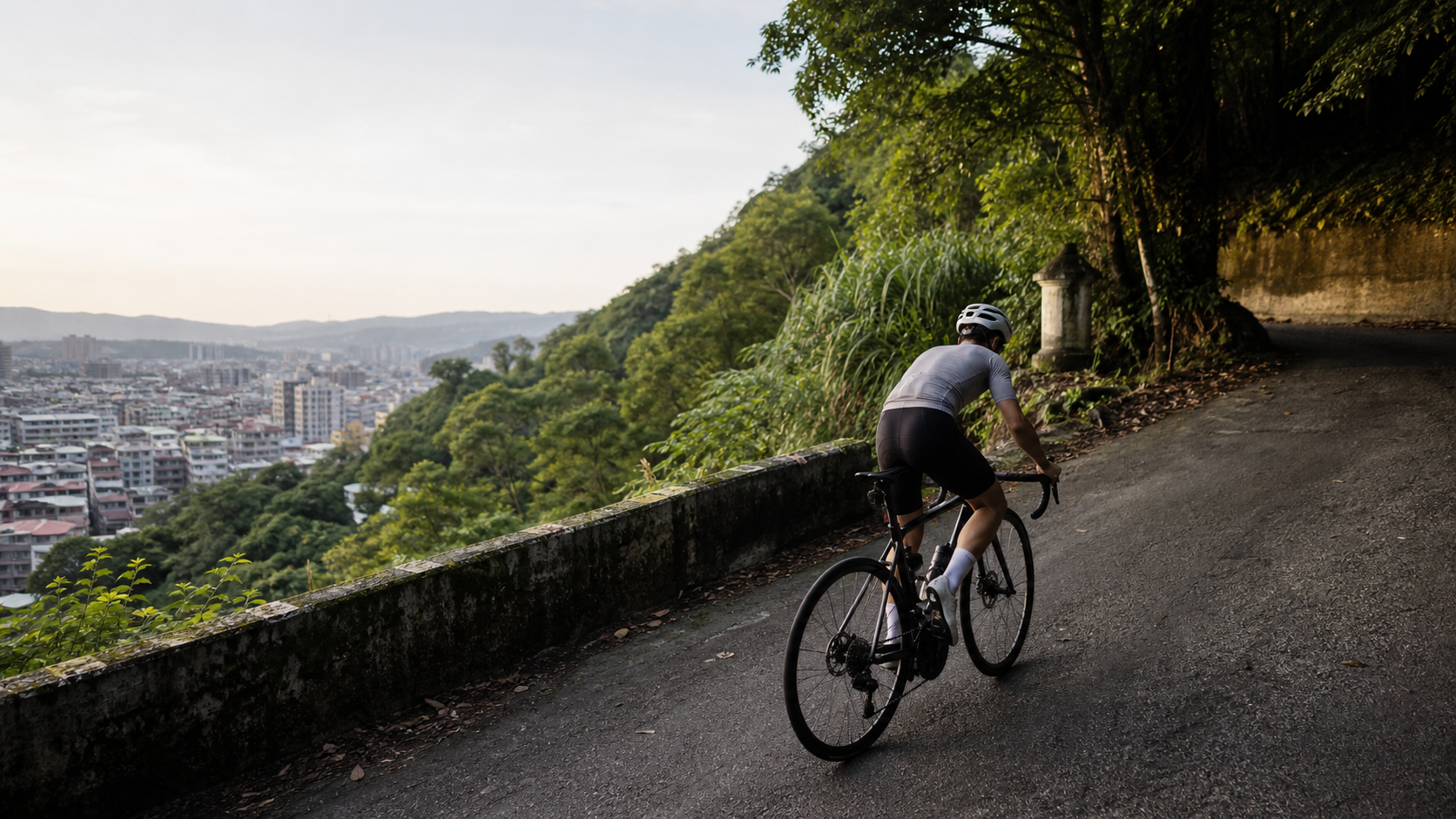
It was an ordinary weekend morning. I parked my car at the edge of downtown Tucheng, watching the small road marked “Guānzìzài” on my navigation wind its way into the hills. The map showed a distance of less than three kilometers—so short that I initially underestimated it—until my legs later told me just how naive that judgment had been.
1. Tucheng, a Boundary on the Southwestern Edge of the Taipei Basin
To understand the road to Guānzìzài, you first need to understand Tucheng’s geography. Tucheng sits on the southwestern edge of New Taipei City, bordering Sanxia, with the Dahan River’s alluvial plain to its west. This is the most typical topographical microcosm of the Taipei Basin’s edge—urban buildings and roads spread across the flat basin floor, but turn south or west, and the hills rise abruptly with no transition, forming a clear dividing line between city and forest.
Riding on Tucheng’s urban roads, it’s hard not to notice this stark topographical contrast. On one side are the familiar convenience stores, apartment blocks, and traffic; on the other, hills covered in greenery, with industrial roads like Guānzìzài tucked at their base, quietly connecting urban life to the mountain trail system. This “sense of urban boundary” is perhaps Tucheng’s most charming yet most easily overlooked trait—it’s not as remote as deep mountains, yet within just a few minutes of riding, it can completely shift you into a different rhythm.
2. Buddhist Imagery in a Road Name: Guānzìzài and Tucheng’s Religious Fabric
The name “Guānzìzài” gave me pause the first time I saw it. It’s an alternative title for Guanyin, the Bodhisattva of Compassion, in Buddhist terminology, literally meaning “to observe freely, without hindrance,” drawn from the opening of the Heart Sutra: “When Guanzizai Bodhisattva was practicing the profound Prajnaparamita…” Using such a term to name a mountain road inevitably evokes the well-known temple culture of the nearby hills—Tucheng’s hilly terrain has had deep ties to local Buddhist faith since the Japanese colonial era, and the mountain trail network and temple incense have long shaped this area’s unique cultural landscape.
I must honestly say that I haven’t verified whether the road’s name directly stems from a specific temple, nor am I certain of its exact geographic relationship to the surrounding trail system—I’ll leave that for friends more familiar with local lore to fill in. But even just starting from the literal imagery, placing the three characters “Guānzìzài” on a steep slope that demands total concentration and leaves almost no room for distraction creates an unexpected resonance—riding this road, in a sense, forces you to “observe the present moment”: you can’t scroll through your phone while tackling the grade ahead; all your attention must be pulled back to your breathing and cadence. This forced focus is perhaps the most honest gift that all steep climbs give to a rider.
3. Underestimating Before the Start, and the Slope’s First Wake-Up Call
Back to that day’s ride. I’m the type who checks the data before setting off, and before leaving, I glanced at the distance—less than three kilometers—and thought to myself, this is at most a warm-up level stretch, done in a few minutes. But less than halfway through the middle section, I realized I had completely misjudged this road’s character.
The grade steepened without warning. It’s hard to describe that feeling in precise numbers, but the body’s response doesn’t lie—cadence dropped instantly, breathing shifted from a steady rhythm to short gasps, and a distinct burning sensation rose in the front of my thighs. I instinctively wanted to stand and sprint, but immediately realized I couldn’t sustain that intensity for long, so I sat back down on the saddle, dropped to the easiest gear, and ground through that short wall at a near-crawling cadence. In that moment, I truly understood the weight of the phrase “short distance doesn’t equal low difficulty”—this road told a complete story about steepness in the shortest possible length.
4. Breathing, the Only Language of This Road
Unlike the gentler climbs I mentioned earlier, where you can chat while riding, Guānzìzài offered me a completely different experience. The steep middle section left me barely able to string together a full sentence; all my energy went into maintaining cadence and keeping the bike from drifting off line. This state of being pushed to the limit has a strange purity to it—when every ounce of physical strength is spent fighting gravity, the mind empties instead. Work worries and life’s distractions are all temporarily pushed out of consciousness, leaving only breathing, heartbeat, and the seemingly endless slope ahead.
I’ve often thought since then that this short, violent climbing experience is an entirely different thing from the mindset of a long, gradual climb. A long climb gives you time to think; a short, steep one offers only one option—“push through”—with no spare energy for anything else. This almost forced sense of the present, in a way, might echo what the name “Guānzìzài” points to: letting go of stray thoughts and facing the moment directly—though at the time, what filled my mind was actually “how much farther,” rather than any Zen insight.
5. The Texture of Life at the Mountain’s Foot
The entrance area of Guānzìzài isn’t the kind of tourist-packaged trailhead; it’s an ordinary scene of suburban Tucheng life—homes, narrow alleys, the occasional scooter, and residents walking their dogs. This unpolished everydayness gave the whole ride an extra layer of authenticity. During the climb, I caught glimpses of residents tending potted plants in their courtyards and others sitting in the shade of their arcades. To a rider huffing and puffing past on pedals, most of them just gave a natural glance, without excessive curiosity or reaction—this plainness made me feel genuinely absorbed into the local rhythm of life, rather than an intruder.
In recent years, New Taipei City has invested considerably in organizing its mountain and suburban trail systems, including partial renovations of nearby hiking trail networks (please refer to official announcements for actual trail conditions and opening status), which has made short connector roads like Guānzìzài increasingly shared routes for local residents and outside riders alike. This seamless link between urban areas and mountains is a unique asset that the hilly terrain around the Taipei Basin grants to New Taipei City’s suburbs.
6. A Brief Aside on the Tucheng Ammunition Depot Ecological Protection Area
While riding Guānzìzài, I also thought of another well-known Tucheng landscape—the Tucheng Ammunition Depot Ecological Protection Area. This zone, whose complete ecosystem was preserved by accident due to long-term military restrictions, has gradually opened parts of its area for public application to enter in recent years, making it a highly distinctive ecological green space in New Taipei City (please refer to the competent authority’s announcements for actual open areas and application procedures). Although Guānzìzài itself isn’t on the same route as the depot protection area, both sit in Tucheng’s hilly belt, and together they paint a picture of this district’s geographic character of “urban and nature tightly interwoven”—on one side, dense urban development; on the other, mountain secrets preserved by chance. Guānzìzài happens to run briefly through the junction of the two.
7. The Descent, a Different Kind of Test
After finishing the climb, the return or turnaround route presents an equally steep descent. The climb tests your lungs and muscles; the descent tests your nerve and brake control. I remember that day’s descent—I deliberately slowed down and feathered the brakes early, avoiding the heat fade from prolonged continuous braking. The downhill sections of steep routes are often the most overlooked part of riding safety—many people put all their attention into how to get up, forgetting that the way down demands equal focus and skill. On that descent, the sound of wind replaced the earlier gasping breaths, offering one of the rare moments in the whole ride to relax the shoulders and neck.
8. Guānzìzài Through the Seasons
Although my first visit was in mild weather, I later passed nearby at noon in high summer, and that combination of oppressive heat and steep grade made me even more certain that early morning or evening are the more comfortable times to take on this road. The reflected sunlight and humidity of Taiwan’s summer hills are a considerable burden on this kind of high-intensity, short-climb route. In contrast, autumn and winter bring drier, cooler air, making it a better fit for slotting Guānzìzài into a training plan—though the occasional damp, cold drizzle of winter reduces grip on the middle section’s steep surface, requiring extra caution while riding.
9. Making Peace with the Imagined “Guānzìzài”
After finishing that ride, I kept wondering whether this road’s name was coincidence or some conscious echo. Over time, I’ve come to feel that the answer perhaps matters less than this: that day on the steep slope, pushed to the point where I could barely hold a stray thought, I did experience something like a moment of “letting go.” Not a deliberately pursued Zen quality, but the most primitive focus forced out by physical limits. This experience is perhaps the unique value of short, steep climbs compared to long, gradual ones—they don’t give you the luxury of thought, only the choice to push through, and when you look back after making it, that lightness feels especially real.
10. Notes for Myself and Other Riders on the Next Visit
If you’re also planning to tackle Tucheng Guanzizai, I’d sincerely suggest this: don’t be fooled by the distance. This road packs an entire narrative of a steep climb into less than three kilometers, and there’s a discrepancy between the officially posted gradient figures and the actual elevation gain, which means the middle section is likely steeper than you imagine. Set out with a humble mindset, prepare a light enough gear ratio, and treat it as a short challenge requiring your full concentration—not a warm-up stretch you can take casually.
11. Extended Possibilities Around the Route
If time permits, consider fitting Guanzizai into a more complete exploration of the Tucheng hill road network, connecting to nearby hiking trail systems or stopping briefly in the surrounding urban amenities (actual road conditions, shops, and opening hours are subject to on-site and official announcements). This kind of itinerary design—“short steep climb plus surrounding exploration”—can extend what would otherwise be just a few minutes of climbing into an afternoon of gaining a more complete understanding of Tucheng.
12-1. Random Thoughts on Equipment and Mindset
Before setting out that day, I actually hesitated over whether to swap in a lighter cassette. Accustomed to riding flat urban roads and gentle slopes, my bike was set up with a relatively heavy gear ratio, but relying on the mistaken intuition that this road was “only three kilometers,” I ultimately set off without changing gears. In hindsight, that was a costly misjudgment—the steep middle section forced me to grind through almost entirely in my heaviest gears, and my knees absorbed far more torque in those few minutes than usual. The soreness in my thighs and around my knees the next day was noticeably worse than after a long, gently graded ride.
This experience made me realize that equipment preparation is never something to cut corners on based on gut feeling, especially on routes that are short yet conceal steep gradients—gear headroom often matters more than you’d think. When I revisited the road later, I specifically swapped in a lighter cassette configuration, and the difference in feel was significant. Though the breathlessness from the steep sections remained, my knees no longer bore that near-brutal torque load. This before-and-after contrast also deepened my understanding that so-called “preparation” is never excessive caution, but the most basic respect for one’s own body.
12. In Closing: A Short but Honest Lesson
What Tucheng Guanzizai taught me can perhaps be condensed into one sentence—don’t judge a road’s weight by its length. This industrial road of less than three kilometers, with its steep middle section and gradient data that carries slight discrepancies, honestly reminds every rider who visits: true difficulty is never measured in kilometers.
After finishing the climb that day, I sat by the roadside drinking water, looking back at the steep slope I’d just conquered. What surfaced in my mind wasn’t the relief of “finally done,” but a clarity that came from being baptized by a short, fierce challenge. This feeling is entirely different from finishing a route tens of kilometers long—the latter is a marathon of physical endurance, while the former is more like a concentrated, explosive dialogue with almost no room to catch your breath.
13. Reflections on “Short” and “Underestimation”
In Taiwan’s cycling culture, we’re accustomed to measuring a route’s significance by distance—century rides of 100 kilometers or more are always more readily labeled “impressive.” But Tucheng Guanzizai made me reconsider the limitations of this habitual judgment. A short route doesn’t mean it deserves to be underestimated; sometimes quite the opposite—short, high-intensity climbs test a completely different set of abilities: explosive power, on-the-spot judgment on steep gradients, and the humility to maintain composure when facing discrepancies in the data. This road reminded me that routes of every length and every gradient have their own reasons to be taken seriously.
14. To the Next Rider Visiting Guanzizai
If these words happen to reach the next rider preparing to take on Tucheng Guanzizai, I want to say this: this road is short—so short you might even wonder if it’s worth a dedicated trip. But trust me, within those less-than-three kilometers lies a solid, honest, unignorable story of a steep climb. Set out with light gear, with sufficient gear ratio preparation, and with a little room for imagination about the name “Guanzizai” (Observing Freedom). You’ll find that this road gives you far more than its length suggests.
15. The Quiet of Riding Solo
I set out alone that day, and thinking back, that likely shaped how I experienced this road. Facing a steep climb by yourself, with no companions shouting encouragement and no psychological pressure of competing with others, there’s only a solitary dialogue between you, the gradient, and your breathing. This solitude becomes especially pronounced in those most grueling seconds of the climb—no one knows whether you’re secretly thinking of giving up, and no one sees you drop your cadence to nearly walking pace just to barely make it through. But precisely because of this audience-free honesty, that ride felt exceptionally real. I’ve since imagined what it would be like to tackle this road with a group of friends—there’d be people shouting encouragement at each other on the steep sections, and perhaps high-fives and cheers at the end. But that day, it was just me, the sun-baked asphalt, and the occasional cicada song from the roadside.
This solo riding experience brings to mind a saying many veteran cyclists often repeat—cycling is ultimately a conversation with yourself; no matter how many companions are around, it’s ultimately only your own body and will that turn the pedals and bear that burning sensation. A short, honest climb like Tucheng Guanzizai might be the most concentrated arena for such a dialogue—there’s little time for idle chatter; everything is compressed into those few minutes of focus.
16. Anticipation of a Return Visit
After finishing that ride, I was already mentally planning the timing of my next visit. Not because I particularly enjoy suffering, but because that feeling of being pushed to the limit by a steep climb and then successfully pushing through carries an indescribable sense of accomplishment that makes you want to verify again—can last time’s limit be pushed just a little further this time? This is perhaps the unique magic of short, steep routes: the challenge is concentrated and clear enough that every improvement can be distinctly felt, unlike long-distance routes where progress often takes much longer to notice.
I imagine that on my next visit to Guanzizai, I might pick a cooler morning, with a slightly adjusted gear ratio, and face that middle steep section anew. Or perhaps I’ll simply want to experience once more that state of being pushed to speechlessness, left with only breath and heartbeat—after all, in the busyness of daily life, few things pull you back into the present moment as directly and uncompromisingly as a steep climb.
17. Other Riders Encountered on the Road
That day, near the middle steep section of Guanzizai, I encountered another rider descending. We briefly exchanged a glance, and he gave me a slight nod, as if to say “hang in there, almost there,” before continuing on his way down. This kind of brief, silent yet mutually understood exchange is especially common on steep routes—everyone knows exactly what kind of ordeal the other is going through; no words are needed, and a single glance or nod conveys all the encouragement and understanding. This unspoken camaraderie among cyclists is one of the gentlest aspects of the sport, and it gave me a little extra strength to keep pedaling on that most exhausting stretch.
Later, when I reached the end of the route and paused to catch my breath, I ran into a few riders who had just completed the challenge, gathered in a circle discussing their finish times and gear ratios. Listening to their conversation, I realized this short, steep road had already built its own reputation and buzz among the local cycling community—some were sharing which corner had the steepest gradient, others were exchanging advice on which tire pressure offered the best grip on this road. This collective knowledge accumulated by the local community through repeated rides is often closer to the real riding experience than any official data, and it’s one of the reasons short, well-known climbs like this continue to attract riders back again and again.
18. Conclusion: The Self Beyond Three Kilometers
For quite a while after that ride, I’d still occasionally think back to that breathless, focused moment on the middle steep section. It wasn’t any grand scenery, nor any record worth boasting about, but it was an experience that made me reacquaint myself with the word “short.” Tucheng Guanzizai—this short, steep road hidden at the junction between the city and the mountains—has left a memory in my mind that isn’t long but is exceptionally vivid, through its gradient that doesn’t quite match the numbers, its sense of focus that echoes its name, and its geographical character tightly bound to the place of Tucheng. Perhaps next time I pass through Tucheng, I’ll still turn onto that road, once again, with humility, to witness its steepness.
Related Reading
- Tucheng Guanzizai Practical Guide: 3 km with 220 m of Climbing, Breaking Down This Hidden Steep Slope with Data
- Sanxia Xiongkong Ridge Crossing: Three Kilometers, Yet the Closest I’ve Ever Been to the Mountain
- That Wall, Called Zihe Road: A One-on-One Dialogue with 2.87 km of Limits
- Rolling Hills in the Aroma of Coffee: A Cyclist’s Private Memories of the Dongshan Coffee Road
觀霧 變好騎了! | 北高車友爆笑大會師 | 公路車 | 單車旅遊 Taiwan Cycling Route GuanWu
6 年前
半日 小台灣 極限單車路線挑戰實錄
7 年前
單車 一日北高 ( 雙城 ) 肥宅雙人瘋狂行 紀錄片 REACTO
10 年前
台北闊瀨陡坡 騎旅 / 日本單車雜誌編輯車友臨時加入!/ 髮香才是最強的 / feat. 北迴歸線小隊 / 公路車 CT Yeh
6 個月前
單車 梅山36灣 坡度介紹 路段介紹 空拍 (相關遊記影片,請參考說明或我的頻道喔,歡迎訂閱)
6 年前
JJSC南台灣單車走春三日行 DAY 1 / 強度 x 美食 x 節慶體驗 / 公路車 CT Yeh
5 個月前
嘉義大埔、阿婆灣挑戰賽,美到以為在日本!ft. 環騎5 Cool 西拉雅188 / 公路車 / CT Yeh
7 個月前
爬坡ITT實境)台中 魔王 松鼠坡 首航 6:12 大肚山 大三元 科福路
8 年前