A Lonely Steep Climb Deep in Tea Country: A Solo Ride on Pinglin North 42 and Notes on a Reservoir Hill Town
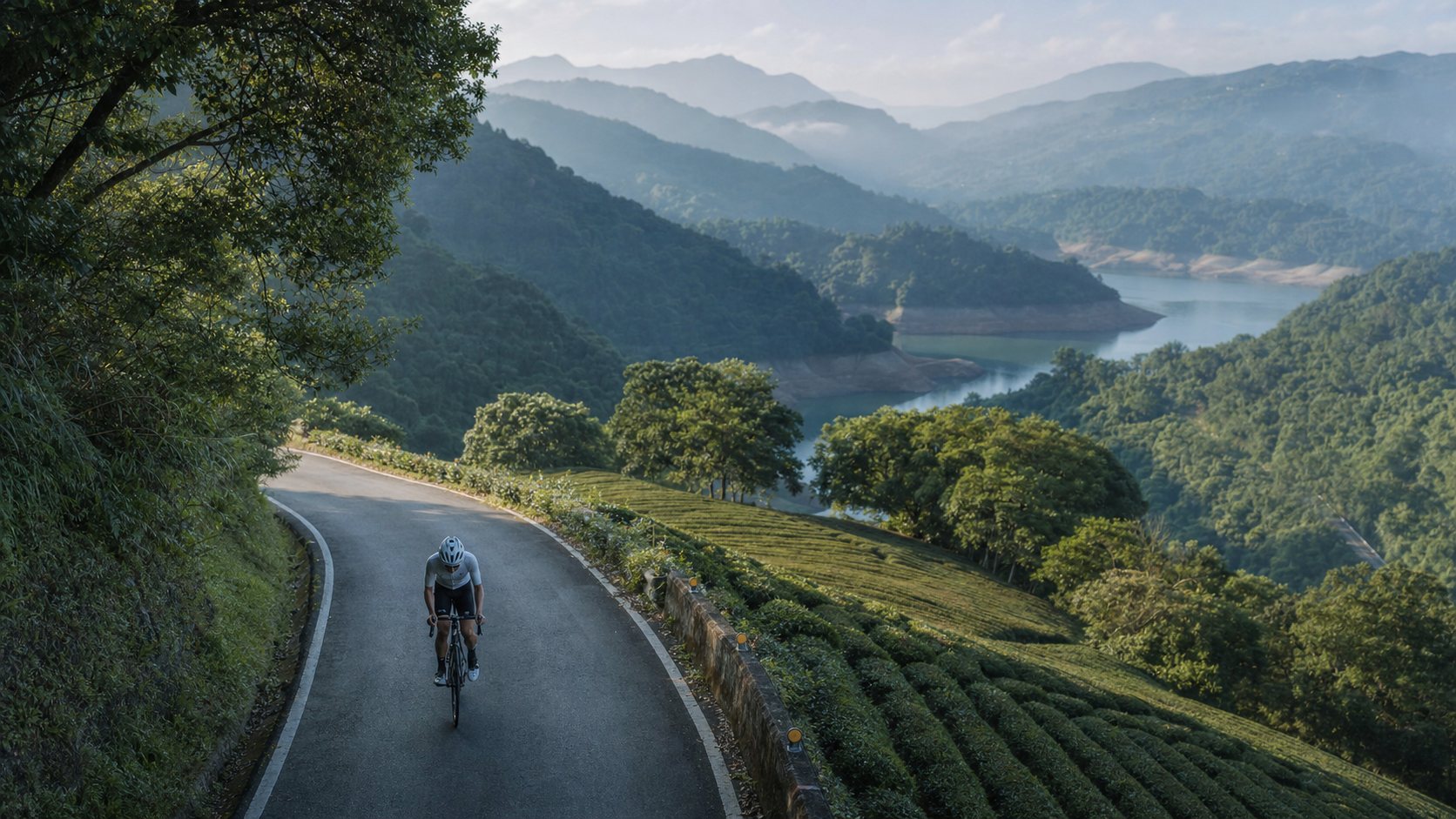
That morning, I barely hesitated before turning my handlebars toward Pinglin. I hadn’t arranged any riding partners, nor had I specifically researched just how tough this County Road 42 would be. All I knew was that it lay hidden on an unremarkable fork in the mountainous terrain of Pinglin—short in distance, yet rumored to have gradients that catch you off guard. Before riding in alone, my thoughts were actually quite simple: I wanted to find a road where no one would accompany me and no one would disturb me, quietly surrendering myself to the mountain.
1. A Pristine Land Protected by the Reservoir Watershed
To understand Pinglin, you first have to understand its inseparable relationship with the Feitsui Reservoir. The Beishi River flows through Pinglin before eventually emptying into the Feitsui Reservoir, which serves as the most important source of drinking water for the greater Taipei area. Precisely because nearly the entire administrative district of Pinglin falls within the protected watershed of the reservoir, local development has been strictly restricted for years. This has unexpectedly allowed this mountain town to retain a sense of purity that has become increasingly rare in the outskirts of Taipei and New Taipei—no excessive commercial development, no congested traffic, only layer upon layer of mountain ridges, the winding Beishi River, and tea gardens quietly growing on the slopes.
Before riding into Pinglin, I spiraled upward along the Beiyi Highway (Provincial Highway 9). This road itself is a renowned classic route in Taiwan’s road cycling world, where countless Taipei cyclists had their climbing initiation. But today, my goal wasn’t the main Beiyi line, but rather the County Road 42 that branches off and delves deeper into the mountains—an industrial road whose very name carries a hint of mystery.
2. The Hometown of Pouchong Tea: Another Identity of Pinglin
When mentioning Pinglin, most people’s first thought is likely “Wenshan Pouchong Tea.” Pinglin is one of Taiwan’s important pouchong tea-producing regions. Its hilly terrain, combined with a year-round humid climate, happens to create an ideal environment for tea plants to thrive—which also explains why the reservoir protection policy, while restricting development, hasn’t strangled the local economic lifeline. Instead, the tea industry has become the most representative way for Pinglin’s residents to coexist and prosper alongside this mountain forest.
Riding along County Road 42, scattered tea garden viewpoints dotted the slopes along the way. The neatly arranged dark-green texture of the tea bushes formed a subtle layered contrast with the deep green of the surrounding secondary forests. I didn’t deliberately stop to study which tea garden belonged to which household; I simply let my gaze sweep across those green terraces as the gradient rose and fell, imagining how bustling the scene would be during tea-picking season (for actual tea garden distribution and harvest season activities, please refer to on-site or official announcements). This faint trace of human culture, mixed with the nearly untouched wilderness of the mountain forest, constitutes the unique character of the Pinglin mountain area—neither pure wilderness nor an overdeveloped tourist zone, but rather an exceptionally rare state of balance between the two.
3. Solitude on the Slope: A Dialogue Between One Person and the Steep Grade
The entrance to County Road 42 is unremarkable. If you hadn’t noted it in advance, it would be easy to ride right past it. After turning in, the road begins climbing almost immediately, and the way it climbs is anything but gentle—before long, the gradient steepened without warning, forcing me to immediately shift down and stand up to power through. It was in that moment that I truly realized this road’s temperament was far more stubborn than I had imagined.
Riding alone on a steep slope with such dramatic gradient changes creates a very peculiar psychological state. Without companions’ laughter to distract you, the only sounds in your ears are your own heavy breathing and the subtle mechanical noise of the chain over the cassette. Every time the gradient suddenly steepens, the body’s instinctive reaction is panic—but panic is useless. You can only rely on yourself, telling yourself again and again: slow down the cadence, steady the breathing, pull your focus back to the short stretch of road right in front of you, and don’t think about how much farther there is to go. This process of complete self-dialogue is an experience that group riding can hardly replicate. In such moments, solitude isn’t a negative emotion; it’s more like a forced honesty—you can’t rely on someone else’s rhythm to carry you through; you can only honestly face your own limits in the present moment.
When I reached the steepest section of the climb, I even briefly wondered whether I had taken the wrong road—the difficulty of this route was clearly out of all proportion to the “county road spur just over 5 kilometers long” I had originally imagined. But it was precisely in that moment, gasping for air, unable to speak, able only to grind out pedal stroke after pedal stroke on sheer willpower, that I suddenly understood why some cyclists are obsessed with these lonely hard battles—they force you to confront your most authentic, unvarnished state. That naked focus is something you’ll never find in your comfort zone.
4. Clouds, Mist, and Silence in the Watershed
The weather in the Pinglin mountains always carries an elusive dampness. That day, the sky was still fairly clear when I set out, but by the middle section of County Road 42, a thin layer of mist began drifting through the valleys, blurring the distant ridgelines into a hazy ink-wash painting. Pinglin has long been known for its frequent rain, which is inseparable from its geographical characteristic of being in a reservoir watershed with consistently high humidity—the moisture nurtures the tea bushes, and it also nurtures this mountain forest’s unique atmosphere where fog can roll in at any moment.
Riding up the steep slope as the mist thickened, my field of vision was narrowed to just a few dozen meters of road ahead, which paradoxically made me even more focused on the pedaling itself. There were no other cyclists around, no traffic—only the occasional birdcall piercing the silence. That feeling of being alone in a mist-shrouded mountain forest carried a hint of unease, yet also an indescribable serene beauty—as if the entire mountain consisted of nothing but me and this endless climb ahead.
5. The Watery Glimmers and Terrain Textures of the Beishi River Valley
On the slightly gentler sections of the gradient, I could occasionally catch glimpses of the winding, glistening waters of the Beishi River valley, appearing and disappearing between the mountain ridges. Pinglin’s terrain is actually quite typical—streams have carved out deep valleys, flanked on both sides by layer upon layer of hills. Roads like County Road 42 often climb along a ridgeline or valley wall, which is why the gradient alternates between steep and gentle in what seems like a patternless fashion. This kind of terrain, in fact, echoes the contradiction between the official data’s total elevation gain and average gradient for this route—because it was never a simple, uniformly graded climb, but rather a hilly path that rises and falls with the contours of the mountains.
Riding through terrain like this, it’s hard to understand a road’s true character through “averages,” just as you can’t sum up a person’s life in a single sentence. Every change in gradient after each turn is the mountain forest, in its own way, telling you about the complexity and truth of the terrain itself.
6. A Quiet Route That Nobody Visits
Pinglin’s County Road 42 is clearly not a popular tourist route. Throughout the entire ride, I encountered almost no other cyclists or obvious signs of human activity—only the occasional one or two houses perched on the slopes, quietly blending into the surrounding greenery. This state of being “unvisited” is, for cyclists accustomed to the constant traffic on popular routes near Taipei and New Taipei, actually a luxury. No check-in spots with queues for photos, no competitive atmosphere of overtaking each other—just you, your breathing, and this seemingly ordinary industrial road that hides its secrets beneath the surface.
I gradually came to understand that this quietness might be an unexpected gift of the reservoir watershed protection policy—because development is restricted, the area hasn’t been packaged into a tourist attraction, and thus retains the most original, most unadorned appearance of the mountain forest. For travelers seeking lively check-ins, this place might not hold much appeal; but for cyclists like me, who just want a place to honestly face their physical limits and honestly coexist with solitude, County Road 42 has become the ideal destination.
7. The Pinglin Mountain Town Through the Turning Seasons
Each season in Pinglin has its own charm. In spring, new buds sprout in the tea gardens—it’s the season for picking spring tea, with the busy figures of tea pickers dotting the slopes (actual harvest schedules depend on that year’s climate); in summer, the mountains are lush and verdant, cicadas call out from all directions in the hot, humid air, and afternoon convective showers are especially common, so it’s advisable to set out before the afternoon; in autumn, the air is clear and crisp—the best visibility of the year for visiting Pinglin, ideal for itineraries combining photography and relaxed riding; in winter, the northeast monsoon brings persistent damp, cold drizzle and fog, making Pinglin’s reputation as a “rainy mountain town” especially real during this season, and riding difficulty increases considerably due to slippery roads.
The season I visited that day, the mountain forest was in full deep green, not yet at the busiest time of tea picking, but I could already sense the long-accumulated rapport between this land and its tea bushes—not a deliberately cultivated tourism resource, but a way of life deeply rooted in the soil and climate.
8. Relief at the End of the Steep Slope
When I finally rode past the steepest section of County Road 42, the gradient began to ease, and my breathing gradually found its rhythm again. Looking back at the mountain path I had just climbed, what welled up inside me wasn’t the sense of accomplishment of having “conquered” something, but a deeper sense of relief—as if I had engaged in an honest, almost naked dialogue with this road and with my own body, and neither of us had lied.
Perhaps the most precious part of solo riding is precisely this experience that cannot be shared, yet feels extraordinarily real. No one will see you almost getting off to walk your bike at the steepest switchback, and no one will hear the words of encouragement you say to yourself when you can’t catch your breath—all of it belongs only to you and this road. This intimacy makes every solo ride an unrepeatable personal memory.
9. Some Reminders for Travelers Planning to Visit Pinglin
If you’d also like to visit this mountain town of Pinglin, besides challenging steep county roads like Route 42, the old street in Pinglin’s town center and the Pinglin Tea Museum are also worth a detour, offering a more complete understanding of the local tea-making culture and historical context (for actual opening hours and exhibition content, please refer to official announcements). The old street retains many traditional tea shops, perfect for sitting down for a cup of tea after the ride, letting your legs and mind, both tense all day, properly unwind.
Since Pinglin is located in a reservoir watershed, shops and supply points along the mountain roads are relatively limited. If you’re planning a longer loop ride, it’s advisable to plan your supplies in advance rather than relying on luck for random resupply along the way.
10. The Meaning of Riding Alone: Not an Escape, but a Choice
I’m often asked why I enjoy riding alone, especially on routes like this one that aren’t even well-known and whose gradients might hide traps. My answer has never changed—riding solo isn’t about escaping people, but about making an active choice: choosing, at certain moments, to completely surrender yourself to a road, a gradient, a rhythm that only you can feel. Group riding has its own unique joys and warmth, but what solo riding offers is a purer space for self-dialogue, allowing you to honestly face your current physical condition and mental resilience without any interference from others.
A route like County Road 42, with its contradictory gradient data and dramatically undulating terrain, happens to provide the perfect arena for this dialogue—it’s short enough that you won’t lose your way in solitude; it’s steep enough that you must be fully focused, with no spare mental energy for anything else. This solitude of just the right intensity is something I’ve never been able to find on many popular tourist routes.
11. In Closing: A Hidden Steep Slope for the Few
Pinglin’s County Road 42 will probably never make it onto Taiwan’s rankings of popular climbing routes—it’s too short, too obscure, and its terrain data even carries confusing contradictions. But it’s precisely these “imperfect” qualities that make it a hidden gem belonging to the few. If you’re tired of the endless stream of cyclists on popular routes, if you’re looking for a lonely steep slope where you can honestly face your physical and mental state, Pinglin’s County Road 42 might be worth a dedicated trip.
After finishing the ride that day, I found a spot at the top of the slope where the shoulder opened up slightly, sat quietly for a few minutes, and gazed at the mist-shrouded mountains and valleys in the distance. No one knew I had been here, and no one would care that I nearly gave up on the steepest section—but these moments, which belonged only to me, became images I would revisit again and again on many tiring days afterward, reminding myself, “You can endure more than you think.”
12. A Reflection on This Land
The fact that Pinglin has been able to maintain its nearly pristine appearance today is, to some extent, thanks to the reservoir protection policy—local residents’ development has been restricted, yet this has unexpectedly preserved the land’s most precious purity. This trade-off of sacrificing local development for overall water security may not have been an easy choice for Pinglin’s residents, but for occasional visitors like me, it means being able to find a piece of pure land in the outskirts of Taipei and New Taipei that still retains the original spirit of the mountain forest.
Riding on roads like County Road 42, I often think that perhaps it’s precisely because this place hasn’t been overdeveloped that every cyclist who comes here in good faith can experience that unvarnished, most authentic terrain challenge and natural landscape. This authenticity is far more precious than any carefully packaged tourist route.
13. Conclusion: What the Steep Slope Taught Me
5.1 kilometers—on paper, it sounds trivial. But that day on Pinglin’s County Road 42, I spent far more time than expected and used far more energy than expected just to ride this road to completion. What this road taught me, perhaps, isn’t just about pacing or gear selection, but a more fundamental reminder—don’t easily trust any single number, whether it’s the average gradient in route data or someone else’s “this isn’t that hard” in life. Some things, you have to pedal up yourself, gasp through yourself, endure through the steepest switchback yourself, before you know their true weight.
If you’re also ready for an honest solitude, find a quiet weekday, turn your handlebars toward Pinglin, and turn onto County Road 42—this unremarkable-looking county road that hides its secrets. Perhaps, like me, you’ll encounter a more honest and more resilient version of yourself on some breathless steep switchback. May every cyclist who reads this find their own answer on their own lonely steep slope.
14. The Waiting and Patience in the Scent of Tea
Pinglin’s tea farmers often say that good tea requires time to wait—from planting the tea bush to the first harvest often takes years, and each season’s tea leaves must go through complex processes of picking, withering, fermentation, and roasting before becoming that sip of sweet aftertaste in your cup. This respect for “waiting” is, to some extent, perfectly aligned with the mindset required to ride a steep slope like County Road 42. You can’t use brute force to shorten the time needed for the climb, nor can you use impatience to skip past the hardest steep section in the middle. The only thing you can do is be patient, pedal round after round, and let your body adapt to the gradient ahead at its own rhythm.
I often feel that this land of Pinglin itself seems to be silently conveying a life philosophy through its tea industry—you can’t go fast, and you can’t rush. Whether it’s the fermentation time of tea leaves or the gasping and soreness a cyclist must endure on a steep slope, there are no shortcuts. That day on County Road 42, gasping and unable to speak, I suddenly thought of the patience required to nurture good tea in this mountain town, and I felt a strange resonance between my own struggle at that moment and the character of this land.
15. A Sound Map in the Silence
Riding alone on such a quiet mountain road, your hearing becomes extraordinarily acute. Without the roar of traffic engines or the chatter of companions, what replaces them is an entire “sound map” composed of natural noises—the rustling of wind through bamboo groves, the calls of unidentified birds echoing through the canopy, the occasional distant dog bark or rooster crow hinting that people still live nearby. On the steepest section of the climb, even my own heavy breathing and heartbeat became clearly discernible, as if the sounds from inside my body had also joined this map.
This amplified auditory experience is something urban riding can never provide. The sounds in the city are too crowded, various noises overlapping and covering each other, making it impossible to hear the true character of any single sound; but on sparsely populated roads like those in the Pinglin mountains, every sound is clear and distinct, as if the entire mountain forest, in its own language, is layer by layer revealing its presence to the solitary traveler. That day, on the section approaching the top of the slope, a gust of wind blew through, and the rustling of bamboo leaves drowned out my panting. The serenity of that instant is still vivid in my memory.
16. A Letter to Myself: On the Next Visit
Writing to this point, I’d like to conclude this article in a more personal way—by writing a short letter to the version of myself who will next visit County Road 42. If you (future me) ride this road again, I hope you still remember that switchback where you gasped and nearly wanted to give up, remember that lonely yet honest psychological state, and remember that sense of relief after reaching the top—something that couldn’t be shared with anyone, yet felt extraordinarily real. Whether your fitness has improved or slightly declined by then, there’s no need to compare too much with today’s self—every time you ride this road, it’s an independent, honest dialogue belonging to that moment’s state, without needing to carry the baggage of any past performance.
I also hope that by then, you’ll still be willing to set out alone, still willing to surrender yourself to this quiet county road with its contradictory gradients and dramatically undulating terrain. Because in the end, perhaps the most precious part of cycling has never been conquering a particular route or setting a particular personal best, but rather how these lonely, honest moments help us, time and again, rediscover ourselves.
17. Afterword: For All Cyclists Searching for Solitude
If you’ve read this far and still feel hesitant about “riding a steep slope alone,” I want to tell you that solitude is never something to fear. It’s simply an honest mirror, reflecting the details you tend to overlook when you’re in a group—your own breathing rhythm, your own physical limits, your most authentic reactions when facing unknown terrain. With its confusing data, dramatically undulating gradients, and nearly isolated tranquility, Pinglin’s County Road 42 unexpectedly became the most fitting arena for my journey in search of solitude. May you also find, on some road of your own, a stretch of time worth revisiting again and again—time spent honestly coexisting with yourself.
Related Reading
- Shiding and Pinglin Tea Country Ride: Mountain Road Experiences of Northern Taiwan’s Tea Culture
- A Secluded Long Climb Off the Beaten Path: Solitary Moments on County Road 47 and the Shiding-Pingxi Mountain Trails
- Maokong Zhanghu Traverse: Rediscovering the Original Joy of Cycling Between Tea Aroma and Clouds
- Riding into Zhongliao Erjian Mountain: Searching for Taiwan’s Quietest Climb in a Tea Town Reborn from the 921 Epicenter
4K單車實境) 嘉義 梅山36灣 訓練台 爬坡 輕鬆騎
6 年前
一定要騎一次!阿里山最深處:里佳部落!單車旅行 | 2800m爬升 | 深度部落體驗:嗨翻晚會、螢火蟲、銀河 | feat. JJSC & 廢物伙伴 | 公路車 CT Yeh
10 個月前
嘉義單車路線推薦:碧湖山茶園超陡坡挑戰!里佳部落-奮起湖-瑞峰 (附路線)
7 個月前
大武山後門26%歡樂陡坡!JJSC南台灣單車行Day2 / 被颱風追著跑 / 公路車 / CT Yeh
2 年前
北宜騎車⋯好刺激 差點被🐒尻 / 露營單車旅 / 公路車後背攜車架開箱!/ 百人大團露 / YAKIMA 設備開箱儀式感都來了 / 公路車 / CT Yeh
12 個月前
#北橫 + #北進武嶺 最硬的員工旅遊 EP1 | #公路車 #拉拉山 | 明池 | 武嶺 | 武陵農場 | 雲海 | Taiwan Cycling Route Wulin
6 年前
風櫃嘴 | 全台最多大砲的單車路線 | 尋寶網攝影師告訴你怎麼擺拍起來才好看 | 熱門攝影地點巡禮
6 年前
藤枝二集團 單車行 Day1 | 南部小武嶺 | 爬坡爬到罵罵叫 | JJSC | 公路車 | CT Yeh
3 年前