Riding into the Mist: A 14-Kilometer Journey Slowly Ascending to Fenqihu Old Street
The Mountain Town’s Name Holds a Story Woven from Land, Water, and Time
Nestled deep in the Chiayi mountains around the Alishan Highway system, Fenqihu is a name that always leaves first-time hearers puzzled—despite being situated in the mountains, it bears the word “lake” (hu) in its name. In reality, Fenqihu is not an actual lake at all. Rather, because the local terrain is high on all sides with a sunken center, resembling a dustpan (benji), it was originally called “Benjihu” (Dustpan Lake) in earlier times. Through phonetic resemblance and refinement, the name gradually evolved into the “Fenqihu” we know today. This kind of naming born from topography can be seen in many mountain settlements across Taiwan, and behind it lies the most direct, unadorned observation and description of the surrounding environment by our ancestors.
Riding this 14.03-kilometer climb with an average gradient of 5.9%, the endpoint is precisely this mountain town at an elevation of approximately 1,400 meters. On Strava, this route is registered as a Category 5 long-distance climb—its distance alone already exceeds many popular routes, and the destination it leads to carries over a century of industrial and cultural memory from the Alishan Forest Railway. This makes the ride, from the very start, more than just a physical challenge; it feels like a journey through time, through elevation, and through the limits of one’s own endurance.
Some roads exist for the sake of arrival, while others exist for the journey itself. The Fenqihu Climb embodies both—the old street at the summit is well worth the anticipation, but the fourteen kilometers of ascending along the way is already the most moving part of the entire journey.
I have always been fascinated by this logic of “place names reflecting topography.” The dustpan is a tool intimately familiar in Taiwan’s early rural life, used for carrying soil, grain, and all manner of items that needed to be scooped and transported. The local ancestors used such a down-to-earth, everyday image to describe the terrain before them—mountains encircling on all sides with a sunken center. That intuitive, unembellished observation reflects a simple wisdom of living and breathing with the land. Compared to the many elegant place names bestowed later, the original name “Benjihu” gives me a deeper sense of connection to this land—it wasn’t a name planned for tourism, but one that genuinely grew out of lived experience.
And “Fenqihu,” the name refined through phonetic resemblance, coincidentally echoes the experience of this ride in a certain way. The characters “Fenqi” (to rise up with vigor) seem perfectly fitting for the terminus of a long climb that demands forceful pedaling and sustained effort against the gradient—as if, by some unseen design, this name born from phonetic evolution had already foretold that every rider must undergo a journey requiring true “rising up” and giving their all before arriving here.
Setting Out from the Foothills of Zhuqi
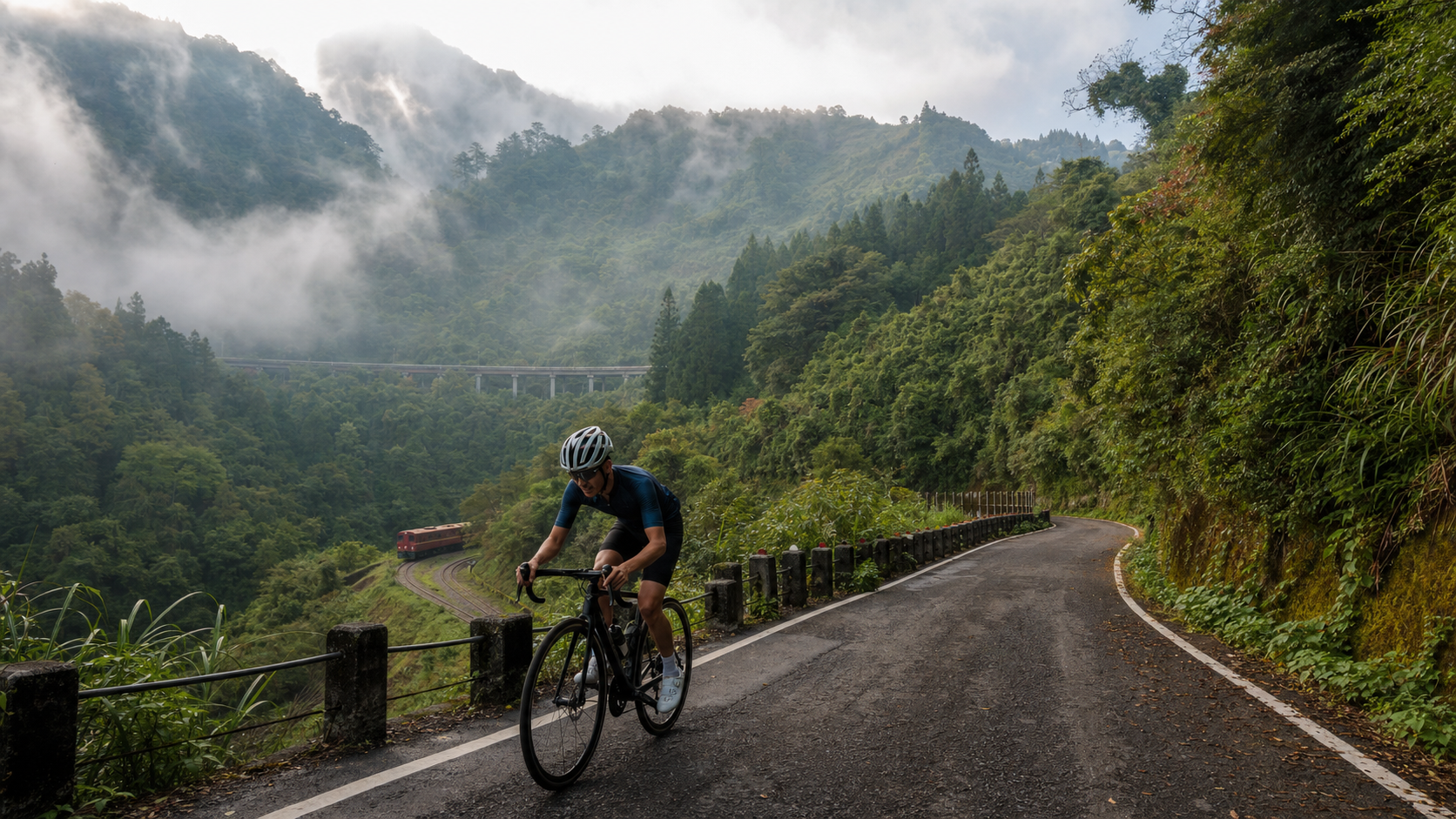
Setting off from the intersection at the foothills in the early morning, the air still carried the damp freshness of dew. The road before me wound upward, disappearing into the mist-shrouded mountains in the distance. Just gazing toward that direction where no end was visible was enough to sense the weight of the journey ahead. Fourteen kilometers might be a mere warm-up distance on flat ground, but when all fourteen are stacked onto a sustained gradient averaging 5.9%, the sense of magnitude is entirely different—this is not a sprint, but a journey demanding a long conversation with one’s own strength, patience, and even emotions.
The mountain region surrounding the Alishan Highway system has, since the Japanese colonial era, developed an industry chain centered on forestry, thanks to its abundant cypress and Taiwan hinoki forests. The Alishan Forest Railway was precisely the critical infrastructure built to transport timber. Fenqihu happens to sit at a midway station along this railway system, having once served as an important node for resupply and for travelers resting mid-journey. Because of this historical positioning, Fenqihu developed a unique mountain-town settlement culture. Similar settlement patterns arising from transportation hubs can be found in other mountain areas of Taiwan, but Fenqihu stands out as particularly representative, thanks to the dual reinforcement of the railway and its terrain.
Riding the road toward Fenqihu, this historical thread seems to quietly merge into the scenery before you—occasional traces of old forestry-related structures along the roadside remind riders of the industrial weight this forest once bore. Although cycling up the mountain today is purely for leisure and physical challenge, standing on the same ground, it’s hard not to imagine how bustling this place was a century ago—timber and supplies flowing through in an endless stream.
The Alishan Forest Railway itself is a historically significant feat of engineering. The terrain along its route is dramatically varied and rugged, winding from the Chiayi Plain steadily upward into the high mountain zone. Along the way, it employs unique spiral and switchback alignment techniques to overcome the steep terrain—an engineering marvel under the technological conditions of its time. Fenqihu Station sits at a relatively mid-point along this railway network. In the past, steam locomotives arriving here often needed to replenish water and fuel, which in turn drove the development of commercial functions in the surrounding settlement, gradually shaping the mountain-town appearance centered on the old street that we know today. This pattern of settlement development driven by railway transportation needs is, in a way, analogous to the logic of cycling routes being given new meaning through training demands—the need for transportation and movement is often the most primal and direct force shaping a place’s developmental trajectory.
Fourteen Kilometers of Physical and Mental Shifts
The most captivating yet grueling aspect of a long climb is that it gives you ample time to experience the full cycle of emotional and physical ups and downs. In the first few kilometers, the body still carries the freshness and drive of departure; the breathing rhythm hasn’t been fully disrupted yet. At this point, the mood is usually light, even somewhat excited—the mountain forest scenery keeps changing, and occasionally you catch glimpses of mist-wrapped peaks in the distance, making you want to slow down and take a few more looks.
After reaching the middle section, the body begins to settle into a sustained “working mode” of continuous effort. Muscle soreness gradually accumulates, and breathing becomes more rhythmic and focused. The mindset at this stage is subtle—neither as relaxed and pleasant as at the start, nor yet at the near-exhaustion agony of the later section. Instead, it’s a state in between, carrying a certain meditative calm. I often let my thoughts drift during this phase, allowing cadence and breath to synchronize naturally. The sounds of the mountain forest, the wind, and the occasional birdsong all become the background score accompanying this journey.
Entering the latter part of the route, the toll on physical energy becomes clearly reflected in riding performance. Speed unconsciously drops, and every pedal stroke demands more willpower. At this point, the image of Fenqihu Old Street becomes the most important mental anchor—imagining the steaming bowl of noodle soup upon arrival, the eagerly anticipated railway bento box, or the wooden buildings arranged in staggered fashion along the old street’s stone steps. These images become the fuel that carries me through the final kilometers. One thing long climbs have taught me is this: fatigue is never a linear accumulation. It fluctuates with your psychological state, and the image of the destination is often the most effective mental fuel.
There was one time, particularly exhausted in the later section, when I tried to recall the anticipation I felt when first planning this ride—repeatedly confirming the route on mapping software, researching Fenqihu-related information. Back then, merely imagining that one day I would personally ride to this mountain town I’d heard so much about was enough to fill me with motivation. And when that imagination truly materialized into the fatigue and sweat I was experiencing in the present moment, there was instead a strange sense of groundedness—all the armchair planning, in the end, must be redeemed into real experience through one step at a time, one pedal stroke after another. This process from imagination to realization is perhaps the most captivating aspect of long-distance challenges: it forces you to transform the blueprint in your mind into memories your body has truly endured.
Mountain Scenery Wrapped in Mist and Clouds
Because of its higher elevation and terrain that easily traps moisture, the mist and cloud landscape around Fenqihu is one of the area’s most representative natural features. While riding through the climb, you can clearly feel the climate gradually shifting as altitude increases—the hot, humid air at the foot of the mountain slowly gives way to cooler, fresher mountain air with every pedal stroke. On the sections near the finish, if the timing is right, you may even witness the dreamlike sight of clouds and mist flowing through the valleys and swirling around the treetops—a visual experience that flatland riding simply cannot compare to.
The area around the Alishan mountain range has long been renowned for its sea of clouds and sunrise views. Although the endpoint of the Fenqihu climb isn’t a dedicated sunrise-viewing spot, the hazy beauty of the mountain forests shrouded in mist is equally captivating. Especially in those moments when the weather clears after rain, with moisture still lingering in the valleys and sunlight piercing through the clouds to scatter across the layered ridges, those interplays of light and shadow often make me stop mid-climb, unable to resist pulling out my phone to capture the scenery—even though I know full well that no camera can truly do justice to the awe I feel in person.
The vegetation along the way also gradually changes with elevation, transitioning from the broadleaf forests common at lower altitudes to mountain flora with coniferous characteristics. This gradual ecological shift is a unique experience of long climbing routes—you’re not just battling the gradient; you’re also feeling an entire vertical ecological zone shift beneath your own two feet, a subtle layer of depth that’s completely lost when you reach the mountains by motorized transport.
I particularly enjoy paying attention to the subtle sensation of temperature dropping as elevation increases during the ride. At the start, I’m drenched in sweat, my cycling jersey already soaked through. But as I keep climbing, at some point I suddenly realize that the wind brushing past my cheeks has turned cool, even giving me goosebumps. This temperature transition has no clear boundary line, yet the body perceives it distinctly—as if reminding the rider that you are, step by step, leaving behind the sweltering routine of the lowlands and gradually entering a high-mountain world with a completely different climate. This gradual sensory shift, in a way, also symbolizes a shift in mindset—leaving the irritations and stuffiness of work and daily life below, bit by bit, behind you as the altitude rises.
The small settlements and scattered homes passed along the way add a touch of human warmth to the journey. Seeing crops drying under the eaves, flowers and plants growing in the courtyards, or exchanging brief nods of acknowledgment with local residents as you pass by—all of these moments give this ride, originally a purely physical challenge, an added layer of connection with local life. These seemingly trivial moments often turn out to be the most memorable and cherished parts of the journey when you look back on it—far more memorable than mere gradient and time data.
Arriving at Fenqihu: Where Old Street Meets the Railway
When the gradient finally eases ahead and the wooden buildings of the old street gradually come into view, that complex mix of exhaustion and accomplishment often leaves you speechless for a moment—all you can do is catch your breath and quietly savor this hard-earned arrival. Fenqihu Old Street developed around Fenqihu Station on the Alishan Forest Railway. Along the narrow stone-stepped walkway stand a variety of distinctive old wooden houses. This settlement pattern, born from the railway, preserves much of the look and atmosphere of early mountain-town life.
When Fenqihu comes to mind, many people immediately think of its railway bento culture. The bento tradition along the Alishan Forest Railway has a long history. As an important stopover along the railway, Fenqihu Station was a place where travelers would pause for a meal, gradually giving rise to a distinctive local bento food culture that has become a must-try experience for many visitors. As for specific shop choices and menu highlights, it’s best to rely on an actual visit and the information provided by the shops at the time—after all, this kind of local food culture evolves with time and business conditions. Visiting in person and savoring it slowly is the most authentic way to experience this mountain-town food culture.
The stone-stepped walkway of the old street itself is also well worth taking slowly. Having just completed the 14-kilometer climb, your legs may still be sore, but stepping onto the gently undulating stone paths of the old street actually serves as excellent recovery exercise—walking while soaking in the nostalgic atmosphere of the surrounding wooden buildings, watching travelers and locals pass by each other, that unhurried pace unique to mountain towns will unconsciously slow your breathing and heart rate, releasing the tension of the climb drop by drop.
Resting at a small shop by the old street, watching the travelers come and go—some are tourists who rode up on the Alishan Forest Railway, some are families who drove up, and here I am, jersey soaked through, helmet still hanging from the handlebar, having ridden up the most primal way possible—on my own two legs. This difference in how one arrives, in a way, gives me a different emotional connection to this mountain town—not a passive arrival delivered by transportation, but an active arrival earned through fourteen kilometers of effort, pedal stroke after pedal stroke. This sense of personal participation makes Fenqihu, for me, more than just a tourist attraction—it feels like a personal memory written in sweat.
And because my body still carries the fatigue from the climb, sitting by the old street to rest, my senses seem sharper than usual—the angle of shadows cast by wooden eaves, the faint sound of a railway whistle in the distance (if a train happens to arrive; please refer to official announcements for actual operating times), the subtle aroma of cooking food drifting through the air. These details that might normally pass by in a blink all feel remarkably vivid and three-dimensional in that moment. Perhaps it’s precisely because of the challenging climb that every sensory experience after reaching the destination is amplified and cherished, becoming especially vivid fragments of memory.
A Profound Lesson About Altitude and Distance
One thing that struck me deeply about this journey is the distinction between “elevation” and “climbing.” Fenqihu itself sits at an elevation of about 1,400 meters—a number describing the absolute height of a location. But the actual climbing I experienced riding here from the starting point is a different matter entirely. This distinction may seem like a mere detail of definition, but after experiencing this ride firsthand, I truly came to understand that every bit of fatigue and soreness the body feels corresponds to “relative climbing” rather than “absolute elevation”—even though Fenqihu’s elevation figure sounds impressive, what truly determines the difficulty and suffering of this ride is where you start and how much elevation difference you actually climb, not how high the destination itself stands. This is a lesson I only truly understood after pedaling through those fourteen kilometers myself.
In a way, this insight also serves as a metaphor for life—we often get intimidated by some seemingly daunting “destination elevation” and hesitate to even start, but what we truly need to face and overcome is simply the distance and elevation difference beneath our own feet, from start to finish, that must be walked step by step and pedaled stroke by stroke. What the Fenqihu climb taught me isn’t just how to pace myself or how to refuel—it’s this pragmatic mindset for facing challenges.
On the descent back, I often find myself unconsciously slowing down. Partly because long descents require extra caution with speed control, but also because I want to give myself more time to re-experience this route from a different direction and perspective. On the way up, focused on pacing and energy management, many details along the way go unnoticed. On the way down, though the speed is faster, the mindset is much more relaxed, allowing me to appreciate the mountain scenery that once had me drenched in sweat and grinding away, almost from an observer’s perspective. This stark contrast in mindset between the outbound and return legs is the dual gift unique to long, big-climb routes—you don’t just complete a challenge; you also come to know the same land anew through two completely different perspectives.
Suggested Stops and Conclusion
If time permits, consider lingering a while longer on Fenqihu Old Street after completing the challenge to soak in the uniquely unhurried pace of life in this mountain town, or take the Alishan Forest Railway shuttle train to experience the charm of this century-old rail line (please refer to official announcements for actual schedules and service status). Whether it’s simply having a hot meal to replenish your energy or strolling along the stone steps of the old street while admiring the wooden architecture along the way, these experiences will make this 14-kilometer long climb feel all the more complete and memorable.
If, like me, you rode up to this mountain town on your own two legs, take a moment to notice the other cyclists around you who are equally out of breath and have just completed the challenge. Exchange a knowing smile or a nod of acknowledgment—that is a bond and mutual respect that can only be truly understood by those who have personally endured the same gradient, the same sweat, and the same fourteen kilometers of long, grinding ascent.
From the foot of the mountain all the way up to Fenqihu at an elevation of roughly 1,400 meters, this journey tests not only your physical endurance and willpower, but also reads like an immersive journey through natural ecology and human history. May every cyclist who has read this far and is preparing to take on this route find their own unique story of encountering this mountain town amidst the mist-shrouded forests, and may you, after finishing the ride, be able to sit in a corner of the old street like I did—drenched in sweat yet filled with emotion and a sense of fulfillment—quietly savoring this hard-earned journey.
Related Reading
- Fenqihu, Chiayi: A Bicycle Route Through the Railway Town at the Foot of Alishan
- Chiayi Alishan Highway Cycling: The Classic Climb from Zhuqi to Fenqihu
- The Complete Guide to the Fenqihu Big Climb: A 14.03 km, 5.9% Average Grade Long-Distance Trial, and a Data Misconception About “Climbing”
- Chiayi Alishan Highway: The Complete Guide to the Long-Distance Climb from Zhuqi to Alishan
梅山36彎 奮起湖 單車挑戰 下集 #公路車
6 年前
梅山36彎 奮起湖 #公路車 之旅 2400m
6 年前
一定要騎一次!阿里山最深處:里佳部落!單車旅行 | 2800m爬升 | 深度部落體驗:嗨翻晚會、螢火蟲、銀河 | feat. JJSC & 廢物伙伴 | 公路車 CT Yeh
9 個月前
4K單車實境) 嘉義 梅山36灣 訓練台 爬坡 輕鬆騎
6 年前
嘉義大埔、阿婆灣挑戰賽,美到以為在日本!ft. 環騎5 Cool 西拉雅188 / 公路車 / CT Yeh
7 個月前
阿里山塔塔加 兩倍特濃版!全新隧道開通! 進喔!公路車 | CT Yeh
3 年前
新竹羅平 x 天湖部落 大禹嶺級變態陡坡! 4K超高畫質 空拍 | 公路車
5 年前
嘉義單車路線推薦:碧湖山茶園超陡坡挑戰!里佳部落-奮起湖-瑞峰 (附路線)
7 個月前