36 Curves, 36 Conversations with Yourself: The Road Marvel and Riding Philosophy of Meishan's 36 Bends
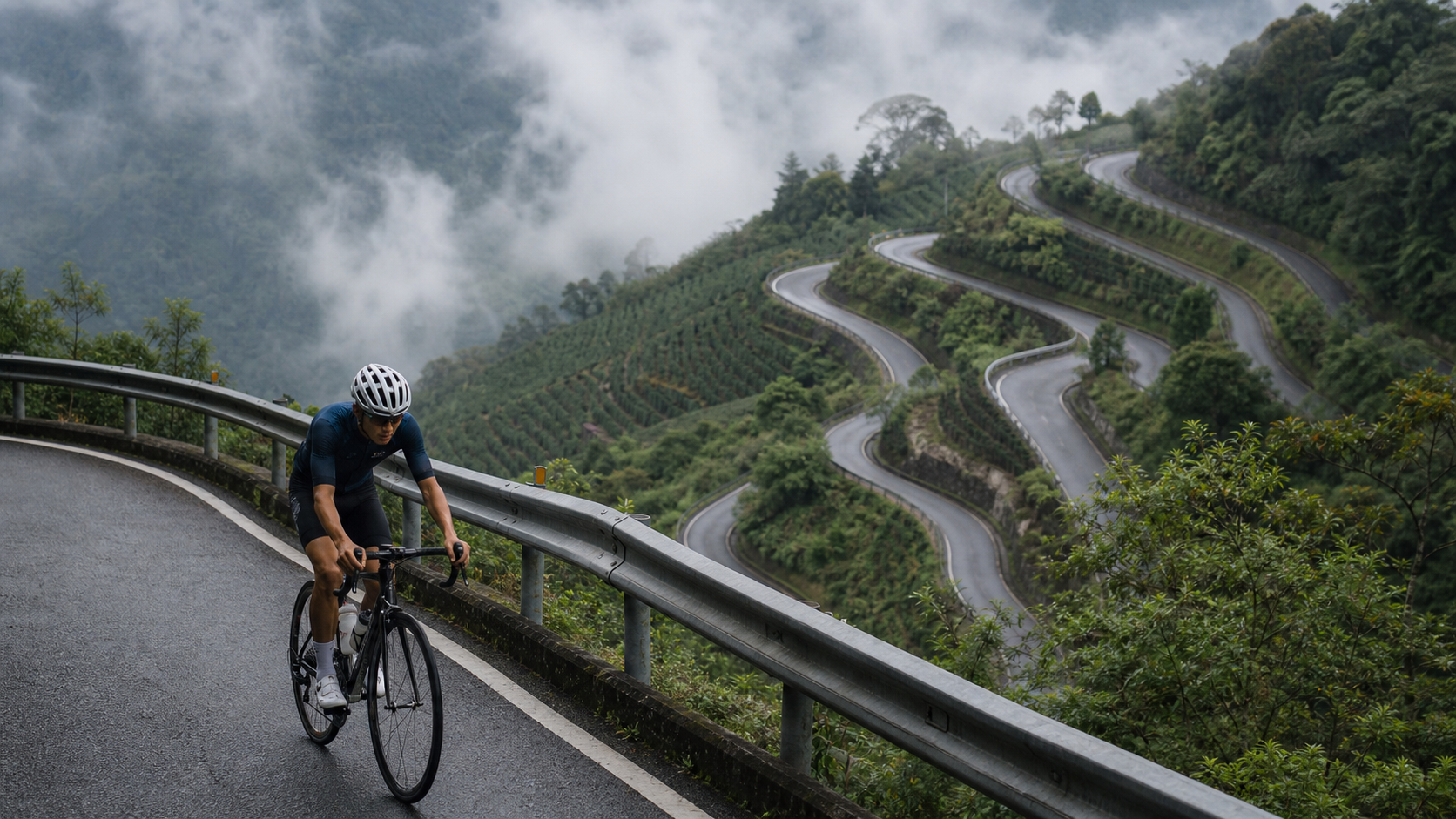
The Most Dramatic Stretch of Curves on Taiwan’s Highways
Some roads, just by hearing their name, carry a unique aura of their own. Meishan 36 Curves, also known as Meishan 36 Bends, is exactly that kind of road. Located in Meishan Township, Chiayi County, it is one of the most iconic landmark sections of Provincial Highway 18 (Alishan Highway) and a road spectacle almost universally known among cyclists and motorists across Taiwan. A distance of 11.84 kilometers with an average gradient of 6.4%—put those two numbers together and it’s already clear this isn’t a climb you can conquer casually. But what truly made it famous across Taiwan isn’t the gradient itself, but those thirty-six continuous hairpin turns stacked layer upon layer, extending deep into the mountains. Meishan Township sits in the mountainous northeastern region of Chiayi County, where “rugged peaks and steep, swift streams” are the most defining geographical features of this land, and the 36 Curves are precisely the most direct—and most spectacular—manifestation of such terrain conditions in highway engineering.
I often think that for a road to earn a name as specific and vivid as “36 Curves” means it has already transcended its purely functional role of transportation, becoming a cultural symbol and a vessel of collective memory for a place. Many mountain roads in Taiwan have steep grades and curves, but few can mark each bend with a clear number like Meishan 36 Curves, allowing every passerby to personally feel the “ritual sense that numbers bring.” It is precisely for this reason that this road is not only a pilgrimage destination for cycling enthusiasts, but also a shared road memory for many travelers driving cars or riding motorcycles along the Alishan Highway. Everyone likely has their own version of the 36 Curves story—some come chasing the sea of clouds, others simply want to test their physical limits, and my version has been slowly accumulated through one cycling challenge after another.
The Shock of Seeing the 36 Curves for the First Time
I will never forget the scene when I first rode near the entrance of Meishan 36 Curves. Looking up from the foothills, the road winding across the entire mountainside looked like a ribbon that had been crumpled up and then spread out again, layer upon layer, extending upward to heights my eyes could barely track. The sheer visual impact is so intense that even if you’ve already seen countless aerial photos online beforehand, the moment you see it in person, you can’t help but catch your breath and stand there stunned for a long while. The first thought that crossed my mind was: this doesn’t look like a road carved out by humans at all—it’s more like some strange compromise and balance achieved through a long-term struggle between nature and engineering skill.
Before riding into the first curve, I deliberately paused at the intersection for a few minutes, staring at the sign marking the curve number, silently calculating in my head that what lay ahead was a grueling endurance and willpower battle spanning thirty-six rounds. This psychological state of “knowing the enemy’s numbers in advance” is actually quite subtle—on one hand, you know exactly how much farther you have to go, without the uncertainty of facing a climb with unknown mileage; but on the other hand, when you watch that number climb from 1 all the way to 36, that sense of endlessness can sometimes be even more torturous than a slope with no markers at all.
That day, two cycling friends I’d known for years joined me in tackling this route. The three of us agreed not to rush each other or deliberately compare speeds—we simply wanted to ride this legendary route in its entirety, each at our own pace. Before setting off, the three of us made a point of taking a commemorative group photo in front of the sign at the first curve. That photo later became one of the most revisited images in my phone’s gallery—not because the composition was particularly refined, but because the expressions on the three faces in the photo, a mix of anticipation and slight nervousness, perfectly captured the most genuine and moving psychological state right before embarking on an unknown challenge.
The Struggle Between Highway Engineering and Terrain
The reason Meishan 36 Curves took the form of continuous hairpin turns is essentially a route design strategy that engineers were forced to adopt when facing the steep, swift terrain of Meishan Township. To carve a road safe for both cars and freight vehicles on such a precipitous mountainside, it was necessary to use repeatedly folding hairpin turns to extend the actual driving distance and reduce the elevation change per unit of distance—a classic and highly practical technique in mountain highway engineering, embodying the wisdom born from a long-term contest between engineering and natural terrain. Provincial Highway 18 (Alishan Highway) itself, as a vital access road connecting Chiayi City with the Alishan Scenic Area, has long carried heavy demand for tourism, industry, and daily livelihood transportation, and Meishan 36 Curves is precisely the most representative section of this important artery in terms of engineering difficulty and terrain challenges.
I cannot definitively verify the exact year this road was originally built or the complete historical details of its subsequent improvement projects. For readers interested in digging deeper, I’d suggest consulting official materials from the highway authority or local cultural and historical units—I don’t want to fill historical gaps with unverified speculation here. But what I can say for certain is that every time I ride through these curves, I can’t help but feel a sense of respect for everyone who participated in this project back then—planning a route that balances safety and traffic efficiency on such steep, complex mountain terrain is by no means an easy task, and that engineering wisdom has now become a classic challenge route that countless cycling enthusiasts consider worth revisiting again and again.
Every time I ride these curves, I can’t help but imagine how the engineers of that era, without modern precision surveying and computing tools, walked step by step across this steep mountainside to survey and determine the best route alignment. This imagination, in a way, also gives me a deeper sense of reverence for this land and human engineering ingenuity during my rides. A highway is not just cold asphalt and guardrails—it carries the labor, planning, and sacrifice of an entire generation, and we riders who later enjoy the thrill of this road’s challenges are, in a sense, both beneficiaries and witnesses of this historical narrative. Provincial Highway 18 (Alishan Highway), as a vital artery connecting the Chiayi Plain with the high mountain region of Alishan, has carried over the years not just the endless stream of tourist traffic, but also the daily needs of residents along the route—livelihood transportation, agricultural produce shipping, emergency rescue, and more. Meishan 36 Curves is precisely the most visually stunning, yet most engineering-demanding, critical section along this lifeline.
Solitude and Dialogue Between the Curves
Riding through continuous hairpin turns is, in a way, a completely different experience from climbing a straight road. On a straight climb, you face a continuous, linearly accumulating distance and gradient; but on the 36 Curves, each bend feels like an independent little checkpoint with its own start, apex, and finish. You have to constantly adjust your cadence, power output, line of sight, and center of gravity within extremely short intervals. This constantly shifting rhythm turns the entire ride into a series of brief yet intense conversations with yourself.
I remember reaching around the twentieth-something curve when my energy had clearly dropped. The soreness in my legs began spreading from localized spots to my entire thighs, and my breathing had become rapid and heavy. At that moment, gasping for air, I found myself bargaining with my own mind: “Just hold on for one more curve,” “Once I get past this bend, I’ll stop and catch my breath.” This almost self-muttering inner dialogue might sound a bit ridiculous, but it was precisely this psychological strategy of breaking down a massive goal into tiny, achievable milestones that ultimately got me through that toughest middle-to-late stretch. Looking back afterward, that process of self-dialogue left a deeper impression on me than the riding itself—it made me realize that long-distance, high-intensity exercise has never been just about testing muscles and cardiovascular capacity; it’s about how a person, in a state of extreme exhaustion, can still maintain patience and trust in themselves.
One of the riding companions on that trip nearly ran out of energy around the twenty-ninth curve and briefly got off his bike to walk a short stretch. I slowed down to stay beside him, without saying much in the way of encouragement—I just quietly matched his pace. After about two or three minutes, he got back on his bike, took a deep breath, and continued climbing. Later he told me that that forced walking time actually helped him rediscover a sense of groundedness—not every challenge has to be completed flawlessly; sometimes allowing yourself to slow down, or even pause, at a certain moment before starting again is equally a way of completing a challenge—and perhaps a more authentic, more human one. That little episode later became one of the shared memories the three of us often revisit and savor together.
A Visual Theater in the Hairpin Turns
Beyond the grueling physical test, what fascinates me most about the 36 Turns of Meishan is the rich sense of visual layering it presents. With every turn, the viewing angle shifts subtly—sometimes you catch distant mountain ridges appearing and disappearing through the clouds and mist, other times the deep valley below suddenly unfolds before your eyes. This experience of the landscape continuously transforming as you climb in elevation is something you simply cannot feel when riding on flat ground.
I especially enjoy re-challenging this route on days when the sky is clear and the clouds haven’t yet fully engulfed the mountain peaks, because under those visibility conditions, you can clearly see the path you’ve already traveled, winding and coiling along the mountainside. That visual experience of “turning back to see the trail you’ve left behind” brings a sense of accomplishment far more profound than merely glancing at the distance reading on your cycling computer. Of course, mountain weather is unpredictable, and conditions of heavy cloud cover and poor visibility are common. For this, I’d suggest adjusting your expectations based on the actual weather of the day, and not obsessing over catching the perfect moment of optimal visibility—after all, the scenery of continuous clouds and mist swirling around the mountains possesses its own hazy, mysterious beauty.
Once, I took on the 36 Turns close to the afternoon. The sky had been clear, but around the fifteenth turn or so, a thin fog began to rise slowly from the valley floor. Within less than ten minutes, the entire mountainside was nearly swallowed by the clouds and mist. That sudden shift from clear visibility to thick fog where you could barely see your hand in front of your face was indeed disorienting at first, even carrying a hint of unease. But as I slowed down and carefully continued climbing, adapting to the rhythm of restricted visibility, I began instead to enjoy that peculiar tranquility of being wrapped in fog—all sounds seemed absorbed by the mist, leaving only my own breathing and the steady rhythm of the pedals turning. It was an almost meditative experience, and to this day it remains one of my most vivid memories of this road. Of course, for safety reasons, if you encounter extremely dense fog with very poor visibility, it’s still advisable to carefully assess whether you should pause the challenge, wait in place for the fog to dissipate, or simply come back another day. There’s no need to take unnecessary risks just to chase a particular scenic moment.
The Tea Country Charm Along the Alishan Highway
Besides being famous throughout Taiwan for its 36 Turns, the hillsides of Meishan Township were originally dominated by fruit tree cultivation, gradually transitioning to high-mountain tea farming. Alishan tea has since become one of the most important pillars of Meishan’s agricultural economy. Riding around the 36 Turns, if you slow down slightly and pay attention to the roadside landscape, you’ll occasionally catch glimpses of terraced tea gardens spread across the mountain contours. That agricultural landscape interwoven with the hairpin-turn road, to some extent, embodies the wisdom of “humans and steep terrain coexisting and thriving together” in this mountain region—whether it’s carving out roads or cultivating tea plantations, both require adapting to such precipitous slopes and finding one’s own way of survival and management.
After completing the 36 Turns challenge and taking a brief rest, I’ve often gazed at the tea gardens on the surrounding slopes, thinking about how these tea bushes are so meticulously cared for on such steep terrain, producing the quality and yield that sustain the entire tea industry of Meishan Township. That respect for the local industry’s years of quiet dedication, in a way, resonates with the respect I hold for the road itself—both are achievements created by humans through long-accumulated patience and wisdom under difficult terrain conditions. As for which specific tea gardens in Meishan are open to visitors and which scenic viewpoints are worth a stop, I’d suggest referring to the latest announcements from the local township office or tourism authorities, as actual information changes over time.
The Taiping Cloud Bridge and its surrounding scenic areas within Meishan Township have also become major reasons for many visitors to explore this mountain region in recent years. Compared to the 36 Turns, they offer a more static, leisurely sightseeing experience. Once, the day after completing a cycling challenge, I arranged a family trip without bringing my bike, and slowly walked through the scenic area around Taiping Village on foot. That completely different pace and perspective gave me a completely different appreciation and understanding of the same mountain region. Conquering the gradients and turns by bike, you feel a tension almost like combat; strolling along the viewing trails on foot, you experience a more unhurried, leisurely contentment closer to the rhythm of daily life. I believe both ways of experiencing this area are indispensable perspectives for truly knowing the mountains of Meishan Township—neither can be omitted—and they keep drawing me back, again and again, to plan new trips and revisit this richly layered mountain forest.
What This Road Has Taught Me
Over the years, I’ve probably taken on the 36 Turns of Meishan no fewer than ten times, and each time, both my physical sensations and inner state have been subtly different. Sometimes it’s the exhilaration of being in peak condition, nearly powering through the entire route in one go; other times it’s the low moments of being forced to stop and catch my breath at some turn, even briefly doubting whether I should give up. But it’s precisely these unique, never-quite-the-same experiences that keep me holding a complex feeling toward this road—both familiar and full of reverence—and that feeling is the core motivation driving me to return here time and time again.
I’ve gradually come to realize that the most important lesson the 36 Turns of Meishan has taught me—one worth pondering again and again—is about the true meaning of “persistence.” None of the thirty-six turns can be skipped; you must ride through them one by one, solidly and completely, with no shortcuts whatsoever. This bears a striking resemblance to many things in life that require long-term commitment before results become visible—there’s no magic to instant success, only the steady accumulation of day after day, stage after stage. Every time I finish the 36 Turns, that complex mix of exhaustion and satisfaction always reminds me of this principle, and I carry that insight back into the rhythm of daily life.
I’ve also slowly noticed that my mindset toward this road has shifted subtly with each accumulated ride. On my first attempt, all I could think was “I must not stop—I have to ride the entire way in one go,” treating the whole ride as a test to be faced with full effort and zero room for error. But on later visits, I began to approach the road with a more forgiving, more relaxed mindset—if I’m not in good form on a given day, stopping midway to catch my breath and take a sip of water is nothing to be ashamed of. It’s not a sign of weak willpower; it’s being honest with your own body. This shift in mindset, to some extent, reflects my growth in other aspects of life over these years—no longer chasing surface-level perfection, but learning to honestly face my true state and needs during the process, while still being willing to see the journey through to the end. Perhaps this is the most precious lesson the 36 Turns of Meishan has truly taught me over all these years.
For Those Preparing to Take on the 36 Turns
If you haven’t yet ridden the 36 Turns of Meishan, I’d sincerely suggest finding a day with clear weather and good physical condition to experience this road for yourself. Don’t rush to chase speed or results—on your first attempt, simply completing the entire route without giving up halfway is already an achievement worth being proud of and savoring again and again. I’d recommend preparing your basic fitness and equipment in advance, and also reminding yourself to keep an open and humble heart, ready to embrace whatever unknown challenges, unexpected surprises, and profound emotions this road may bring. After finishing, feel free to pause at a spot with a broad view nearby, turn back to look at the winding mountainside you’ve just conquered—that indescribable sense of accomplishment will be one of the most vivid scenes in your lasting memory.
And if you’ve already ridden it many times, I’d like to invite you to occasionally let go of your obsession with completion time, and take on this road once more with a more relaxed mindset, closer to the experience itself. Try lingering a few extra minutes at some turn, gazing at the distant ridges and clouds, looking at the tea gardens and vegetation along the roadside, and feeling the deep substance of this road beyond its “difficulty”—a richness woven from both the land and engineering wisdom. The 36 Turns of Meishan is not just a slope for setting new personal records; it’s a living landscape museum worth visiting repeatedly and savoring carefully.
I also sincerely hope that whether you’re coming for the first time or, like me, an old friend who has visited countless times, you’ll find your own unique insights and life stories within these thirty-six turns. After all, every moment you step onto the pedals and face that first turn marks the beginning of a brand-new journey, and this winding mountain road will always stand there quietly, patiently waiting for the next kindred rider willing to pedal upward and savor its charm.
Related Reading
- Meishan 36 Curves Complete Guide: How to Tackle the 11.84 km, 6.4% Average Grade Hairpin Battle
- Chiayi Meishan Taiping Mountain Route: Detailed Analysis of a Climbing Training Route in Chiayi County
- Riding to the Sacred Mountain in the Clouds: The Geography, History, and a Journey of Self-Conquest on the Alishan Highway
- Chiayi Ruili Mountain Area Route: A Guide to Planning High-Altitude Climbing Training Routes
梅山36彎 奮起湖 單車挑戰 下集 #公路車
6 年前
4K單車實境) 嘉義 梅山36灣 訓練台 爬坡 輕鬆騎
6 年前
單車 梅山36灣 坡度介紹 路段介紹 空拍 (相關遊記影片,請參考說明或我的頻道喔,歡迎訂閱)
6 年前
梅山36彎 奮起湖 #公路車 之旅 2400m
6 年前
大武山後門26%歡樂陡坡!JJSC南台灣單車行Day2 / 被颱風追著跑 / 公路車 / CT Yeh
2 年前
里佳部落 阿里山單車深度旅遊! | 竹山/草嶺/來吉/奮起湖 | 無敵銀河絕景 全新路線探索! 驚險狀況百出! | 4K沉浸式畫質 | 公路車 | CT Yeh
3 年前
台北闊瀨陡坡 騎旅 / 日本單車雜誌編輯車友臨時加入!/ 髮香才是最強的 / feat. 北迴歸線小隊 / 公路車 CT Yeh
6 個月前
一定要騎一次!阿里山最深處:里佳部落!單車旅行 | 2800m爬升 | 深度部落體驗:嗨翻晚會、螢火蟲、銀河 | feat. JJSC & 廢物伙伴 | 公路車 CT Yeh
9 個月前