What Wangfeng Pavilion Sees Is More Than the Chianan Plain: A Cycling Reflection Through the Meishan Hills
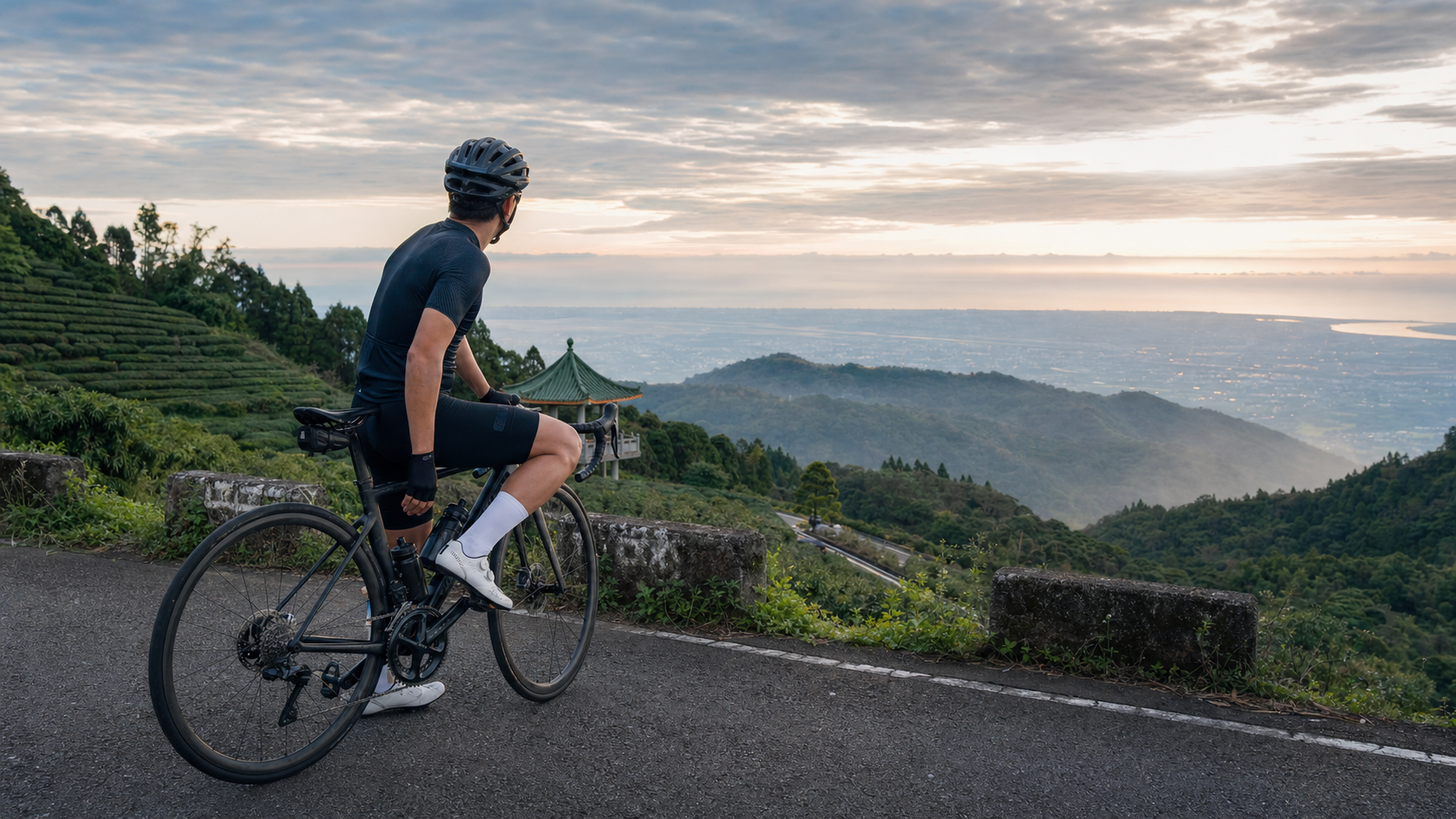
That Early Morning, I Turned My Handlebar Toward Meishan
When my bike computer read 9,056.11 meters, I knew I had made it to Wangfeng Pavilion. The road isn’t long—just over nine kilometers with an average gradient of 6.4%. It’s not brutally hard by elite standards, but it’s certainly not easy enough to fool your thigh muscles. But more than the numbers, what I really want to talk about is what this road gave me—something hard to measure in Strava segment times: that feeling of reaching the top, looking back, and seeing the entire Chianan Plain spread out beneath your feet.
Meishan Township—the name carries a quality of being close to the mountains, yet not entirely belonging to the deep wilderness. It sits in the transitional zone between the Chiayi foothills and the Alishan mountain range, where the terrain rises gently from the plain, gradually linking up to higher and more distant peaks. Wangfeng Pavilion, as the name suggests, is a place to “gaze at the wind”—a viewing platform where, after climbing up, you can stand at a high point and take in the wind, the view, and the entire Chianan Plain at a glance. The name itself carries an invitation: it’s not saying “this is a hard climb,” but rather “climb up, and you’ll see a view worth the effort.”
I often think that one of the most captivating things about this island of Taiwan is that the distance from flatland to high mountain isn’t really that far. In a single day, you can set out from a bustling city, ride into quiet hills, and continue onward to even higher mountain areas. Meishan Township happens to be one of the key nodes on this “vertical journey”—it’s not deep mountain territory, yet it already carries the breath of the mountains; it’s still connected to the fabric of plain life, yet it also begins to reveal the layered stacking unique to hilly terrain. For a rider who commutes and trains in the urban concrete jungle day after day, the moment you step into Meishan feels almost like switching to a different time zone—the air you breathe, the sounds around you, the angle of the light, all of it is completely different from the city you just left behind.
As for the origin of the name “Wangfeng Pavilion,” while there isn’t a single widely circulated story with clear documentary records, simply appreciating its literal meaning is enough to build anticipation for the place—gazing at the wind, perhaps the mountain breeze, or perhaps the longing to see into the distance that the vast, breath-taking view itself inspires. Such poetic place names are actually not uncommon in Taiwan’s hills and mountains. They are often not products of official, rigid naming, but rather the most direct and honest observations and descriptions of the surrounding environment by people who have lived on that land for generations, gradually passed down until they become a coordinate on the map.
The Hesitation at the Start, and the Resolve to Push Down on the Pedals
I’ll always remember that early morning—the sky still tinged with a grayish blue, the air carrying the distinctive moist scent of grass from the Chiayi foothills. Before setting off, I looked at the route data: 9 kilometers, average gradient 6.4%. Honestly, I felt a bit anxious. It wasn’t the distance that intimidated me—nine kilometers is nothing for any rider with a decent foundation—but rather that sense of “not knowing what’s coming next.” Climbing a new route for the first time always carries a hint of unease; you don’t know if the gradient will suddenly steepen, or what might be hiding around the next bend.
But once the pedals start turning, that hesitation gradually gives way to the rhythm of your body. In the early section, the gradient is still gentle, and the scenery on both sides transitions from residential homes to orchards and tea gardens. A faint aroma begins to drift through the air—a blend of soil and vegetation. Meishan Township is itself one of Chiayi’s renowned tea-growing areas; the climate and soil conditions of the hilly terrain nurture a tea industry that enjoys considerable local fame. Riding on these agricultural roads, you realize this isn’t just an exercise route—it’s also the everyday working road for local tea farmers commuting to their gardens. Along the way, you occasionally spot neatly maintained tea terraces, contour lines wrapping around the hillsides in rings. That pattern formed by the long-term coexistence of people and land is a scene no indoor trainer in any city can ever give you.
Riding on such a road, you unconsciously let go of your obsession with “speed.” In the first few hundred meters of the climb, I was still calculating what average speed I wanted to finish with and whether to chase a personal record. But as the tea garden scenery gradually unfolded on both sides, that anxious fixation on seconds slowly gave way to a near-leisurely calm. The tea bushes stood in orderly rows on the slopes, their leaves gleaming with a moist, dark green luster in the morning light. Occasionally, I could spot early-rising tea farmers already moving through their gardens, bending down to inspect the growth of the tea buds. The scene was so quiet that you’d feel your own panting breath echoing clearly across the hillside—yet it didn’t feel out of place at all. It was as if this road was meant to be traveled and experienced at exactly this slow, focused pace.
The smell in the air also changed gradually with the altitude. At the start, it carried the familiar flatland scent of asphalt mixed with dust; by the middle section, it shifted to a fresh blend of vegetation and damp soil; and a bit higher, you could even catch a faint, elusive hint of tea fragrance—the olfactory imprint left by years of tea-making industry, belonging to this land. This layered transformation of scent is actually easier to overlook than the visual changes in scenery, yet it more directly lets your body feel that “you are climbing.” You don’t need to glance down at the elevation reading on your bike computer—just by breathing, you can sense yourself slowly leaving behind the rhythm of flatland life.
The Struggle in the Middle, and the Moment Your Breathing Finds Its Rhythm
By the middle section of the route, the gradient noticeably steepened. I could feel my breathing shift from steady to rapid, and the soreness in my thighs evolved from a dull ache to something clearly discernible. This is the “struggle phase” that every climbing route has—your body hasn’t fully adapted to the intensity yet, and thoughts of wanting to stop and catch your breath start floating through your mind. But it’s also in this phase that you gradually find your own breathing rhythm: two counts in, two counts out, synced with your cadence. Slowly, that suffocating anxiety is replaced by a near-meditative focus.
I remember that day, midway through the climb, I encountered an older man working in a roadside tea garden. He looked up at me, smiled, and shouted a word of encouragement. That kind of goodwill from locals toward a stranger on a bike always quietly gives you a second wind exactly when you need it most. This subtle, word-light connection between people is one of the most charming aspects of cycling—you’re not sweating alone in front of a gym mirror, but genuinely passing through other people’s lives, becoming a brief part of that scene.
As the elevation rose, the temperature dropped noticeably. Sweat dried in the wind, leaving a cool sensation on the skin. Glancing back, the view below began to open up—the plain that had been hidden by the hills slowly revealed itself through gaps in the trees. This gradual visual reward is the most honest feedback mechanism in climbing: the more you climb, the more the world opens up before you. There are no shortcuts, no lucky breaks.
This sustained middle section was also when I started having conversations with myself. There’s something奇妙 about climbing—the more pressure your body endures, the clearer your thoughts become. Work-related worries left unresolved, trivial distractions from daily life—under this continuous effort and continuous breathing, they were sifted through and settled out one by one, leaving only the simplest thoughts: one more rotation, one more stretch, what scenery will appear after the next bend. This is probably why so many people fall in love with climbing—it forces you to bring your attention back to the present moment. The physical soreness is real, yet it strangely brings a kind of psychological emptying and release.
Passing through a slightly flatter section, I took the opportunity to regulate my breathing and took a look at the surrounding terrain. Meishan’s hilly landscape isn’t as steep and rugged as deep mountain areas; instead, it carries a soft, layered sense of curves. Distant peaks appeared and disappeared through the morning mist, while nearby tea gardens and fruit trees showed their branches and leaves in clear detail. This topographical character of “soft yet substantial” is, in a way, reflected in the route’s gradient data—a 6.4% average isn’t the kind of brutal, intimidating steepness, but rather a gentle test that requires patience and sustained focus to conquer, much like the overall impression this land of Meishan gives you.
The View from Wangfeng Pavilion: The Jianan Plain and the Sea in the Distance
When I finally rode up to the Wangfeng Pavilion viewing platform, I stopped my bike, took off my helmet, and let the wind blow through my sweat-soaked hair. The pavilion itself sits at an elevation of just over 1,000 meters. Standing here and looking west, the entire Jianan Plain unfolds before you without any obstruction—fields, settlements, winding rivers—like an unrolled scroll. On clear days with good visibility, it’s said that at this elevation you can even catch a glimpse of the sunlight reflecting off the Taiwan Strait. That spatial span of “seeing the sea from the mountaintop” makes you instantly feel that you’re standing in a geographically remarkable position—on one side, the peaks of the Alishan range stretching eastward; on the other, the endless plain and ocean spreading west.
During those few minutes at Wangfeng Pavilion, I thought back to the nine kilometers I had just ridden. A climb of roughly 580 meters (a figure I later recalculated from distance and gradient when checking the route data, rather than the misleading 1,000-plus meters in the database—that’s actually the pavilion’s elevation, not the amount I climbed) bought me this view that stretched nearly beyond sight. This experience of “exchanging sweat for a view” is one of cycling’s most primal and moving values: you can’t drive directly into this kind of emotional satisfaction. That genuine sense of groundedness that wells up when you stand there—only those who’ve turned the pedals, lap after lap, truly understand it.
A few early-rising hikers and local residents were scattered across the viewing platform. We nodded to each other in greeting, no words needed—there’s always an unspoken understanding between strangers who meet at a high point: we all came here for the same scenery, having put in the same effort to arrive. An auntie who looked like a regular saw me parking my bike, out of breath, and smiled as she handed me half a bottle of water, saying the weather was hot and I should stay hydrated. That kind of instinctive warmth and kindness, so characteristic of Taiwanese towns, always quietly warms your heart at the most exhausting moments of a journey. I thanked her, sat by the railing of the platform, watched the thin mist slowly rising in the distance, set my helmet aside, and let the mountain breeze dissipate the heat from my body.
In that moment, I suddenly understood why the name “Wangfeng Pavilion” is so fitting. Standing here, you’re not just looking at scenery—you’re looking toward a kind of openness of mind. The pace of life in the city, compressed and fragmented into countless trivial to-dos, seems to be pulled back to a grander, more unhurried scale the moment this view unfolds. Nine kilometers of climbing, over 500 meters of elevation gain—what you get in return isn’t just a photo for social media, but this shift in perspective that comes from standing high above, looking down at the road you’ve traveled.
Sea of Clouds and Sunset: Wangfeng Pavilion’s Seasonal Scenery
Among local riders, word has it that during specific seasons and weather conditions, there’s a chance to encounter a sea of clouds at Wangfeng Pavilion—when moisture from below condenses into a white layer of clouds among the hills under particular temperatures and wind directions, and the pavilion happens to sit above that cloud layer. That image of “standing on solid ground yet feeling like you’re floating above the clouds” is what many local photographers and riders consider the pavilion’s most enchanting aspect. Of course, a sea of clouds is a rare gift that requires the right timing and conditions. For riders hoping to chase one, it’s worth keeping an eye on radiation fog or cloud-cover forecasts from meteorological agencies, and heading up on early mornings in late autumn or early winter when the temperature difference between day and night is greatest—your odds will be better.
If you arrive at Wangfeng Pavilion in the late afternoon instead, you’ll be treated to a completely different kind of scenery—the sun slowly sinking into the western edge of the Jianan Plain, the sky shifting from orange-red to deep blue, and the entire plain lighting up with scattered points of light in the twilight. That moment of day turning to night, combined with the physical fatigue and psychological satisfaction that come after completing a solid climb, creates an emotional connection to cycling that transcends sport itself.
I later found another opportunity to revisit Wangfeng Pavilion, deliberately choosing a time close to dusk. That experience was completely different from the early morning—the evening light carried a lazy, warm tone, and the mountain breeze no longer had the chill of dawn but instead held the residual warmth of a day in the sun. As the sun began to set, the entire Jianan Plain gradually turned orange-red, and on the distant sea (if the air was clear enough that day), you could occasionally catch the shimmering reflection of the sunset on the water. That image, paired with a body that was sore yet strangely relaxed after the climb, stirred an indescribable emotion—as if the fatigue in your body and the beauty before your eyes were a pair of mutually reinforcing causes and effects: without the effort of the nine kilometers before, there would be no such pure awe in this moment.
I stayed until the sky was completely dark, and the lights below began to flicker on one by one, as if someone had scattered a handful of stars across the night. On the way down, I turned on my headlight and carefully controlled my braking and speed. The mountain wind carried the distinct coolness of night against my face. That transition from overwhelming visual spectacle to a quiet descent, alone with the darkness and the winding road, is another side of the Wangfeng Pavilion route—rarely mentioned, yet equally worth experiencing.
Meishan’s Tea and the Texture of Life in the Hill Country
Beyond serving as one of the gateways into the Alishan mountain region, Meishan Township has its own distinctive character in industry and daily culture. The hilly terrain and climate here have long nurtured a well-known tea industry, and the tea-garden landscapes you ride past along the way are, in fact, a microcosm of the local economy and way of life. If time allows, after completing the climbing challenge of Wangfeng Pavilion, it’s worth slowing down and stopping by a local tea shop or roadside vendor (for specific shops, it’s best to follow the signs and local notices on-site) to enjoy a cup of locally grown tea, letting your body gradually shift from athletic exertion back to a leisurely travel mindset. This rhythm of “sweat first, tea afterward” is, for me, the most complete way to experience riding through the Meishan hill country—not just completing a Strava segment, but truly immersing your body in the rhythm of life on this land.
I later chatted with a local tea farmer who told me that the tea bushes here, having grown for years in the hills with large day-night temperature swings and misty conditions, are directly influenced by the climate in developing their flavor. As he spoke, he casually brewed a pot and offered me a cup. The tea had a clean, sweet aftertaste that seemed to echo, in a curious way, the tea-garden scenery I’d just ridden past and the faint fragrance of tea in the mountain breeze. Sitting on a bench outside the tea shop, looking at the rolling ridgelines in the distance, sipping freshly brewed hot tea, the fatigue in my body gradually melted away in that unhurried rhythm. That sense of satisfaction was a completely different kind from the awe of gazing across the plain from Wangfeng Pavilion—yet just as profound.
This is also why I particularly enjoy combining cycling with local life—a route reduced to nothing more than a vessel for training data would be a terrible waste. The hills of Meishan, the tea gardens, the view from Wangfeng Pavilion, and the unplanned warmth of the people along the way together form the true soul of this route—and none of it can be fully conveyed by any Strava route file or gradient chart.
What This Road Means to Me
Looking back, the reason the Wangfeng Pavilion route lingers in my mind isn’t because of how daunting its gradient is, or how intimidating the elevation gain numbers look—in fact, its true elevation gain, estimated honestly, comes to around 580 meters, which places it at only a moderate, entry-level tier within the broader Alishan Highway training network. What keeps drawing me back is that sense of density—“just nine kilometers, yet a complete cycling experience distilled into one ride”: the terrain shifting from flatland to rolling hills, the scenery progressing from tea plantations to a viewing platform, the body transitioning from labored breathing to finding its rhythm, and the mindset turning from drenched-in-sweat effort to gazing out over the Chianan Plain and the distant sea.
For many people who spend their riding lives in the city, a route like Wangfeng Pavilion offers a chance to “recalibrate”—to reconnect with the most direct link between body and land, to remember that cycling, beyond power numbers and finish times, is also about scenery, about the views earned through sweat, and about the strangers who smile at you along the roadside. Nine kilometers is a short distance, but the memories it leaves behind can stretch on for a very, very long time. If you’re planning a visit to Chiayi, put Wangfeng Pavilion on your itinerary—not just to complete another Strava record, but for that moment when you stand at the summit, wind brushing past your cheeks, with the entire plain and ocean unfolding before your eyes.
Whenever I introduce the Meishan Wangfeng Pavilion route to friends, I always make a point to emphasize: don’t treat it merely as a gradient statistic to be conquered, and don’t just chase your personal best. Slow down a little, take note of the busy figures working in the tea plantations along the roadside, notice the subtle shifts in the scent of the air as altitude changes, and observe the expressions on the faces of strangers who, like you, have worked hard to climb up to that viewing platform for the same view. The meaning of this route has never been just the 9,056.11 meters of distance, or the 6.4% average gradient—it’s the complete experience woven together from body, land, and human warmth along the way. Some routes are made for breaking records; others are made for savoring slowly—and for me, Wangfeng Pavilion absolutely belongs to the latter. Whenever the pace of life becomes too tense, I still think back to that morning, to the scent of fresh grass in the tea gardens, to the Chianan Plain unfolding without reservation from the top of Wangfeng Pavilion, and I tell myself it’s time to point the handlebars back toward Meishan once again.
Related Reading
- Meishan Wangfeng Pavilion Practical Guide: A Complete Analysis of Chiayi’s 9km, 6.4% Gradient Rolling Training Route
- Chiayi Meishan Taiping Mountain Route: Detailed Analysis of a Climbing Training Route in Chiayi County
- The Wind at Buyan Pavilion: Solitude and Vastness Amid the Rolling Hills of Shuangxi
- The Steep Sacred Mountain of a Hakka Hill Town: Riding into Shitan, Encountering Xianshan
大武山後門26%歡樂陡坡!JJSC南台灣單車行Day2 / 被颱風追著跑 / 公路車 / CT Yeh
2 年前
梅山36彎 奮起湖 單車挑戰 下集 #公路車
6 年前
4K單車實境) 嘉義 梅山36灣 訓練台 爬坡 輕鬆騎
6 年前
梅山36彎 奮起湖 #公路車 之旅 2400m
6 年前
單車 梅山36灣 坡度介紹 路段介紹 空拍 (相關遊記影片,請參考說明或我的頻道喔,歡迎訂閱)
6 年前
觀霧 變好騎了! | 北高車友爆笑大會師 | 公路車 | 單車旅遊 Taiwan Cycling Route GuanWu
6 年前
#北橫 + #北進武嶺 最硬的員工旅遊 EP1 | #公路車 #拉拉山 | 明池 | 武嶺 | 武陵農場 | 雲海 | Taiwan Cycling Route Wulin
6 年前
大武山20%魔王陡坡【JJSC南台灣遊騎Day2】!屁股真的要裂開了...凡士林抹滿也沒用?神秘金教堂還有超便宜夜市
3 個月前