Riding to the Sacred Mountain in the Clouds: The Geography, History, and a Journey of Self-Conquest on the Alishan Highway
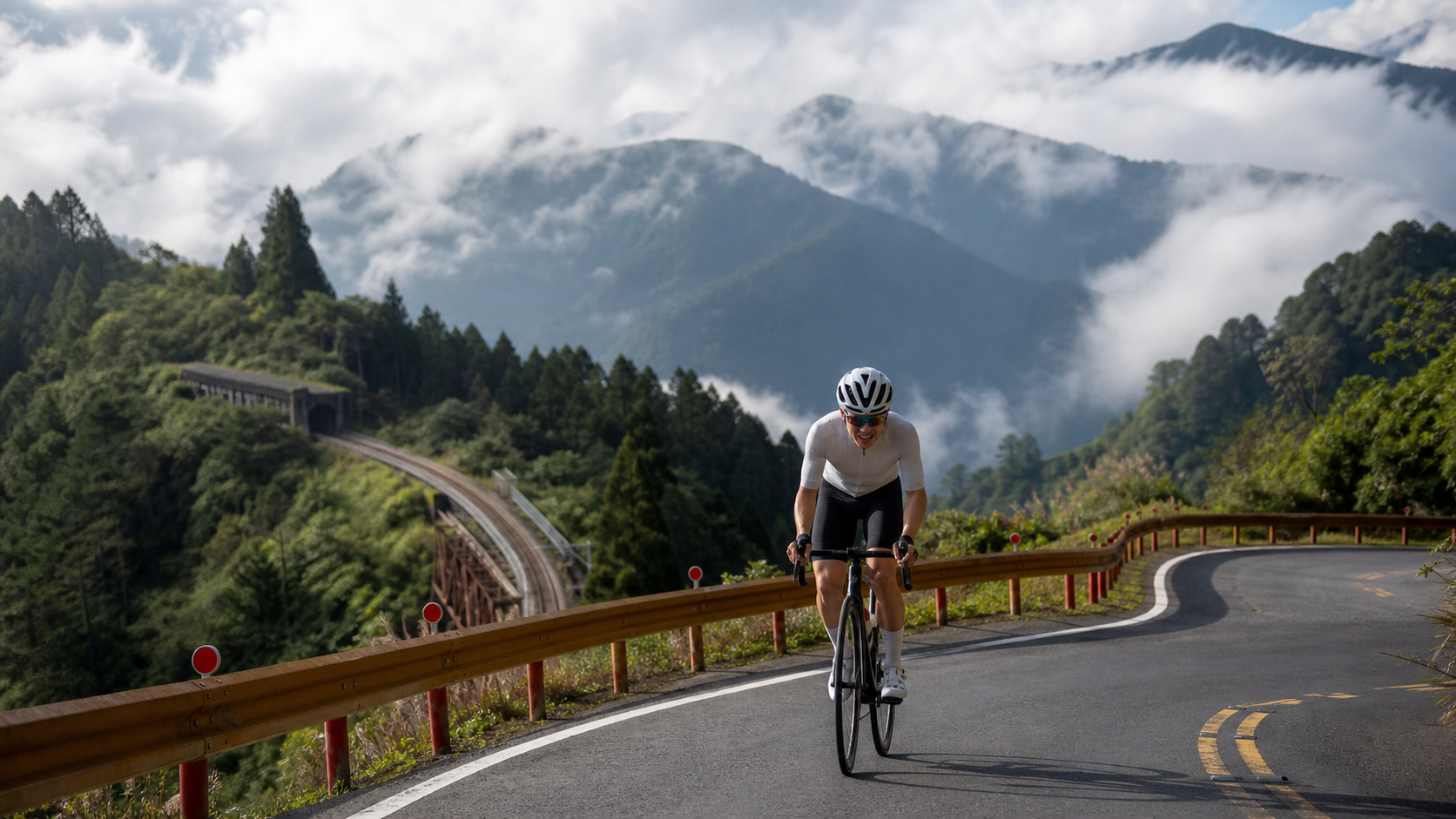
As my wheels pressed against the asphalt at Chukou, I knew what lay ahead was a journey of 53.57 kilometers, climbing over two thousand meters in elevation. The numbers on the map were calm and mechanical, but when your legs truly start turning, when the altitude stacks up meter by meter, this road tells you: it has never been just a set of data, but a three-dimensional epic spanning geography, history, and humanity. This is my story of riding toward Alishan.
1. From Contour Lines on a Map to the Vast Mountain Before My Eyes
Before setting off, I spread out a map and studied this road—Alishan Highway, the mountain section of Provincial Highway 18, stretching over fifty kilometers, carrying riders from the Chiayi Plain at just over a hundred meters above sea level all the way up to the Alishan National Forest Recreation Area at over two thousand meters. The contour lines were densely packed together on the map—one of the most spectacular climbing profiles I had ever seen in my life. But a map is ultimately an abstract symbol on a flat surface. It wasn’t until I actually stood on this road that I understood: for the people of Taiwan, this mountain has never been merely a geographical term.
Alishan is one of Taiwan’s most iconic alpine scenic areas, lying at the core of the Alishan National Scenic Area. It has long been renowned worldwide for its sea of clouds, sunrises, sacred trees, and forest railway, making it a must-visit destination in the hearts of countless Taiwanese and international travelers alike. For cyclists, however, it carries another layer of meaning—this highway is the unavoidable mountain in the hearts of all who revere long-distance climbing. It stands alongside the very top-tier climbing routes in Taiwan’s road cycling scene, ranked at the very pinnacle of many seasoned riders’ “bucket list.” When I finally mounted my bike and faced this mountain, what surged within me was not fear, but a solemn sense akin to pilgrimage.
2. The Forest Railway and the Logging Era: How This Mountain Was Once Written
To understand Alishan, one cannot ignore the forest railway that has been intertwined with its fate. The Alishan Forest Railway is a mountain railway built during the Japanese colonial era to develop the region’s abundant cypress and red cypress forestry resources. It is internationally renowned for its astonishing elevation gain and its unique “switchback” climbing method, and it remains one of the few surviving alpine forest railway systems in the world. In that era, these mountain forests were a major hub of Taiwan’s timber industry—massive red cypress and Taiwan hinoki were felled and transported down the mountain, forging a chapter of forestry development that was both glorious and laden with complex historical sentiment.
Today, the logging industry of those days has long since transformed. The Alishan National Scenic Area now centers on ecological conservation and tourism, standing as a vital natural and cultural asset of Taiwan. Riding along the highway, I could occasionally glimpse the winding traces of the railway in the distance. In that moment, my mind conjured images of a very different kind of bustle and clamor that once filled these same mountain forests, generations upon generations ago. History does not speak to you directly, but when you traverse these woods in the slowest, most earth-hugging way—by bicycle—those layered depths of time seep into your consciousness in a peculiar manner. You suddenly realize that this asphalt road, which appears to be merely “a road,” actually carries over a century of industrial transformation and cultural memory.
The highway and the railway are, in fact, two parallel narratives running through these forests. The railway tells the story of industry and labor—those giant trees felled and hauled down the mountain supported an unavoidable chapter in Taiwan’s modernization; the highway, on the other hand, tells the story of how these forests gradually shifted from “resource exploitation” toward “ecological stewardship”—a transformation of values. When I spotted an interpretive sign beside a curve briefly introducing this history, it struck me that every turn of the crankset beneath my feet was layered upon the tracks of this long history. This feeling is difficult to describe precisely in words. Suffice it to say, when you cross this mountain in the most primal way—without mechanical assistance, relying solely on your lungs and legs—history is no longer distant text in a textbook, but a living experience being rewritten right now by your breath and your sweat.
3. A Vertical Ecological Journey: The Dramatic Shift in Vegetation from Tropical to Temperate
One of the most fascinating—and easily overlooked—aspects of riding Alishan Highway is that it lets you experience, in a single day, a “vertical ecological journey” firsthand. At the start, the vegetation around the Chiayi Plain still bears the typical subtropical appearance, with lush broadleaf forests interspersed with farmland. As the elevation climbs and you pass through Chukou into the mountains, the vegetation begins to shift quietly—broadleaf forests gradually intermingle with the silhouettes of conifers. Farther up, around Xiding and Shizhuo, you’ll see layer upon layer of tea plantations carved into the hillsides—the distinctive landscape of this renowned high-mountain tea region. By the time you reach the high-altitude zone near the Alishan National Forest Recreation Area, temperate coniferous forests of Taiwan hinoki, red cypress, and Taiwan fir have completely replaced the broadleaf species from below, and the air carries a crisp, woody fragrance, with temperatures a dozen degrees cooler than when you started.
This phenomenon of vegetation changing dramatically with altitude is known in ecology as “vertical zonation”—a natural wonder unique to mountainous terrain. And the most moving aspect of cycling over this mountain is precisely this: you are not passively transported through these ecological zones by a vehicle, but rather, with your own breath and heartbeat, you physically carry your body inch by inch from a tropical climate into a temperate forest. With every breath, you can feel the humidity and scent of the air changing; with every glance upward, you can see the color of the sky and the shape of the clouds changing. This is a hands-on geographical education that no car or cable car can provide.
I particularly remember one stretch of road, roughly the section continuing from Xiding toward Leye, where the tree species on both sides sat precisely in the transitional zone between broadleaf and coniferous forests. That mixed forest composition, in a way, is the most captivating metaphor for this route—it is itself a road of “transition,” connecting lowlands and high mountains, subtropical and temperate zones, the clamor of urban life and the tranquility of remote mountain wilderness. Riding through such a transitional zone, you suddenly become aware that you are personally participating in a slow yet real geographical displacement—and this displacement is not knowledge acquired through screens or books, but rather the soreness of leg muscles, the depth of lung expansion, the temperature changes felt on your skin—all summed up into an utterly real bodily memory. This memory is etched into my mind far more profoundly than any geography lesson ever could.
4. The Sea of Clouds at Xiding and the Mist at Shizhuo: Moments When Mountain and Weather Dance Together
If I had to pick the most breathtaking scenery on this road, the sea of clouds around Xiding would rank at the very top. When warm, moist air rises along the valleys and meets the relatively cooler air at higher elevations, it condenses into a magnificent sea of clouds over the sun-facing peaks. Especially under specific weather conditions in the early morning or afternoon, the entire valley appears to be blanketed in a soft, dense layer of white cotton. I will never forget that moment—just as my legs were beginning to ache from the sustained climb, I looked up and was struck by the sight of clouds surging and rolling before me. All fatigue seemed to hit a pause button in that instant. It was a spectacle that no photograph could fully convey—a gift that can only be received by standing at that elevation, at that angle, at that very moment.
Continuing upward to the Shizhuo area, this is an important settlement along Provincial Highway 18 and the junction leading to Fenchihu. The cloud and mist transformations around Shizhuo are equally spectacular—mountain fog frequently drifts with the wind, sometimes shrouding entire tea plantations, then suddenly parting to reveal the layered ridgelines of distant peaks. This ever-shifting nature of the weather is precisely what makes alpine terrain so captivating yet so deserving of reverence—you can never fully predict whether the next turn will bring clear skies or fog so thick you can’t see your hand in front of your face. This uncertainty, in a way, echoes the philosophy of cycling itself: you can only prepare as best you can, then humbly accept whatever nature presents before you.
5. Leye Village and the Mountain Wisdom of the Tsou People
Passing through the Leye area, you’ll sense that this mountain forest carries not only natural scenery but also a deep indigenous cultural heritage. The Alishan region is the traditional territory of the Tsou people, one of Taiwan’s indigenous groups with the deepest ties to this high-mountain forest. Their traditional rituals, social structures, and wisdom in utilizing mountain resources have coexisted intimately with this land for generations. Riding past the villages, you’ll occasionally spot architectural decorations or roadside symbolic markers incorporating Tsou cultural elements—reminders to cyclists that this magnificent landscape is not an “untouched wilderness” but a homeland carefully guarded and imbued with profound cultural meaning by generations of its people.
For cyclists who have long lived in flatland cities, such encounters often bring a humbling realization—we ride expensive road bikes, equipped with advanced cycling computers and energy supplements, spending a few hours “conquering” this mountain; but for the people who have lived here for generations, this mountain is the foundation of their ancestors’ lives, hunting, farming, and cultural transmission. This convergence of perspectives transforms the ride from a mere physical challenge into a renewed appreciation of Taiwan’s diverse cultures and land ethics.
In traditional Tsou culture, there exists a refined and profound ethical framework regarding mountain resources, emphasizing measured use and harmonious coexistence with nature, rather than one-sided extraction and conquest. This wisdom of living with the land, accumulated from centuries of generational experience in these mountains, is far closer to the pulse of the land itself than any modern ecological conservation slogan. As I rode along this modern asphalt road, I was, in a sense, traveling across the surface of a land covered by this ancient wisdom. This made me reflect that terms like “challenge” and “conquest” might merely be frameworks cyclists unilaterally impose on the journey; for this mountain and its indigenous inhabitants, what they might rather hope to see is every visitor arriving with respect and gratitude, rather than treating the place as a natural playground for setting personal records. With this realization, my cadence remained steady for the rest of the ride, but my state of mind had already shifted.
6. High-Mountain Tea Culture: Another Industrial Landscape on the Slopes
The layered tea plantations around Xiding and Shizhuo are another distinctive cultural landmark along this route. Alishan high-mountain tea, blessed by its unique high-altitude climate—large diurnal temperature variations, lingering cloud cover, and relatively short sunshine duration—produces a clear, fragrant, and sweet infusion that is widely beloved, making it one of the most representative tea-producing regions in Taiwan’s tea landscape. Riding past these plantations, you’ll often catch sight of tea farmers busily picking leaves, their way of life intimately tied to the land forming a stark contrast with the hurried passage of cyclists—yet together they compose one of the most vibrant scenes along this route.
The sight of tea terraces stacked layer upon layer along the mountain contours is itself a human landscape of striking visual power. When sunlight pierces through the clouds and falls upon the emerald tips of tea bushes, the interplay of light and shadow is a beauty no carefully designed tourist attraction could replicate, because it is a genuine scene of industry and daily life, not a stage set crafted for tourism. As cyclists, we are passersby in this agricultural landscape, but precisely because we have chosen the slowest mode of travel, the one closest to the land, we are able to feel more deeply the warmth of local life embedded in these tea mountains.
7. Conquering the Sacred Mountain: The Inner Shift from Flatland to Cloudline
What truly made this journey unforgettable was the subtle transformation of my inner state as altitude increased. At the start, on the gentle roads around Chukou, my mood was light and eager, carrying a touch of rookie confidence. As the gradient steepened and altitude climbed, physical exertion began to test my willpower. At certain moments mid-ride, the ache in my legs and the shortness of breath would surface doubts: “Can I really make it through this distance and elevation?” Such doubts often peaked in the latter half of the journey—the body already fatigued, while the finish line remained faintly visible somewhere deep in the distant clouds.
Yet it was precisely this struggle that made the final arrival at Alishan Forest Recreation Area feel extraordinarily precious. When your legs finally stop turning, when your breathing finally steadies, when you look back at the winding road disappearing into the valley mist below, an indescribable sense of accomplishment wells up from within. It wasn’t just completing a ride of over fifty kilometers with more than two thousand meters of climbing; it felt like a head-on confrontation with your own inner doubts—and winning. Many seasoned cyclists regard completing the Alishan Highway as the “graduation exam” of their cycling careers, placing it alongside routes that represent the ceiling of Taiwan’s road cycling climbs, an irreplaceable legendary milestone. It wasn’t until I experienced it firsthand that I truly understood the depth of that claim.
8. Sacred Trees, Sunrise, and Sea of Clouds: Gifts Awaiting You at the Summit
Arriving at Alishan Forest Recreation Area, the rewards of this journey were far from over. The famous sacred tree grove within the park is one of Alishan’s most iconic natural landmarks. These towering trees, having weathered hundreds or even thousands of years, stand silently in the mist-shrouded forest, radiating an almost solemn life force. Standing at the foot of these giants, the fatigue and struggle of the ride suddenly seemed imbued with deeper meaning—you brought yourself, step by step on your own two feet, to stand before a forest that has witnessed countless centuries.
And Alishan’s most renowned sunrise and sea of clouds spectacles are natural feasts that many travelers brave all obstacles to witness with their own eyes. In the early morning, if weather conditions align, standing on the viewing platform as the first rays of dawn pierce through the sea of clouds, gilding the entire mountain range in a golden halo, the beauty of grandeur interwoven with tranquility is often a lifelong memory. Of course, these sights are highly dependent on weather and season; whether you get to see them largely depends on the heavens’ mood. But it is precisely this uncertainty that makes every encounter all the more precious.
9. Seasonal Romance: Cherry Blossoms, Seas of Clouds, and the Changing Seasons
The Alishan National Scenic Area is renowned for its distinct four-season scenery, with the spring cherry blossom season being the most widely known. Every spring, cherry blossoms along the park and roadside bloom in succession, with petals of pale white and crimson adorning the emerald forests, drawing large crowds of visitors and photography enthusiasts (actual blooming periods fluctuate with weather conditions, so it’s advisable to check the latest bloom information before your trip). If you can take on this route during peak blossom season, the scenery along the way gains an entirely different layer of romantic charm, adding a delightful visual respite to the grueling climb.
Beyond spring blossoms, the changing seasons bring distinctly different faces to this route: in summer, the forests are lush and verdant, with afternoon thunderstorms and mountain mists weaving a humid, mysterious atmosphere; autumn typically offers the most stable weather with expansive views, making it an excellent season for appreciating seas of clouds and distant ridgelines; in winter, high-altitude areas occasionally experience low temperatures and even freezing fog, with mountain peaks sometimes dusted with a thin frost, presenting a cold, crystalline mountain scene rarely seen in Taiwan. Each season, this road greets cyclists with a completely different expression, which is why many riders, even after completing it once, willingly return in different seasons, seeking slightly different scenic memories each time.
10. Side Trip Suggestions and the Journey’s Afterglow
After completing this long haul, if time and energy permit, there are many corners around Alishan Forest Recreation Area worth lingering over—riding the preserved forest railway branch line, strolling along the sacred tree grove trails, or finding a local tea house to order a pot of hot tea brewed from local high-mountain leaves, letting your body gradually ease out of its high-intensity riding state. Any of these makes a perfect ending to the journey. If time allows, the nearby Fenqihu old street is also a popular side trip, where you can savor the area’s famous railway lunchboxes and various mountain snacks, experiencing a leisurely pace distinct from the ride itself.
On the way back, watching the mountain peaks recede in the rearview mirror, I recalled the numbers I had looked up before setting out—53.57 kilometers of distance, over 2,000 meters of climbing, an average gradient of 3.7 percent. These cold figures now carried entirely different weight in my heart. They were no longer just reference values for assessing difficulty during trip planning, but the measured markers of a journey truly traveled, recording my complete transformation from flatland to cloudline, from tropical forest to temperate giants, from self-doubt to the joy of conquest.
Conclusion: A Sacred Mountain Memory for Every Rider
Alishan Highway, for Taiwan’s cyclists, has long surpassed the definition of a mere exercise route. It is a living vertical ecological showcase straight out of a geography textbook, a silent witness to Taiwan’s forestry and forest railway history, a precious homeland guarded by the Tsou people for generations, and a sacred mountain in the hearts of countless riders that must be climbed in person before its true weight can be understood. Every rider who has ever traveled this road carries a unique moment of their own—perhaps the breathtaking sea of clouds at Xiding, the humbling encounter with Tsou culture in the Leye tribe, or simply that moment at the finish line when, removing the helmet, you finally take that deep breath of cold, high-mountain air tinged with the scent of hinoki cypress.
What this road taught me is not just how to conquer over two thousand meters of elevation gain with my legs, but also how, in the midst of a long and arduous journey, to rediscover the layered beauty and depth of this land. If you too are a traveler who loves riding, the Alishan Highway deserves a full day of your time to feel, to experience, and to write your own chapter of the sacred mountain battle.
Years later, when I look back on this journey, the images that come to mind are often not a specific gradient figure, nor the time displayed on the bike computer at the moment of completion, but rather a series of fragmented yet vivid sensory snapshots—the moist air hitting your face as the sea of clouds surges at Xiding, the crops swaying in the wind along the roadside in the Leye tribe, the play of sunlight piercing through mist over the tea gardens at Shizhuo, and the cold, crisp air carrying the fragrance of hinoki as you finally reach the summit and draw it deep into your lungs. These fragments are far closer to the true soul of this road than any set of statistics. Perhaps this is precisely what makes cycling so precious—it is never merely a matter of efficiently moving the body from point A to point B, but rather an opportunity to rediscover, at the slowest and most honest pace, a land you once thought you already knew well.
Related Reading
- Alishan Highway Cycling Challenge: An Epic Climb from the Chiayi Plain to the Clouds
- First Attempt on Alishan Highway: A 74km Climb from Zero to the Summit
- The Complete Alishan Highway Guide: The 53.57km Southern Taiwan Pilgrimage with Over 2,000 Meters of Climbing
- Chiayi Alishan Highway (Provincial Highway 18): The Climbing Challenge from the Plains to the Clouds
里佳部落 阿里山單車深度旅遊! | 竹山/草嶺/來吉/奮起湖 | 無敵銀河絕景 全新路線探索! 驚險狀況百出! | 4K沉浸式畫質 | 公路車 | CT Yeh
3 年前
一定要騎一次!阿里山最深處:里佳部落!單車旅行 | 2800m爬升 | 深度部落體驗:嗨翻晚會、螢火蟲、銀河 | feat. JJSC & 廢物伙伴 | 公路車 CT Yeh
9 個月前
那瑪夏x茶山 阿里山系深山單車行 Day2 累積爬升6000M | 🥶超陡連續下坡 整路看隊友刷 | 爬升一座西進武嶺 | JJSC | 公路車 | CT Yeh
3 年前
梅山36彎 奮起湖 單車挑戰 下集 #公路車
6 年前
半日 小台灣 極限單車路線挑戰實錄
7 年前
嘉義大埔、阿婆灣挑戰賽,美到以為在日本!ft. 環騎5 Cool 西拉雅188 / 公路車 / CT Yeh
7 個月前
太平山單車員工旅遊 | 這樣玩CP值最高!| 公路車
5 年前
阿里山塔塔加 兩倍特濃版!全新隧道開通! 進喔!公路車 | CT Yeh
3 年前