The Plum Blossom Fragrance of Banana Mountain: A Ride to Meiling on Provincial Highway 3, Cycling into Tainan’s Gentlest Mountain
The Plum Blossom Scent of Banana Mountain: A Ride on Route 3 through Meiling, Entering Tainan’s Gentlest Mountain
From Banana Mountain to Meiling: A Mountain Story of Industrial Transformation
The first time I heard the place name “Meiling” (Plum Ridge), I was actually a bit confused—this mountain is clearly covered in plum trees, so why was the old name “Banana Mountain”? Later, after researching, I understood that this mountain was indeed an important banana production area in the Nanxi area of Tainan in the past. In the early days, farmers relied on planting bananas on these slopes to make a living, and this once supported a significant portion of the local economy. However, with the rise and fall of the banana industry, plus the fact that the mountainous climate and soil conditions were actually more suitable for plum trees, farmers gradually switched crops. One by one, plum trees replaced banana plantations. The accumulated cultivated area reached about 2,000 hectares, becoming one of the largest concentrated plum orchard areas in Taiwan.
This turn from Banana Mountain to Meiling sounds lightly described, but for the farming families who have cultivated the land for generations, it was actually an industrial bet for an entire generation. It takes several years for plum trees to grow from planting to maturity and fruiting, unlike short-term crops that can quickly recover costs. Willingness to cut down an entire hillside of banana plantations and replant with plum trees is, to some extent, a trust investment in the future of that land. Looking back now, this transformation was undoubtedly successful—Meiling has not only become an important plum production area in Taiwan, but also, due to the beautiful scenery of plum blossoms blooming all over the mountain, it has transformed into one of Tainan’s most representative flower-viewing destinations. Industry and tourism have found a symbiotic balance on this mountain.
Riding on Route 3 in the Meiling section, looking at the layered plum orchards along the way, it’s hard not to imagine what kind of mood the farmers who cut down the banana trees and planted the first batch of plum seedlings were in when they made this decision. This route itself is, to some extent, a microcosm of this industrial history—from gentle lowland terrain, gradually climbing into deeper mountainous areas, just like the land’s industrial focus shifting step by step from lowland cash crops to plum agriculture that relies more on mountainous terrain and climatic characteristics.
The area where Meiling is located is administratively part of Wanqiu Industrial Road, Yushan Village, Nanxi District, Tainan City. Geographically, it is close to the Zengwen Reservoir Scenic Area, and both areas fall under the jurisdiction of the Xilaya National Scenic Area. The name “Xilaya” itself carries the historical imprint of the plains indigenous people living on this land long ago. The subsequent Han Chinese reclamation, forest development during the Japanese colonial period, and the current landscape dominated by tourism and precision agriculture, with layers of history stacked between the terraces and orchards on this mountain, are all quietly hidden there.
Later, I thought again that a change in a place name is never as simple as just changing a title. The three characters “Banana Mountain” carry the industrial memory of southern Taiwan’s hilly areas relying on a single cash crop for a living from the Japanese colonial period to the early post-war era; while the later widely used name “Meiling” marks that this land found a new positioning—transforming from a pure food and cash crop production area into a mountainous region with a dual identity of agricultural production and tourism leisure. Every time I ride past here, looking at the old plum trees by the roadside that appear to have considerable age, I can’t help but imagine whether these trees are the witnesses of the first batch of crop switching, quietly on this hillside, watching generation after generation of riders and tourists riding in and out of this mountain forest along the same Route 3.
The Breath of the Starting Point: Mood Shift on the Gentle Route 3 Approach
The beginning of every ride always has a transition period where the body and mind slowly find their rhythm. The starting point of the Route 3 Meiling section is exactly such a gentle prelude—the road hasn’t truly entered the mountainous terrain yet, and both sides are mostly orchards and scattered farmhouses. The gradient isn’t fierce; rather, there’s a feeling of being gently pushed upwards.
I like to slow down my cadence on this section, aligning my breathing with the surrounding environment. When setting off while the morning light still carries a coolness, the air is mixed with the scent of earth and vegetation. Occasionally, you can hear roosters crowing and dogs barking from afar. Such sounds are almost extinct in the city, but on the rural roads in this Nanxi area, they remain the background noise of daily life. The feeling this road gives isn’t like “preparing to challenge a difficult route,” but rather “preparing to enter a quiet world.”
As the altitude slowly rises, the hustle of the lowlands is gradually left behind, replaced by an increasing sense of tranquility approaching the forest. This is the unique rhythm of “lowland gentle ascent into mountainous areas” terrain like Route 3—it won’t immediately throw you into a steep challenge, but first gives you an adaptation period, allowing your body, breathing, and mood to slowly adjust to the gradients you are about to face. For me, this starting section is less about a physical warm-up and more about a mental shift—from the pace of daily life to a riding state focused on the current cadence and breathing.
Mountain Breeze and Sweat: Riding Sensations After Entering the Mountain
After the gentle ascent into the mountain, the road begins to show obvious changes in gradient, and the scenery on both sides gradually shifts from orchards to denser mountain forest vegetation. This is the core section of the entire route that requires the most focus. The gradient varies between gentle and steep, like the mountain itself having its own breathing rhythm—a gentle slope where you can catch your breath, followed by a steep ascent that makes your thigh muscles tense and hot.
Riding on this section, I often feel my breathing and the sound of the chain turning forming a strange resonance in the valley. Sweat slides down from my forehead, dripping onto the handlebars or top tube; that salty taste mixed with the fresh mountain air is a complex sensation hard to describe in words—pain and pleasure coexisting. Your body tells you “this is tiring,” but there’s an indescribable sense of solidity in your heart, as if every pedal stroke is engaging in a silent dialogue with this mountain.
The mountain wind plays a subtle role on this section. Sometimes a cool breeze blows up the slope, instantly taking away the stifling heat, making you忍不住 take a deep breath; sometimes the wind blows against you, combined with the resistance of the gradient, making pedaling extra difficult. This uncertainty in wind direction, to some extent, echoes the uneven distribution of gradients on this route—you can never fully predict what kind of challenge the next turn will bring; you can only focus on every pedal stroke in the present moment.
This mountainous road also made me re-understand the meaning of “climbing” for riders. It’s not just physical exhaustion, but more of a process of dialogue with oneself—when muscles start to ache and breathing becomes rapid, the thoughts that float in the mind are often not “how much further,” but “why am I riding this road.” And the answer usually naturally surfaces when you climb to a certain height and the view suddenly opens up.
Once, when I reached the steepest section, I deliberately slowed my speed down, almost pushing with a walking cadence. At that moment, I suddenly noticed a cluster of unknown wildflowers by the roadside, gently swaying in the mountain breeze. That moment made me realize that the self who usually chases speed and records while riding had actually missed too many such subtle moments. The gradient fluctuations on the Meiling route, to some extent, force riders to slow down—you can’t deal with it using the all-out sprint rhythm of the lowlands; the mountain uses its terrain to force you to slow down, catch your breath, and observe, and this forced slowing down instead creates a rare experience of refocusing on nature.
Scenic Landmarks Along the Way: Wulong Trail and the Distant View of Zengwen Reservoir
In the Meiling area, besides Route 3, the main connecting road, there is a complete system of trails around it. The Wulong Trail is the most representative one. The gradient of the Wulong Trail is relatively gentle, and it is planted with a large number of plum trees. It is one of the most visited routes by tourists during the plum-blooming season. If you arrange time to get off the bike and walk a section during a ride, you can overlook the lake and mountain scenery of Zengwen Reservoir from a high point on the trail. That emerald green water body, embraced by mountains, forms a quite healing picture.
Zengwen Reservoir is one of the largest reservoirs in Taiwan. For a long time, it has not only been an important water resource lifeline for the south but also the most prominent landmark of this mountainous landscape. Looking down at the reservoir from the highest point of the Meiling mountainous area, the feeling of being high up with an open view is one of the best rewards during the ride—especially after finishing a steep slope and being out of breath, suddenly turning a corner and seeing the distant reservoir scenery with the view suddenly opening up, all fatigue seems to be diluted by this scenery.
Besides the Wulong Trail, the Meiling mountainous area also has trail systems such as the Meilong Trail, Meifeng Ancient Trail, and Guanyin Trail. Among them, the Meifeng Ancient Trail is about 2.3 kilometers long, and a one-way walk takes about an hour. The trail is well-shaded by trees along the way and is a highly recommended route for hiking enthusiasts. These trails connect with each other, forming a complete mountain leisure system. For riders who have finished the Route 3 Meiling section and still have energy, if time permits, you might consider parking your bike in a safe place and walking a section of the trail on foot, feeling the layers of this mountain again with a different rhythm—riding and hiking are completely different ways of bodily perception; the former pursues speed and rhythm, while the latter is closer to slow and detailed observation.
The Aroma of Plum Chicken: Memories of Local Food Culture
After a mountain ride, nothing is more anticipated than rewarding oneself with a meal of local cuisine. The Meiling area, known for its abundant plum production, has developed a culinary culture featuring many dishes made with plums. Among these, the most representative is undoubtedly plum chicken. Several free-range chicken restaurants and garden-style eateries in the mountains use locally grown plums in their cooking to create plum chicken and broken cloth fruit (paku-pu-tsu) dishes. This approach, which combines local agricultural products with traditional free-range chicken cuisine, is a unique culinary memory of this mountain range.
The tart aroma of plums, when incorporated into chicken soup or chicken dishes, effectively cuts through greasiness and enhances the complexity of flavors. For a body that has just finished a high-intensity climbing ride, such a dish with a slightly sour, appetizing quality is particularly effective in awakening the appetite, which may have become somewhat lethargic due to prolonged exercise. Besides plum chicken, broken cloth fruit, another local specialty ingredient, frequently appears on mountain tables, paired with steamed fish or stewed dishes, representing a home-style taste familiar to older generations of Taiwanese people.
Beyond dishes that directly incorporate ingredients, the Meiling area has also developed numerous agricultural processing products related to plums, such as crispy plums, Q-plums, plum essence, and plum vinegar. Behind these processing techniques lies a continuation of the complete industrial knowledge of early farmers, from planting to preservation and processing. After each ride, buying a pack of locally produced crispy plums or plum powder at a mountain shop to replenish the salt and sugar lost during exercise while reminiscing about the sweat shed on the mountain road is, in my opinion, the most complete sense of ritual when riding the Meiling route—the body’s fatigue needs food to repair, and these local delicacies with the tart aroma of plums perfectly complete the final piece of this ritual.
This wisdom of relying on the mountains and developing an entire food system based on plums actually reflects the survival philosophy of Taiwan’s shallow mountain rural areas for a long time—wasting not a single fruit, extending the value this land can offer from fresh picking to salted preservation, and finally to seasoning in dishes. I often feel that taking a bite of plum chicken is not just satisfying hunger, but rather tasting a microcosm of the mountain’s history. From the industrial transformation from banana to plum trees to the bowl of soup on today’s table, it is actually different chapters of the same story. For riders, such food with a story is far more meaningful than simple calorie replenishment, adding a layer of cultural depth to the entire riding experience.
Snow White and Fireflies: Seasonal Meiling Scenery
The most charming aspect of the Meiling route lies in its scenery, which changes dramatically with the seasons. The same road offers a completely different experience depending on the month of the year.
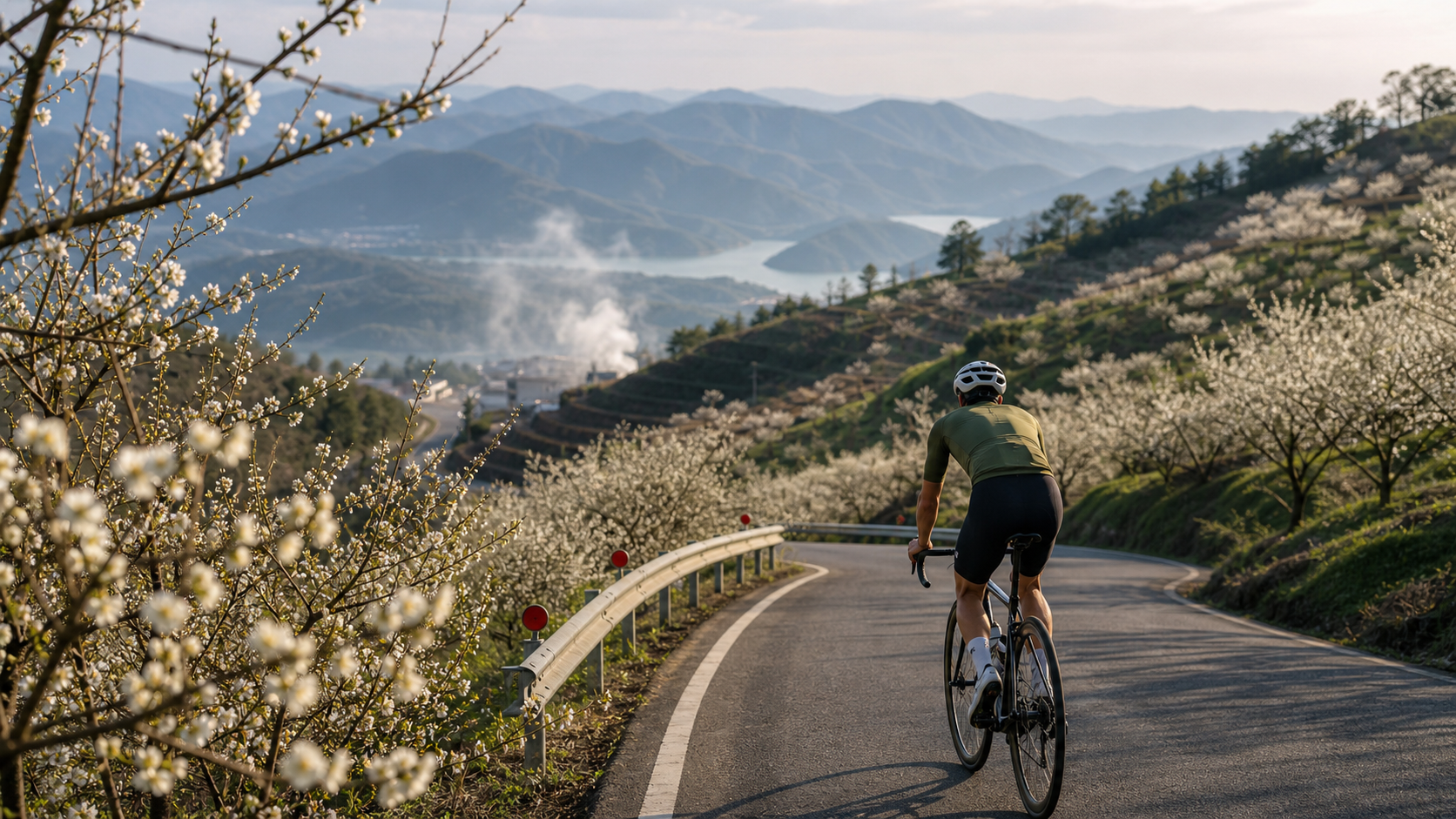
Around January each year is the most grand visual feast of the year in Meiling—plum blossoms bloom across the mountains, with petals as white as snow covering the entire mountain range. Occasionally, petals drift down when the breeze blows, like a gentle snowfall. At this time, riding through the Wulong Trail, Er-Liao Ping, and Fu-Lai Plum Garden, the air is filled with a faint plum blossom fragrance. This elegant yet unassuming scent is completely different from the strong vegetation scent of the mountain area in mid-summer, a unique aroma that can only be captured in winter. During the plum viewing season, Meiling is bustling with tourists, and the mountain roads are congested with vehicles. While this may not be the ideal time for riders seeking speed, for those who simply wish to enjoy the scenery, this is the most worthwhile moment of the year to slow down and savor.
In the winter morning, after riding around a bend, suddenly a vast expanse of snow-white plum grove appears before your eyes. In that moment, all the fatigue from climbing is gently soothed by this scenery.
By April and May, the plum blossoms have long fallen, replaced by a completely different scenery—the Wulong Trail area hosts firefly viewing activities. After nightfall, the forest is dotted with fireflies flickering and dancing in the darkness, creating a serene and dreamlike scene that contrasts sharply with the physical sensation of sweating profusely while riding during the day. By May and June, Meiling dons another outfit—oil camellia flowers begin to fall, and white oil camellia petals scattered like snowflakes can occasionally be seen along the mountain roads. Moreover, this is also the season for picking plums, and mountain farmers are busy harvesting plums, with the air filled with an atmosphere of harvest.
This scenery that constantly changes with the passing of months makes the Meiling route almost impossible to “grow tired of”—each visit, as long as the season is different, the scene before your eyes and the scent in the air will be completely different. This is also one of the reasons why I keep wanting to return to this route.
The Meaning of This Road for Riders: The Tug-of-War Between Commute and Exploration
For local cycling friends who have long ridden this route, the Meiling section of Highway 3 often swings between two completely different meanings. On ordinary mornings or evenings, when it is treated as part of the daily training menu, this road feels more like a “commute”—fixed distance, familiar bends, and predictable slope changes, riding with a sense of ritualistic regularity, a daily lesson to keep the body in good condition.
But on holidays, especially when the weather is clear and the mood is to temporarily distance oneself from the city’s pace, the same road transforms into a vehicle for exploration and relaxation. At this time, I deliberately slow down, no longer focusing on the pace numbers on the computer, but rather paying attention to the light and shadow from different angles along the road, wild birds occasionally peeking out, or plums and agricultural products drying at the door of mountain farms. This switch in mindset is what makes this route so interesting—it simultaneously possesses the identities of both a “training route” and a “leisure route,” depending on what the rider wants to gain from it at the moment.
I often feel that a truly rideable route worth revisiting should be able to carry the needs of riders under different mindsets. Meiling achieves this—it is not like certain competition routes that purely pursue speed and records, serving only a single riding purpose; it is more like a very inclusive old friend. Whether you come with training goals or simply want to find a place to rest and breathe, this road can provide corresponding feedback.
Side Trip Suggestions: Zengwen Reservoir, Gudun Hot Springs, and Mountain Trails
If the scheduled itinerary allows for ample time, there are actually many worthwhile attractions around Meiling that can be visited en route, extending a simple ride into a more complete day or half-day tour.
Zengwen Reservoir is the most obvious side trip choice. Besides viewing the reservoir scenery from a high point in the mountains, if time permits, you can also arrange some time to walk around the scenic areas near the reservoir, feeling the grand scale of this important water resource lifeline of Taiwan. Continuing to explore deeper along the mountain roads, you can also reach the Gudun Hot Springs area. This is one of the few areas in Tainan that retains natural hot spring resources. For riders who have just finished a high-intensity climbing ride and are in pain all over, if time can be arranged to soak in a hot spring, it is undoubtedly an excellent way to soothe muscle fatigue.
In addition, the Wulong Trail, Meilong Trail, Meifeng Ancient Trail, and Guanyin Trail mentioned earlier constitute the complete trail system of the Meiling mountain area. For travelers who like to combine cycling with hiking, this mountain range can almost be planned into several different itinerary combinations—finish the climbing section of Highway 3 in the morning, take a leisurely walk on a trail in the afternoon, and then soak in a hot spring and eat a meal of plum chicken in the evening, condensing the four experiences of cycling, hiking, hot springs, and food into the same journey. For me, this kind of itinerary arrangement is exactly the most charming aspect of the Meiling mountain range—it is never just a cycling route, but a complete set of mountain life proposals worth savoring slowly.
Epilogue: Reasons for Revisiting Meiling
Every time I finish a ride in Meiling and sit in a quiet corner of the mountains to catch my breath, I always think of the story of this mountain transforming from a banana mountain to a plum grove. The people on this land took several generations to operate this mountain range into its current form—not just a simple agricultural production area, but a composite space carrying historical memories, industrial wisdom, and seasonal scenery.
As someone who frequently rides this route back and forth, I always feel that Meiling brings me far more than just physical training. The numbers of 8.91 kilometers and 618.1 meters of climbing might be simplified into a line of data on a training record sheet, but when actually riding on this road, the mountain wind facing you, the plum blossom fragrance caught by your nose, the moment sweat drips down your forehead, and the surprise of suddenly seeing Zengwen Reservoir after turning a bend—these experiences are anything that data tables cannot fully record. This is exactly the reason why I keep revisiting Meiling—it is not just a route, but rather an invitation letter handed to every rider by the southern Tainan mountain range, inviting you to slow down and personally use your feet and breath to feel the gentle appearance of the mountain range’s seasonal changes.
Related Theme Reading
- Miaoli Sanyi to Zhuolan: Hillside Rural Cycling on the Middle Section of Highway 3
- Highway 3 Meiling Practical Guide: 8.91 km, 618m Climbing, How to Ride This Tainan Mountain Road
- What Wangfeng Pavilion Sees, Not Just the Jiannan Plain: Cycling Thoughts on a Meishan Hillside
- Neishan Highway on Highway 3: Riding the Transversal Mountain Line from Taipei to Pingtung
#北橫 + #北進武嶺 最硬的員工旅遊 EP1 | #公路車 #拉拉山 | 明池 | 武嶺 | 武陵農場 | 雲海 | Taiwan Cycling Route Wulin
6 年前
梅山36彎 奮起湖 單車挑戰 下集 #公路車
6 年前
太平山單車員工旅遊 | 這樣玩CP值最高!| 公路車
5 年前
藤枝二集團 單車行 Day1 | 南部小武嶺 | 爬坡爬到罵罵叫 | JJSC | 公路車 | CT Yeh
3 年前
4K單車實境) 嘉義 梅山36灣 訓練台 爬坡 輕鬆騎
6 年前
新竹羅平 x 天湖部落 大禹嶺級變態陡坡! 4K超高畫質 空拍 | 公路車
5 年前
浪漫 #臺三線 #單車 員工旅遊 桃園到台中 老少咸宜 環台賽 路線探索
6 年前
大武山20%魔王陡坡【JJSC南台灣遊騎Day2】!屁股真的要裂開了...凡士林抹滿也沒用?神秘金教堂還有超便宜夜市
3 個月前