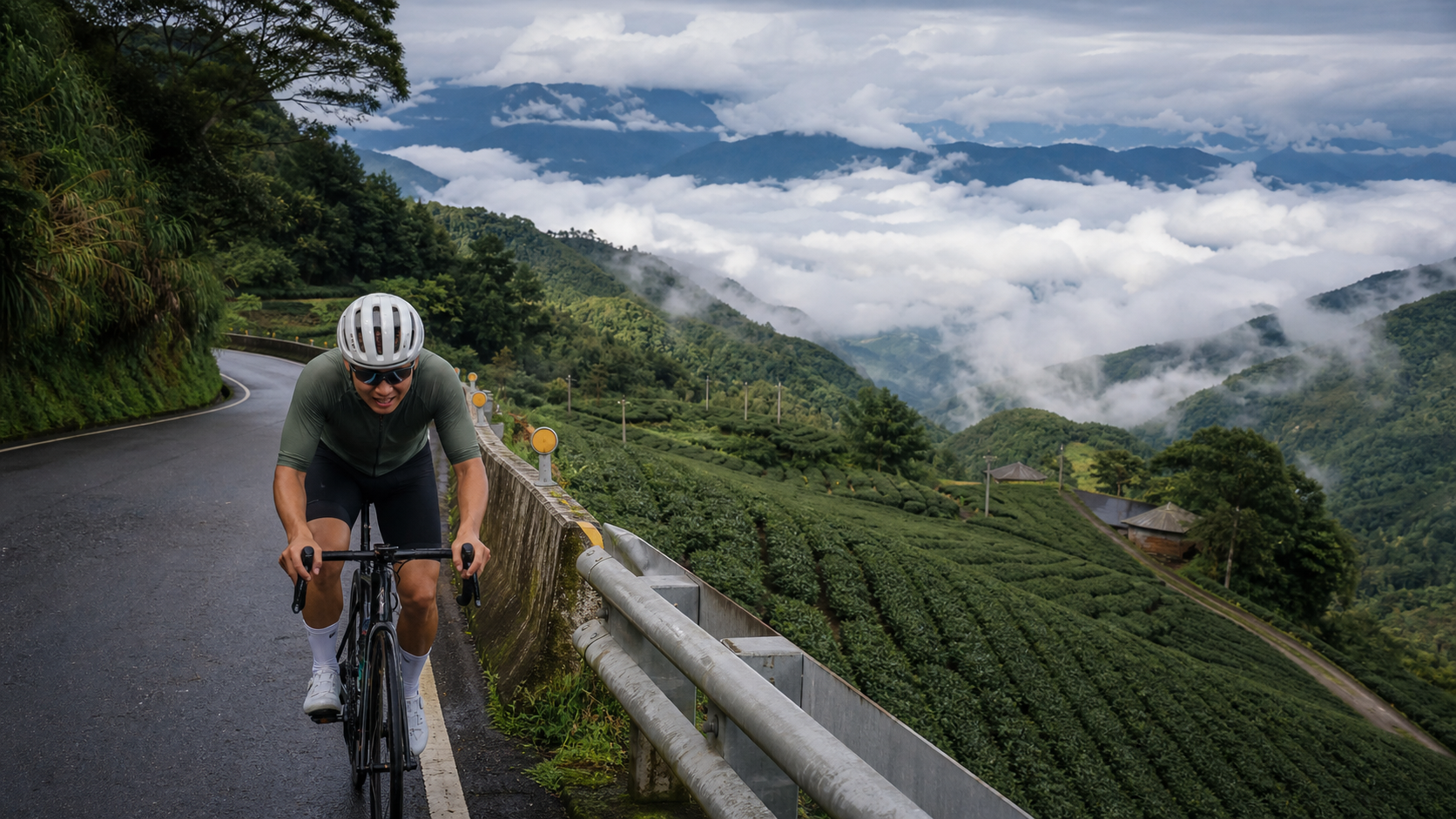
“Have you ridden Xiding?” In the road cycling circles of Chiayi, this phrase is almost like a secret password. Those who nod usually wear a complex expression blending painful memories and pride.
Xiding, a Place Whose Name Hides a Topographical Code
Xiding, as its name suggests, is the “top of the gap” between mountain ridges. Located in Fanlu Township, Chiayi County, along the Alishan Highway (Provincial Highway 18), it sits at an elevation of around 1,250 meters. The name itself precisely describes its topographical features—when you ride this stretch, you’ll find the mountain walls on both sides seemingly closing in on you, until the view suddenly opens up at the top, with clouds, mist, and tea gardens appearing before your eyes at once.
Since ancient times, this area has been a necessary passage between the Chiayi mountain region and the Tsou tribes of Alishan. During the Japanese colonial period, to develop Alishan’s forest resources, connecting roads and a forest railway system were built, gradually transforming Xiding from a mere geographical node into an important waystation for travelers. Today’s Alishan Highway was widened and constructed on the foundation of this historical route, with many old settlements and tea garden landscapes along the way bearing witness to this development history. Riding this road, in a sense, means traveling a path deeply interwoven with the history of Taiwan’s mountain development.
Xiding is locally renowned for its “Three Treasures”: the tea garden trails, the cloud waterfalls (a spectacular sight where clouds and mist surge out from between valleys, cascading like waterfalls), and the sunset views from Eryenping Trail, making it one of Taiwan’s classic spots for mountain sunrises, sunsets, and seas of clouds. This also means Xiding is not just a training ground for cycling enthusiasts, but a multi-identity venue cherished by photographers, hikers, and tea lovers alike—cyclists here are just one tributary among many pilgrims.
Scenery and Landmarks Along the Way: One Road, Three Identities
Climbing up Provincial Highway 18 from downtown Chiayi, the landscape around Xiding continuously shifts in character as elevation rises. The lower sections still carry the typical humid heat of southern Taiwan, but the higher you ride, the cooler the air becomes, with betel nut palms and orchards gradually replaced by layer upon layer of tea gardens—that’s right, this area is one of the core regions of Chiayi high-mountain tea (especially the famous “Alishan tea” production area).
As you ride through the Xiding section, you’ll notice several landmarks worth slowing down for, or even stopping to photograph:
- Chalinshan Trail and surrounding viewing platforms: Several viewing platforms are interspersed along the route, offering excellent vantage points overlooking the layered tea garden landscape. Many platforms are only about a 10-minute walk away, making them perfect for a cool-down activity after the climbing challenge
- Eryenping Trail: The most famous hiking route around Xiding, and the signature spot for viewing the sea of clouds and sunsets. Praised by many travel media as the most accessible trail for viewing the Alishan sea of clouds, the trailhead sits right beside the highway, making it extremely convenient to reach
- Taiping Cloud Bridge: In the nearby Taiping area, not far from Xiding, stands Taiwan’s highest-altitude suspension bridge. Spanning between Taiping Mountain and Jhutoujung Mountain, it stretches 281 meters and has become a popular new attraction in recent years—worth arranging a side trip if time permits
This combination of “popular sightseeing trails right next to a climbing section” makes Xiding fundamentally different from most of Taiwan’s purely training climbs—it was never a road built for cycling. The tea gardens and tribal life came first, and cycling enthusiasts are later arrivals, who must, to some extent, experience this land with a measure of humility and respect.
Local Culture and Tea Aroma: A Rider’s Taste Memory
The industries and daily life of residents along the Alishan Highway revolve almost entirely around “tea.” The tea gardens around Xiding sit at elevations between 1,000 and 1,400 meters. The diurnal temperature variation and the humid, mist-shrouded climate of this altitude range happen to be the perfect natural conditions for nurturing the exceptional flavor of high-mountain oolong tea—this is also the geographical reason why “Alishan high-mountain tea” holds its place in Taiwan’s tea market.
For cyclists who ride here, if time permits, it’s worth finding a tea house beside a tea garden after completing the climbing challenge, sitting down to order a pot of locally produced high-mountain tea, and watching the clouds and mist drift through the valleys outside the window—this kind of “leisure earned through sweat” often becomes one of the most profound memory fragments of the entire ride. Some local tea gardens also operate dining services, offering simple meals based on local ingredients, making them an excellent choice for replenishing after the ride (please refer to on-site information for actual establishments and menu items; mountain-area business hours often adjust with seasons and weather, so it’s recommended to confirm by phone or online before riding).
Besides tea, this area also benefits from its elevation to develop specialty agricultural products such as highland vegetables and wasabi. Occasionally along the way, you’ll spot small farm-direct sales stalls—the most direct window into local life. Rather than viewing Xiding simply as a training climb, it’s better to see it as a micro-journey through the fabric of tea-country life, where the mode of transport just happens to be a road bike.
First-Person Riding Narrative: That Afternoon That Made My Legs Go Weak
My first time challenging Xiding was on a weekday afternoon in late autumn. I’d thought, “It’s only a little over 3 kilometers—how bad can it be?” That complacent attitude was mercilessly slapped down less than 500 meters into the climb.
The gradient steepened without warning. The front derailleur had already dropped to the smallest chainring, and the rear was nearing its easiest gear. I found myself switching between seated and standing positions in a less-than-polished manner, trying to find a rhythm that would let my thigh muscles catch their breath. The surroundings were eerily quiet—all I could hear was my own heavy breathing and the faint sound of the chain rubbing. Occasionally a scooter would roar past, stirring up a gust of wind before quickly returning to silence. Turning a corner, my view was suddenly filled with an entire expanse of tea gardens stacked upward—in that moment, the pain seemed to hit pause.
Continuing upward, clouds and mist began to rise slowly from between the valleys, carrying a damp coolness that washed over my face, a stark contrast to my cheeks flushed from exertion. The sweat-soaked jersey, hit by the mountain breeze, brought a strangely wonderful sense of refreshment, as if my body were responding to this slope’s punishment in another way. When I reached the vicinity of Xiding’s high point, it was close to dusk. Light spilled through gaps in the clouds, dyeing the entire mountain range in a strange hue somewhere between gold and grayish blue. In that moment, I suddenly understood why local riders always speak of Xiding with a tone of both reverence and affection—it tests your will with nearly cruel gradients, yet rewards your perseverance with scenery given without reservation.
That day, I lingered at the viewing platform for nearly half an hour, watching the sea of clouds churn below while distant peaks appeared and disappeared. Suddenly, those few minutes of gasping nearly to the point of vomiting on the steep slope didn’t seem so unbearable anymore. This is probably a kind of shared “Stockholm syndrome” among climber-type cyclists—clearly abused by the gradient, yet willingly returning again and again.
What Xiding Means to Riders: A Concentrated Practice
In the minds of many local Chiayi cyclists, Xiding plays a role somewhat akin to “fundamentals” in martial arts training—it’s short in distance, requiring no full-day itinerary planning, yet it can push your cardiovascular system and muscular strength to their limits in an extremely short time. It’s the most honest mirror for testing your climbing ability.
Many riders treat Xiding as a warm-up or touchstone before the “Alishan Highway challenge”: if you can complete Xiding in reasonable condition, it means you possess the foundational ability to take on Shihjhuo, Fenchihu, or even push all the way to the Alishan Forest Recreation Area. Conversely, if Xiding gives you a brutal beating, that’s also an honest signal—it’s time to go back and build a more solid foundation of strength and cardiovascular fitness.
This quality of being “small yet profound” leaves Xiding with a disproportionately deep impression in many people’s cycling careers. Compared to long climbs spanning tens of kilometers, Xiding tells an entire story of struggle and scenery in the most concise format, making it a recurring topic of lively banter in many Chiayi cycling clubs’ regular group rides—always good for a round of teasing each other with “want to go get tortured at Xiding today?”
Seasonal Scenery and Suggested Side Trips
The landscape around Xiding changes dramatically with the seasons, which is why many cyclists are willing to return again and again:
- Autumn/Winter (October to February): The chance of seeing a sea of clouds is higher, with early morning and dusk being the best viewing times. This is also the season for autumn/winter tea harvesting, and a faint aroma of tea often lingers in the air—making it the favorite season for photography enthusiasts.
- Spring: New tea shoots sprout across the plantations, creating layers of tender green. The climate is relatively cool and comfortable, making it ideal for arranging a longer Alishan Highway challenge ride.
- Summer: Afternoon convection is strong, making fog and even rain more likely. It’s advisable to set off early and complete the climbing section before noon. However, the mountain air in early summer mornings is exceptionally fresh, offering its own unique charm.
If you’d like to incorporate Xiding into a full-day or half-day itinerary, it’s recommended to pair it with a hike on the nearby Eryuanping Trail, tea tasting at a local tea house, or even a visit to the Taiping Cloud Bridge. Combining the sense of accomplishment from the cycling challenge with local culture and scenery ensures this ride stays with you not just as sore legs, but as vivid impressions of taste and sight.
A Word to the Next Challenger
If this is your first time hearing the name Xiding and you’re planning a cycling trip to Chiayi, here’s my advice: don’t treat it merely as a training climb for chasing times or comparing Strava rankings. Slow down a little, stop at the scenic overlook platforms where it’s safe to pull over, and give yourself the chance to truly see this land—the mist-shrouded tea plantations, the layered mountain ridges in the distance, and the scenery that can only be earned through your own sweat.
Xiding may be only a little over 3 kilometers, but it packs the climbing challenge of the Alishan Highway, the misty beauty, and the tea-country culture into that short stretch of road in the most concentrated way possible. That’s exactly why countless riders love it and hate it in equal measure, yet can never stop thinking about it—after the pain, you’ll find that what lingers in your memory isn’t the numbers on those 15% ramps, but that moment when the sea of clouds rolls in and you suddenly feel it was all worth it.
A Conversation with Local Riders: What the Climb Taught Me
Over time, I rode Xiding several more times and gradually got to know a few veteran cyclists from Chiayi. One of them, a local bike shop owner, once described this stretch of road like this: “Many out-of-towners coming to challenge the Alishan Highway will make a special detour to ride Xiding. Not because it’s particularly famous, but because it’s short enough and representative enough—after one ride, you know exactly what shape your legs are in that day.” In a way, this captures Xiding’s unique position in Chiayi’s cycling ecosystem—it’s both a proving ground for beginners and a yardstick for veterans to calibrate their form.
Another rider who regularly participates in various hill-climb time trials shared that the road he visits most frequently during the autumn/winter sea-of-clouds season is Xiding. Not to set new personal records, but simply to enjoy that sense of efficiency—“maximum scenic reward for the shortest time and most concentrated suffering.” For him, Xiding is like a ritual: whenever word spreads that the sea of clouds is out, a group of riders will gather at dawn without prior arrangement, paying their respects to the mountain in the most honest way possible.
Practical Advice for Planners
If you’re planning a cycling trip centered on Xiding, here are some practical pre-departure considerations:
- Transport connections: Xiding is located along the Alishan Highway (Provincial Highway 18). Whether you ride up from Chiayi City, Shuishang, or Zhongpu via Highway 18, or arrange a shuttle to drop you off at the base before tackling the climb, both are viable options—it all depends on how you want to allocate your time and energy.
- Accommodation: If you’re planning a multi-day trip, the nearby areas of Shihzhuo and Fenchihu offer a variety of lodging options. You could schedule Xiding as the challenge segment on the first afternoon, then decide the next day based on your legs whether to continue tackling higher-altitude sections.
- Riding companions: It’s best to avoid riding solo on this steep climb, especially in the early morning or on weekdays when traffic is light. Riding with others isn’t just about safety—you can also encourage each other through the most painful sections of the gradient.
- Gear checklist: In addition to the gear-ratio setup mentioned earlier, it’s recommended to bring a lightweight rain jacket (mountain weather is unpredictable), a basic tire repair kit, and enough power banks to ensure your phone’s navigation and camera won’t die mid-ride.
What Xiding taught me isn’t just how to face a climb with a 10% average gradient—it’s more about the humility and patience required when facing any challenge. It never gets gentler no matter how many times you ride it, but as long as you’re willing to honestly confront your limits, it will always respond to your persistence in the most magnificent way, the moment the clouds part.
Four Seasons of One Road, One Person’s Growth
I eventually developed a habit of visiting Xiding once every season. In spring, I ride up to tea plantations bathed in tender green, the air carrying the distinctive grassy scent of new shoots. In summer, I set out at dawn to beat the afternoon thunderstorms, the mountain breeze still humid and warm, sweat soaking through my entire jersey. In autumn and winter, the sea of clouds takes center stage—often before dawn has fully broken, a group of riders will already be gathered at the overlook, quietly waiting for the first rays of morning light to pierce through the clouds.
On one winter visit, the temperature at the summit was so low my fingers went stiff, and I could feel the sluggishness in my knuckles when shifting gears. But just as the thought of giving up and turning back began to surface, the sea of clouds suddenly surged up from the valley without warning, instantly swallowing every peak in sight, leaving only the ridgelines of the highest points floating above the mist like islands. That image is still seared into my memory to this day—more than the satisfaction of any personal record, the awe of unexpectedly encountering such a natural wonder is the true gift Xiding has given me.
Over the years, Xiding has become more than just a synonym for a training climb—it’s more like an old friend. It doesn’t get easier just because you’ve gotten stronger, but every visit reminds you in a different way: the mountain is always there; what matters is the mindset you bring to face it.
An Invitation to City Riders
If you’ve spent years riding only on urban asphalt and riverside bike paths, and have never experienced that complex emotion of being pushed to question your very existence by a gradient, only to be instantly released by a sea of clouds, I sincerely suggest picking a crisp autumn weekend, planning a short trip to Chiayi, and putting Xiding on your itinerary.
There’s no need to bring a record-breaking mindset, and no need to compare pace with anyone. Simply treat it as an opportunity for a conversation with yourself—during those few minutes on the steep slope when you can barely catch your breath, you’ll face your physical limits with complete honesty. And in that moment when the clouds part and the tea plantations and mountain ridges come into view at once, you’ll also honestly feel that all this effort was already worth it.
That, perhaps, is the answer to why Xiding makes countless Chiayi riders love it and hate it in equal measure, yet never stop thinking about it.
Suggested Side-Trip Routes: Making the Most of Your Day
If you’re planning to turn the Xiding cycling challenge into a full-day itinerary, here are some common combinations to help balance your physical and mental energy:
Half-Day Light Trip Combo: Challenge the Xiding climb in the morning, enjoy a casual meal and tea tasting at a nearby tea house around noon, then hike the Eryuanping Trail in the afternoon (the trail has a gentle grade, making it a good cool-down activity after the climb). In the evening, depending on the weather and your energy, decide whether to stay for the sunset and sea of clouds.
Full-Day Advanced Combo: Set off from Chiayi City in the early morning, ride along Highway 18 all the way to Xiding, take a short break, then continue upward to Shihzhuo or Fenchihu if your legs allow. The cumulative elevation gain and mileage over the day make for a solid training ride—but be sure to assess whether your fitness and supply planning are sufficient.
Photography-Focused Itinerary: If your main goal is to capture the sea of clouds and sunset, it’s recommended to check into a homestay near Shihzhuo or Fenchihu the night before, then set off in the dark the next morning to challenge Xiding, arriving at the overlook before sunrise to secure a good spot. This is a well-established routine for many photography enthusiasts.
Whichever combination you choose, Xiding will be the most unforgettable chapter of the trip—it teaches you not just how to face a gradient, but how to maintain your ability to perceive beauty even in difficulty. And perhaps that is the most precious reward of cycle touring.
Strangers Met at Xiding
One of the most charming aspects of cycling travel is that you never know who you’ll meet on the road. Once, while taking a brief rest at the observation platform in Xiding, I encountered an elderly man who had hiked up alone carrying a camera and tripod. He told me he makes time to come up the mountain once or twice a month to photograph the sea of clouds, and has been doing so for nearly a decade. As we chatted, he pointed toward a direction where the mist was gradually dissipating, revealing layered mountain ridges, and said: “These mountains look different every day. What you see today will never repeat tomorrow.”
Those words have stayed with me ever since. In the process of chasing gradients, chasing speed, and chasing personal records on a bike, it’s easy to forget to stop and truly gaze at the unique, never-repeating scenery before your eyes. What makes Xiding special, perhaps, is that it forces you to slow down at your most painful moment—when your legs can no longer accelerate, the only thing you can do is honestly feel everything in this present moment: the temperature of the mountain breeze, the moisture of the mist, the fragrance wafting from the tea gardens, and the sound of your own heavy yet steady breathing.
It was also from that time onward that I began to understand why local riders always speak of Xiding with a tone bordering on reverence. This is not just a climb; it is a place where one can hold a proper conversation with nature and with oneself. Every visit is an opportunity to get to know yourself anew.
Whenever friends ask me which route in Chiayi is worth a special trip, Xiding is always the first that comes to mind. It is not the longest, not the one with the most elevation gain, and not the most famous route, but it condenses all the most moving elements of mountain cycling travel in Taiwan—challenge, scenery, culture, and chance encounters—all packed into a mere 3-plus kilometers of roadway, waiting for every rider willing to push down on the pedals to uncover the answer in person.
Related Reading
- Xiding Climb Full Analysis: How to Ride the 3.16km Mini Beast with 10% Average Gradient on Alishan Highway
- Chiayi Alishan Highway Climb: A Road Bike Challenge Amid Tea Gardens and Mountain Mist
- Chiayi Alishan Highway: The Tea-Scented Long Haul on Provincial Highway 18 from the Plains to 2,200 Meters
- Riding Toward the Sacred Mountain in the Clouds: The Geography, History, and a Journey of Self-Conquest on Alishan Highway
嘉義大埔、阿婆灣挑戰賽,美到以為在日本!ft. 環騎5 Cool 西拉雅188 / 公路車 / CT Yeh
7 個月前
一定要騎一次!阿里山最深處:里佳部落!單車旅行 | 2800m爬升 | 深度部落體驗:嗨翻晚會、螢火蟲、銀河 | feat. JJSC & 廢物伙伴 | 公路車 CT Yeh
9 個月前
梅山36彎 奮起湖 單車挑戰 下集 #公路車
6 年前
阿里山塔塔加 兩倍特濃版!全新隧道開通! 進喔!公路車 | CT Yeh
3 年前
96 彰化讚 挑戰組實錄 x 空拍繞圈賽集團衝刺 | 公路車 | ARTC 車測中心 | CT Yeh
6 年前
台北闊瀨陡坡 騎旅 / 日本單車雜誌編輯車友臨時加入!/ 髮香才是最強的 / feat. 北迴歸線小隊 / 公路車 CT Yeh
6 個月前
里佳部落 阿里山單車深度旅遊! | 竹山/草嶺/來吉/奮起湖 | 無敵銀河絕景 全新路線探索! 驚險狀況百出! | 4K沉浸式畫質 | 公路車 | CT Yeh
3 年前
4K單車實境) 嘉義 梅山36灣 訓練台 爬坡 輕鬆騎
6 年前