Wind and Aiyu Aroma Beneath the Gucheon Bridge: A Paiwan Mountain Trail Ride to the Edge of Wutai
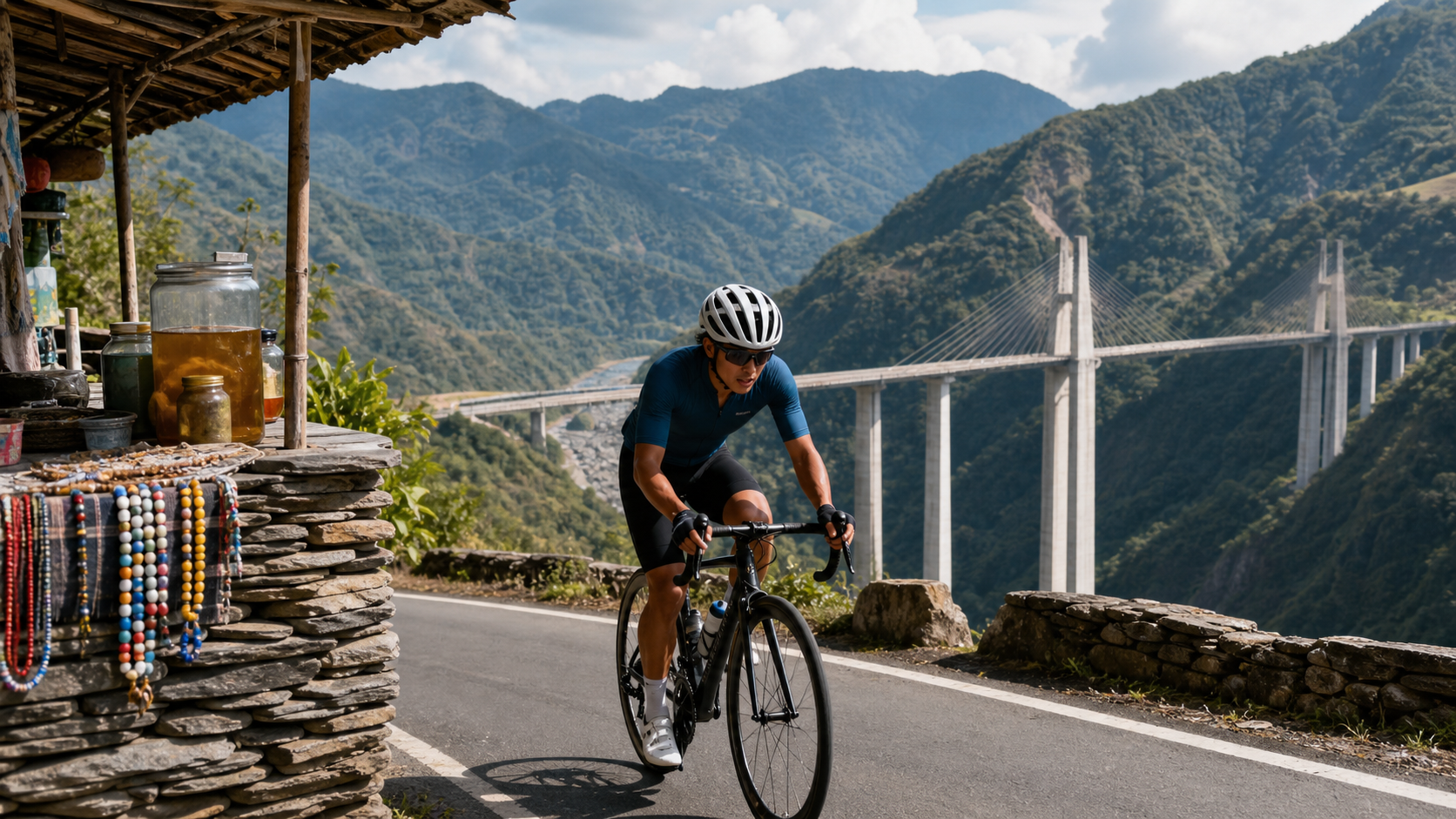
Wind and aiyu jelly fragrance beneath Guqiao Bridge: a Paiwan mountain trail ride to the edge of Wutai
Before departure: geography and culture starting from Sandimen
If you unfold a map of Pingtung County, you’ll find that Sandimen Township is a particularly special geographic node—it is the gateway from the plains into the Wutai mountain area, a border zone where the traditional territories of the Paiwan and Rukai peoples intersect, and where long-term interaction with the plains-dwelling Han society has taken place. Provincial Highway 24 winds upward from downtown Sandimen, ultimately reaching the deep-mountain tribes of Wutai Township. This road is not merely a scenic highway; it is a lifeline that local indigenous peoples have relied on for generations to connect their tribes with the outside world.
Sandimen, called “Timur” in the Paiwan language, is one of the townships with the highest concentration of Paiwan people in Pingtung County, and has long been renowned throughout Taiwan for its exquisite glass bead craftsmanship. Walking into Sandimen, you’ll see glass bead workshops and craft shops lining both sides of the streets. Translucent glass beads are strung into necklaces and bracelets, and the patterns and colors of each bead carry Paiwan legends and social hierarchy meanings—such as beads symbolizing tears, beads symbolizing warriors, and beads symbolizing the status of chieftains. Each type has its own unique cultural context; they are not mere ornaments but living carriers of oral history.
Venturing deeper into the mountains, past Sandimen lies the territory of Wutai Township, the traditional domain of the Rukai people. Although the Rukai and Paiwan are easily confused in the eyes of many outsiders (after all, the two groups share many similarities in clothing patterns and social systems), they are in fact two independent indigenous peoples, each with their own distinct characteristics. The most representative architectural culture of Wutai Township is undoubtedly the slate house—the Rukai people sourced materials locally, stacking the region’s abundant slate into traditional homes that stay cool in summer and warm in winter. This architectural wisdom has evolved over centuries and remains the most moving visual landmark in the Wutai tribal landscape. Many slate house exteriors are also carved with motifs such as the hundred-pacer viper and human-head patterns, telling of the Rukai people’s ancestral spirit beliefs and social systems.
As I mounted my bike, preparing to take on this route marked as “Sandimen Guqiao Aiyu,” what occupied my mind was not just the gradient and heart rate numbers, but the stories of an entire mountain forest and its tribes that this road connects to.
Guqiao Bridge: an engineering legend carved into the valley
The reason this route is named “Guqiao” points to the Guqiao Bridge, which stands at the boundary between Sandimen and Wutai, spanning the Ailiao North Creek—this bridge itself is an engineering legend worth telling on its own.
The construction of Guqiao Bridge took nearly three years, and its most striking figure is the pier height of 99 meters, surpassing the 68-meter elevated bridge at the Guoxing Interchange on National Freeway 6, making it the tallest bridge pier in Taiwan. The bridge is 654 meters long and about 10 meters wide, spanning the deep Ailiao North Creek valley in an elegant arc. From a distance, the slender piers and the wide deck create a striking visual contrast, like a ribbon suspended across the valley.
For the residents of Wutai Township, Guqiao Bridge is by no means merely a tourist landmark; it is a lifeline road that concerns life and death. Wutai Township is located in a mountainous area. In the past, whenever typhoons or torrential rains struck, the connecting roads were frequently cut off by mudslides and landslides, potentially hindering the delivery of supplies and emergency medical care for residents. The construction of Guqiao Bridge was precisely aimed at strengthening the disaster resilience of this connecting road, giving Wutai Township residents a more stable path home that is less likely to be severed by nature in an era of increasingly frequent extreme weather. The reason the piers were built so tall was precisely to stay above the reach of surging torrents and mudslide impacts at the valley bottom during typhoons and heavy rains—a critical design decision made by the engineering team after in-depth study of the geology and hydrology of the Ailiao North Creek watershed.
As I climbed slowly along Provincial Highway 24 and first caught sight of Guqiao Bridge’s towering, slender piers in the distance, I have to admit, I was somewhat awestruck. That awe did not come solely from the grandeur of the engineering scale, but from the realization that this bridge before me carries the most basic yet profound desire of the entire mountain tribe community: to “return home safely.” Riding up this slope, each push of the pedal was, in a sense, a tribute to this mountain forest and to the engineering and human stories behind this bridge.
Scenery and landmarks along the way: slate houses, glass beads, and a mountain symphony
Riding along Provincial Highway 24 from Sandimen toward Guqiao Bridge, the scenery along the way is a visual feast of layered depth. Climbing gradually from the suburban settlements, the roadside first features orchards and low farmhouses; then, as elevation increases, the mountains begin to close in, and the valley terrain of Ailiao North Creek starts to appear intermittently through the roadside trees.
Sandimen itself is primarily composed of Paiwan tribal settlements. If you have time to linger before or after your ride, you’ll notice that many homes’ exterior walls or public spaces in the tribe are decorated with glass bead patterns, slate motifs, hundred-pacer viper carvings, and other elements. These are not merely tourist-oriented installation art but a natural continuation of traditional Paiwan culture in contemporary living spaces. Many of the tribe’s master craftsmen still preserve the traditional techniques of hand-firing glass beads. From color selection, shaping, to firing, each bead requires considerable time and effort. This spirit of insisting on handcraft, in a way, subtly echoes the cyclist’s spirit of insisting on pedaling without relying on external assistance.
Continuing deeper into the mountains, as the gradient steepens, the view opens up as well. Looking back at the road behind, you can see the Sandimen settlements scattered across gentle slopes and terraces. On clear days, the outline of the Pingtung Plain in the distance is clearly discernible, and looking even farther, you can faintly make out the glimmering waves of the Taiwan Strait—this elevated perspective where mountains and sea merge is a unique experience that few flatland routes can offer.
On the section approaching Guqiao Bridge, the valley scenery of Ailiao North Creek gradually becomes the visual focus. The creek water is clear, with lush vegetation on both banks. After rain, the abundant flow even produces a clearly audible sound of water, interweaving with the cicadas and birdsong of the forest into a natural symphony belonging to the mountains of southern Taiwan. If the weather is clear and visibility is good, there’s also a chance to glimpse the towering piers of Guqiao Bridge in the distance, standing out strikingly against the green mountains and clear waters. This bridge has already become the most iconic visual landmark on this route.
Shenshan aiyu and tribal cuisine: Wutai’s refreshing flavors
When it comes to Wutai Township, one cannot fail to mention “Shenshan Aiyu”—a well-known attraction and food spot located at No. 16-1, Shenshan Lane, Wutai Township, which has long been a popular stop for visitors to the Wutai mountain area. Aiyu is a native Taiwanese plant; after the fruits are rubbed and washed and left to set, they naturally coagulate into a translucent jelly—the familiar “aiyu jelly”—one of the classic summer desserts for Taiwanese people. The reason Shenshan Aiyu has made a name for itself in the Wutai mountain area, besides its geographic advantage—situated on the必经之路 to the deep mountains of Wutai, making it a natural stop for travelers to rest and resupply—is that the quality and freshness of the handmade local product are also key reasons countless visitors make the drive specifically to come here.
I must honestly note that this “Sandimen Guqiao Aiyu” segment is only 5.37 kilometers in total length, and its actual geographic scope may not truly reach the Shenshan tribe in Wutai Township where the Shenshan Aiyu shop is located—Wutai Township itself lies deeper in the mountains, and the actual road distance between it and Sandimen far exceeds 5.37 kilometers. Therefore, if you treat this segment purely as a climbing training route, then enjoying Shenshan aiyu will likely have to wait until you extend your entire trip deeper into the Wutai mountains. I’d suggest planning it as a reward for continuing toward Wutai after conquering this climb, rather than mistakenly expecting to eat that bowl of refreshing aiyu jelly immediately after finishing these 5.37 kilometers.
Beyond aiyu, in recent years the Shenshan tribe of Wutai Township has also actively developed what is called a “tribal culinary school,” leading travelers to gain a deeper understanding of local ingredients and traditional food culture. Rukai traditional cuisine emphasizes sourcing locally and following the seasons. Wild boar meat, millet, pumpkin, pigeon peas, and other local ingredients are transformed through the generational skills of tribal mothers into dishes full of mountain wildness and cultural depth. This “farm-to-table” food philosophy, in a way, coincides with the spirit of “personal experience and down-to-earth effort” that cycling emphasizes—both are about getting close to the truest face of the land and culture through physical practice.
First-person riding narrative: a mountain dialogue through the pedals
That morning, I deliberately set out at the moment when dawn light had just appeared and the summer heat had not yet arrived. The air still carried a hint of moist night dew, the distant mountains presented layers of blue-purple tones in the early morning light, and the streets of Sandimen were still quite quiet, with only the occasional crow of a rooster or bark of a dog reminding me that this place still maintains the most primitive rhythm of mountain village life.
Starting from downtown and climbing slowly along Provincial Highway 24, the first kilometer or so had a relatively gentle gradient, just right for letting the body gradually adapt and settle into a riding rhythm. Orchards heavy with fruit appeared from time to time along the roadside—mangoes and atemoya dotting the lush green branches—and the air carried a faint sweet aroma of ripe fruit, mixed with the cool morning mountain breeze. This dual stimulation of smell and touch is a subtle sensation that can only be experienced by actually riding on this land.
As the gradient gradually steepened, my breathing became rapid, and sweat began to trickle down my temples. At that moment, I deliberately slowed my thoughts, not thinking about distance numbers or gradient percentages, but focusing on feeling the exchange of force between body and earth transmitted through the pedals—each push of the pedal was a concrete practice of the body resisting gravity and climbing upward, while the surrounding mountains, valleys, and tribal settlements were like a silent yet generous witness, quietly watching every rider interpret their connection to this land in their own way.
On the most demanding section of the climb, the mountain walls on both sides gradually closed in, and the sound of Ailiao North Creek’s water faintly drifted through the forest. That feeling of being embraced by the mountains, as if temporarily cut off from the outside world, unconsciously slowed my breathing rhythm and also quieted the distractions in my mind. This is precisely the most captivating aspect of mountain climbing routes—they force you to put down your phone, put aside worldly affairs, and focus entirely on the winding road ahead and your body’s most honest reactions.
When the view gradually opened up and the towering, slender piers of Guqiao Bridge finally came into sight in the distance, the complex emotion mixing fatigue and awe was truly hard to express in a few words. At that moment, I felt I could begin to understand what this bridge means to the residents of the mountain tribes—it is not just a transportation structure spanning a valley, but a concrete symbol connecting tribes with the outside world, tradition with modernity, and safety with hope.
What this route means to riders: gains beyond speed
In today’s increasingly competitive and data-driven cycling world, it’s easy to fall into a misconception—believing that the value of riding is entirely determined by power output, average speed, or rankings on the Strava leaderboard. The Sandimen Guqiao Aiyu route offers precisely an opportunity to reflect on this misconception.
At just 5.37 kilometers, even at full sprint, it would be over in a dozen or so minutes. But if you’re willing to slow down and savor the geographic and cultural context along the way, what this route can give you far exceeds a set of cold power numbers. It connects to the Paiwan glass bead craft and tribal life wisdom, to the Rukai slate house architectural culture and the engineering legend of Guqiao Bridge, and to the long-standing interdependence between tribe and land behind that bowl of refreshing Shenshan aiyu.
For me, the meaning of this route lies in its reminder to every rider who climbs it—cycling has never been merely an arena for physical fitness, but a unique way of going deep into the land, understanding culture, and forming connections with local communities. When you’re gasping for breath riding up this slope, sweat soaking your jersey, legs burning and trembling from lactic acid buildup, what you’ve conquered is not just the 6.8% average gradient and 365 meters of elevation gain, but also a geographic and psychological distance spanning plains and mountains, and spanning different ethnic cultures.
I know quite a few cycling friends whose daily training takes place on riverside bike paths in urban areas or on repetitive fixed routes, pursuing stable training volume and predictable data growth. Such training patterns certainly have their efficiency and value, but over time, riding can inevitably degenerate into a mechanized repetitive labor, losing some of the thrill and novelty that first made people fall in love with cycling. Routes like Sandimen Guqiao Aiyu offer precisely a remedy—they skillfully blend “training” with “exploration,” “data” with “humanity,” allowing riders to push their physical limits while unconsciously opening their senses, relearning to observe, listen, and feel the breathing of a land at a slow and focused pace.
For this reason, I often share with fellow riders that before challenging an unfamiliar mountain route, it’s worth spending some time doing a bit of homework, understanding the tribes the road passes through and the historical and cultural context it connects to. When you know you’re riding on the traditional territory where the Paiwan and Rukai peoples have lived for generations, and know that behind the bridge before you lies the earnest hope of an entire mountain tribe community for safe passage home, then no matter how steep the gradient or how much sweat is shed, each turn of the pedal seems to carry an added measure of solemnity and respect. This shift in mindset may be one of the most precious gifts cycling can give us—it transforms movement from mere displacement into a pathway for understanding the world and the ways others live.
Seasonal scenery: when it’s most beautiful
If you ask me which season is most beautiful for visiting the Sandimen Guqiao Aiyu route, my answer would follow the seasonal changes of southern Taiwan’s mountain areas.
Late spring to early summer (approximately April to May) is the season when mountain life is at its most vigorous. The vegetation on both sides is lush and verdant, and occasionally you can see fruit trees in tribal orchards blooming and bearing fruit. The air is filled with a fresh scent of vegetation, and temperatures haven’t yet reached the scorching summer heat—a relatively comfortable riding season.
Autumn to winter (approximately November to January) is the dry, pleasant season in southern Taiwan. The sky often displays a clear, transparent azure tone, and the views of the Pingtung Plain and even the Taiwan Strait are at their clearest. Combined with pleasant temperatures, this is an ideal time for a deep, slow ride incorporating tribal cultural experiences and glass bead craft visits, combining cycling with cultural tourism into a complete southern Taiwan mountain getaway.
As for summer (June to September), while it’s the high-risk season for typhoons and afternoon thundershowers, if you choose to set out in the early morning hours, you can instead enjoy the mountain’s characteristic misty cloud scenery—morning moisture gathers and rises in the valleys, sunlight pierces through the clouds and mist to cast dreamlike light and shadow effects across the forest. Just be sure to check the weather forecast and avoid the hours of strong afternoon convection. Safety always takes precedence over the allure of scenery.
Suggested extensions: turning this climb into a complete mountain journey
If, like me, you’re not satisfied with merely completing this 5.37-kilometer climbing challenge and want to extend the trip into a more complete Sandimen and Wutai cultural and natural tour, here are a few suggestions for riders and travelers to consider.
Sandimen tribal tour: Before or after tackling the climb, consider setting aside some time to visit the Sandimen settlement, tour glass bead workshops, and witness firsthand how master craftsmen fire translucent beads into artworks carrying Paiwan cultural memory. Some workshops also offer visitors the chance to try simple glass bead DIY—a highly meaningful cultural experience activity.
Extended visit to Wutai slate house settlements: If your energy and time permit, and you’ve confirmed that relevant access regulations are in order, consider extending the trip to Wutai Township to appreciate the traditional Rukai slate house architecture up close, experiencing the traditional building wisdom of sourcing local materials and adapting to the mountain terrain. Some tribes also offer cultural guided tours or craft experience programs for a deeper understanding of Rukai history and way of life.
Tasting Shenshan aiyu and tribal cuisine: As mentioned earlier, Shenshan Aiyu is located deep in the Wutai mountains. If your itinerary covers that area, don’t miss this handmade local summer delicacy. Also keep an eye out for any tribal culinary school experience programs in the area, through which you can get closer to the life wisdom of the Rukai and Paiwan peoples via food culture.
Be mindful of mountain entry regulations: If your itinerary goes deep into the Wutai mountain area, especially toward more remote tribal sections like Ali or Dawu, be sure to confirm in advance whether an entry permit is required, as well as relevant access hours and group size limits. It’s best to consult directly with the Pingtung County Government, Wutai Township Office, or local police authorities, and rely on the latest official announcements. Don’t speculate on your own or discover obstacles on the spot, which could disrupt the rhythm and mood of your entire trip.
Watch for weather and road condition changes: Weather in southern Taiwan’s mountain areas changes rapidly, especially during typhoon season. Be sure to check the latest weather forecasts and road access conditions before departure. If heavy rain advisories or typhoon warnings are issued, safety should be the highest priority, and adjust or postpone your trip accordingly.
Conclusion: a short mountain road connecting land and hearts
Sandimen Guqiao Aiyu—this climbing route of just 5.37 kilometers might at first glance appear to be nothing more than an unremarkable set of numbers in the vast Strava segment database. But when you actually ride this road, measuring and feeling it with your legs and wheels, you’ll discover that within this short distance are condensed the wisdom of Paiwan glass bead craftsmanship, the slate house architectural culture of the Rukai people, the moving engineering legend of Guqiao Bridge, and the simple yet meaningful refreshment of that bowl of Shenshan aiyu.
For me, cycling has never been merely a sport, but a medium for understanding the land and getting close to culture. Each push of the pedal is the most honest dialogue between body and earth; each climb is a threshold leading to a deeper understanding of this land’s stories. If you’ve ever ridden the Sandimen Guqiao Aiyu route, or are planning your own Sandimen and Wutai mountain journey, I hope this article can add some warmth of humanity and history to your trip—so that beyond speed and gradient, you’ll also remember that bridge, those slate houses, that bowl of aiyu jelly, and the wisdom and resilience of the Paiwan and Rukai people who have always quietly guarded this mountain forest.
On the descent back, the wind was noticeably cooler than on the way up, and the muscles that had been tense during the climb gradually relaxed with the easy glide. I deliberately slowed my descent—partly because sightlines are limited on mountain curves and reckless speed isn’t safe, and partly because I wanted to take a few more looks at the scenic details I’d missed along the way—millet drying in front of someone’s home, a weathered yet still vivid glass bead relief on a stone wall, a distant mountain mist glimpsed unexpectedly at a turn. These details are easy to miss if you spend the entire ride staring at your bike computer and heart rate numbers.
Back in downtown Sandimen, I found a local eatery, sat down, and ordered a simple plate of mountain vegetables and a bowl of refreshingly cold aiyu. As I savored the memory of that brief yet solid climbing challenge while watching the tribal artisans outside still busy with their glass bead craft, I suddenly felt that the meaning of this ride far exceeded the finish time and average power numbers on that line of Strava records. It was a physical workout and a spiritual cleansing—reminding me that no matter how technology advances or how precise data becomes, what truly makes a route worth riding again and again is ultimately the moving stories behind it about land, about people, and about cultural heritage. Next time you set foot on this slope from Sandimen toward Guqiao Bridge, consider slowing your pace a little—let your body feel the rise and fall of the gradient, and let your heart listen to all that this mountain forest and its tribes have to say.
Related reading
- A ride to the land of clouds: a journey through the Rukai of Wutai Township and the dual migrations of Haocha tribe
- A stick of incense at the end of the mountain trail: riding notes from Sanxia Li Mountain Shrine
- The hidden mountain trail of the indigo-dyeing town: riding up Sanxia North 113 Dongyan Bridge, I understood what “numbers don’t lie, but they stay silent” means
- A back door to Taiwu Township: reading resilience and life wisdom on rugged land
觀霧 變好騎了! | 北高車友爆笑大會師 | 公路車 | 單車旅遊 Taiwan Cycling Route GuanWu
6 年前
一定要騎一次!阿里山最深處:里佳部落!單車旅行 | 2800m爬升 | 深度部落體驗:嗨翻晚會、螢火蟲、銀河 | feat. JJSC & 廢物伙伴 | 公路車 CT Yeh
10 個月前
嘉義大埔、阿婆灣挑戰賽,美到以為在日本!ft. 環騎5 Cool 西拉雅188 / 公路車 / CT Yeh
7 個月前
大武山20%魔王陡坡【JJSC南台灣遊騎Day2】!屁股真的要裂開了...凡士林抹滿也沒用?神秘金教堂還有超便宜夜市
3 個月前
2026紫南宮環線99.9K挑戰Vlog 多視角第一集團 跟看看.. / CT Yeh 公路車
1 個月前
台北闊瀨陡坡 騎旅 / 日本單車雜誌編輯車友臨時加入!/ 髮香才是最強的 / feat. 北迴歸線小隊 / 公路車 CT Yeh
6 個月前
西進武嶺 世界紀錄挑戰!破2:30 ?!一群人推著一個夢上山 直播精華版 / ft. 張翰允 & 台視主播魏于恬 & KPLUS / #cycling 公路車 CT Yeh
2 個月前
[4K空拍] 三灣落羽松 秘境 與 神仙谷
7 年前