Shaoya Industrial Road: Riding into the Paiwan Tribe Village Beyond Tuwu Suspension Bridge, a Secluded Long Climb with Sparse Traffic
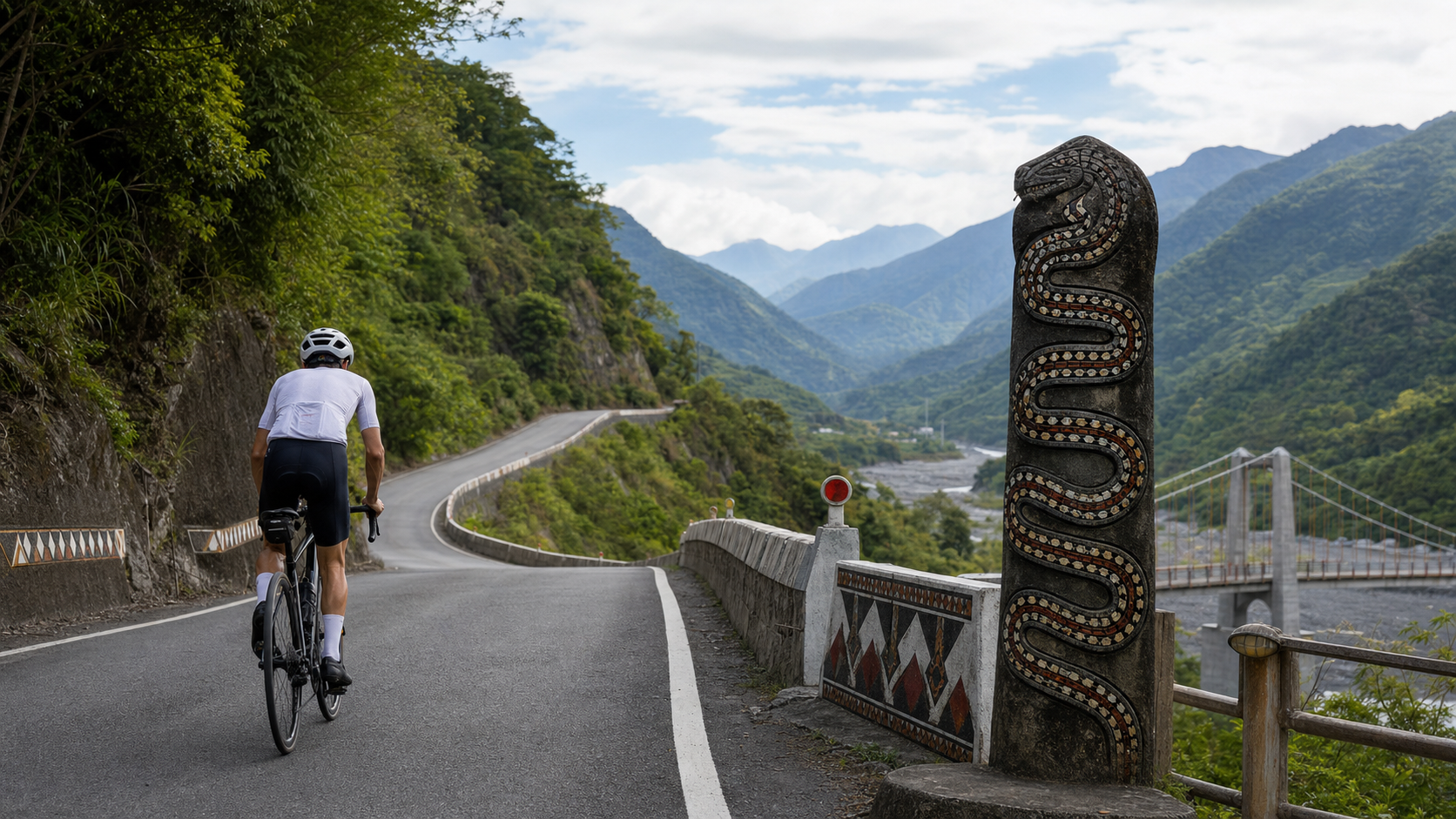
One of the southernmost indigenous villages in Taiwan, a rebuilt century-old suspension bridge, and an industrial road climbing 672 meters—Shaoya holds the least-known hidden moments of the South Link mountain region.
1. The First Step into the Hidden Realm: Tuban Suspension Bridge
To reach the starting point of Shaoya Industrial Road, you must first ride across Tuban Suspension Bridge. The bridge itself is a piece of history worth savoring. The original suspension bridge was built in 1938 during the Japanese colonial period to connect Tuban Village and Xinxing Village. In an era when transportation infrastructure was still relatively scarce, a bridge often carried the most vital lifeline between two villages. This old bridge served for more than fifty years before eventually being damaged by disasters and abandoned, temporarily severing Tuban Village’s connection with the outside world.
It wasn’t until 2011 that the new Tuban Suspension Bridge was rebuilt, spanning 123 meters with an arched structural design. Most moving of all, the bridge entrance and cable walls are adorned with traditional Paiwan motifs—hundred-pacer snakes, clay pots, and warriors. This is not merely a piece of transportation infrastructure but a public artwork carrying the cultural identity of the tribe. Visitors who have crossed this bridge describe it as “quite sturdy, not feeling very shaky,” with a solid structure that lets you peacefully admire the scenery of the creek valley and distant mountains below.
Standing on the bridge, a breeze carries a hint of coolness through the valley. Looking up at the intricate totem carvings on the bridge cables, you feel something powerful—you are about to enter not just a climbing route, but a place with its own cultural context and historical memory.
2. Tuban Village: The Daily Life of the Paiwan People
Tuban is a Paiwan tribe village in Daren Township, Taitung County, located in one of Taiwan’s southernmost indigenous mountain areas. The environment here retains a relatively pristine character with few visitors, as a traveler who once visited nearby roads described in their journal: “Sparse traffic, a strong sense of hidden-realm atmosphere.” This tranquility, far from tourist bustle, allows visitors to experience the most authentic side of tribal life.
Riding into Tuban Park, you’ll see installation art themed around the Paiwan “Five-Year Festival spear-throwing ritual,” set up for visitors to take photos. The Five-Year Festival is one of the most important traditional ceremonies for the Paiwan and Rukai tribes, with the “spear-throwing” ritual being its most iconic core activity—tribal members hold long bamboo poles, attempting to spear a rattan ball tossed into the air, with the spot where it’s struck symbolizing different blessings. Such cultural installation art allows even first-time visitors to roughly grasp a corner of Paiwan traditional ceremonial culture through visual and spatial experience.
3. Nearby History Worth Noting: Guzilun Racing Road
When planning a trip on Shaoya Industrial Road, it’s worth mentioning another nearby road in Daren Township that differs from Shaoya Industrial Road—Guzilun Racing Road. This road connecting Xinhua Village and Tuban Village in Daren Township, known for its many curves and distinctive alignment, was once certified by the Fédération Internationale de l’Automobile (FIA) and is famous for its circuit-grade corner design, making it one of the few roads in Taiwan with an international racing certification background.
However, this road was severely damaged in the 2009 Typhoon Morakot disaster and remained closed for over a decade. After more than ten years of restoration efforts by the Daren Township Office, it was finally reopened in November 2023, with a rally event held after reopening. Although Guzilun Racing Road and the Shaoya Industrial Road introduced in this article are not the same route, both are part of Daren Township’s mountain road network. This history, to some extent, reflects the fragility and resilience of the South Link mountain road system in the face of natural disasters—behind every road that allows riders to pass safely, there may lie a long story of struggle against and repair from natural calamities.
4. First-Person Perspective: An Early Morning Departure with the Hundred-Pacer Snake Totem
Arriving at Tuban Suspension Bridge in the early morning, the valley still held the lingering coolness of the night. The creek flowed quietly beneath the bridge, with the occasional sound of birdsong. Wheeling my bike onto the bridge, my fingertips traced the carved lines of the hundred-pacer snake totem on the railing, and a strange sense of ritual came over me—as if, before formally beginning this climbing challenge, I was greeting the culture of this land.
After crossing the bridge, the climbing section of Shaoya Industrial Road officially begins. In the first few kilometers, dense mountain vegetation lines both sides of the road, with the occasional sound of flowing water drifting from afar or the crisp calls of unknown birds. This feeling of being completely enveloped by nature is utterly different from riding through bustling city traffic—here there are no traffic lights, no tension of fighting for space with cars and scooters, only the undulating terrain and a gradually rising heartbeat.
As the gradient steepens, breathing becomes rapid, and sweat trickles down my cheeks. Near the steepest sections, the world seems to shrink to just the small stretch of road ahead—staring at the front wheel, counting cadence, feeling the burning sensation in my thigh muscles with every pedal stroke. I encounter almost no other vehicles or pedestrians on this road, so quiet that only my own heavy breathing and the sound of the chain turning remain. Occasionally a mountain breeze rustles through the treetops, reminding me that this is indeed living forest, not an isolated island cut off from the world.
At the moment of reaching the summit, looking back at the road I’ve climbed, I can see layered mountain ridges and a faint coastline in the distance. That complex emotion mixing fatigue and accomplishment is a taste only those who have personally climbed this slope can truly understand.
5. Landscapes Worth Noting Along the Way
Beyond the suspension bridge and tribal park in Tuban Village, there are several other landscapes worth knowing. Although whether some lie directly along Shaoya Industrial Road still requires on-site confirmation, they all belong to the shared cultural and natural assets of this area: Titanic Rock, famous for its resemblance to the bow of the Titanic, is a newly emerging landmark of the Ji tribe (located in Alishan Township, Chiayi—not the same area as Tuban, but sharing the common naming practice of distinctive landmarks among Taiwan’s indigenous villages); and within Daren Township, similar natural landscapes given whimsical names based on distinctive terrain features are also found. This naming culture that connects natural landforms with everyday imagination is itself a manifestation of indigenous tribes’ wisdom in coexisting with the land.
Next to Daxi Elementary School, the 2022 South Link Art Festival work “Glimmer Pavilion” was once exhibited, using sunlight transmission to create visual effects—a contemporary art highlight added to this mountain area during the festival. The holding of such art festivals, to some extent, reflects how the government and local communities have recently attempted, through the infusion of artistic and cultural resources, to let the outside world rediscover this relatively low-profile indigenous land in the South Link mountains.
6. The Test of Seasons and Geography
The South Link mountain area occupies a unique geographical position, adjacent to the Pacific Ocean and the southern section of the Central Mountain Range. During the summer and autumn typhoon seasons, it is susceptible to heavy rainfall, with risks of rockfalls and roadbed erosion on mountain roads. This is also why Daren Township’s mountain road system has been damaged multiple times by wind disasters historically (such as the aforementioned case of Guzilun Racing Road being closed for over a decade). This geographical fate of coexisting with natural disasters has, to some extent, shaped the resilient and optimistic attitude toward life among South Link tribal residents.
If you choose to ride during the spring or autumn, when the climate is relatively stable, you can more comfortably enjoy the unique experience of nature and culture interwoven along this route. Although summer brings lush green vegetation, the muggy weather and uncertainty of afternoon convective showers require riders to make more thorough risk assessments and contingency preparations.
7. Local Culture and Way of Life
Tuban Village still preserves a relatively original Paiwan way of life and cultural characteristics. This authenticity, unpolished by excessive tourism, is the most precious aspect of this route. While no reliable public information is available on specific local food establishments, and it would be inappropriate to fabricate specific dishes or restaurant names here, one thing is certain: if riders have the opportunity to interact with tribal residents, that unadorned warmth and simplicity often become the most heartwarming unexpected reward of the entire journey.
8. Side Trip Suggestions and Final Thoughts
If time permits, it’s recommended to incorporate the challenge of Shaoya Industrial Road into a broader itinerary exploring the cultural landscape of Daren Township. Besides Tuban Suspension Bridge and the tribal park, depending on your time and energy, you might also explore the hidden-realm atmosphere along nearby township roads (East 68, East 70), experiencing how the dense yet low-key road network of the South Link mountains connects the daily lives of Paiwan villages.
Shaoya Industrial Road is not the kind of famous attraction that appears on popular travel lists. It lies hidden in Taiwan’s southernmost indigenous mountain area, quietly waiting for riders willing to invest time and effort to visit in person. When you ride across the hundred-pacer snake totems on Tuban Suspension Bridge, climb 672 meters to the route’s highest point, and look back at this land guarded by both the Central Mountain Range and the Pacific Ocean, you’ll understand why some hidden places deserve to be explored in the most primal way—pedaling with your own legs, drenched in sweat—rather than merely imagined through photos on a screen.
9. The Metaphor Between Bridge and Road
From the old bridge of 1938, to half a century of abandonment, to the 2011 reconstruction into today’s new bridge adorned with hundred-pacer snake totems, this history spanning nearly a century is, in a way, a metaphor—connection is never accomplished in a single stroke, but requires the willingness to reinvest effort in repair and continuation after rupture. What this bridge carries is not just the transportation link between Tuban Village and Xinxing Village, but also the memory of an entire generation of Paiwan culture—how it finds ways to coexist with traditional totems amid modernization.
The moment you ride across this bridge and begin climbing Shaoya Industrial Road, you are, to some extent, participating in the continuation of this “connection”—every rider who visits here, through their own two wheels and sweat, adds an opportunity for this relatively low-profile South Link hidden gem to be seen and remembered by the outside world.
10. Daren Township’s Resilience and Optimism
If you compare the history of nearby Guzilun Racing Road—damaged in the 2009 Typhoon Morakot disaster, closed for over a decade, and only reopened in 2023—you’ll find that this land of Daren Township has always coexisted with the threat of natural disasters. Every post-typhoon restoration project requires enormous time and resources, yet local residents and the township office never gave up—more than ten years of restoration efforts ultimately resulted in the road’s reopening and the hosting of a rally event, symbolizing this land’s unwavering resilience and optimism in the face of adversity.
This spirit, to some extent, also infects every rider who visits this mountain area. When you grit your teeth through the 16.9% steep grade of Shaoya Industrial Road, perhaps a similar realization crosses your mind—scenery and achievements truly worth cherishing often require arduous effort before they can truly be reached.
11. Reminders and Blessings for Future Visitors
If you’ve read this article and decided to personally pedal to Shaoya Industrial Road, please remember that this is not a touristy hotspot but a Paiwan tribe village that still maintains its original way of life. When visiting, please maintain basic respect for the local culture and residents—speak softly, don’t wander into private spaces uninvited, and approach tribal residents you encounter with friendliness and gratitude.
When you complete this challenge and stand at the highest point of Shaoya Industrial Road, overlooking the layered mountain ridges and the distant coastline, I hope what you take away is not just the sense of accomplishment from conquering a steep climb, but also an understanding of and respect for this land of Taiwan’s southernmost indigenous communities. This, perhaps, is the most precious gift Shaoya Industrial Road wants to leave with every visitor.
12. The Five-Year Festival and the Measure of Time
The Paiwan Five-Year Festival is an important ceremony held on a five-year cycle. This way of marking the rhythm of life with a longer time span is fundamentally different from modern society’s habit of annual calendars, or even shorter daily planning. Standing before the spear-throwing themed installation art in Tuban Park, one is prompted to reconsider the meaning of “time” for different cultures—for the Paiwan people, five years is not just a number, but carries the collective memory of generational inheritance, blessing-seeking, and vow-fulfillment for the entire tribe.
This concept of time, out of step with modern life’s pace, echoes to some extent the experience of climbing Shaoya Industrial Road—it doesn’t pursue extreme speed breakthroughs, nor is it a short climb that can be conquered in minutes. Instead, it requires you to spend half an hour or even a full hour, at a relatively slow yet steady rhythm, accumulating 672 meters of elevation gain step by step. Perhaps this is a life philosophy that the tribal culture of the South Link mountains subtly transmits to every visitor: things truly worth cherishing often require the accumulation of time, not shortcuts to quick results.
13. A Final Look Back Before Leaving
Before preparing to descend and head home, it’s worth pausing at the highest point of Shaoya Industrial Road to give yourself time to properly look back at the trajectory of your climb. From the hundred-pacer snake totem carvings on Tuban Suspension Bridge, to the dense mountain vegetation along the way, to the occasional sounds of flowing water and birdsong—these fragments pieced together form a journey memory far richer than simply “completing a climb.”
When you ride away from this mountain area and return to the hustle and bustle of daily life on the plains, perhaps at some moment the image of the arched structure interwoven with traditional totems on Tuban Suspension Bridge will suddenly surface in your mind. At that moment, you’ll understand that what Shaoya Industrial Road has left you is not just a training record or a set of GPS data, but a unique connection forged with Taiwan’s southernmost indigenous land.
14. To the Next Visitor: Hidden Gems Deserve Gentle Treatment
When recommending such a relatively low-profile route, there’s always a contradictory feeling—hoping more people can personally experience the beauty of this land, yet worrying that excessive tourism might destroy its original purity. If you decide to visit Shaoya Industrial Road, please treat this “hidden-realm feeling” as a gift to be cherished and handled gently: don’t litter, don’t make noise that disturbs residents’ lives, and maintain basic courtesy and respect toward every tribal member you meet.
The reason Tuban Village and Shaoya Industrial Road have been able to preserve this original and authentic appearance to this day is, to some extent, precisely because they haven’t yet been altered by excessive commercial development and tourist crowds. As visitors, what we can do is pass through this land with the lightest footprints and the most sincere hearts—leaving no marks that would change it.
15. The South Link: A Route Worth Returning To
The South Link region of Taitung still has many riding routes like Shaoya Industrial Road, hidden between tribes and forests, yet to be discovered by mass tourism. Each visit is an opportunity to reacquaint yourself with Taiwan’s diverse indigenous cultures. With its 672 meters of total elevation gain, its steepest grade of 16.9%, and the hundred-pacer snake totems on Tuban Suspension Bridge, Shaoya Industrial Road tells every rider willing to personally pedal here about this land’s unique resilience, optimism, and cultural depth.
If the opportunity arises, I hope you won’t ride Shaoya Industrial Road just once, but will be willing to return again and again in different seasons and different states of mind, gradually building up that indescribable yet ever-real connection between yourself and this South Link hidden gem.
16. After All the Words
Sometimes, the most precious part of a journey lies not in whether it’s been written into popular attraction lists, nor in how many social media likes it has accumulated. The value of Shaoya Industrial Road lies precisely in its low profile and authenticity—a suspension bridge carrying nearly a century of history, a steep climb that tests willpower, a Paiwan tribe village still maintaining its original way of life. These elements interwoven together form a unique experience that cannot be easily replicated, nor fully conveyed through words.
If this article has sparked a hint of curiosity about Shaoya Industrial Road, then the true answer can perhaps only be fully revealed by personally pedaling up and climbing those 672 meters yourself. This forest at Taiwan’s southernmost tip is quietly waiting for every rider willing to use sweat and time to get to know it, understand it, and in turn cherish it. May you, on some clear morning, walk your bike across Tuban Suspension Bridge, letting the hundred-pacer snake totem write the gentlest yet firmest blessing for your journey.
17. Afterword: On the Weight of a Place Name
The origin of the place name “Shaoya” remains unverifiable even after extensive research. It may be an ancient tribal designation, or it may be related to some topographical feature long forgotten by time. But perhaps, whether a place name has clear written records doesn’t diminish the weight it carries—every person who has climbed this steep slope and crossed that hundred-pacer snake totem bridge is, through their own bodily experience, re-endowing the name “Shaoya” with meaning and memory for this era.
This, perhaps, is one of the most moving aspects of cycling: even when historical records have gaps, even when the origin of a place name is disputed, as long as you’re willing to personally pedal and personally feel that steepness and hardship, this road will ultimately become a real part of your life’s memory map. And the next time someone asks where “Shaoya” is and what it represents, you might answer in your own way: it’s a hidden long climb of 672 meters, tucked deep within Tuban Village, a place that inspires genuine awe for this land—an answer written in sweat, yours alone—and this is precisely the most unique gift Shaoya Industrial Road leaves with everyone who has truly ridden it: a South Link memory that cannot be replicated, that can only be truly understood by going there in person—keep it safely, and then one day, return with the same reverence, cross that bridge again, climb that slope again, feel again this land’s unchanging warmth and weight, and remind yourself once more why you fell in love with cycling in the first place.
Related Reading
- Shaoya Industrial Road (Tuban) Practical Guide: A 10.4 km, 672 m Climb on a South Link Hidden Long Slope
- 12 km Upstream: Tonghou Forest Road and the Path the Atayal People Walked
- Riding Along the Nanshi River Toward a Cloudtop Tribe: The 14.4 km Upstream Road to Fushan
- A Back Door to Taiwu Township: Reading Resilience and Life Wisdom on Rugged Land
嘉義大埔、阿婆灣挑戰賽,美到以為在日本!ft. 環騎5 Cool 西拉雅188 / 公路車 / CT Yeh
7 個月前
台北闊瀨陡坡 騎旅 / 日本單車雜誌編輯車友臨時加入!/ 髮香才是最強的 / feat. 北迴歸線小隊 / 公路車 CT Yeh
6 個月前
大武山20%魔王陡坡【JJSC南台灣遊騎Day2】!屁股真的要裂開了...凡士林抹滿也沒用?神秘金教堂還有超便宜夜市
3 個月前
一定要騎一次!阿里山最深處:里佳部落!單車旅行 | 2800m爬升 | 深度部落體驗:嗨翻晚會、螢火蟲、銀河 | feat. JJSC & 廢物伙伴 | 公路車 CT Yeh
10 個月前
新竹羅平 x 天湖部落 大禹嶺級變態陡坡! 4K超高畫質 空拍 | 公路車
5 年前
小野田真的存在!日本赤城山爬坡公路賽 台灣首發團完全實錄 | 頭文字D真實賽道! | 看完東奧自行車賽後好想再去騎一次啊! | 公路車 | CT Yeh
4 年前
藤枝二集團 單車行 Day1 | 南部小武嶺 | 爬坡爬到罵罵叫 | JJSC | 公路車 | CT Yeh
3 年前
萬年峽谷! 30% 超激陡坡 里佳部落DAY2 還是很硬! | 公路車 | CT Yeh
3 年前