Chiayi Route 155 from Laiji to Mt. Daton: From the Tsou Tribe Village of Pnguu, Riding Toward the Skyline of Seas of Clouds and the Tashan Peaks
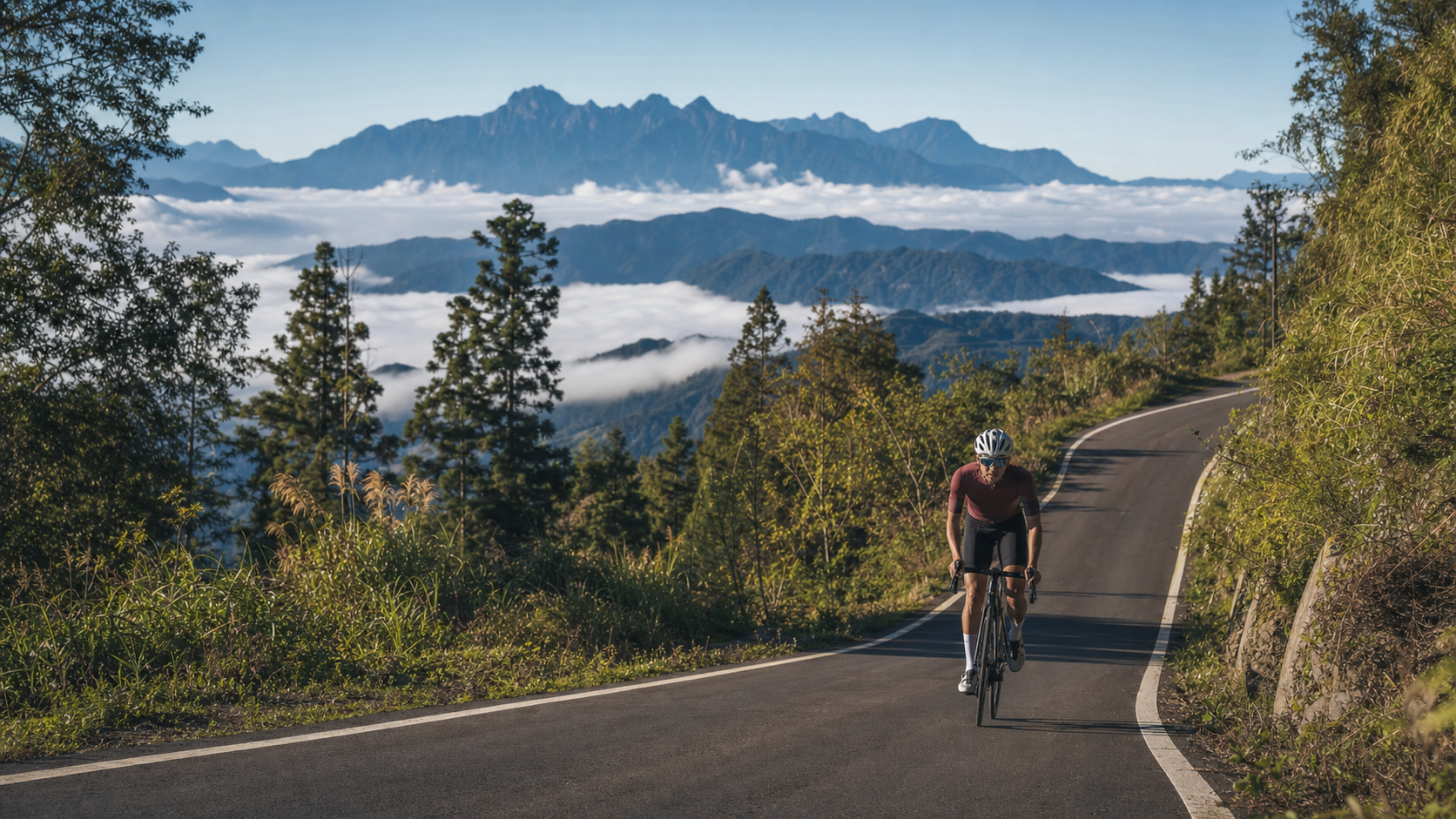
Pnguu, meaning “the place where hunters rest and turn” in the Tsou language—this is the original name of Laiji Village. Today, you set out from here, following the same mountain contours, riding toward another summit that overlooks the entire Alishan mountain range.
1. Pnguu: A Tsou Tribe Village Where Hunters Rest
Laiji Village, called Pnguu in Tsou, has a rather poetic origin for its name—it was originally a resting and turning point for hunters (called Denohiu in Tsou) during their hunts, and later, thanks to its pleasant climate, gradually developed into a settlement. It belongs to the Tfuya branch of the Tsou people, located at approximately 23°31′49″N, 120°45′09″E. The area above 2,000 meters in elevation still retains its indigenous character.
The most distinctive topographical feature of Laiji Village is the steeply dropping riverbed carved by the Alishan Creek, creating a unique and rugged geographic environment. This settlement pattern, closely tied to river-cut terrain, has to some extent shaped the wisdom of Laiji villagers across generations in coexisting with this rugged mountain landscape.
2. Titanic Rock and Sanlong Bridge: Old and New Landmarks in the Village
Laiji Village is home to two particularly well-known landmarks. The first is Titanic Rock, famous for its resemblance to the bow of the Titanic, and it has become a popular new attraction in Laiji Village in recent years, drawing many visitors who come specifically to take photos. The second is Sanlong Bridge, a red arch bridge that serves as the必经之路 to Laiji Village, its vivid red standing out strikingly against the lush green backdrop of the surrounding mountains.
In addition, the village also features natural sights such as Zhajigu Waterfall and Xian Cave (with year-round springs), as well as Goat Pass—a narrow mountain saddle along the Tashan climbing route. Together, these landscapes form the rich and diverse natural and cultural resources of Laiji Village, and they are worth taking time to explore and appreciate before taking on the long climb of Jia 155.
3. One Mountain, Two Names: A Geographic Misunderstanding
When planning this ride, one geographic detail needs special clarification: Taiwan actually has two mountains with the same name, “Dadongshan.” One is located on the border between Baihe District, Tainan City, and Dapu Township, Chiayi County, near the Guanziling hot spring area mentioned earlier; the other is located on the border between Meishan Township and Alishan Township, Chiayi County, near Fenqihu Station, at an elevation of approximately 1,976 meters, commonly called Fenqihu Dadongshan.
Based on the route description of County Road 155 starting from Laiji Village, the destination refers to the latter—Fenqihu Dadongshan on the border of Alishan and Meishan Townships. Mountains sharing the same name are not uncommon in Taiwan’s geography, but this also reminds every rider planning a trip to carefully verify maps and route details before setting out, to avoid being misled by identical names into heading toward a completely different mountain.
4. First-Person Perspective: The Journey from Pnguu to the Clouds
Setting out from Laiji Bridge and passing through the village settlement, you can feel a pace of life entirely different from ordinary lowland towns—traditional Tsou architectural elements and the relaxed demeanor of the villagers remind you that you are entering a land steeped in deep indigenous cultural heritage. As you cross Sanlong Bridge, the vivid red bridge stands out brightly in the sunlight, while the steep riverbed carved by Alishan Creek below tells the geological story of this land over hundreds of millions of years.
As the gradient gradually increases, the village landscape gives way to dense mountain forests, breathing becomes quicker, and sweat runs down your cheeks. The elevation continues to rise, and the temperature gradually drops along with it, the initially muggy sensation slowly replaced by the cool mountain air. This layering of climate that comes with elevation change is what makes this route uniquely special compared to lowland rides.
Nearing the Dadongshan Trail entrance, if the timing happens to align with the conditions for sea-of-clouds formation, the view ahead may suddenly be filled with a surging expanse of white mist—the sheer awe of that moment can seem to wash away all the fatigue accumulated from the climb. If energy and time permit, continue on foot to the observation deck at the summit, where overlooking Yushan, Great Tashan, Little Tashan, and other peaks, the breathtaking grandeur of the scenery will be the most treasured image of the entire journey.
5. Dadongshan: A Summit of Sea of Clouds and Night Views
The summit of Dadongshan features an observation deck where you can enjoy the sunrise and take in panoramic views of Yushan, Great Tashan, Little Tashan, and other peaks. The surrounding area also includes attractions such as Mingyue Cave, Liuxing Cliff, Huitou Ridge, and Cuizhu Slope, which after renovation form a hiking trail of approximately 5 kilometers in total—a popular mountain route in recent years. This combination of a cycling climb challenge extended into a hiking excursion makes Dadongshan an excellent destination that offers both athletic and nature-appreciation value.
Although the name “Dadongshan National Trail” is widely used, according to administrative classification, this trail is actually categorized by the Forestry and Nature Conservation Agency as a regional trail system, not a national trail system. This detail reminds us that even for well-known and popular attractions, the official administrative classification may not always match common usage.
6. The Connection Between Tsou Culture and This Land
Laiji Village remains an active Tsou settlement, preserving traditional indigenous ways of life and cultural characteristics. While specific details such as the names of particular ceremonies or specific food items lack sufficient reliable public documentation and should not be fabricated here, what is certain is that the Tsou culture passed down through generations on this land adds a depth of human heritage to the entire Jia 155 long climb that far exceeds mere natural scenery.
The high-mountain tea and coffee industries of Alishan Township are more commonly associated with Shizhuo, Leye, and Xiding, while Laiji Village itself is known for its Tsou tribal culture and mountain hiking. When writing and planning this trip, it is advisable to faithfully present Laiji Village’s unique positioning centered on culture and hiking, without forcing in elements of the tea and coffee industries.
7. Seasonal Layers of Scenery
The Jia 155 route presents rich visual layers that change with the seasons and elevation. In spring and summer, the mountain vegetation is dense and lush green, with occasional bird and insect calls; in autumn and winter, as temperatures drop, the likelihood of sea-of-clouds formation at the summit increases, making it an excellent time to enjoy the magnificent views at the end of the route.
If you choose to tackle this route in the early morning, arriving at the Dadongshan Trail entrance or the summit observation deck around sunrise offers the chance to witness the spectacular sight of sunlight spilling across the Yushan peaks—a precious moment that requires an early start and often becomes the most unforgettable part of the entire journey.
8. Final Thoughts: From a Hunter’s Resting Place to a Scenic Summit
Setting out from Laiji Village, whose Tsou name Pnguu means “the place where hunters rest and turn,” climbing 11.575 kilometers to finally reach Dadongshan at nearly 2,000 meters in elevation, with panoramic views of the Yushan peaks, this journey is in some ways an echo across time—where hunters once sought places to rest and turn in these mountains, today’s riders use their legs and sweat to seek their own summits and scenery.
If you too long for a journey that combines physical challenge, natural beauty, and cultural depth, the long climb of Jia 155 from Laiji Village to Dadongshan is a complete journey within Alishan Township worth carefully planning and experiencing firsthand. When you stand on the Dadongshan observation deck, looking out over the majestic peaks and sea of clouds before you, you will understand that this journey from village to clouds gives you far more than a record of a completed challenge—something richer and deeper.
9. Goat Pass and Tashan: A Broader Vision of Mountain Hiking
Beyond Dadongshan, Laiji Village also connects to another more challenging hiking route—the climbing path to Tashan, which passes through the narrow mountain saddle of Goat Pass. Although this hiking route is not the same path as the Jia 155 cycling climb described in this article, together they speak to Laiji Village’s geographic character as an important base for mountain hiking. For travelers who love both cycling and hiking, Laiji Village offers an excellent dual base—after completing the Jia 155 climb, if energy and time allow, you could even extend the trip into a combined cycling and hiking itinerary.
This diversity of outdoor activity possibilities in one place also makes Laiji Village and the Dadongshan area a rich base within Alishan Township worth revisiting again and again, each time uncovering different experiences.
10. The Wisdom of Villagers Living in Harmony with the Land
The steeply dropping riverbed terrain of Laiji Village, carved by Alishan Creek, has to some extent led its residents to develop a wisdom of living harmoniously with the rugged landscape. The Tsou people who have lived here for generations know the temperament of these mountains well—when to be wary of rising creek waters, which sections are prone to landslides during the rainy season, which slopes are best for farming or hunting. These life experiences passed down through generations are a profound wisdom that outside visitors can hardly fully appreciate during a brief visit.
As you ride the long climb of Jia 155 and pass through the village settlement, if you can slow down and carefully observe the arrangement of village buildings and their surrounding environment, you might catch a glimpse of this life philosophy accumulated over centuries of coexistence with the land. This observation of and respect for local wisdom is also a travel attitude especially worth cultivating when visiting indigenous villages.
11. For Riders Tackling a High-Altitude Long Climb for the First Time
If Jia 155 from Laiji to Dadongshan is your first time tackling a long climb with a summit elevation near 2,000 meters, be sure to prepare adequate warm clothing—even if the temperature is warm at the start, as elevation rises, the temperature at the summit may be significantly lower, especially if you plan to linger at the observation deck to enjoy the scenery; insufficient warmth can lead to risk of hypothermia.
Additionally, at high altitudes, the body’s efficiency in utilizing oxygen decreases slightly, so it is advisable to adjust your pace expectations accordingly, rather than holding yourself to the same standards as on flatland rides. Proceeding gradually and within your limits is the way to complete this journey from village to clouds safely and enjoyably.
12. Smallness and Grandeur Beneath the Yushan Peaks
Standing on the Dadongshan observation deck, gazing at Yushan, Great Tashan, Little Tashan, and other peaks, it is hard not to be awed by the magnificent mountain scenery before you. As Taiwan’s highest peak, Yushan conveys an imposing majesty even when viewed from a secondary high-altitude summit like Dadongshan. This firsthand experience of witnessing Taiwan’s rooftop, in a way, makes one reconsider just how small one’s existence is before this vast landscape.
But it is precisely this sense of smallness that makes the sense of accomplishment from completing this 11.575-kilometer climb feel especially real and profound—you used your own legs to ascend 757 meters inch by inch, finally standing at a vantage point overlooking Taiwan’s highest peaks. This expansive view earned through physical effort is far more awe-inspiring than any postcard or aerial photograph.
13. Imagining the Connection Between Sea of Clouds and Tribal Legends
Although no definitive literature has been found confirming specific Tsou legends related to the sea of clouds circulating in Laiji Village or the Dadongshan area, standing in this misty high-altitude mountain region, it is hard not to be inspired with rich imagination—perhaps the Tsou people who have lived here for generations, on some morning, also gazed at the same surging sea of clouds and wove their own tribal stories and cosmology. This space of imaginative openness is, in a way, an attitude of respect when visiting indigenous villages—not casually fabricating or appropriating cultural elements, while still maintaining an open and reverent imagination for the profound stories this land may hold.
14. For Every Rider Who Longs for Deep Travel
If you are tired of superficial sightseeing tours and long for a journey that allows you to deeply understand local culture while challenging your physical limits, Jia 155 from Laiji to Dadongshan is an ideal choice. Setting out from Pnguu, a Tsou village name full of poetry, climbing through the rugged terrain carved by Alishan Creek, and finally reaching a summit overlooking the peaks of Taiwan’s rooftop—this journey combines three distinct yet equally precious travel elements: physical challenge, natural scenery, and cultural history.
15. Goodwill as You Pass Through the Village
As you ride through the Laiji Village settlement, if you happen to pass by villagers busy with their work, a friendly smile or a nod of acknowledgment can often add unexpected warmth to the journey. Village life has its own rhythm and pace; as a visitor, maintaining basic respect and courtesy—not being noisy, not trespassing into private spaces, and keeping an open and humble attitude toward local culture—is a travel ethic every rider should keep in mind while enjoying the beauty of this land.
This mindset of visiting with respect, in a way, can elevate the entire journey beyond a mere physical challenge into a genuine cultural exchange and connection with the land.
16. Final Thoughts: Imagining the Legacy from Hunter to Rider
The place name Pnguu tells the ancient story of hunters seeking places to rest and turn in the mountains. Today, this land still draws another group of people—riders on bicycles, eager to challenge their own limits—who come seeking their own moments of rest and turning. Though their identities and purposes are entirely different, that reverence and longing for these mountains perhaps transcends time, finding a subtle resonance and inheritance on this land of Laiji.
When you complete this journey from Pnguu to Dadongshan and stand on the observation deck overlooking the Yushan peaks, I hope what you take away is not just a record of a completed challenge, but a profound and sincere understanding of and respect for this Tsou land.
17. Echoes After the Journey
Back in the routine of lowland daily life, perhaps at some moment you will suddenly recall the vast sea of clouds and peaks from the Dadongshan observation deck, or the image of that vivid red bridge in the sunlight as you rode across Sanlong Bridge. These fragments will surface in your mind from time to time in the days ahead, reminding you that you once measured the height and breadth of this Tsou land with your own legs.
This, perhaps, is the most precious reward of deep travel—it does not disappear when the journey ends, but quietly takes up residence in the depths of memory, becoming an image of your own that surfaces unbidden every time you think of Alishan Township.
18. To the Next Rider Preparing to Set Out
If you have read this far, it means you now have a fairly complete understanding of and anticipation for this long climb from Pnguu to Dadongshan. What remains is to find a suitable day, with thorough preparation and an open heart, to personally embark on this journey. May you feel the profound Tsou cultural heritage in Laiji Village, and may you witness with your own eyes that breathtaking expanse of peaks and sea of clouds at the Dadongshan observation deck, writing your own unique memory of Alishan Township.
19. Afterword: A Journey, an Encounter of Two Identities
This journey from Pnguu to Dadongshan is, in a way, an encounter of two identities—on one side, the Tsou people who have guarded these mountains for generations; on the other, cyclists who have come from afar, eager to challenge themselves. Though their identities seem vastly different, both have found their own ways of conversing with this land within the same mountains. May every rider who visits Laiji Village and Dadongshan carry this understanding and respect, making this journey not just a physical challenge, but a sincere and profound cultural encounter.
20. A Final Invitation
If this article has sparked a longing in you for Laiji Village and Dadongshan, why not find a day with stable weather and personally embark on this journey from Pnguu to the clouds. With thorough preparation, respect for this Tsou land, and a heart willing to slow down and savor the scenery and culture along the way, you will find that this 11.575-kilometer climb offers far more abundant and unforgettable rewards than simply completing a riding record.
21. For Those Willing to Return Again and Again
Every mountain and every village in Taiwan holds stories worth revisiting and savoring. Jia 155 from Laiji to Dadongshan may not be the first famous destination you have heard of, but with its profound Tsou cultural heritage, reliable riding data, and that breathtaking expanse of peaks and sea of clouds at the end, it deserves a place in the hearts of every rider who loves deep travel, becoming a precious journey worth returning to again and again, and rediscovering each time.
22. A Final Blessing
May you, on some clear morning, set out from Laiji Bridge, carrying respect and curiosity for this Tsou land, pedaling and climbing step by step, finally standing on the Dadongshan observation deck, facing the morning light, overlooking the vast Yushan peaks and sea of clouds. The scenery of this moment belongs to every rider willing to earn it with sweat and personal effort—may this scenery also belong to you, becoming the most magnificent and warmest memory of your cycling career, a complete story that begins at a hunter’s resting place and ends in the clouds—may you too write your own chapter, making Pnguu and Dadongshan a stop in your cycling journey forever worth savoring, and a personal experience you will be most proud to share when introducing Alishan Township to friends. This long climb, setting out from a Tsou village and leading to a summit in the clouds, quietly awaits every rider who approaches with reverence and anticipation, to personally complete this journey across culture and elevation, and at its end, to receive that sense of wonder at the skyline that can only be truly felt by those who arrive in person—a gift that belongs to Pnguu, to Dadongshan, and to every rider willing to personally undertake this journey, the most precious and forever treasured memory of Alishan Township, earned with sweat, time, and respect, irreplaceable, quietly awaiting the next rider willing to set out in person, to receive this blessing and wonder unique to the space between clouds and village, becoming your own forever-cherished chapter of Alishan Township, a complete journey that departs from Pnguu and arrives in the clouds.
Related Reading
- Jia 155 Laiji to Dadongshan Practical Guide: 11.6 km Climbing 757 Meters, a Long Slope from a Tsou Village to a Sea-of-Clouds Viewing Platform
- Wujie: The Homeland of Clouds and Siyuan Suspension Bridge, a Humble Ride Toward the Mountains
- A Journey to the Land of Mist: A Ride Through the Double Migration of the Rukai People of Wutai Township and Haocha Village
- On the 10.2% Gradient of Syuewunao, I Learned to Have a Dialogue with My Own Limits
里佳部落 阿里山單車深度旅遊! | 竹山/草嶺/來吉/奮起湖 | 無敵銀河絕景 全新路線探索! 驚險狀況百出! | 4K沉浸式畫質 | 公路車 | CT Yeh
3 年前
一定要騎一次!阿里山最深處:里佳部落!單車旅行 | 2800m爬升 | 深度部落體驗:嗨翻晚會、螢火蟲、銀河 | feat. JJSC & 廢物伙伴 | 公路車 CT Yeh
10 個月前
觀霧 變好騎了! | 北高車友爆笑大會師 | 公路車 | 單車旅遊 Taiwan Cycling Route GuanWu
6 年前
新竹羅平 x 天湖部落 大禹嶺級變態陡坡! 4K超高畫質 空拍 | 公路車
5 年前
嘉義大埔、阿婆灣挑戰賽,美到以為在日本!ft. 環騎5 Cool 西拉雅188 / 公路車 / CT Yeh
7 個月前
藤枝二集團 單車行 Day1 | 南部小武嶺 | 爬坡爬到罵罵叫 | JJSC | 公路車 | CT Yeh
3 年前
阿里山塔塔加 兩倍特濃版!全新隧道開通! 進喔!公路車 | CT Yeh
3 年前
大武山20%魔王陡坡【JJSC南台灣遊騎Day2】!屁股真的要裂開了...凡士林抹滿也沒用?神秘金教堂還有超便宜夜市
3 個月前