Prologue: A Long-Planned Visit
I had been planning this trip to Dewen Mountain for quite some time. Every time I looked at the map, tracing the terrain contours within Sandimen Township that rise sharply from the plains to over two thousand meters, a complex mix of anticipation and quiet reverence would well up inside me. Today, I finally set foot on this long-awaited route—one that stirs both excitement and apprehension—and my heartbeat was already quicker than usual.
Into Sandimen, Into the Layered Mountains of Dewen
The topographic span of Sandimen Township is something that never fails to surprise me every time I ride here—from elevations below 100 meters on the lowest plains, stretching all the way up to mountainous areas exceeding 2,159 meters at its highest point. The entire township covers 196.4 square kilometers, ranking third among all townships in Pingtung County. The Ailiao River winds its way through the entire township like a quiet yet powerful artery, nourishing the villages and farmlands scattered along its banks. And the Dewen Tribe sits precisely within this dramatically undulating mountain terrain.
I set off from the plains side of Sandimen Township. As the elevation gradually climbed, the scenery around me transitioned from open orchards and betel nut plantations to more pristine, denser mountain forests. This shift in landscape happened more rapidly than anywhere else I had experienced—within just a few kilometers, the elevation gains over 600 meters. This compressed geographic transformation, in a way, echoes the chapters of the Dewen Tribe’s own history, which saw drastic changes unfold within short spans of time.
A Tribal Story of Migration and Resilience
If I had to choose one word to describe the Dewen Tribe’s journey over the past decade and more, “resilience” would be the most fitting. The Morakot Typhoon in 2009 brought an astonishing 2,500 millimeters of rainfall to Sandimen Township in just two days—a figure that remains one of the most harrowing chapters in Taiwan’s meteorological records. Faced with such extreme natural forces, the Dewen Tribe’s original way of life, composed of three small settlements—Beiba, Dugufule, and Jindaluan—was severely impacted. Some residents relocated to the Changzhi Baihe Tribal Settlement in 2010, beginning a new chapter in their lives.
Riding on the road toward the Dewen Tribe, I tried to imagine the inner struggle and reluctance the residents must have felt when faced with the decision that their homeland might no longer be safe. Migration has never been an easy thing, especially for people who have lived on the same land for generations, bound by deep emotional ties to these mountains and forests. To leave meant bidding farewell to the footsteps of their ancestors, to familiar landscapes and memories. But at the same time, migration is also a wisdom of survival—a responsible choice made for one’s family and for the next generation.
This complex and profound emotion is something that an outsider like me, a visiting cyclist, could never fully comprehend or speak for. All I can do is approach this history with understanding and respect, and as I ride through this land, meet it with a humbler heart, feeling everything it has carried—both in the past and in the present.
Breathing and Struggling Within Just 5 Kilometers
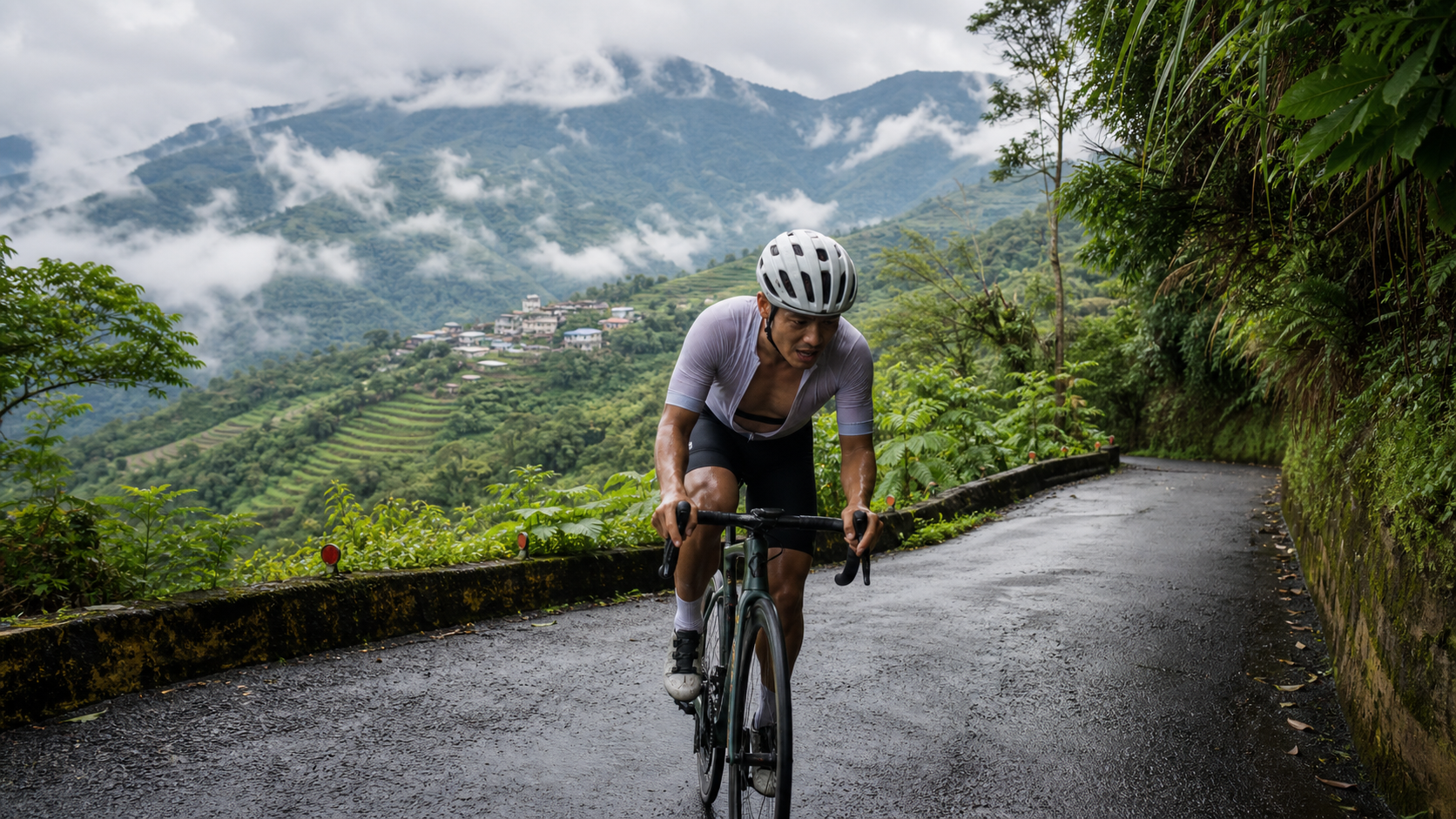
The climbing route up Dewen Mountain is astonishingly short, yet it packs in 652.5 meters of elevation gain. Riding this road, I had almost no room to catch my breath—every inhale was accompanied by the burning sensation in my thigh muscles, and every pedal stroke reminded me that the steepness of this land far exceeded my imagination.
There were moments when I nearly wanted to give up, to get off and walk my bike. But every time I looked up toward the distance and saw the layered mountain ridges displaying varying shades of green under the sunlight, a strong surge of motivation to keep riding would reignite within me. This process of physical limits pulling against willpower, in a way, gave me a bit more empathy and imaginative space for the challenges and choices the residents of this land once faced—of course, physical exhaustion is nowhere near comparable to the emotional weight of leaving one’s homeland, but at least this riding experience gave me a more visceral, more three-dimensional understanding of the words “perseverance” and “resilience.”
Traces of Wisdom in Tribal Architecture
Passing by the remnants or rebuilt settlements of the Dewen Tribe along the way, I paid special attention to the traditional house structures built primarily with slate. The architectural wisdom of the Paiwan people excels at using local materials, harnessing the abundant slate resources to construct living spaces that can withstand wind and rain while coexisting harmoniously with the surrounding mountain environment. This building technique, refined through centuries of transmission and adaptation, can still be recognized by attentive eyes in the corners of the tribe today.
I stopped my bike and carefully examined a low slate wall that seemed to have weathered many storms, thinking about how many generations of daily life these stones must have witnessed, how many seasonal cycles, how many trials of wind and rain. This sense of presence spanning across the river of time is a unique texture and warmth that no modern building material or technique could ever replicate.
Tribal Daily Life in the Mountain Breeze
Along the ride, I occasionally encountered residents busy in their courtyards, or elders gathered in small groups chatting. They always responded to me—this out-of-breath, sweat-soaked outsider on a bike—with kind smiles or simple nods of acknowledgment. This particular warmth of mountain tribal communities, so free of any guardedness, always feels especially heartwarming to me, and especially precious and rare.
I made no effort to disrupt the rhythm of their daily lives, only quietly observing and quietly absorbing the way people on this land interact with nature and with each other—at a pace that is relatively slow yet grounded, and genuinely sincere. Having lived in the city for so long, it’s easy to forget that life can have a completely different tempo and texture—one that doesn’t require racing against time at every moment, but instead follows the seasons and the rhythm of the mountains, living one’s own unhurried days.
The View as a Reward After Sweat and Effort
When I finally finished this short yet extremely steep climb and looked back at the road I had come from, that complex mix of exhaustion and accomplishment welled up in me once again. The layered mountain ridges before me, bathed in the afternoon sunlight, displayed interwoven shades of emerald green, while the distant horizon was softly diffused by mist and clouds, forming a serene yet powerful landscape painting that lingered in my heart for a long time.
In that moment, I suddenly understood why the people who have lived in these mountains for generations regard this land as an inseparable part of their lives and culture. Such scenery is not something any city park or artificial landscape could easily replicate. It requires the accumulation of time, the wisdom of coexisting with nature, and the deep emotions that generation after generation has guarded and carried forward with their very lives.
For Those Who Are About to Visit
If you’re also planning to take on the Dewen Mountain route, I want to tell you: don’t treat it merely as a physical test, or just a number on the Strava leaderboard. Slow down, and during your ride, try to learn more about the real stories behind this land—stories of migration, of rebuilding, of resilience. Approach these mountains and this tribe with respect and humility, feeling the arduous journey they have walked, as well as the vitality that continues to thrive to this day.
Before leaving the Dewen Tribe, I took one last look back at those layered mountain ridges, silently noting in my heart the awe and emotion this journey had brought me. This road, though only 5 kilometers short, gave me a far deeper and more three-dimensional understanding of the words “land” and “resilience” than I had when I set out.
An Elder’s Gaze
Pausing briefly at the edge of the tribe, I saw an elder sitting in front of his home, gazing blankly at the mountain view in the distance. In his eyes seemed to reside a certain world-weariness and acceptance that only those who had experienced the typhoon and the choice of migration could truly understand. I didn’t approach to disturb him, only stood quietly to the side, gazing at the same mountain scenery alongside him.
In that moment, I suddenly felt that language was unnecessary. Some stories don’t need to be conveyed through words—they can be felt through a gaze, through silence, through a shared moment of looking at the same landscape, allowing one to sense the weight and depth contained within. This wordless encounter was the most precious, and the most difficult to fully capture in words, moment of my entire Dewen Mountain journey.
In Closing: Relearning About the Land
As I left the Dewen Tribe and continued on the rest of my riding itinerary, a weighty reflection settled in my heart. This 5-kilometer ride with 652.5 meters of climbing was, on the surface, a physical trial. In reality, it was a profound lesson about land, about history, about how humans and nature coexist and sustain one another.
What Dewen Mountain taught me was not just how to manage my gear ratios or adjust my breathing rhythm to tackle the steep slopes—more importantly, it taught me how to approach with humility and respect a land and a people that have endured drastic upheaval yet remain unyielding. If I ever have the chance to visit again, I think I will spend more time, at a slower pace, listening to these mountains, this tribe, and the many stories that have yet to be told.
The Sound of Water and Memories by the Ailiao River
During the ride, I deliberately took a detour along a stretch of road near the Ailiao River, listening to the sound of the stream flowing gently over gravel. That natural soundscape, suspended somewhere between clamor and tranquility, unconsciously slowed both my breathing and my pedaling rhythm. The Ailiao River runs through the entire Sandimen Township, serving as a vital lifeline of water for this land and an indispensable part of the living memories of countless generations of tribal people. During Typhoon Morakot, this same river revealed an entirely different face—one of destructive force—as floodwaters surged violently. This dual character of gentleness and ferocity coexisting is, in a way, the most authentic and unadorned expression of nature’s power.
Standing by the riverbank, watching the clear or slightly silt-laden water flow slowly by, I tried to imagine how many generations of lives this river had witnessed—tribal people drawing water, washing, fishing, and children playing by the water’s edge. Perhaps these images still remain vivid and clear in the memories of tribal elders. And I, as a passing cyclist, could only attempt to capture, through this brief pause and gaze, the deep and enduring textures of life woven into the story of this river.
The Transformation of Industry Between Betel Nut Groves and Orchards
On the road from the lowlands of Sandimen Township toward the Dewen tribe, the landscape on both sides underwent a clear shift in industrial patterns—transitioning from the betel nut groves and orchards common in the flatlands to the more pristine forest cover of the mountains. This change in the industrial landscape reflects, to some extent, the trajectory of economic development that Taiwan’s indigenous mountain communities have experienced across different historical periods. The betel nut industry was once a major source of income for many mountain townships, but as times have changed and health awareness has risen, this type of single-crop economy has gradually faced pressure to transform and adapt.
I don’t have enough information to judge the rights and wrongs behind these industrial changes, but as I rode through these stretches where landscapes intermingled, I could genuinely sense that the residents of this land have always been trying to find their own path toward sustainable development—one truly suited to this land and to the next generation’s long-term livelihood—while navigating between traditional ways of life and modern economic pressures. This ongoing process of adaptation and seeking balance is, in a sense, a microcosm of the broader effort by Taiwan’s indigenous mountain communities to preserve their cultural identity amid the tide of rapid modernization.
A Moment of Stillness as Sunlight Pierces the Treetops
During the climb, there was a stretch of road where the dense canopy cut the scorching sunlight into fine dappled patterns that fell upon the asphalt, gently swaying with the breeze. I deliberately slowed down to give myself the chance to fully savor this moment of stillness and beauty. Amid the sustained high-intensity effort of climbing, such moments of respite are not merely physical relaxation but also a form of spiritual settling and recharging.
I’ve often felt that one of the most enchanting aspects of mountain riding is its ability to intersperse the most grueling sections with such unexpected and precious moments of beauty. It’s as if nature itself, in its own way, is reminding every cyclist laboring up a steep grade: even if the road ahead remains steep, don’t forget to look up and take in the scenery along the way, to feel this hard-earned stillness and beauty.
A Reflection on Naming
The place name “Dewen” is a designation that has survived through Chinese transliteration, but the tribe’s original name in its own language, along with the cultural significance it carries, is perhaps far richer and more profound than this Chinese rendering. During my ride, I made a point of watching for signage along the road that might bear the indigenous place name, trying through these fragmentary textual clues to sense the cultural context and identity this land possessed before it was given a Chinese name.
This curiosity and exploration into the origins of place names is, to some degree, what I believe every traveler visiting an indigenous tribe should possess as basic literacy—not merely being satisfied with surface-level names and scenery, but rather attempting to understand the historical memories and cultural weight these names carry, and to re-examine one’s own relationship with the land through that understanding.
Fragments of Conversation with a Fellow Rider
I didn’t undertake this ride alone; I was accompanied by a friend who shares the same passion for mountain cycling. On a section where the grade eased slightly, we rode side by side, briefly exchanging our impressions of this route and this land. He told me that shortly after the typhoon disaster, he had joined a volunteer relief team and briefly stayed in another indigenous mountain community in Pingtung nearby, helping to transport supplies and clean up homes. That experience gave him a special emotional connection to the residents of this mountain region.
Listening to his story, I suddenly realized that everyone who visits this land carries their own unique life stories and emotional connections, and these stories, interwoven together, constitute the gradually deepening understanding and friendship between the outside world and this indigenous homeland. They also add layer upon layer of shared memories belonging to travelers of different generations and backgrounds. These connections built through genuine interaction and companionship are far more profound and precious than any superficial sightseeing tour.
The Laughter of Tribal Children
During the ride, as I passed an open area, I saw several tribal children chasing and playing, their bell-like laughter echoing through the valley. This pure and unreserved joy unconsciously brought a smile to my face as well. The children showed unabashed curiosity toward this panting, sweat-soaked stranger on a bike, and a few of them even waved and greeted me with young but loud voices.
I stopped my bike and simply waved back, feeling an indescribable warmth welling up inside me. These children are the future hope and continuation of this land. Growing up in such a simple and beautiful mountain environment, they share a deep connection and sense of belonging with the land and their tribal culture that an outsider like me can never fully comprehend. Looking at their innocent smiles, I sincerely hope that the beauty and resilience of this land will continue to guard their growing years, allowing this innate cultural identity and vitality to be passed down through generations without the slightest diminishment or loss due to changing times or external pressures.
Contemplation and Gratitude After the Ride
After completing the challenge of Dewen Mountain, I sat by the roadside to rest, gazing at the layered mountain ridges in the distance, and a deep sense of gratitude welled up within me. Gratitude that this land, even as I sat there breathless and disheveled, still showed me its most authentic and moving face; gratitude that the residents of this land, through the wisdom and resilience accumulated over generations, have safeguarded these mountains and forests, as well as their own culture and way of life.
This journey prompted me to reconsider what kind of relationship we, as cyclists and as travelers, should establish with every piece of land we visit. Perhaps the answer is simple—to approach with curiosity rather than voyeurism, with respect rather than superiority, with gratitude rather than entitlement, and to feel, learn from, and cherish every precious moment of encountering the land. This, truly, is the most profound and lasting gift that cycling travel can offer us.
Epilogue: One Road, Multiple Identities
For different people, the Dewen Mountain route carries vastly different identities and meanings. For competitive cyclists, it is a demanding proving ground for climbing ability; for cultural travel enthusiasts, it is a window into the deep history and cultural heritage of the Dewen tribe in Sandimen Township; and for the tribal people who have lived here for generations, it is an essential lifeline connecting home, memory, and the footsteps of their ancestors.
I believe this is precisely what makes routes like this, which reach deep into indigenous homelands, most worthy of appreciation and respect—it is never merely a cold set of gradient and distance data, but rather a living narrative of the land carrying multiple identities and meanings, deserving of every visitor’s own way of understanding, feeling, and cherishing. It is also a precious gift that must be continuously written and passed on. May everyone who rides this road carry this understanding and emotion forward into their future cycling journeys, and continue to approach every piece of land on this island worthy of serious regard with ever greater humility.
As I was leaving, I turned back one last time to look at the mountain ridgeline bathed in golden-orange sunset light, and silently made a promise to myself—that given the opportunity, I would definitely return, with more time and deeper understanding, to walk this road again, to listen once more to this land and the stories that have yet to be told. Until then, this memory will remain warmly preserved in the softest corner of my heart, serving as the original inspiration and driving force for my continued writing about this indigenous mountain homeland in Pingtung, and as an important reminder to maintain humility and respect every time I set out on similar routes in the future.
Related Reading
- Dewen Mountain Climbing Guide: A Hardcore 5km Route with 652m of Elevation Gain in Sandimen Township
- A Back Door to Taiwu Township: Reading Resilience and Life Wisdom on Rugged Terrain
- Journey to the Land of Clouds and Mist: A Ride into the Rukai People of Wutai Township and the Double Migration of Haocha Village
- Riding into Dona: Slate Houses, Zhuokou River, and Rukai Tribal Memories After Typhoon Reconstruction
大武山後門26%歡樂陡坡!JJSC南台灣單車行Day2 / 被颱風追著跑 / 公路車 / CT Yeh
2 年前
觀霧 變好騎了! | 北高車友爆笑大會師 | 公路車 | 單車旅遊 Taiwan Cycling Route GuanWu
6 年前
一定要騎一次!阿里山最深處:里佳部落!單車旅行 | 2800m爬升 | 深度部落體驗:嗨翻晚會、螢火蟲、銀河 | feat. JJSC & 廢物伙伴 | 公路車 CT Yeh
9 個月前
新竹白蘭部落! 爬陡坡還能講笑話...? 廢物伙伴の約騎 | 公路車 | CT Yeh
4 年前
#北橫 + #北進武嶺 最硬的員工旅遊 EP1 | #公路車 #拉拉山 | 明池 | 武嶺 | 武陵農場 | 雲海 | Taiwan Cycling Route Wulin
6 年前
新竹羅平 x 天湖部落 大禹嶺級變態陡坡! 4K超高畫質 空拍 | 公路車
5 年前
#Canyon Aeroad 公路車 三年騎乘 #心得 | 出保方式 | 購買價格計算 | 同場加映累積三年大保養慘況
6 年前
台北闊瀨陡坡 騎旅 / 日本單車雜誌編輯車友臨時加入!/ 髮香才是最強的 / feat. 北迴歸線小隊 / 公路車 CT Yeh
6 個月前