Quiet Moments by the Mudan Reservoir: A Cycling Journey Through the Mudan Incident and the Power of Serenity
Prologue: The Mood Before Departure
As I packed my bags in the early morning, I reminded myself that this journey did not need to chase speed or records. All I needed was a heart willing to slow down, to feel the gentle chapters that the land of Mudan Township was about to unfold.
A Gentle Road, Leading to a Heavy History
Not every cycling journey needs a steep gradient to prove its worth. The Mudan Reservoir 199, a route with an average gradient of just 1.4%, carried me in its gentle and unhurried manner from the mountains of Mudan Township in Pingtung, all the way to an artificial lake that officially began storing water in 1996 and has since borne the water-supply memories of countless residents of the Hengchun Peninsula. But behind this seemingly tranquil and serene lake-and-mountain scenery lies an extremely heavy and complex chapter in Taiwan’s modern history.
Mudan Township, an indigenous mountain township administering six villages—Shimen, Mudan, Dongyuan, Xuhai, Gaoshi, and Silin—is predominantly inhabited by the Paiwan people, with a small number of Amis also living here. The place name “Mudan” itself originates from the Mudan Incident of 1874, an event that shook the entire diplomatic landscape of East Asia.
The Mudan Incident: A Historical Site Now Covered by Reservoir Waters
In 1874, several Ryukyuan sailors drifted to the Hengchun Peninsula after a shipwreck and came into conflict with local indigenous people. This accidental event ultimately became Japan’s official pretext for dispatching troops to Taiwan under the banner of “protecting Ryukyuan subjects.” This military action, known historically as the Mudan Incident, was not only a significant case of Japan’s first overseas military deployment in modern times, but also profoundly influenced the subsequent shift in Qing Dynasty governance policies toward Taiwan. In a sense, it was also a crucial prelude in the historical context of Japan’s later colonization of Taiwan.
Riding on the road toward Mudan Reservoir, I tried to imagine what this land looked like 150 years ago—a scene of flashing blades, gunfire, and war. Now, all I could see before me was a calm, ripple-free lake reflecting the layered mountains around it, with the occasional waterbird skimming across the surface. Time, in its own way, has soothed the wounds and conflicts of the past, allowing this land to rediscover its own tranquility and beauty.
But tranquility does not mean forgetting. The Mudan Incident Memorial Park and the Mudan Incident Story House established within Mudan Township are concrete practices through which this land has chosen to remember and pass on this complex history in a constructive manner. Although I did not personally visit the full details of these memorial facilities during this ride, simply knowing they exist was enough to add a profound weight of historical significance to the seemingly ordinary landscape before me, reminding me to carry this awareness as I continued onward.
A Quiet Moment by the Reservoir Lakeshore
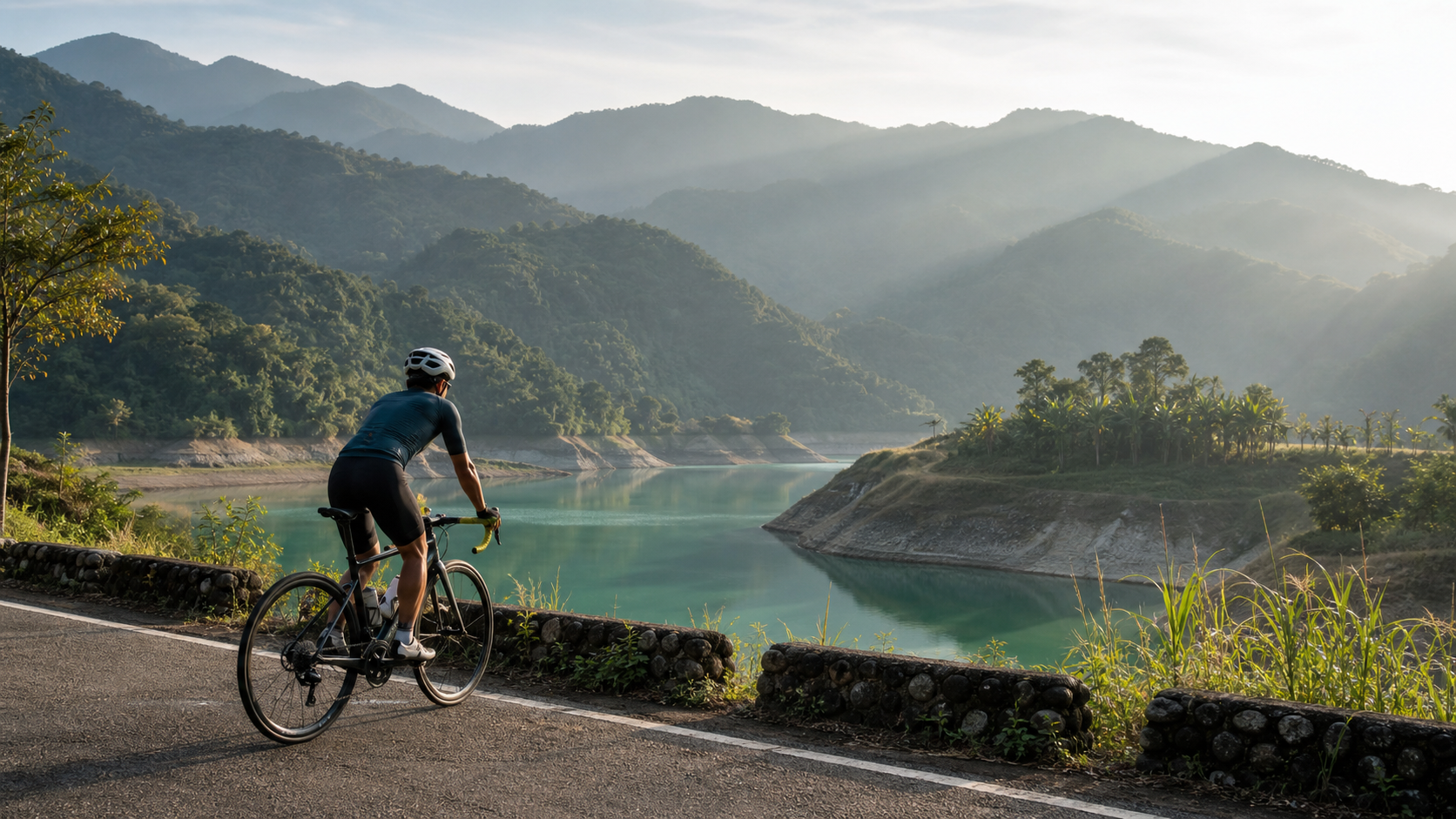
As I rode closer to the core area of Mudan Reservoir, the view suddenly opened up—a vast expanse of emerald-green water lay quietly cradled in the embrace of surrounding mountains, with a gentle breeze stirring ripples across the surface. This massive reservoir, with a dam 65 meters high and a storage capacity exceeding 30 million cubic meters, is a vital lifeline of water resources for the Hengchun Peninsula, supplying domestic and agricultural water needs for a vast downstream area. It is also an indispensable piece of critical infrastructure on this land.
I paused briefly by the lakeshore, gazing at the wide, tranquil waters before me, and felt a sense of calm rise within me—inexpressible yet profoundly real. Compared to the adrenaline rush of high-intensity climbs on other routes in this series, Mudan Reservoir 199 offered me a completely different yet equally precious riding experience—a sense of ease and leisure that allows one to slow down and quietly appreciate the beauty all around.
Occasionally, waterbirds swept across the lake with light, effortless grace. Perhaps they had long come to regard this artificial lake as a perfectly natural habitat and home. Watching them fly freely, it suddenly struck me that this reservoir, born out of human engineering needs, has, after nearly three decades of settling, reached a subtle and harmonious coexistence with the surrounding natural ecology—as if it had always been a part of this landscape.
The Wind and Sun of the Hengchun Peninsula
Mudan Township sits at the northern edge of the Hengchun Peninsula, a land with unique climatic conditions and geographical characteristics compared to other parts of Taiwan. The famous fall-season downslope winds bring this land a distinctive character and set of living challenges, while the scorching summer sun gives the vegetation and crops here a vitality and appearance entirely different from those of the north or central regions.
Riding on this relatively gentle route, I had more leisure to feel the unique atmosphere woven by wind and sunlight on this land. A light breeze brushed across my face, carrying the faint scent of grass, trees, and soil. Sunlight spilled onto the road and the lake, reflecting a brilliance that was dazzling yet not harsh. This sense of physical and mental ease, of riding freely without any pressure, in a way also gave me a deeper understanding of what “travel” truly means—not every journey needs to be defined by pushing limits; sometimes, simply slowing down and feeling deeply can bring equally profound and precious rewards.
The Topographical Metaphor of Shimen
The Shimen area along County Highway 199 earned its name from its narrow, gate-like terrain. This topographical metaphor, in a sense, echoes the special role this land of Mudan Township has played in history—it has been both an important passage for the Hengchun Peninsula’s external connections, one of the core sites of the Mudan Incident, and a key hub linking mountain tribes with lowland settlements.
Riding through this relatively narrow stretch of Shimen, I deliberately slowed down to feel the terrain closing in from both sides and then gradually opening up again. This topographical metaphor, experienced firsthand during the ride, conveys the complex, multilayered significance this land carries geographically and historically far more intuitively than any written description ever could.
Advice for the Next Rider
If you are also planning to take on the Mudan Reservoir 199 route, I want to tell you this: do not dismiss its value by treating it merely as an “easy” or “unchallenging” route. Slow down, feel the tranquility of the lakeshore with your heart, and by all means set aside time to delve into the Mudan Incident—a chapter of history with pivotal influence on Taiwan’s modern development. What this route offers is not just physical relaxation and comfort, but a precious opportunity to gain a deeper understanding of Taiwan’s history and the cultural fabric of this land.
Before leaving Mudan Reservoir, I took one last look at that expanse of emerald-green water, silently noting in my heart all the feelings and insights this journey had given me. This road, though gentle in gradient, had in its own way given me a brand-new understanding of the words “easy” and “profound”—for the value of a journey is never necessarily proportional to the physical challenge it presents. Sometimes, the deepest moments of emotion lie precisely in those seemingly ordinary corners that hold within them a wealth of history and human depth.
A Meditation on Reconciliation and Coexistence
Standing on the reservoir’s embankment, gazing at this artificial lake born of engineering works yet now coexisting harmoniously with the natural ecology, I could not help but think of the Mudan Incident 150 years ago, which erupted from misunderstanding and conflict, and of the long process by which the various ethnic groups and cultures on this land gradually moved toward understanding and coexistence. This reconciliation and coexistence across the river of time is, in a sense, also embodied in the lake-and-mountain scenery before me, where the artificial and the natural intermingle, and history and the present coexist.
I believe this is precisely what makes the Mudan Reservoir 199 route most worthy of savoring—it carries every visitor, in the gentlest and most unhurried way, across this land bearing complex historical memories, ultimately arriving at a tranquil and beautiful lakeside vista. It is as if to symbolize that no matter how heavy history may have been, this land and the people who live on it will always find their own way to keep moving forward.
From Upper Mudan to Shimen: An Underrated Corridor of Landscapes
The stretch of County Highway 199 from Upper Mudan to Shimen was, to my surprise, the most intriguing section of my entire journey. The landscape on both sides kept shifting between open valleys and relatively narrow river-valley terrain—sometimes revealing layered mountain silhouettes in the distance, sometimes enveloping me with walls of rock closing in from both sides, creating a rich and varied visual rhythm. This diversity of landscape, in a way, shattered my original preconception that a “gentle-gradient route” would be monotonous and dull.
I particularly enjoyed passing through several stretches with wide-open views, quietly gazing out over the rolling mountains of all of Mudan Township. The afternoon sun gilded these ridges with a warm golden glow, forming a striking and beautiful contrast against the deep blue sky. Such scenes made me stop repeatedly, pulling out my phone to capture these fleeting moments of beauty. Sometimes, the most moving parts of a journey are not the well-known attractions that have been deliberately planned and heavily promoted, but rather these unplanned moments that happen to drift into view—the beautiful fragments that belong to the journey itself.
Daily Life in Tribal Communities Coexisting with the Reservoir
Nearly thirty years have passed since the tribal settlements within Mudan Township began developing a subtle yet natural coexistence with this man-made reservoir. During the ride, I occasionally spotted residents traveling along the industrial roads around the reservoir on scooters or on foot, going about their daily farming routines or running errands. This precious everyday scenery—where the reservoir and tribal life intertwine—gave me a more grounded, three-dimensional understanding of this artificial lake. It is not merely a hydraulic engineering project; it is an inseparable part of the daily lives of the people who call this land home.
Although I did not have the opportunity to engage in deep conversations with local residents to learn about their specific feelings and perspectives regarding the reservoir, these fragments of everyday observation allowed me to sense that, over time, a relatively harmonious and interdependent relationship can indeed develop between people and engineering projects. This relationship may not be as naturally formed as that of an ecosystem, yet it is equally worthy of being cherished and respected—just as inseparable and integral to this land.
A Letter Written to the Lake
If the lake could understand human language, I would say to Mudan Reservoir: thank you. While bearing the weight of countless residents’ water needs across the Hengchun Peninsula, you have still preserved such a tranquil and beautiful visage, offering passing travelers like myself a precious space for respite and healing amid the fatigue of cycling. You have witnessed the conflicts and wounds that once occurred on this land, yet now, with your calm and unruffled demeanor, you quietly tell us that time can eventually soothe many old scars, allowing this land to rediscover its own harmony and serenity.
Such a slightly poetic, even personified self-dialogue may seem somewhat sentimental, but I have always believed that when a person is willing to feel a piece of land or a body of water with their heart, the emotional connection—even if tinged with subjective imagination—remains genuine and precious. It deserves to be honestly recorded, without fear of appearing overly emotional or melancholic.
The Season Before the Downslope Winds Arrive
The season in which I visited Mudan Reservoir 199 happened to be before the downslope winds truly unleashed their power. A gentle breeze blew, and the sunlight was warm without being scorching—highly comfortable cycling weather. I tried to imagine how this landscape of lake and mountains might present a completely different character and atmosphere during the autumn and winter seasons when the downslope winds prevail—perhaps the lake surface would ripple more visibly, and the vegetation on both shores would display another kind of resilient and moving posture and vitality under the forceful gusts.
This imagination and anticipation of how the same scenery might manifest in diverse forms across different seasons and weather conditions has, to some extent, become one of the key motivations for me to plan a return visit to this route in the future—something worth continuously anticipating and exploring. After all, places truly worth revisiting are often precisely those that, under different temporal and spatial conditions, continue to offer travelers fresh and rich experiences—worthy of being written about, savored, and reflected upon again and again.
In Closing: On the Power of Stillness
As I departed Mudan Reservoir 199 and continued on to the next leg of my journey, I carried with me an indescribable sense of calm and fulfillment. This ride involved no adrenaline surge from steep gradients, nor the intense struggle of sweating profusely and gasping for breath. In their place was a composed, expansive cycling experience—no less profound or precious for its gentleness.
I believe this is the most important lesson Mudan Reservoir 199 taught me: stillness is also a form of power. It does not need to prove its worth through fierce confrontation or challenge; instead, it exists quietly with a gentle yet steadfast presence, waiting for every traveler willing to slow down and feel deeply to come and discover its unique charm and profound meaning.
An Unexpected Summons of Childhood Memory
Riding along this gentle route, gazing at the shimmering lake surface, I unexpectedly recalled a vague childhood memory of visiting a reservoir with my family. Back then, I did not yet appreciate the historical context or engineering details behind the scenery. I was simply drawn to the vast open water and fresh air, running and playing along the lakeshore, leaving behind a carefree, innocent, and beautiful memory.
Now, many years later, standing on the shore of another reservoir as a cyclist—as someone attempting to document the stories of the land through words—my state of mind and perspective are entirely different from my childhood years, carrying a certain maturity and refined observation that comes with sedimentation. This sense of temporal and spatial overlap made me realize that the relationship between people and landscapes continually generates new layers and meanings as one progresses through different stages of life. The same lake, visited at different moments in life, always evokes different yet equally precious emotional resonances.
The Unsung Heroes Behind the Hydraulic Engineering
The construction of Mudan Reservoir, from its groundbreaking in 1988 to its completion in 1995, spanned nearly seven years. Behind this endeavor lay the dedication and effort of countless engineers, planners, and construction crews. These unsung heroes may not appear prominently in any tourism brochures or history textbooks, but it is precisely because of their contributions that residents across the vast Hengchun Peninsula have been able to enjoy a stable and sufficient supply of domestic water.
Standing on the reservoir embankment, gazing at the magnificent artificial lake before me, I silently offered a belated yet sincere tribute to all those who participated in this massive construction project. Every time we enjoy the convenience of clean water flowing from the tap, behind it lies the accumulated effort and wisdom of countless individuals who worked quietly in the background, rarely seen or acknowledged.
Light, Shadow, and the Sense of Time by the Lakeshore
In the afternoon, the angle of the sunlight gradually shifted, gilding the lake surface with a warm, soft golden glow so beautiful it took one’s breath away. I sat on a rock by the lakeshore, quietly watching the light and shadow slowly shift and transform across the water as time passed. This pure, purposeless act of gazing and feeling was a precious moment I had long ceased to experience in urban life.
The pace of modern life is fast; we are constantly bombarded by to-do lists and information, always rushing forward, rarely having the opportunity to simply sit down, do nothing, and just watch the play of light and shadow before us, feeling time flow gently by in a slow, poetic manner, without any urgency or anxiety. In a sense, the Mudan Reservoir 199 route granted me exactly such a rare opportunity—to relearn how to slow down, how to simply exist in the present moment, without counting speed or comparing mileage numbers, just purely sharing the same time and space with the lake and mountains before me. This long-missed, pure sense of presence is perhaps the precious ability we most easily forget in our fast-paced modern lives—and the one most in need of being reawakened.
A Gentle Reminder for Future Visitors
If you are also planning to ride the Mudan Reservoir 199 route, beyond the supply and weather advice mentioned earlier, I would like to offer you a reminder that touches a deeper, more spiritual level: do not rush to complete the entire ride, and do not hurry to take photos for social media or rush off to the next destination. Try to find a comfortable spot by the lakeshore, sit down, and stay for a while, allowing your body and mind to truly immerse themselves in the peace and healing that this landscape of lake and mountains offers.
This suggestion may seem to run counter to the emphasis on “efficiency” and “finish time” found in typical guide articles, but I have always believed that the most precious value of the Mudan Reservoir 199 route lies precisely in the composure and leisure it affords riders. May every traveler who visits here carry this mindset and fully enjoy the unique beauty of this land.
Epilogue: Farewell by the Lakeshore
As the sun gradually sank toward the west, I knew it was time to leave this enchanting landscape of lake and mountains and resume my journey homeward. Before departing, I took one final look back at the lake surface dyed orange-red by the setting sun and silently made a promise to myself—this would not be my last visit to Mudan Reservoir. In the future, I will certainly return with more time and leisure, continuing to explore the stories and beauty of this land that have yet to be discovered, and continuing to document, through words and two wheels, the unique and moving chapters of this landscape.
Mudan Reservoir 199—a route with gentle gradients yet profound historical and cultural depth—taught me, through its uniquely tender demeanor, that the meaning of travel is never necessarily proportional to the intensity of the challenge. Sometimes, the deepest emotions are hidden precisely in those seemingly ordinary moments of stillness that deserve to be savored with care, waiting for every traveler willing to slow down to come and discover them firsthand—and to pass on that feeling to the next person willing to listen with an open heart.
Related Reading
- Pingtung Hengchun Mudan Reservoir Loop: A Hidden Climbing Route in Southern Taiwan
- Mudan Reservoir Route 199 Guide: A 13.2 km Gentle-Grade Family-Friendly Long-Distance Route
- Sun Moon Lake Cycling Notes: Four Temples, Black Tea, and Morning Mist Around One Lake
- Riding from Dakeng to Xinshe: A Slow One-Day Ride Through Mushrooms, Flower Seas, and Taichung’s Mountain Town
#墾丁 #單車 微蜜月旅行 | 社頂公園絕景 | 恆春 鵝鑾鼻公園
6 年前
嘉義大埔、阿婆灣挑戰賽,美到以為在日本!ft. 環騎5 Cool 西拉雅188 / 公路車 / CT Yeh
7 個月前
鯉魚潭水庫 歡笑單車騎旅,季節限定大景 | 大湖/鯉魚潭水庫/龍騰斷橋/薑麻園 | 公路車 | CT Yeh
3 年前
虎豹潭!日本老師來台一日約騎 台灣車友熱情招待私房路線 / CT Yeh
21 天前
微東進 太魯閣 蘇花 單車兩日遊 ! 颱風過後路況超刺激 行程大亂 | 最狂的鹹酥雞訂單 | CT Yeh | 4K 高畫質空拍絕景!
4 年前
山道猴出沒!? JJSC屏東單車行 Day1 一直催 / 皮卡丘來了!/ 墾丁 旭海 恆春 社頂 / 公路車 / CT Yeh
2 年前
司馬庫斯 | 單車員工旅遊 | 比武嶺還接近上帝的路 | 2021 全面實況 路況解析 | 空拍 櫻花炸開超濃密 | 財伯觀光果園 | CT Yeh
5 年前
大禹嶺 到 武嶺牌樓 全程前後實況錄影 | 北進武嶺 | 東進武嶺 | KOM | 訓練台 | 坡度分析 | Taiwan KOM Last 10 km HARD | 公路車
6 年前