A Six-Kilometer Journey Through Time: The 921 Memories, Tea Garden Light, and Zhushan Hospitality of Caoling Road
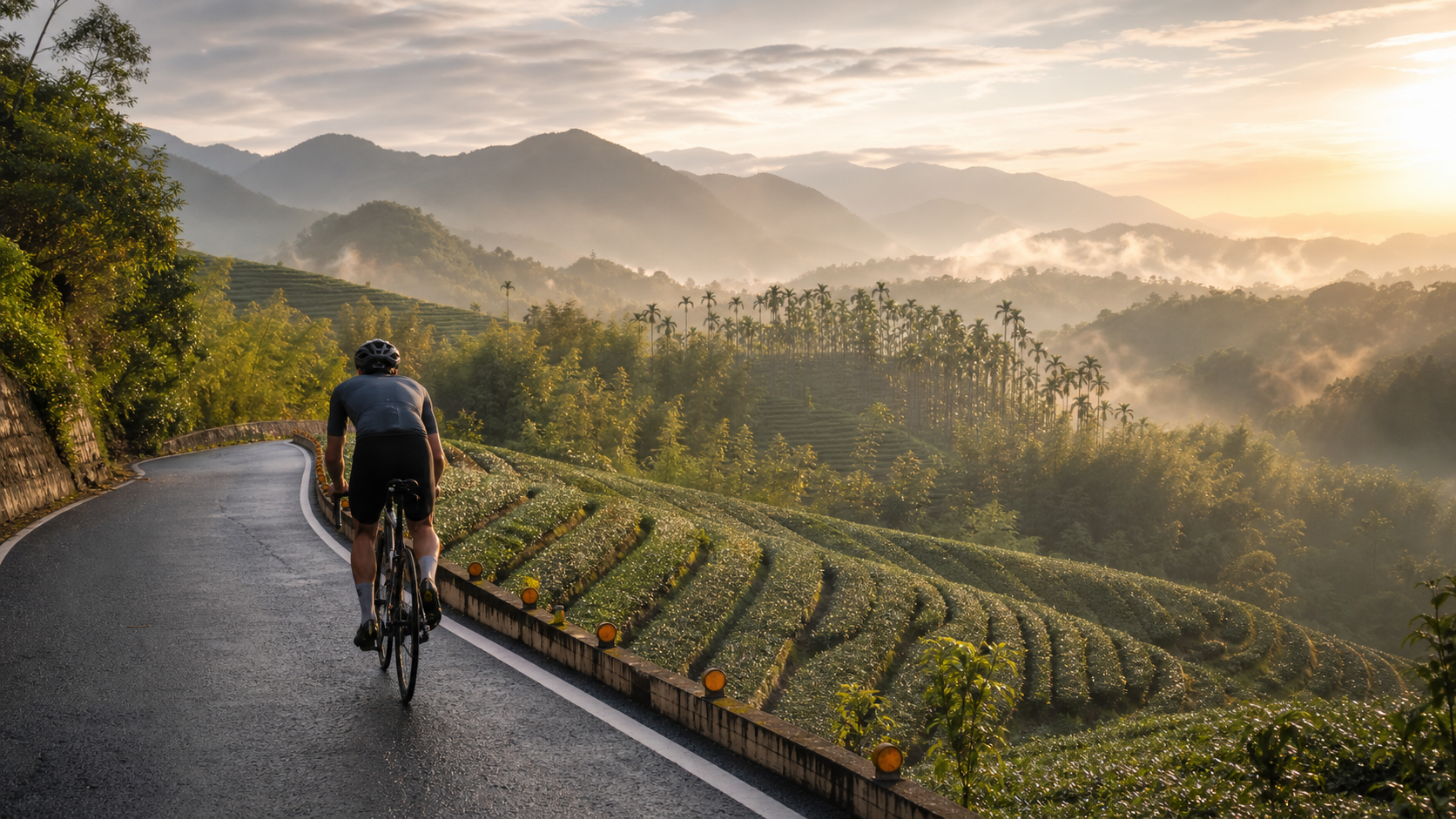
Starting from Zhushan, a Six-Kilometer Journey Through Time
At six in the morning, Zhushan Township was still shrouded in a thin layer of mist. Steam billowed from the steamers at breakfast shops along the street, and the occasional scooter roared past, cutting through the town’s特有的 tranquility. I filled my water bottle, checked my tire pressure, and wheeled my bike out of the homestay where I’d spent the night, ready to take on the long-anticipated challenge of Caoling Road. According to the map, the straight-line distance from here to Caoling was just over six kilometers, yet the elevation gain would exceed 400 meters—for a weekend rider accustomed to riverside bike paths, that number sounded both exhilarating and a little daunting.
Zhushan, a town located in the southeastern corner of Yunlin County, adjacent to Nantou’s Zhushan Township (referring here to the mountainous Yunlin settlement bordering Nantou’s Zhushan in terms of administrative divisions), has been the gateway to the hilly terrain on the western side of the Alishan mountain range since ancient times. It was once an important hub for the bamboo industry, from which the name “Zhushan” (Bamboo Mountain) derives, and the bamboo forests covering the hillsides remain the most distinctive landscape imprint of this land to this day. Caoling Road is precisely the artery that winds upward from this town of bamboo into the deeper mountain regions.
Once I got on the bike, the gradient had already begun to climb after just a few pedal strokes. The houses along the road gradually thinned out, replaced by layer upon layer of betel nut plantations and tea gardens. Morning light slanted across the leaves, and dewdrops reflected tiny glints of light. The air carried a special scent—a blend of moist earth, fresh vegetation, and a faint, elusive hint of tea—the distinctive aroma of Yunlin’s mountain region, belonging uniquely to the early morning.
The Scars of 921 and the Past and Present of Caoling Lake
Along the ride, if you take a moment to observe the geological textures by the roadside, you’ll notice that the rock formations in this mountain area are not as stable and even as one might imagine. In fact, the Caoling area was one of the regions most profoundly affected by the most dramatic chapter in Taiwan’s modern geological history—the 921 Earthquake of 1999. The powerful quake triggered a massive landslide in the upper reaches of the Qingshui River, and the accumulated debris once dammed the river channel, forming the famous “Caoling Lake” barrier lake. This lake, born of disaster, underwent multiple breaches and reformations over the following years, affecting the lives and safety of countless downstream residents and etching the name “Caoling” deeply into Taiwan’s collective memory.
Riding through this mountain area today, it’s hard not to imagine the shock of that earth-shattering event more than two decades ago. The earthquake changed not only the surface of the land but also reshaped the way local residents relate to this terrain—roads were repaired only to be damaged again, residents migrated away and then returned, and the forests of Caoling, with almost tenacious vitality, grew green anew time and again from the wounds. As a traveler passing through on a bike, one may not truly comprehend how arduous those years of natural disaster were, but pedaling along this road that has stood firm through geological upheaval, one cannot help but feel a greater sense of respect and humility.
Beyond the 921 Earthquake, the Caoling area has also faced numerous typhoons and torrential rains in the decades since, and the fragility of the mountain geology has always been a challenge that this land must coexist with. For this reason, if you plan to ride here, be sure to pay attention to the latest road condition announcements—not only is this a matter of taking responsibility for your own safety, but it is also a way of showing due respect for the trauma this land has endured.
Breathing and Thoughts on the Climb
The gradient truly began to assert itself around the two-kilometer mark. The breath that had allowed for conversation was gradually replaced by rapid panting, and sweat from my forehead dripped down along the helmet strap, landing on the handlebar. It was at this point that the series of hairpin turns on Caoling Road began to show their true character—one after another, like carefully designed checkpoints by the mountain, testing the will of every challenger.
I remember at one particular bend, I looked up and happened to see a flock of egrets gliding across the sky above a distant tea garden, their wings gleaming with a silvery-white sheen in the morning light. In that instant, the soreness in my legs seemed to be briefly paused, replaced by a strange sense of calm—this is perhaps the most enchanting aspect of climbing on a bike: while the body endures extreme exertion, the mind is utterly healed by the scenery at some unexpected moment.
The rhythm of riding in the mountains is entirely different from riding on flat ground. There are no traffic lights to interrupt, no hustle and bustle of traffic—only the sound of your own heartbeat, the subtle whir of the chain turning, and the occasional birdsong. This near-meditative state of focus transforms climbing from a mere physical exertion into something more like a journey of self-dialogue—you begin to wonder why you chose to take on this seemingly self-punishing route. The answer often becomes crystal clear the moment you reach the summit.
Tea Gardens and Betel Nut Plantations Along the Way: The Industrial Landscape of Yunlin’s Mountains
The most striking visual impression along Caoling Road is undoubtedly the layered tea gardens and betel nut plantations. While Yunlin’s mountain region is not as renowned nationwide for its tea as Nantou’s Lugu, these shallow hills nurture locally grown tea varieties of considerable quality. Many tea gardens still maintain traditional small-farmer operations, and in the early morning hours, it’s common to see tea farmers in bamboo hats with tea baskets slung across their backs, moving between the neatly arranged rows of tea bushes to pick leaves.
Betel nut plantations present a completely different landscape language. The slender, straight trunks of betel nut palms are arranged in layers, creating a unique visual rhythm on the slopes, and the canopy of interwoven foliage provides welcome shade on the hotter stretches of the ride. Although the betel nut industry has faced increasing controversy and pressure to transform in recent years due to health concerns, as a vital economic lifeline for Yunlin’s mountain region for decades, it remains an indelible part of the industrial memory of this land and an unavoidable aspect of understanding the region’s agricultural transformation.
As you ride past these industrial landscapes, consider slowing down to observe the subtle differences in crop distribution at various elevations—at lower altitudes, betel nut palms and bamboo dominate, gradually giving way to a mix of tea gardens and orchards as elevation rises. This vertically stratified agricultural landscape is a typical land-use pattern in Taiwan’s shallow hill regions, and it’s living, breathing geographical knowledge that riders can experience firsthand—something textbooks can never fully convey.
Reaching the Summit of Caoling: The Moment the View Opens Up
When the gradient finally begins to ease, it means the toughest section has been left behind. Gasping for breath, I looked up, and the view suddenly opened before me—the Caoling area unfolded in its entirety, with layered mountain ridges stretching into the distance and wisps of cloud and mist occasionally curling through the valleys, creating a hazy, ink-wash painting-like scene. In that moment, every ache from each pedal stroke and every thought of almost giving up seemed to have found its due reward.
The Caoling area retains much of its rustic mountain village character. Along the way, there are occasional small local produce shops or simple stalls set up by residents (please refer to on-site conditions for actual business hours and offerings), selling seasonal fruits, mountain products, and homemade tea—great spots to replenish energy during the ride while soaking in the local way of life. Compared to the standardized convenience stores in the city, these brief exchanges imbued with human warmth are often among the most memorable moments of a deep-mountain cycling journey.
Standing at the high point and gazing out, one can feel the vicissitudes and resilience this land has experienced. From the devastation of the 921 Earthquake, to the erosion of successive typhoons, to the repeated rebuilding and perseverance of its residents, the name Caoling carries not just a point on a geographic coordinate, but a story of how land and people coexist and how life finds its way back after disaster.
Seasonal Scenery and Suggested Side Trips
Caoling Road offers a different face in every season. In spring, new buds emerge on the tea gardens, and the mountains are vibrant with fresh green vitality; summer is the season of densest greenery, and although temperatures are higher, the mountain area retains a measure of coolness in the early morning, making it a preferred riding time for many local cyclists. In autumn and winter, the air in Yunlin’s mountains tends to be clearer, visibility improves, and the panoramic views from the heights of Caoling are at their best—making it the ideal season for photography.
If time permits, I’d suggest combining a ride on Caoling Road with a visit to the old street culture of downtown Zhushan. Zhushan Old Street preserves many traditional buildings and local snacks. After completing the riding challenge, stopping by to enjoy a bowl of authentic local fare or a drink to replenish lost energy serves as a warm conclusion to the journey (please refer to on-site visits for actual shops and offerings).
A Word to the Next Challenger
If you ask me whether Caoling Road is worth riding, my answer is an unequivocal yes—not only because its gradient data qualifies it as a representative training route in central-southern Taiwan, but because this road carries the story of a piece of Taiwanese land that endured violent upheaval yet chose to stand up again. Every pedal stroke feels like a conversation with the past of this land; every gasp for breath at the summit reminds you that no matter how steep the road ahead, as long as you’re willing to keep pedaling, you will eventually reach the moment when the view opens wide.
For riders accustomed to urban bike lanes and riverside greenways, Caoling Road may be no small challenge, but precisely because of that, it is all the more worth remembering. If you ever have the chance to visit Yunlin, consider adding this road to your itinerary—not just for the satisfaction of your training data, but to personally experience the beauty of these shallow hills that have weathered so much yet remain so beautiful.
Post-Ride Reflections: Traces Left in Body and Memory
After completing the Caoling Highway challenge, the leg soreness the next day is often the most honest souvenir. But more enduring than muscle soreness are the images left in memory—the silhouettes of bamboo groves in morning mist, a white egret suddenly gliding past a bend, the focused profile of tea farmers at work, and that complex feeling mixing exhaustion and satisfaction when standing atop the summit gazing at the surrounding mountains.
This is precisely the biggest difference between route riding and pure physical training. Spinning bikes or treadmills in the gym can train muscles and心肺, but they cannot provide this experience of connecting with the land, with history, with local life. The Caoling Highway tests your legs with its steep gradients, yet it also nourishes every rider’s deeper understanding and affection for this island through the scenery and stories along the way.
If you have ever ridden up this winding mountain road alone or with companions on some early morning, and felt that contradictory yet healing sensation of both pain and solace, I believe you will understand—this is precisely the most captivating and most rewarding aspect of Taiwan’s cycling culture.
Brief Encounters with Local Residents
Along the ride, you occasionally pass farmers tending their tea gardens. Most of them hold a friendly and curious attitude toward passing cyclists, sometimes pausing their work to look up at these strangers sweating profusely yet still striving to pedal upward. This unique warmth of mountain communities is a kind of human touch increasingly scarce in urban life.
On one ride, while taking a brief rest by the roadside, I met an elderly man tending his vegetable garden. Seeing me panting as I stopped by the road, he proactively offered a bottle of his homemade herbal tea, smiling as he said the mountain road was tough and I should rest more. That cool, slightly bitter yet sweet tea was especially precious under the blazing sun—not just for quenching thirst, but as a gesture of goodwill transcending age and background. Though brief, such encounters often become the warmest moments in a cyclist’s memory—a reward that no precise power data can quantify.
Most residents of Yunlin’s mountain areas still maintain a lifestyle closely tied to the land, with daily routines adjusting to sunrise and sunset during farming seasons. This simple, rhythmic pace of life stands in stark contrast to the minute-by-minute urgency of urban living. As a passing cyclist, being able to briefly融入 such a temporal rhythm, even for just a few minutes, is a rare moment of mental stillness.
Light and Shadow Among the Bamboo Groves
One of the most impressive natural landscapes along the Caoling Highway is the unbroken expanse of bamboo groves. Morning light filters through the dense gaps between bamboo leaves, casting dappled, dancing shadows on the ground. As the breeze blows, the rustling of bamboo leaves creates a unique symphony of sound and sight. The name Zhushan (Bamboo Mountain) is no coincidence—this land’s deep connection with bamboo has long been woven into the local industrial history and cultural life.
In the past, Zhushan’s bamboo industry once flourished, from bamboo weaving crafts to bamboo furniture, sustaining countless local families. Though the traditional bamboo industry has gradually declined with changing times, vast bamboo groves still remain across these mountain forests, becoming one of the most iconic visual imprints for cyclists passing through. If you pause briefly during your ride and quietly listen to the wind rustling through bamboo leaves, you’ll discover it’s an incredibly healing natural white noise, enough to ease even the most taut nerves.
The Meaning of Riding Alone
Routes like the Caoling Highway are especially suited for solo riding. Without the conversation and comparison of companions, you can more purely converse with your own body and your surroundings. Every rapid breath, every bead of sweat, every sudden vista after a turn becomes vividly real and profound.
In such solitary moments, thoughts often drift unconsciously toward matters neglected in daily life—work pressures, tangled relationships, uncertainty about the future. Curiously, when your legs are bearing the极限 load of climbing, these worries that usually occupy your mind seem to evaporate along with your sweat, leaving only the purest connection between this moment, this place, and this winding mountain road.
Perhaps this is why, even though modern society offers all kinds of more convenient and comfortable leisure options, so many people still choose to ride steep, exhausting mountain roads on early weekend mornings, fighting off lingering drowsiness. Because in that process, what we reclaim is not just physical training, but a long-missed opportunity to be honestly face-to-face with our inner selves.
A Note to Those Planning to Conquer Caoling
If you’re hesitating about whether to plan a ride on the Caoling Highway, let me tell you: this road will not disappoint you. It may not have the resounding fame of Wuling, nor the halo of Taiwan’s top-100 must-ride routes, but it possesses a simple and sincere charm—within just over six kilometers, it condenses the most moving natural scenery of Yunlin’s mountains, the most profound geological memory, and the warmest stories of human connection.
Prepare your water bottles, adjust your gear ratios, and set out on a clear morning. When you arrive breathless at the summit and look back at the road you’ve climbed, that feeling mixing exhaustion and accomplishment will make you understand—some scenery can only be truly etched into life’s memory when you’ve pedaled it out yourself with your own two feet (or rather, two wheels).
Moments of Stillness on the Descent
After the joy of reaching the summit comes the descent, which demands equally full concentration. Unlike the muscle soreness of climbing, descending tests a completely different kind of focus—your fingers must be ready to squeeze the brakes at any moment, your eyes must anticipate the curvature of upcoming bends, and your body weight must adjust fluidly with the undulations of the road. This state of heightened alertness is, in a way, a peculiar flow experience, allowing you to temporarily forget the fatigue of climbing and shift into another rhythm of being fully present.
As you descend, the wind howls past your ears, and the tea gardens and bamboo groves you slowly admired moments ago now blur into flowing green streaks. This shift in speed echoes the metaphor of the journey itself—on the climb, time seems stretched, every second filled with bodily struggle and the tug-of-war of will; on the descent, time suddenly compresses, and the road you conquered with such effort often takes only a third or even less of the climbing time to glide all the way back to the start.
Back in Zhushan’s town center, the bustling sounds of the market pull you back to reality. But that sense of tranquility carried down from the mountains will continue to ferment and echo over the following days, along with the soreness in your legs. Perhaps this is why every cyclist who loves climbing keeps returning to similar routes again and again—not out of an obsession with breaking records, but to rediscover that grounded feeling that can only be experienced where极限 meets stillness.
A Caoling Memory Belongs to Every Rider
Every cyclist who visits the Caoling Highway carries away a memory version uniquely their own—some remember the magnificent sea of clouds that suddenly appeared beside a bend, others can’t forget the handmade aiyu jelly sold by a roadside vendor at the summit (actual stalls and items sold are subject to on-site conditions), and still others simply enjoy the utterly exhausted yet immensely exhilarating sense of accomplishment after pushing their limits.
The Caoling Highway may not rank as Taiwan’s most spectacular or most famous cycling route, but it shows every rider willing to invest time and effort a unique gentleness and resilience of Yunlin’s mountain region in the most authentic, down-to-earth way. This road carries the perseverance of post-earthquake reconstruction, the heritage of agricultural culture, and the wisdom of local residents living in symbiosis with the land day after day—none of which can be fully conveyed by mere gradient percentages or elevation gain figures.
May every one of you reading this and planning your trip be able, on some clear morning, to personally pedal up this mountain road belonging to Zhushan and Caoling, and write your own story with your own two wheels.
Before you leave, consider sitting down at a local eatery in Zhushan’s town center, ordering a steaming bowl of noodle soup or a glass of cold herbal tea, letting the muscles that have been tense all morning slowly relax. Gazing at the still-bustling street scene outside the window, you’ll realize that those few hours spent alone among the mountains have quietly become an indescribable yet invaluable treasure in your heart. This is perhaps the most enchanting thing about cycling: what it gives you is never just a workout for your legs, but repeated opportunities to rediscover the land and yourself. And the Caoling Highway is precisely such a road—one worth remembering and revisiting again and again, worth re-mounting your pedals for time after time, heading toward that winding road climbing upward.
Related Reading
- Yunlin Caoling Historic Trail: A Holy Site for Northern Taiwan Hikers and Cyclists
- Caoling Road Battle Guide: How to Ride the 6.4km, 429m Climb Training Slope in Yunlin’s Mountains
- Riding into Zhongliao Erjian Mountain: A Tea Country Reborn at the 921 Epicenter, Searching for Taiwan’s Quietest Climb
- Riding into Southern Taiwan’s Little Xitou: The Mist, Forestry History, and Post-Typhoon Reconstruction of Tengzhi Forest Road
#北橫 + #北進武嶺 最硬的員工旅遊 EP1 | #公路車 #拉拉山 | 明池 | 武嶺 | 武陵農場 | 雲海 | Taiwan Cycling Route Wulin
6 年前
一定要騎一次!阿里山最深處:里佳部落!單車旅行 | 2800m爬升 | 深度部落體驗:嗨翻晚會、螢火蟲、銀河 | feat. JJSC & 廢物伙伴 | 公路車 CT Yeh
9 個月前
藤枝二集團 單車行 Day1 | 南部小武嶺 | 爬坡爬到罵罵叫 | JJSC | 公路車 | CT Yeh
3 年前
新竹羅平 x 天湖部落 大禹嶺級變態陡坡! 4K超高畫質 空拍 | 公路車
5 年前
里佳部落 阿里山單車深度旅遊! | 竹山/草嶺/來吉/奮起湖 | 無敵銀河絕景 全新路線探索! 驚險狀況百出! | 4K沉浸式畫質 | 公路車 | CT Yeh
3 年前
微東進 太魯閣 蘇花 單車兩日遊 ! 颱風過後路況超刺激 行程大亂 | 最狂的鹹酥雞訂單 | CT Yeh | 4K 高畫質空拍絕景!
4 年前
2026紫南宮環線99.9K挑戰Vlog 多視角第一集團 跟看看.. / CT Yeh 公路車
1 個月前
那瑪夏x茶山 阿里山系深山單車行 Day2 累積爬升6000M | 🥶超陡連續下坡 整路看隊友刷 | 爬升一座西進武嶺 | JJSC | 公路車 | CT Yeh
3 年前