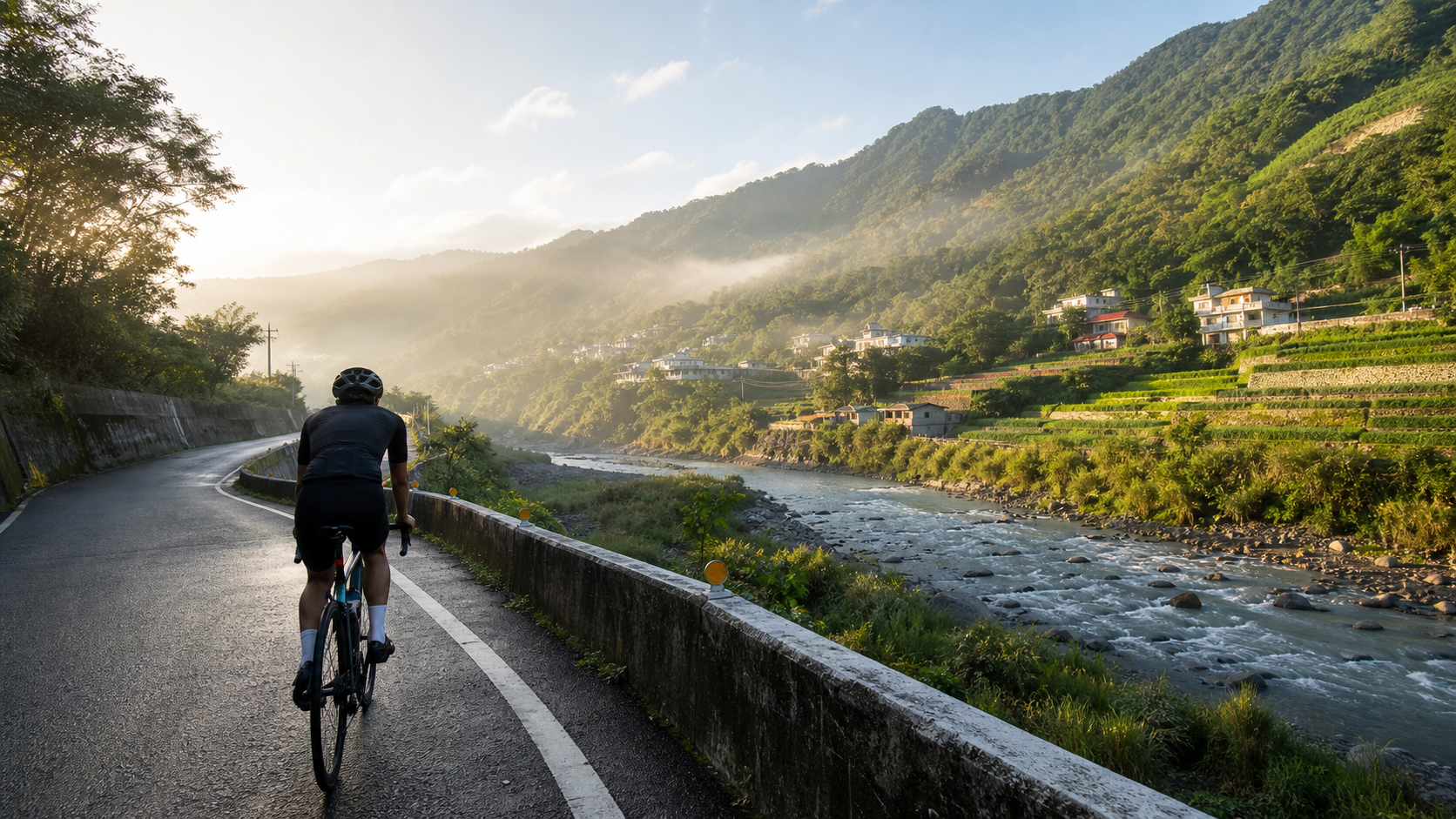
From Baolai to Jiasian, the straight-line distance is barely over five kilometers, yet it is a road that links two mountain towns in Kaohsiung, crosses the Laonong River basin, and carries the scars and memories of this land’s rebirth. This article aims to tell, from a cyclist’s perspective, a slow story about hot springs, taro, and resilience.
Before Setting Off, Get to Know This Land
If you only look at the numbers, Baolai–Jiasian is a 5.29-kilometer route with 202.2 meters of climbing, Category 2, taking roughly twenty minutes to ride. But if you slow your pace a little and take off your earphones, this road is actually a window, letting you see the most profound stories of Kaohsiung’s mountain region over the past few decades.
Baolai, part of Liugui District in Kaohsiung City, sits along the Laonong River and is one of the most important staging settlements before the western section of the Southern Cross-Island Highway enters the mountains. It is renowned for its hot springs; as early as years ago, the name “Baolai Hot Springs” circulated among hikers and soakers. The Laonong River valley terrain gives this area abundant natural hot spring resources, making Baolai a go-to pick for many people’s weekend getaways. Continuing south along Provincial Highway 29, over this gentle slope of less than six kilometers, you arrive at Jiasian—the administrative and living center of Jiasian District, Kaohsiung City, a small mountain town famous nationwide for its taro industry.
This road connects not just two geographical points, but two mountain towns with distinct characters: Baolai leans toward quiet healing, a hot spring village along the Laonong River where fatigue melts away; Jiasian carries more of the lively bustle of a market town, with taro fields and street-side snacks forming its everyday scenery. Riding this stretch, you’ll clearly feel this shift in atmosphere—from the humid moisture of the river valley, gradually transitioning to the vibrant, lived-in feel of a mountain town’s streets.
For those familiar with the geography of Kaohsiung’s mountain region, Baolai and Jiasian both sit within a larger geographical context—the hills and valleys carved out by the Laonong River and the Nanzihsian River on the southwestern side of the Central Mountain Range. This area has historically been a meeting ground for Han Chinese, Plains Indigenous peoples, and Bunun Indigenous communities, and this diverse ethnic history has layered rich cultural depth onto the mountains. To this day, whether it’s Baolai’s hot spring industry or Jiasian’s crop cultivation, both are inseparable from these geographical conditions and historical threads. When we ride through this area, we are actually traveling along a path that has carried centuries of human movement—it’s just that most of the time, we’re focused on the gradient and the scenery, rarely stopping to think about it.
Along the Laonong River: The Everyday Scenery of Baolai’s Hot Spring Town
Setting out from Baolai in the early morning, the first thing you often notice is the faint, elusive scent of sulfur in the air, mingling with the moisture of the Laonong River, creating a unique atmosphere found only in a hot spring town. The Laonong River is one of the major rivers within Kaohsiung, originating in the Central Mountain Range with a vast watershed. Baolai sits right in the valley carved out by this river’s flow. Beyond nurturing hot spring resources, the valley terrain has also shaped the area’s distinctive geology—steep slopes and deep gorges, which is why the western section of the Southern Cross-Island Highway, climbing from Liugui and Baolai, offers breathtaking valley views all along the way.
Baolai’s hot spring industry has a long history of development, with early reputations spread by word of mouth among hikers and hot spring enthusiasts under names like “Bulao Hot Springs.” For the average traveler, Baolai is an important stop along the Southern Cross-Island Highway for resting, soaking, and unwinding; for cyclists, Baolai carries an additional special significance—it is one of the starting points for tackling the western section of the Southern Cross-Island Highway. Many long-distance riders planning to conquer the highway (heading toward Meishan or Yako) choose Baolai or downtown Liugui as their pre-ride staging point for preparation, lodging, and sleep.
In the early morning, Baolai’s streets still hold a sense of tranquility. Occasionally, you’ll see hot spring resort staff up early preparing for business, or fellow cyclists in full kit nodding in greeting as they prepare to take on the Southern Cross-Island Highway. This quiet, peaceful feeling unique to a mountain town at dawn is a world apart from the clamorous traffic of the city—and it’s the part of riding this route that’s easiest to overlook, yet most worth savoring.
For many cycling enthusiasts, the name Baolai itself carries a sense of “ritual”—it’s not a destination, but a threshold to greater challenges. The western section of the Southern Cross-Island Highway winds up from Liugui and Baolai, crossing the Central Mountain Range to reach Taitung, making it one of the most prestigious long-distance challenge routes in Taiwan’s road cycling scene. Every year, many riders list “conquering the Southern Cross-Island Highway” as their annual goal, and Baolai is often where they get one last good night’s sleep, one last good meal, and one last relaxing hot spring soak before setting out. This “eve of battle” atmosphere gives this small town a special emotional connection—it has witnessed countless riders’ anticipation and nerves before departure, and has seen them return after their challenge, tired but wearing satisfied smiles.
The Initial Climb: The First Slope of the Laonong River Valley
Rolling out from Baolai and heading toward Jiasian, you’ll soon feel the road beginning to climb gently. Although this slope averages only 3.8%, because—as mentioned earlier—its gradient distribution is remarkably even and clean, you immediately sense that sustained effort from the start. It’s not like city roads with constant ups and downs; instead, it’s a steady cadence and steady resistance, climbing consistently upward.
Riding on a stretch like this, your thoughts tend to quiet down. There are no frequent traffic light interruptions, no pressure from traffic flow; instead, there’s mountain breeze, birdsong, and the occasional sound of the stream in the distance. The vegetation along this section of Provincial Highway 29 is quite dense, with layered mountain ridges on both sides. On clear days, sunlight filters through the treetops and spills onto the road, creating dappled patterns of light and shadow. This kind of riding experience is something hard to quantify with numbers, yet unforgettable once you’ve felt it—it’s not about pacing or power, but about the present-moment sensation of being immersed in this mountain forest.
As elevation gradually increases, looking back toward Baolai, the contours of the Laonong River valley slowly unfold. The river winds through the gorge, and depending on the weather, you might even catch the sight of mountain mist drifting slowly. Scenery like this is one of the most precious added values of cycling—earning, through the power of your own legs, perspectives that only reveal themselves when you slow down.
Riding on such a gradient, your breathing naturally finds a steady rhythm, each inhale and exhale syncing with your cadence, and your body seems to enter a state close to meditation. This is why many long-time cyclists say “climbing heals the mind”—when you must focus all your attention on your breath, cadence, and the road ahead, the trivial worries of daily life get pushed aside, at least temporarily. For many urban commuter cyclists, driving two or three hours every weekend just to come to these mountains and grind out a climb isn’t merely about the exercise benefits—it’s about this indescribable process of mental clarity and grounding.
The Weight of Memory: The Morakot Disaster and the Scars on This Land
If I only wrote about hot springs and taro, this article wouldn’t fully tell the story of this land. In August 2009, Typhoon Morakot (commonly known as the 88 Flood Disaster) brought historically staggering rainfall to the mountainous regions of central and southern Taiwan. Among the hardest hit were the mountains of Kaohsiung—especially the Liouguei and Jiasian areas. Mudslides, landslides, and surging rivers destroyed countless homes and roads, and permanently altered the face of many settlements in these mountains.
In this disaster, the most heartbreaking tragedy occurred in Xiaolin Village, Jiasian District. At the time, days of torrential rain triggered a massive landslide on Xiandu Mountain, and the earth and rock instantly buried the entire settlement of Xiaolin Village, claiming the lives of hundreds of villagers. It was the single deadliest event of Typhoon Morakot and remains one of the most profound natural disaster memories in Taiwan’s modern history. This tragedy not only took many lives, but also nearly erased overnight a settlement that carried a unique Siraya Plains Indigenous culture and a tradition of night ceremonies.
As travelers passing through this land by bike, we are in no position to speak lightly of this disaster, nor should we treat it as a curiosity to spice up our itinerary. The Xiaolin Village tragedy was a real and immense wound, involving the shattered life stories of many families. To this day, survivors and the families of the victims still carry this memory with them. If you pass by any memorial facilities or sites along your ride, please treat them with the most basic respect—slow down, stay quiet, and refrain from taking photos just for social media. That is the least we owe to the departed and to this land.
After the disaster, the Liouguei and Jiasian areas embarked on a long reconstruction effort. Road repairs, settlement relocation, and industrial recovery each required enormous resources and time. Provincial Highway 29, which this route follows, along with the surrounding road network connecting Baolai, Liouguei, and Jiasian, sustained considerable damage in the storm and underwent lengthy repair and reinforcement works before gradually returning to the safe condition riders enjoy today. When we ride on this smooth road today, taking in the beautiful scenery of the Laonong River valley, we are in fact riding atop a history that rose back up from ruin.
Over the years, government agencies and civic groups have established memorial facilities and spaces around the original site of Xiaolin Village, allowing future generations to mourn the victims, understand the full story of the disaster, and giving surviving villagers and their families a place to hold their memories. The night ceremony culture that the Siraya Plains Indigenous people had long preserved in Xiaolin Village is a precious intangible cultural asset of this settlement. After the disaster, some cultural inheritors and workers have continued their efforts, hoping that this cultural memory will not be completely severed along with the disappearance of the settlement. In a way, these efforts echo the spirit of post-disaster reconstruction across the Jiasian and Liouguei region—not just rebuilding physical infrastructure like houses and roads, but also striving to preserve the cultural and life stories that once existed on this land and deserve to be remembered.
As travelers passing through by bike, we may not be able to do much, but we can at least practice “understanding” and “not forgetting.” When you ride through these mountains and see a memorial inscription or interpretive sign by the roadside, take a moment to stop and read it. Let this history become more than just words in a textbook or a news report—let it become part of the real memory you have personally traveled through and witnessed with your own eyes.
The Power of Rebirth: Jiasian from Post-Disaster to Today
After the disaster, Jiasian and its surrounding communities were not defeated. Over the years, local residents, government agencies, and various civic forces have invested in long-term reconstruction and industrial recovery. Jiasian has gradually regained its own rhythm of life from the trauma and has once again polished the reputation of its famed taro industry.
Walking into Jiasian today, you’ll see the streets have regained their sense of everyday life—the sound of bargaining at the morning market, children’s laughter as school lets out, and the aroma of taro wafting from roadside shops. This restoration of “everydayness” is precisely the most difficult yet most precious achievement of the reconstruction effort. Houses can be rebuilt and roads repaved, but helping a community rediscover its own pace of life and human warmth requires far more time and far more people’s efforts than any construction project.
For travelers passing through by bike, this history reminds us that the seemingly ordinary country roads and mountain-town markets before our eyes carry the arduous journey this land and its residents have walked. This is not meant to weigh down the ride along this route, but rather to hope that every rider who passes through will view Baolai and Jiasian with greater understanding and respect—they are not just place names on a route list, but places where real people live, and where real suffering was once endured.
Jiasian Taro: The Sweet Mark of a Mountain Town
After climbing this stretch and arriving in downtown Jiasian, the first thing that hits you is often the aroma of taro. Jiasian’s taro industry enjoys nationwide renown; the local soil and climate conditions are highly suitable for taro cultivation, and over years of accumulation, “Jiasian taro” has become practically synonymous with a regional brand.
Many snack shops and dessert spots along Jiasian’s main street feature taro in their dishes and sweets, and taro ice is a local specialty that nearly every visitor stops to try. After just finishing a climb, sweaty and tired, sitting down to a bowl of taro ice—that cool, creamy texture paired with the exhilaration of post-ride satisfaction—is the most vivid first impression many riders have of Jiasian. As for which specific shop to choose, it’s best to explore on the ground when you arrive and follow the recommendations of locals—this kind of food exploration in a small town is one of the most enjoyable parts of any ride, and leaving a little room for spontaneous discovery is often more rewarding than following a checklist.
Beyond taro ice, Jiasian’s taro is also widely used in a variety of processed goods and souvenirs, from taro pastries and taro mochi to all kinds of taro products, forming this mountain town’s unique industry and food culture. The continuation and growth of these industries is, in a sense, a testament to Jiasian’s forward momentum after disaster reconstruction—local people have used their most familiar crop to gradually rebuild Jiasian’s economic lifeline and local identity.
Taro as a crop requires a long growing and care cycle. From planting to harvest often takes months or even longer, during which farmers must continuously tend their fields, managing water and soil conditions. This agricultural character of patience and long-term commitment is, in many ways, a mirror of Jiasian’s own reconstruction journey over the years—there are no shortcuts, only steady steps, slowly accumulating results through time and patience. When you enjoy a bowl of taro ice on the streets of Jiasian, behind that sweet, creamy texture lies a full year—or even a whole generation—of hard cultivation by this land and its people.
In recent years, Jiasian’s taro industry has gradually integrated with tourism and experiential agriculture. Some farms now open their doors to visitors, allowing them to tour the taro fields and learn about the complete process from planting to table. For riders passing through, if time permits, consider staying a little longer in Jiasian and actually walking into the fields to see this industry firsthand—it will give you a far deeper appreciation of the profound connection between this land and its crops than simply eating a bowl of ice.
A Rider’s First-Person Perspective: What This Road Taught Me
To be honest, 5.29 kilometers is really not long. If you treat it merely as a “check-in item on a route list,” you might finish it in twenty-some minutes and be done, without leaving much of an impression. But if you’re willing to slow down, this stretch can give you far more than its length suggests.
I remember the first time I rode this road, it was at the hour when the morning mist had not yet lifted. Setting out from Baolai, the distinctive sulfur scent of the hot spring area still lingered in the air. As my cadence gradually picked up, my body warmed, and the outlines of the valley came into clearer focus in the morning light. Reaching the middle section, I glanced back in the direction I’d come from—the Laonong River shimmered faintly in the valley, and that image is still etched in my mind to this day.
The moment I arrived in Jiasian, what I felt first wasn’t a sense of accomplishment, but a strange, grounded contentment—as if I had completed a small double crossing, both geographic and psychological. From the tranquility of a hot spring town to the lively bustle of a mountain market; from the physical fatigue of riding to the satisfaction of sitting down to a bowl of taro ice. This process of transition is one of the most captivating things about cycling: it lets you experience, in the most direct and slowest way, the real distance and difference between two places—unlike driving through, where you blink and miss every detail worth stopping for along the way.
It was only after that ride that I made a more serious effort to learn about the history of the Baolai and Jiasian area—including the immense pain brought by Typhoon Morakot and the slow but steadfast reconstruction that has followed over the years. This made me realize that as travelers passing through by bike, we have a responsibility to understand the full picture of the land beneath our wheels, rather than treating it merely as a scenic training route. This understanding adds another layer of meaning to every ride—not just physical training, but also a gesture of respect, a tribute to this land and the people who live on it.
Suggested Side Trips: Slow Your Pace Down
If time permits, it’s recommended not to treat the Baolai–Jiaxian stretch as a mere transit segment to be rushed through, but rather to incorporate it into a fuller itinerary that includes hot springs and culinary exploration.
Baolai End: You can arrange to stay at a local hot spring resort the night before or after the ride, letting your legs, sore from climbing, soak in the soothing thermal waters. The hot spring resources along the Laonong River have always been Baolai’s most iconic feature. Fitting a hot spring soak before or after a bike ride is something many seasoned cyclists already do, and it’s well worth following their lead.
Jiaxian End: After arriving in Jiaxian, beyond savoring taro ice and related taro products, you can also slow down and take a stroll through the streets of Jiaxian, experiencing the current look of this mountain town that has been rebuilt after typhoon disasters. If time allows, you can also learn more about the Morakot Typhoon and the reconstruction process in this area, gaining a more complete and deeper understanding of this land.
Route Extensions: For riders with plenty of energy who want to take on longer distances, the Baolai–Jiaxian stretch can also serve as part of a loop ride around Liugui and Baolai, or as a segment of a long-distance challenge on the western section of the Southern Cross-Island Highway. Whichever arrangement you choose, it’s advisable to allow ample time and not miss the scenery and stories truly worth stopping for along the way due to a tight schedule.
Conclusion: One Road, Two Moods, One Measure of Respect
From Baolai to Jiaxian, a distance of less than six kilometers, yet it holds the tranquility of a hot spring town, the lively bustle of a mountain market, the magnificent vistas of the Laonong River valley, and the pain and rebirth this land has endured. For cyclists, this route can be a solid training segment or a short journey rich in cultural depth—it all depends on the mindset you choose to ride it with.
Next time you clip in and slowly climb from Baolai toward Jiaxian, consider easing off the pace a little, paying more attention to the scenery and scents along the way, and remembering to carry respect for this land and for the people who once endured tremendous suffering here. This is not just a cycling route; it is a journey worth experiencing with your heart.
Through the Seasons: Baolai–Jiaxian in Different Times of Year
Although the Baolai–Jiaxian stretch is short, its location at the junction of the Laonong River valley and the foothills means it presents distinctly different faces across the four seasons. Spring is the season when the mountain vegetation is most vibrant, with layered shades of green on the slopes on either side, occasionally dotted with wild mountain flowers. The air is especially fresh on morning rides, making it the season most recommended by local cyclists.
In summer, the Laonong River valley reveals another kind of abundant vitality. The river’s water volume increases, and the moisture in the valley becomes more pronounced. In the early morning hours, thin mist can often be seen wrapping around the mountainsides, creating dreamlike scenery. However, summer afternoons in the Kaohsiung mountain areas are prone to thunderstorms, and with higher temperatures, it’s advisable to schedule rides in the early morning or near dusk, while keeping an eye on weather forecasts to avoid sudden rainfall in the mountains.
Autumn and winter bring the best air quality and visibility of the year. Without the summer humidity and the threat of afternoon thunderstorms, riding the Baolai–Jiaxian stretch on autumn and winter mornings often delivers the most comfortable temperatures and clearest views—an excellent time for photography and savoring the scenery along the way. This season also coincides with one of the important production and peak harvest periods for Jiaxian taro, which nicely complements the wonderful moment of sitting down to enjoy a bowl of taro dessert after completing the ride.
No matter which season you visit, the Baolai–Jiaxian stretch reminds cyclists that Taiwan’s mountains are never a static backdrop, but a living presence that constantly changes its appearance with the turning seasons. Each revisit may reveal completely different scenery depending on the season, weather, and light—which is precisely why so many local cyclists are willing to ride the same route again and again without ever growing tired of it.
One Stretch of Road, Two Industries, the Same Resilience of the Land
If we zoom out for a broader perspective, Baolai’s hot spring industry and Jiaxian’s taro agriculture may seem to belong to completely different economic models—one relying on geothermal resources and tourism services, the other grounded in agricultural cultivation and processing—but they actually share a common trait: both are highly dependent on the natural conditions of this land itself, both suffered impacts of varying degrees in the Morakot Typhoon, and both have since undergone a long and arduous recovery process.
After the typhoon, the hot spring industry faced not only the repair and reconstruction of physical facilities but also the need to rebuild tourists’ confidence; the agricultural sector, meanwhile, confronted multiple challenges including loss of farmland, disruption of irrigation water sources, and severed transportation links, with the road back to cultivation often proving far longer than outsiders might imagine. Over the years, the fact that Baolai and Jiaxian have managed to regain their footing is due not just to government reconstruction projects, but more to the persistent, day-after-day efforts of local residents—rehabilitating hot spring resorts, turning over the soil and replanting, and gradually piecing back together the supply chains that had been broken.
As travelers passing through on bicycles, we may never fully comprehend the hardship and ordeal of that reconstruction process, but we can at least support the continued recovery of this land in the most direct way possible—by visiting in person and actually spending money on local industries, whether that means staying at a hot spring resort, purchasing local agricultural products, or simply enjoying a bowl of taro ice. This is also why many seasoned cyclists, when planning routes with special historical backgrounds like Baolai–Jiaxian, place particular emphasis on a travel philosophy of “don’t just ride through—stop, spend locally, and learn the stories”—because every act of local spending is the most tangible form of support and affirmation for this land’s road to recovery.
Related Reading
- Kaohsiung Qishan to Jiaxian: An Easy Ride and Supply Guide Along the Laonong River Valley
- Baolai–Jiaxian Route Guide: A Perfect Data-Driven Training Climb of 5.29 km with 202.2 m of Elevation Gain
- Riding into Southern Taiwan’s Little Xitou: The Clouds, Forestry History, and Post-Typhoon Reconstruction of Tengzhi Forest Road
- Riding into the Landscape of Xindian: The South Side of Shitou Mountain, a Climbing Memory Alongside the Xindian River
台中大雪山 膏王領騎 震到都沒畫面了 公路車
5 年前
嘉義大埔、阿婆灣挑戰賽,美到以為在日本!ft. 環騎5 Cool 西拉雅188 / 公路車 / CT Yeh
7 個月前
大武山20%魔王陡坡【JJSC南台灣遊騎Day2】!屁股真的要裂開了...凡士林抹滿也沒用?神秘金教堂還有超便宜夜市
3 個月前
水金九不厭五分 10度寒流冷到不願停!feat. 卡卡 / 公路車 / CT Yeh
6 個月前
太平山單車員工旅遊 | 這樣玩CP值最高!| 公路車
5 年前
藤枝二集團 單車行 Day1 | 南部小武嶺 | 爬坡爬到罵罵叫 | JJSC | 公路車 | CT Yeh
3 年前
爬坡ITT實境)台中 魔王 松鼠坡 首航 6:12 大肚山 大三元 科福路
8 年前
#北橫 + #北進武嶺 最硬的員工旅遊 EP1 | #公路車 #拉拉山 | 明池 | 武嶺 | 武陵農場 | 雲海 | Taiwan Cycling Route Wulin
6 年前