Riding into the Little Sitou of Southern Taiwan: The Mist, Forestry History, and Post-Disaster Rebuilding of Tengjhih Forest Road
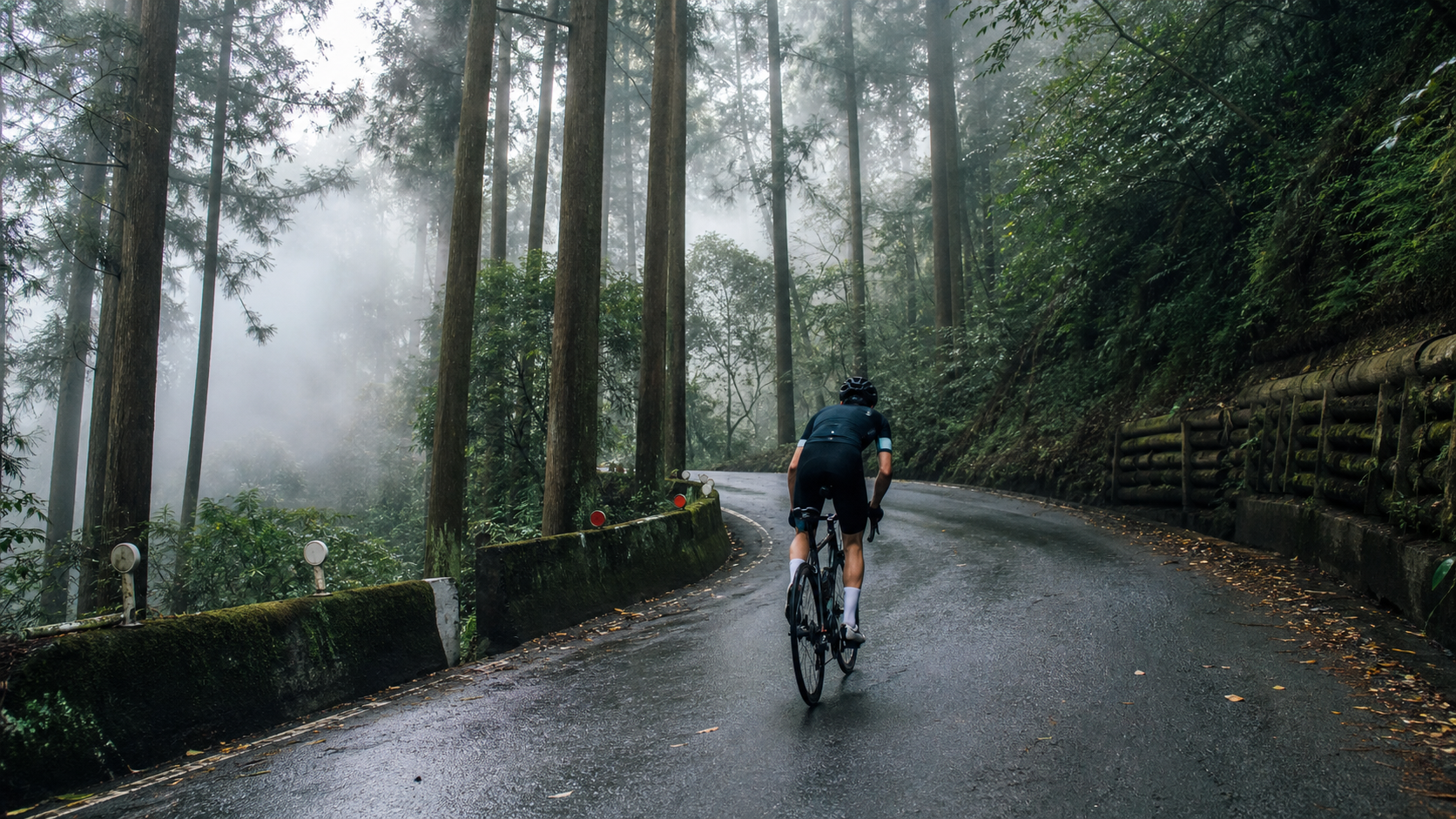
Some say riding into Tengjhih is like riding into a forest that breathes. As the elevation gradually climbs, the acacia trees and betel nut orchards lining both sides of the asphalt road give way to cedar and broadleaf forests, and the air shifts from the sticky, sweltering heat of the lowlands to a cool, moist freshness. This is a journey about forests, about history, and about a personal dialogue with the gradient.
Where the Nickname “Little Xitou of Southern Taiwan” Comes From
The first time I heard the nickname “Little Xitou,” I couldn’t help but raise an eyebrow—Xitou is in Nantou, while Tengjhih is in Liouguei, Kaohsiung. The two places are separated by well over a hundred kilometers, so how could they be mentioned in the same metaphor? It wasn’t until I personally rode deep into Tengjhih’s forest roads that I understood the logic behind this nickname. It isn’t about geographical similarity, but rather a resonance of character and atmosphere.
What makes Xitou so enchanting is its vast stands of Japanese cedar planted through large-scale afforestation, where mist and clouds perpetually shroud the forest, making a walk through it feel like stepping into a fairyland. Tengjhih is much the same—its forests are likewise dominated by planted Japanese cedar and China fir, intermingling with surrounding natural broadleaf forests to create a richly layered forest structure. At an elevation of around 1,600 meters, the climate here is markedly different from the oppressive heat at the foot of the mountains in Liouguei. It remains moist and cool year-round, with clouds and mist often gathering slowly in the afternoon, wrapping the entire forest in a hazy white veil. This dual sense of “Xitou déjà vu”—both visual and physical—is precisely the origin of the nickname “Little Xitou of Southern Taiwan.”
The process of cycling up to Tengjhih is, in itself, a journey of experiencing this climatic transition firsthand. Setting out from downtown Liouguei, you still feel the typical scorching sun of southern Taiwan’s mountain regions, with the asphalt reflecting harsh white light. But as the elevation steadily climbs, you gradually notice the wind carrying moisture, the shade of the trees growing more enveloping, and sunlight being fractured into dappled patches scattered across the road. This gradual climatic shift, rather than an abrupt alpine vista, offers a more grounded sense of “measuring elevation with your body”—every meter of climbing is accompanied by subtle changes in humidity and temperature in the air, a delicate sensation that driving through simply cannot convey.
The fact that Tengjhih National Forest Recreation Area maintains such a rich forest structure is also tied to its relative seclusion and visitor numbers far smaller than Xitou’s. With less disturbance from mass tourism, this forest retains a more pristine and tranquil character. The calls of birds and the rustling of wind through the conifers become the most moving soundtrack to the ride. This experience of a “hidden gem for the few” is perhaps exactly why so many cycling enthusiasts return again and again, never able to forget it.
I often think that the nickname “Little Xitou” also carries a quiet aspiration—the hope that Tengjhih, like Xitou, will become a forest space people are willing to approach and savor slowly, rather than just a spot hurriedly passed through, photographed, and left behind. Cycling, as a mode of movement, happens to give us a perfect opportunity to practice this “slow savoring”: it’s slower than driving and faster than walking, landing right at a sweet spot where you can perceive environmental changes without spending an entire day on foot to cover the full distance. You can clearly feel how the forest composition shifts with every turn of the gradient, yet you don’t need a whole day of hiking to complete the route. This rhythm, poised between fast and slow, is perhaps the most captivating quality of cycle touring—and the most fitting way to experience the forests of Tengjhih.
Precisely because this process of personally experiencing changes in elevation and forest composition is unique to cycling, I always feel that this Tengjhih route is especially worth recommending to friends who normally only pedal on trainers in the gym but rarely venture out to real mountain trails. Numbers on a gradient or elevation gain can never compare to the authenticity of breathing in forest air laced with cedar fragrance and moisture. This is also why, even knowing full well this route isn’t an easy climb, I find myself wanting to come back time and time again.
The Forestry Development History of Liouguei: The Path This Mountain Forest Has Walked
To understand why the forests of Tengjhih present the landscape they do today—Japanese cedar interwoven with broadleaf trees—one must examine the forestry development history of the Liouguei region. Since the Japanese colonial era, Liouguei District has been one of the important forestry hubs in the mountains of Kaohsiung. Its abundant forest resources once supported a significant piece of Taiwan’s overall forestry economy.
In the early years, Taiwan’s forestry development was concentrated in the economically valuable natural coniferous forest belts around the Central Mountain Range. The Liouguei area and the surrounding Laonong River basin, thanks to their favorable terrain and forest conditions, became one of the key regions for logging and reforestation. As the times evolved, the model of simply logging primary forests was gradually replaced by人工造林 (artificial afforestation). Fast-growing species with stable economic value, such as Japanese cedar and China fir, were planted in large numbers across areas where the original forest cover had been developed. The Japanese cedar stands visible around Tengjhih today are a direct testament to this chapter of forestry history.
Riding along the Tengjhih Forest Road, if you pay a little attention, you can actually read a silent history of forestry development from the subtle differences in forest composition. Plantation areas typically feature a single tree species arranged in neat rows, imparting a sense of order as you pass through. In contrast, the patches of natural broadleaf forest interspersed among them have more irregular, varied tree shapes and a richer, more chaotic understory. This landscape of plantation and natural forest coexisting side by side is a microcosm of Taiwan’s forestry transitioning from a past focused on resource extraction to one that balances ecological conservation with forest recreation.
Liouguei’s history as a forestry hub has also profoundly shaped the settlement patterns and industrial character of the region. The entire industrial chain—from logging and log collection to transport—once supported a considerable workforce and economic activity in the Liouguei mountains. Today, as Taiwan’s forestry policy has shifted toward conservation-first, large-scale commercial logging has become a thing of the past. This forest has gradually transformed from a production base into a space for recreation and ecological education. The fact that we can now ride leisurely through it, breathing in the fresh scent of the cedar forests, is in a sense standing on the fruits of this historical transition.
With this background in mind, riding back into Tengjhih’s forest roads, every Japanese cedar before your eyes seems to carry an added weight of history. This is not merely a cycling route; it is a local development history written in trees, worthy of riders pausing between breaths to slow down slightly and savor every patch of green along the way.
Beyond forestry, the Liouguei area is also an important mountain agricultural settlement. In the early days, as forestry workers moved in and gathered, they spurred the development of surrounding farming and mountain produce economies. The fertile alluvial soils of the Laonong River basin have nurtured many renowned mountain agricultural products—from fruit to coffee—all finding suitable ground to thrive on this land. This industrial pattern of forestry and agriculture coexisting has, to some extent, shaped Liouguei’s unique cultural character—combining the tenacity and pragmatism of mountain developers with the simple warmth of farming families who have cultivated the land for generations. On the ride from downtown Liouguei toward Tengjhih, the occasional orchards and small farm-produce stands along the way are precisely the everyday scenery left by this industrial heritage—an often-overlooked yet worthwhile cultural landscape to savor on this journey.
The Road to Recovery After Typhoon Morakot
If the history of forestry development is the more distant memory of this forest at Tengjhih, then Typhoon Morakot in 2009 (commonly known as the 88 Flood Disaster) is undoubtedly one of the most profound scars in the region’s modern history. The astonishing rainfall brought by this super typhoon devastated the entire mountainous area of southern Taiwan, with the Liouguei and Laonong River basins among the hardest-hit regions. Access roads were severely damaged, and some settlements were even permanently relocated.
Tengjhih National Forest Recreation Area and its surrounding access roads suffered tremendous impact in this disaster as well. Multiple sections of the mountain access road collapsed and were cut off, while facilities within the recreation area sustained varying degrees of damage from the fierce winds and torrential rain. For a considerable period afterward, reconstruction and repair efforts in the Tengjhih area required massive investments of manpower and resources before the access roads could be reopened and the forest recreation area could gradually resume its operations.
Riding along these roads that were devastated by the disaster and then gradually restored, it is hard not to develop a complex emotion toward this mountain forest. Every stretch of smooth pavement you see, every stabilized slope engineering project, likely represents the results of countless emergency repairs and reinforcements. The reconstruction of mountain roads is never a one-time, permanent solution—every typhoon season, these roads built along the mountainsides must once again face the risks of landslides and roadbed loss, which is why mountain access routes require continuous maintenance and monitoring.
It is worth noting that, given the highly unpredictable nature of natural disasters and road conditions, the actual opening status, accessibility, and facility usage regulations in the Tengjhih area are subject to change with the seasons, weather, and the latest construction progress. Riders planning to take on this route are advised to check the latest official announcements before setting out, confirming whether the access roads are open and whether the forest recreation area is accessible. Do not rely solely on past experience or outdated information found online, to avoid arriving to find the area closed or encountering unexpected road hazards.
In a sense, the post-disaster reconstruction has also given the residents of this forest and surrounding communities a deeper understanding of “coexisting with the mountains.” Today, riding along the Tengjhih Forest Road, what you see is not just the repaired and operational roads and facilities, but also the resilient will of an entire region to continue guarding this forest and living in harmony with nature after being struck by disaster. This resilience may well be the most moving essence of the Liouguei land.
As a cyclist who frequently rides in mountainous areas across Taiwan, I have always believed that understanding the disaster and reconstruction history behind a route allows us to ride with greater humility and respect. Every seemingly ordinary stretch of asphalt may have once been destroyed by landslides, only to be repaved through the efforts of countless engineers and local residents. The fact that we can smoothly pedal through this mountain forest is built upon the fruits of many people’s hard work. This awareness elevates cycling from a mere physical challenge into a tribute to the land and its history.
First Person: A Climbing Journey Through the Forest
At 6:30 in the morning, as the sky was just beginning to brighten, I wheeled my bike out of the garage, ready to head to Liouguei. This was my third time challenging Tengjhih, but my feelings were different each time—the first two attempts were about testing my limits; this time, I wanted to try a different mindset and truly savor the route itself.
Setting off from downtown Liouguei, the initial stretch still carried the familiar atmosphere of southern Taiwan’s mountain regions: air tinged with a hint of dust, scattered betel nut plantations and fruit trees along the roadside, and the occasional local resident casting curious yet friendly glances at a fully geared-up cyclist passing by. This distinctive warmth of mountain towns always helps me shed some of my pre-climb tension before the real ascent begins.
As the gradient gradually emerged, I deliberately kept my power output in check, reminding myself not to repeat the mistake of starting too aggressively as I had in my first two attempts. After roughly two to three kilometers of riding, I began to notice a clear shift in the surrounding vegetation—the scattered fruit trees and mixed woodlands gradually gave way to denser, more orderly cedar forests. Sunlight filtered through gaps in the coniferous canopy, casting dappled, dancing shadows on the asphalt that shifted position with my forward speed, as if the forest were playing a game of light and shadow with me.
Temperature changes are the most honest indicator of altitude. Setting off from the base with a thin sheen of sweat, I felt the coolness brought by rising humidity against my skin as I continued climbing, and at one particular switchback, I could even faintly see wisps of white vapor in my exhaled breath. This process of having your physical senses gradually redefined by the environment is the most captivating and authentic part of cycling uphill—you cannot experience it through imagination; you can only transport yourself to that elevation by turning the pedals, one revolution at a time.
Around the midpoint of the route, the gradient noticeably steepened, my breathing grew rapid, and the familiar ache and burn spread through my thigh muscles. Just at the moment when both physical strength and willpower were being tested, a veil of clouds and mist quietly emerged from the forest, slowly enveloping the entire mountain road. Visibility dropped instantly to just a few dozen meters, leaving only the sound of my own panting, the subtle whir of the chain, and the occasional birdcall. In that moment, I suddenly felt the entire world fall silent—even the frustration brought on by the steep grade was gently wrapped and soothed by the dense fog.
Continuing upward, the mist thickened and thinned by turns, as if playing hide-and-seek with me. Every time the clouds parted slightly, the silhouettes of the cedar forests on both sides would emerge faintly, their ethereal beauty making one want to stop and take in the view—but my legs told me this was not yet the time to pause. On the final stretch of climbing, the gradient seemed to ease somewhat, and in rhythm with my breathing and heartbeat, I finally felt the view ahead gradually opening up. That sense of nearing the summit surged fresh energy through my weary body.
The Seasonal Spectacle of Mist and Clouds
The cloud and mist scenery at Tengjhih is not a fixed landscape you can encounter at any time; rather, it is more like a limited performance closely tied to the season and time of day. Generally, afternoon hours tend to bring cloud accumulation in mountain areas due to strong convection, which is why many experienced cyclists recommend setting off in the early morning—not only to avoid the risk of afternoon thunderstorms, but also to capture that most dreamlike mountain scenery that exists between morning light and thin mist.
In the early morning at Tengjhih, the sunlight still carries a soft golden hue, piercing through the lingering overnight moisture to form beams of light through the forest—a natural phenomenon photography enthusiasts call “Jesus light,” which is especially easy to capture among Tengjhih’s cedar groves. If you happen to reach the summit area at just the right time, slowing down slightly and finding a safe spot to pull over, quietly absorbing the serene beauty of this forest woven together by morning light and mist, will be the most treasured moment of your entire ride.
Visiting Tengjhih in different seasons also reveals completely different expressions of the forest. In spring and summer, the mountains don their most lush green, with abundant rainfall making the entire forest burst with vitality; in autumn and winter, while lacking summer’s verdant exuberance, the crisp air often makes the layers of mist more distinct, and combined with moisture brought by the northeast monsoon, you can sometimes encounter even more spectacular and dense sea-of-clouds vistas. This forest countenance that transforms with the turning seasons is Tengjhih’s most enchanting seasonal gift, and a compelling reason to return again and again for a closer look.
Birdwatching Ecology: Hidden Surprises in the Forest
Tengjhih’s rich forest structure also nurtures a remarkably diverse bird population, making it a true treasure trove for riders who enjoy observing natural ecology along the way—a place well worth slowing down for and pricking up your ears. The coexistence of plantation forests and natural broadleaf forests provides a variety of habitat types, from the canopy layer down to the understory shrubs, each potentially harboring the presence and songs of different bird species.
The early morning hours are when bird activity peaks, which conveniently coincides with the departure time many cyclists choose. Riding along the forest road, you will hear birdcalls rising and falling in succession, woven into a natural symphony. Even if you cannot name every species, simply immersing yourself in this richly layered soundscape is a rare and healing experience. The occasional glimpse of a fleeting silhouette on a branch, or the clear, resonant call echoing through the valley from afar, will temporarily push the fatigue of the climb to the back of your mind.
For riders who are truly passionate about birdwatching, bringing a pair of lightweight binoculars is recommended. Where your energy allows, pause briefly and carefully observe the movements in the forest. Of course, birdwatching ultimately requires a measure of luck and patience, and the specific species you encounter will vary with the season, time of day, and the day’s fortune. No overly specific species guarantees are offered here, but one thing is certain: the ecological richness of Tengjhih’s forest absolutely merits slowing your pace and devoting your attention to listening to and observing the vitality nurtured by these mountains.
A Soothing Ritual After the Climb: A Side Trip to Baolai Hot Springs
After completing the climbing challenge of Tengjhih, if time and energy permit, a side trip to the hot spring village around Baolai in Liouguei is highly recommended to give the journey a perfect ending. The Baolai hot spring area is located along the route from Liouguei to Tengjhih and is one of the most well-known hot spring villages along the Southern Cross-Island Highway. With its mild spring quality, it has long been a healing destination for mountain travelers to shed their fatigue.
After a climb, muscles tend to accumulate large amounts of lactic acid and sustain minor micro-tears. At this point, a hot spring bath can not only effectively soothe tense and sore muscles but also promote blood circulation and accelerate the removal of metabolic waste. The relaxing sensation of warm spring water enveloping the entire body is the best reward for the legs that have worked so hard. Many cycling enthusiasts have long regarded “finishing a climb, then soaking in a hot spring” as a ritualistic routine. This physical relaxation, paired with the lingering memories of the forest scenery along the way, often elevates the satisfaction of the entire ride to another level.
The Baolai area currently offers several hot spring resorts and bathhouses to choose from. Actual operating conditions, prices, and services vary by establishment and change over time, so it is advisable to do some research beforehand or inquire on-site to select a hot spring resort that suits your needs and schedule. If time permits, be sure to keep an eye out for local snacks and agricultural specialties in the area. The fruits and processed agricultural products abundant in the Liouguei mountain region are local flavors worth sampling as you bring this Tengjhih journey to a close.
Riding into Tengjhih, what you gain is not just a finishing record for the climb, but also a profound memory of the forest, of history, and of how this land has stood resilient in the aftermath of natural disasters. Should you have the chance to visit again, perhaps try slowing down to immerse yourself more fully in this misty “Little Xitou” of southern Taiwan, and feel the silent love letter that this route writes to every visitor through its gradients and forest scenery.
Related Reading
- From Xitou to Shanlinxi: A Misty Journey Through Japanese Cedar, Monster Village, and Songlongyan Waterfall
- A Six-Kilometer Journey Through Time: The 921 Memories, Tea Garden Light and Shadow, and Local Charm of Caoling Highway
- From Baolai to Jiasian: A Cycling Memory of Hot Springs, Taro, and a Land Reborn
- Riding into the Landscape of Xindian: The Southern Side of ShihTou Mountain, a Climbing Memory Alongside the Xindian River
藤枝二集團 單車行 Day1 | 南部小武嶺 | 爬坡爬到罵罵叫 | JJSC | 公路車 | CT Yeh
3 年前
觀霧 變好騎了! | 北高車友爆笑大會師 | 公路車 | 單車旅遊 Taiwan Cycling Route GuanWu
6 年前
嘉義大埔、阿婆灣挑戰賽,美到以為在日本!ft. 環騎5 Cool 西拉雅188 / 公路車 / CT Yeh
7 個月前
大武山20%魔王陡坡【JJSC南台灣遊騎Day2】!屁股真的要裂開了...凡士林抹滿也沒用?神秘金教堂還有超便宜夜市
3 個月前
微東進 太魯閣 蘇花 單車兩日遊 ! 颱風過後路況超刺激 行程大亂 | 最狂的鹹酥雞訂單 | CT Yeh | 4K 高畫質空拍絕景!
4 年前
太平山單車員工旅遊 | 這樣玩CP值最高!| 公路車
5 年前
新竹白蘭部落! 爬陡坡還能講笑話...? 廢物伙伴の約騎 | 公路車 | CT Yeh
4 年前
大武山後門26%歡樂陡坡!JJSC南台灣單車行Day2 / 被颱風追著跑 / 公路車 / CT Yeh
2 年前