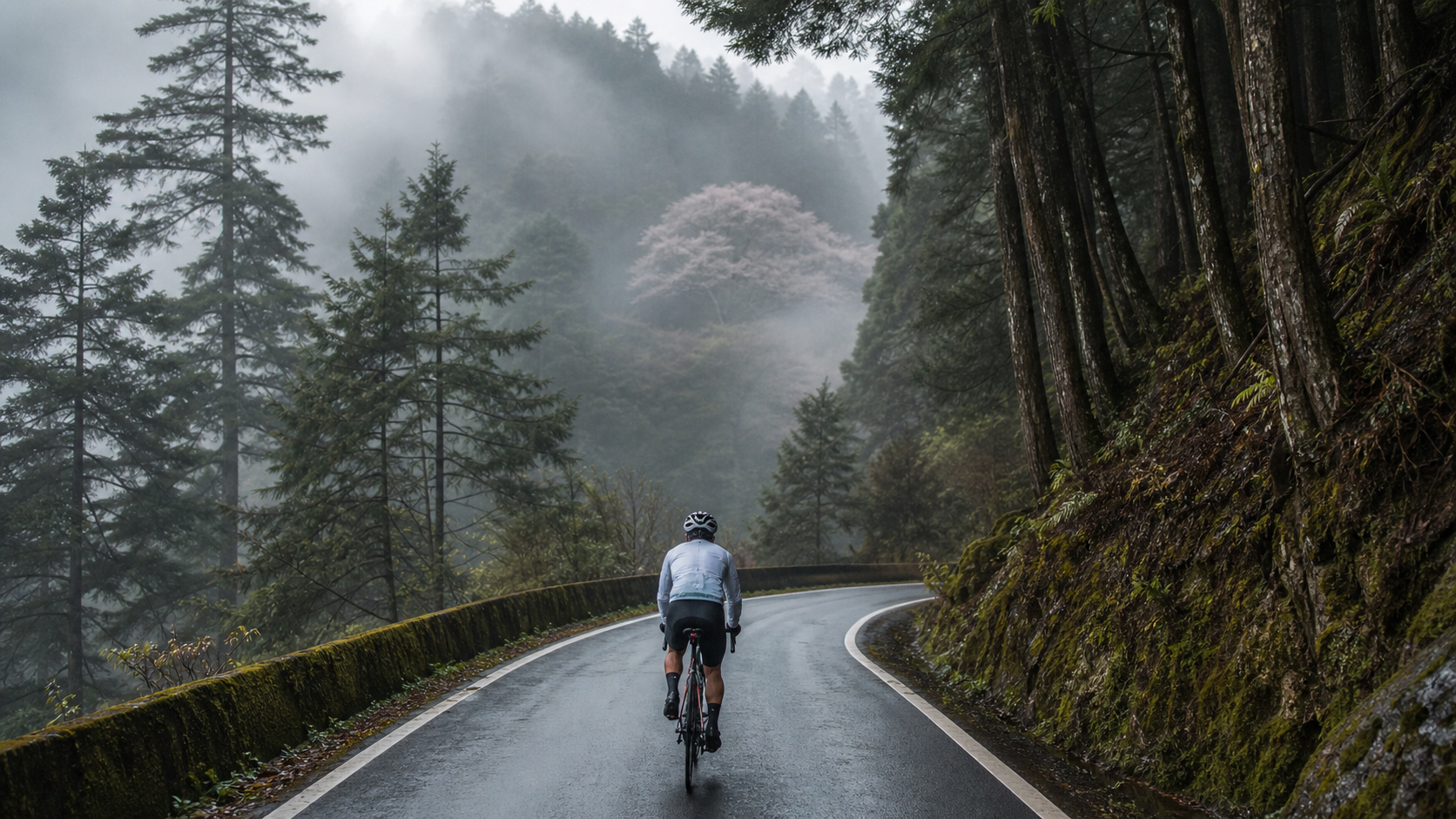
Riding into the Misty Depths: A 27-Kilometer Soulful Pilgrimage to the Guanwu Cherry Blossom King
Foreword: That “Are You Coming to See the Cherry Blossom King?”
The night before departure, as I was sorting through my gear checklist, one phrase kept echoing in my mind—“Are you coming to see the Cherry Blossom King?” I couldn’t remember exactly which casual chat in the team group chat it came from, but it inexplicably stuck with me, becoming the most primal motivation for this ride. It wasn’t some grand slogan; rather, it felt like a casual invitation between old friends, carrying a warmth that was both anticipatory and lazily familiar. And behind that invitation lay the destination: the famed giant old mountain cherry tree—the Cherry Blossom King—in the Guanwu Recreation Area of Shei-Pa National Park in Hsinchu County.
Guanwu—just the name itself carries a poetic quality when spoken. The character “wu” (mist) precisely captures the most enchanting and mysterious trait of these mountains: shrouded in clouds and fog year-round, visibility shifting at any moment, with ridgelines alternately crisp and then swallowed by milky-white moisture. To reach this misty high-mountain sanctuary, one must first ride a 27.3-kilometer stretch with 1,540.8 meters of elevation gain—winding up from the Zhang Xueliang Entrance, through Dalu Forest Road, until reaching the police checkpoint near the 22-kilometer control point. This isn’t just a cycling challenge; it’s more like a slow, devout pilgrimage, using the power of one’s legs to carry oneself, step by step, into the misty depths.
1. Guanwu’s Geography and History: Forestry Memories on the Edge of Shei-Pa National Park
Before diving into the riding experience, I’d like to spend a bit of time introducing the story of the Guanwu woodlands. The Guanwu area is located in the mountains of Hsinchu County, adjacent to Shei-Pa National Park, serving as one of the key gateways into the park. At an elevation approaching 2,000 meters, the climate is cool year-round, and the ever-present clouds and mist are practically part of the daily scenery. The name “Guanwu” (literally “viewing the mist”) is said to derive precisely from the spectacular seas of clouds and fog visible here throughout the year.
The vital road connecting the lowlands to Guanwu is the Dalu Forest Road. Its earliest origins are closely tied to Taiwan’s early forestry development history. From the Japanese colonial period through the post-war era, many of Taiwan’s high-altitude forests were important sources of timber resources, and the road systems built for transporting lumber and developing logging operations formed the prototypes of many of today’s well-known forest roads and mountain highways. Dalu Forest Road is a living testament to this forestry history. Though its role in logging has long faded, this winding mountain path still lies quietly among the forests, witnessing the passage of eras while carrying the tire tracks of riders like me who come today—whether to challenge ourselves or simply to get closer to nature.
As for the “Zhang Xueliang Entrance” mentioned in the route name, it’s the starting point named after a landmark on this Strava segment. The historical figure Zhang Xueliang does indeed have a connection to the Hsinchu mountains—he was once held under house arrest for many years in the nearby Cingquan (Qingquan) tribal area, and that chapter of history remains an important cultural asset for the region to this day. However, it’s worth clarifying that this Guanwu Dalu Forest Road route’s main story doesn’t revolve around Zhang Xueliang’s history; the “Zhang Xueliang Entrance” functions more as a place-name marker near the start of the segment, reminding us that these woodlands once intersected with a complex and subtle period of Taiwan’s modern history. As for the exact geographical origins and naming rationale of this entrance, I haven’t done excessive research or speculation—I simply regard it with respect as a historical footnote worth noting but not over-embellishing, riding past it and continuing onward toward Guanwu.
Beyond the clouds and forest scenery, the true signature attraction that makes Guanwu unforgettable is that enormous old mountain cherry tree affectionately nicknamed the “Cherry Blossom King.” Every year around March, the mountain cherries enter their blooming season, and when this remarkably aged and sizable old tree bursts into full crimson bloom, it draws crowds of visitors and photography enthusiasts who make the arduous journey up the mountain to pay homage. It’s precisely because of this tree that “going to see the Cherry Blossom King” has gradually become a phrase of tacit understanding among cycling friends—it’s not just about seeing a tree; it’s more like completing a ritual journey to a high-mountain sanctuary.
2. First-Person Riding Narrative: A Sensory Transformation from the Lowlands to the Clouds
On the day of departure, the sky still held a faint grayish-blue tint, and the air carried that distinctive lowland humidity and mugginess. After warming up near the Zhang Xueliang Entrance, adjusting my cycling computer and water bottles, I took a deep breath and officially embarked on this 27.3-kilometer journey.
For the first few kilometers, my body hadn’t fully awakened—muscles still carrying a hint of sluggishness, breathing yet to find its rhythm. The scenery around me was familiar low-mountain landscape: betel nut palms, mixed woodlands, the occasional scattered farmhouse, sunlight filtering through the clouds with that sticky early-summer warmth. I deliberately rode conservatively on this stretch, reminding myself not to get carried away by initial excitement—after all, there were still over 20 kilometers and more than 1,500 meters of climbing ahead.
Around the five- or six-kilometer mark, the forest composition began to change. The broadleaf forests typical of lower elevations gradually gave way to taller, denser tree species, and the scent in the air subtly shifted—the muggy lowland humidity fading, replaced by a fresh sensation carrying hints of pine resin and damp earth. This olfactory change is actually the most honest elevation indicator, letting the body intuitively feel “I’m climbing” far better than any number on the cycling computer.
As the gradient steadily carried me upward, around the middle section the temperature dropped noticeably, sweat evaporating from my skin in waves of coolness, the initial mugginess gradually replaced by a crisp, even slightly chilly air. It was around then that I began to notice a thin layer of white mist slowly drifting across the distant ridgelines, as if someone had tipped over a whole bucket of milk in the valley, slowly diffusing outward. In that moment, I suddenly understood why this place is called “Guanwu”—that mist isn’t a static sheet of white; it’s alive and flowing, sometimes veiling the peaks, sometimes blown apart by the wind to reveal the layered ridgelines behind.
Entering the latter part of the route, deeper into Dalu Forest Road, the trees grew taller and more lush, sunlight filtered through layer upon layer of canopy, casting dappled shadows across the asphalt. By this point, physical fatigue was quite pronounced—thigh muscles aching persistently, breathing growing more rapid—but curiously, my mind felt exceptionally clear. Perhaps it was because the surrounding scenery was so overwhelming that the body’s fatigue was temporarily suppressed by a state approaching “flow.” I remember on that stretch, I barely glanced at my cycling computer, simply focusing on my cadence, my breathing, and the gradual transformation of temperature and humidity around me, as if my entire being was slowly synchronizing with the rhythm of these mountains.
In the final few kilometers, near the 22-kilometer control point and police checkpoint on Dalu Forest Road, the mist had grown noticeably thicker, visibility dropping dramatically. The road ahead seemed to be sliced into short segments, with only ten to twenty meters of asphalt and the white edge lines visible at any given moment. That feeling of being enveloped by mist was both mysterious and tinged with solitude, as if the entire world had shrunk to just me, my bicycle, and this stretch of road endlessly extending before me. When I finally rode into the section near the end, my legs were already weak and aching, but what welled up inside was an indescribable sense of groundedness and fulfillment.
3. Landmarks and Scenic Spots Along the Way: Dalu Forest Road, the Huge Cypress Grove Trail, and the Guanwu Visitor Center
Every landmark along this route deserves to be savored at a slower pace. First and foremost is the Dalu Forest Road itself, which runs through the entire route—this mountain path carries the historical memory of the logging industry, yet today the trees on both sides are lush and verdant, and traces of the old timber-hauling operations are barely visible anymore. What remains instead is a dense, pristine forest landscape. Riding through it feels like passing through a time tunnel, leaving the bustling industrial road behind and returning to the tranquil, deep embrace of the mountains.
After arriving at the Guanwu Recreation Area, one of the most famous must-visit spots is the Huge Cypress Grove Trail. This trail is renowned for the massive cypress trees scattered along its length, some of which are remarkably old, with thick trunks and gnarled, weathered forms. Standing beneath these giants and looking up, you can’t help but feel the vastness of nature’s timescale—these trees have stood silently in these mountains for far longer than a single human lifetime. The sense of awe at being surrounded by such enormous living beings is an experience no urban jungle can offer. If you still have energy left after completing this climbing challenge, I strongly recommend parking your bike securely, changing into walking shoes, and spending some time on this trail to experience a pace and forest atmosphere completely different from riding.
Next is the Shei-Pa National Park Guanwu Visitor Center, the information hub of the entire Guanwu Recreation Area. It provides ecological interpretation of the national park, trail information, and essential rest and supply facilities. For riders who are exhausted after a long climb, the visitor center is an excellent midway rest stop—you can take a break here, replenish water and energy, and learn about the area’s rich ecological knowledge, including the unique flora and fauna of the Guanwu region and the reasons behind the special cloud-zone climate.
The ultimate romantic finale of this journey is, of course, the Queen Cherry Blossom Tree. Even if you visit outside its blooming season, the sheer size of this massive old mountain cherry tree and its sturdy, gnarled branches are enough to convey the vitality accumulated over the years. If you’re fortunate enough to visit during its peak bloom around March each year, the sight of the tree covered in crimson blossoms against a backdrop of swirling mountain mist is almost dreamlike in its beauty—no wonder it has become a pilgrimage site for photography enthusiasts and travelers alike. However, please note that for the most accurate bloom status and access information, it’s best to refer to the national park’s latest official announcements and on-site conditions, since the climate varies slightly each year and the blooming period shifts accordingly.
4. The Sounds and Scents of the Mountains: Guanwu in Sensory Memory
One of the wonderful things about cycling is that it puts you in a nearly meditative state of focus, allowing you to perceive details in your surroundings that are easily overlooked in everyday life. What remains most vividly in my memory from this trip to Guanwu, beyond the visual changes in clouds and forest, are the fragments of sounds and scents.
In the lower-elevation sections at the start of the climb, the air carried the humid, stuffy warmth typical of low mountains, mixed with occasional smells of woodsmoke or cooking wafting from farmhouses along the way—reminders that I was still in the foothills where human presence hadn’t fully faded. As the elevation gradually increased, those traces of human life quietly receded, replaced by increasingly rich plant aromas—moist earth, the natural fermentation of accumulated leaf litter, and the crisp, resinous scent of conifers when the wind blew through them. Taking a deep breath felt almost like having my lungs cleansed.
As for sounds, in the lower sections I could occasionally hear distant vehicle engines and the occasional bark of a dog—traces of human activity. But the deeper I went into the mountains, the more these man-made noises were replaced by the sounds of nature: the rustling of wind through treetops, the crisp calls of unidentified birds, the faint scurrying of small animals darting through roadside undergrowth, and my own increasingly audible breathing and heartbeat as I panted for air. In the later sections of the route, where the clouds grew thicker, the surroundings became so quiet that almost the only sounds were my own breath and the rhythm of my pedaling. That silence wasn’t an empty void, but a tranquility gently enveloped by the natural soundscape, making you unconsciously slow your mind and merge with the environment around you.
There’s another kind of sensory memory that’s hard to describe precisely in words: the physical sensation of “temperature and humidity intertwined.” The stuffy heat of the low elevations, the cooling sensation of evaporating sweat during the mid-climb, the damp chill of the cloud-enshrouded summit—this sequence of bodily temperature shifts felt like my body recording every segment of the journey and every meter of elevation gain in the most direct way possible. Years from now, the numbers on my cycling computer may fade, but these memories of scents and temperatures will remain the most vivid and easily recalled.
5. What Riding This Route Means to Me
Everyone has different reasons for riding a bike—some chase competitive results, some ride for health, and some simply enjoy the thrill of speed. But for me, a challenging route like Guanwu, with its long distance and high elevation gain, carries meaning far beyond the sport itself.
Before riding this route, I had gone through a period of low confidence in both my physical fitness and mental fortitude. Work pressure and the chaos of daily life had made me doubt whether I could still complete a hard, long-distance climbing challenge like I used to. In a way, Guanwu’s 27.3 kilometers and 1,540.8 meters of climbing became a trial for me to re-examine myself and rediscover my inner strength.
During the ride, especially in the middle and later stages when my body began to tire and my willpower was being tested, I found myself engaged in a series of internal dialogues—“Can I keep going?” “Should I stop and rest?” “Why does this section feel so long?” And every time I chose to keep pushing down on the pedals and not give up, it felt like making a deposit into my inner confidence. When I finally reached the section near the end, the sense of accomplishment wasn’t just physical—it was a psychological reaffirmation that I was still the person willing to grit my teeth and face challenges head-on.
This is perhaps the most precious thing about long-distance climbing. Unlike short sprints that demand instantaneous explosive power, it gives you ample time to have a proper conversation with your body, your willpower, and even the doubts and fears buried deep inside. And the mist-shrouded forests of Guanwu, with their ever-changing yet always gentle and embracing demeanor, seem to silently witness every rider’s journey of reconciliation with themselves on this road.
6. Seasonal Scenery: Sea of Clouds, Cherry Blossoms, and Possible Autumn Foliage
Because of its unique geographical location and climatic conditions, the Guanwu area offers completely different scenery depending on the season you visit—this is part of what makes these mountains so captivating.
The most well-known attraction is, of course, the cherry blossom season around March each year. The Queen Cherry Blossom Tree mentioned earlier, along with other mountain cherry species around Guanwu, burst into bloom during this period, adding a passionate splash of crimson to the perpetually misty mountains. The cherry blossoms blooming against a backdrop of clouds and verdant forest create a unique high-mountain aesthetic—wild and weathered in a way that’s completely different from the neatly planted ornamental cherry trees in lowland parks.
Aside from cherry blossoms, the sea of clouds is almost an everyday spectacle in the Guanwu area. Whenever weather conditions align, especially in the early morning or afternoon, you can often see clouds churning and flowing through the valleys, with layers of mountain ridges appearing and disappearing above the cloud sea. The sheer visual grandeur is enough to make you stop in your tracks and gaze quietly for a long while, even if you’ve witnessed it many times before. This is also why the name “Guanwu” (literally “viewing the mist”) is so fitting—it’s not just a geographical name, but a precise description of these mountains’ most everyday yet most enchanting form of scenery.
As for autumn foliage, while Guanwu isn’t as famous for maple leaves as other well-known leaf-peeping destinations in Taiwan, certain deciduous trees in some areas do display rich, layered color changes during autumn and winter, influenced by elevation and terrain. Combined with the area’s characteristic clouds and morning light, the scene carries a distinctively melancholic yet elegant atmosphere. However, the extent and timing of the fall colors vary from year to year depending on climatic conditions. If you’re specifically chasing this seasonal spectacle, it’s best to rely on the actual weather conditions and on-site observations for that particular year, rather than fixating on specific dates—this way, you can better enjoy the serendipitous surprise that nature offers.
No matter which season you visit, Guanwu’s year-round cool climate and its rich, ever-changing cloud and mist scenery make it a high-mountain hidden gem worth returning to again and again, with new vistas to discover each time.
7. Suggested Add-ons: For Those Planning a Deeper Exploration of Guanwu
If you’re also planning to take on this 27.3-kilometer climbing route, I’d sincerely suggest not treating it merely as a “ride-and-go” physical challenge, but rather planning it as a deeper journey that combines sport with a mini getaway.
After arriving at the Guanwu Recreation Area, I recommend setting aside at least one to two hours to allow yourself to gradually shift from the high-intensity climbing state to a relaxed traveler’s pace. You can start by visiting the Shei-Pa National Park Guanwu Visitor Center, where ecological interpretation and trail information are usually available—a great knowledge stop for riders who want to learn more about the mountain forest ecology.
If your energy allows, I strongly recommend scheduling a short hike on the Kuaishan Giant Tree Trail, standing in person beneath those ancient trees that have weathered countless years, and feeling a pace and spatial awe completely different from the speed sensation of cycling. This dual experience of “first conquering the mountains with speed, then getting close to them on foot” often yields deeper and more complete travel memories than a single activity.
Regarding food and supplies, since Guanwu is located in a mountainous area with relatively limited shops and dining options, I suggest preparing enough water and portable snacks at the foot of the mountain beforehand. If there are dining or supply points within or around the park, the actual offerings and operating hours may change over time, so it’s best to rely on on-site conditions and the latest announcements rather than assuming supplies will always be available along the way.
For transportation, since this is a long round-trip into the mountains, I recommend planning a complete outbound and return schedule in advance, including time for the climbing challenge, time spent in the mountain area, and the long descent or shuttle time—avoiding an overly tight schedule that might force you to rush in dim light or thick cloud and fog, compromising riding safety.
8. Words from the Heart to Future Challengers
If you’re hesitating about whether to take on the Guanwu route, let me tell you: this is absolutely a journey worth taking. The 27.3-kilometer distance may sound daunting, and the 1540.8-meter elevation gain may feel intimidating, but trust me—what this route gives back to riders far exceeds the physical effort it demands.
It won’t crush your will with brutal, violent gradients in an instant. Instead, it invites you—slowly, persistently, almost gently—to pedal step by step, revolution by revolution, deeper into the clouds and mist. Along the way, you’ll experience layer upon layer of shifting temperatures, smell the gradual transition from the scent of everyday human life to the aroma of primeval forest, and watch how the clouds drift and transform through the valleys, until finally, around some bend, you encounter that cherry blossom queen that has witnessed countless years.
To every future rider preparing to take on this route, I want to say: please make thorough preparations—adequate training, suitable gearing, sufficient supplies, and gear for the mountain’s changeable weather. But beyond these concrete preparations, what matters even more is to set out with a heart willing to slow down and truly take in everything around you. The most precious gift of this route is not the finish time on your bike computer, but the sensory memories and inner dialogues accumulated along the way.
When you finally ride to near the 22-kilometer control point on Dalu Forest Road, legs aching yet mind clear, gazing at the mist-shrouded mountain scenery before you, I believe you’ll feel the same as I did—softly saying to yourself from the bottom of your heart: “I’m glad I came to see the cherry blossom queen.” And what this journey leaves you with will be not just a record of a successful challenge, but a profound memory worth revisiting again and again—a memory of how you found reconciliation with yourself deep in the mountains. May every reader of this article who is preparing to set out find their own touch of emotion and strength in the misty depths of Guanwu.
Related Reading
- Guanwu Dalu Forest Road Battle Guide: 27.3 km, 1540 m of Climbing, a Marathon-Style Long Ascent into the Clouds and the Cherry Blossom Queen
- Sacred Trees and Heavenly Ponds in the Mist: A Cycling Pilgrimage to Daxueshan, Riding Altitude into a Spiritual Practice
- Alone, One Forest Road, 24.94 Kilometers: The Solitude and Grandeur of Xuejian Sima Limit Forest Road
- Riding Where the Clouds Rise: Yunhai, Sacred Springs, and Wushe Memories from Lushan Hot Springs to Provincial Highway 14
觀霧 變好騎了! | 北高車友爆笑大會師 | 公路車 | 單車旅遊 Taiwan Cycling Route GuanWu
6 年前
司馬庫斯 | 單車員工旅遊 | 比武嶺還接近上帝的路 | 2021 全面實況 路況解析 | 空拍 櫻花炸開超濃密 | 財伯觀光果園 | CT Yeh
5 年前
台北闊瀨陡坡 騎旅 / 日本單車雜誌編輯車友臨時加入!/ 髮香才是最強的 / feat. 北迴歸線小隊 / 公路車 CT Yeh
6 個月前
台灣登山王之路 KOM 全程參賽4K臨空錄影 PART1 穿越峽谷地形! #東進武嶺 太魯閣 / 燕子口 / 天祥 / 西寶 PART1 (公路車 / CT Yeh)
3 年前
大武山後門26%歡樂陡坡!JJSC南台灣單車行Day2 / 被颱風追著跑 / 公路車 / CT Yeh
2 年前
台中大雪山 膏王領騎 震到都沒畫面了 公路車
5 年前
大武山20%魔王陡坡【JJSC南台灣遊騎Day2】!屁股真的要裂開了...凡士林抹滿也沒用?神秘金教堂還有超便宜夜市
3 個月前
#北橫 + #北進武嶺 最硬的員工旅遊 EP1 | #公路車 #拉拉山 | 明池 | 武嶺 | 武陵農場 | 雲海 | Taiwan Cycling Route Wulin
6 年前