Seven Kilometers of Steep Climb, the Silence of a Whole Mountain: The Beihang Branch Line I Encountered on Taoyuan 116 Baling Road
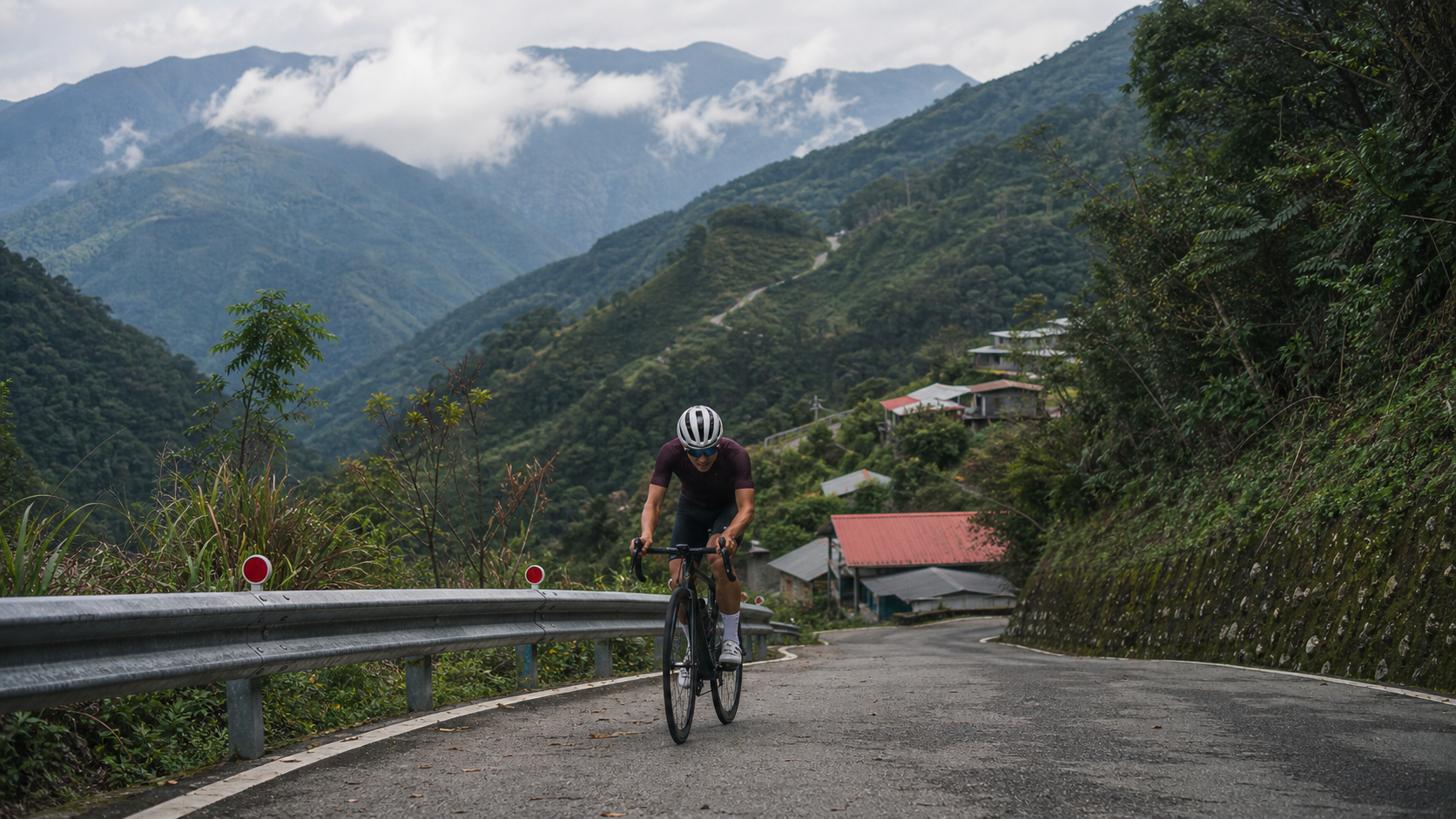
Seven Kilometers of Steep Climb, the Silence of an Entire Mountain: The Northern Cross-ridge Branch I Encountered on Taoyuan 116 Baling Road
Some routes are meant for chasing times; Taoyuan 116 is not one of them. It is short enough that you never have time to prepare, yet steep enough that it grants you no room to catch your breath. This article is not about pacing charts—it simply aims to record how an ordinary weekend rider came to re-understand the weight of the word “climbing” on this short, steep branch road tucked away in a corner of the Northern Cross-ridge Highway.
1. A Small Road Beside the Northern Cross-ridge Highway: The Geographic Identity of Taoyuan 116 and Baling
If you unfold a map of Taoyuan’s Fuxing District, you will find the Northern Cross-ridge Highway (Provincial Highway 7) running like a main artery through the entire mountain region, while County Road Taoyuan 116 is one of those unremarkable yet characterful branches that quietly splits off, leading toward the mountain settlements around Baling. It is not the kind of road that gets featured on the cover of tourism brochures; rather, it feels like a low-key yet solidly present passage between local life and outside challengers.
The Fuxing District of Taoyuan has long been an important living territory for the Atayal people. Along the Northern Cross-ridge Highway and its surroundings, including the area traversed by Taoyuan 116, Atayal tribes have taken root and continued their way of life for many years. For them, this mountain forest is not merely a point on a geographic coordinate—it is a living realm carrying hunting trails, cultivated fields, ancestral beliefs, and tribal memory. As a traveler who rides up from the city, every time I pass through mountain roads like this, I remind myself: this asphalt road, now planned as a recreational cycling route, was once someone else’s home, a mountain path their ancestors walked countless times. This awareness does not make the climb any easier, but it adds a measure of respect to the entire ride and subtracts a bit of the arrogance of purely “conquering a route.”
The construction of the Northern Cross-ridge Highway itself is a representative chapter in the history of Taiwan’s mountain road building, linking the three administrative regions of Taoyuan, Hsinchu, and Yilan while crossing the complex terrain of the northern Central Mountain Range. Branch roads like Taoyuan 116, in a sense, grew out of the main trunk line, gradually taking shape as local roads driven by tribal life and the needs of forestry and agricultural development. They lack the touristic glamour of the main highway, yet they quietly shoulder the role of connecting settlements and sustaining the functional fabric of mountain life.
The Baling area has always enjoyed a certain renown along the Northern Cross-ridge Highway. Its elevation and climate conditions have fostered agriculture and tribal cultural landscapes with local character. Taoyuan 116 Baling Road sits right in this region—a mere seven kilometers in length, yet with a gradient so concentrated it is almost startling, as if the mountain’s steepest, most uncompromising temper had been distilled into this one small road. For cyclists, this is a challenge; but if you are willing to slow your mindset and understand, it is also an opportunity to draw closer to the texture of the mountain forest and its human context—though I must honestly admit that, as an outsider rider, my knowledge of the finer details of tribal life and landmark stories along the route is limited. Rather than forcing out a few impressive-sounding place names, I would rather say this truthfully: this is a mountain forest worth experiencing firsthand with your own feet and wheels, not one to be imagined through words alone.
2. First-Person Riding Narrative: When the Gradient Becomes a Dialogue the Body Cannot Avoid
I will always remember that morning when I decided to take on Taoyuan 116. The sky still held a hint of grayish blue, and the mountain air was damp with the scent of vegetation. Before setting off, I had repeated to myself countless times, “It’s only seven kilometers—push through and it’ll be over.” But the moment my front wheel truly pressed onto Taoyuan 116’s asphalt and my rear wheel began to feel the resistance of the gradient, I realized that the shortness of the distance had done nothing to dilute the ferocity of the climb.
For the first short stretch, the gradient greeted me in a relatively mild manner. My breathing rhythm could still hover on the edge of conversation, and my mind even had spare capacity to notice the layered vegetation along the roadside and the shifting colors of distant mountain ridges. But that sense of ease faded quickly. After roughly the first obvious switchback, the gradient seemed to change character entirely—no longer easing in gradually, but laying its steepness directly before me, without reservation.
At that moment, the sensation in my thighs was not mere soreness, but a persistent tightness carrying a burning heat, as if the muscle fibers were reminding me in an almost protesting manner: this intensity exceeds what you thought was your “warm-up range.” My breathing grew rapid and shallow, my chest feeling as though an invisible hand were slowly constricting it—each inhalation requiring more effort to sense enough air entering. Sweat slid down my forehead and dripped into my eyes with a stinging sensation, yet even the luxury of raising a hand to wipe it away felt too costly—because that fraction of a second of distraction could drop my cadence and shatter the rhythm I had worked so hard to establish.
Past the middle section, my world shrank to nothing but the small patch of asphalt ahead, the vibrations coming through the handlebars, and my own heavy breathing. My heartbeat pounded like a drum in my ears, and I could almost hear the sound of blood flowing. In this state, the sense of time becomes very strange—it was only seven kilometers, yet during the steepest core section, every minute stretched long and sticky, as if I had been pedaling for ages, only to glance at the computer and find that mere hundreds of meters had passed.
I will not deny that, at a few moments in the middle section, I seriously considered whether to simply get off and walk. That thought was not cowardice; it was an honest signal sent by a body at its limit. But in the end, I chose to keep pedaling—not because my willpower was especially strong, but because I told myself: the fatigue of walking is, in essence, the same fatigue as riding to the finish. Since a price must be paid either way, I might as well choose the more complete, more personal sense of accomplishment that comes from finishing the ride.
On the final stretch, the gradient still refused to relent, but my body seemed to enter a strange state of numbness—not that the pain was gone, but that it had been taken over by a nearly mechanical pedaling rhythm. I stopped thinking about how much farther remained and simply focused on each downward press and upward pull of the pedals, as if entering a meditative repetition. When I finally became aware that the gradient was easing and the signals from my body were loosening from “limit” to “I can still hold on,” I knew the hardest part had been ridden through.
3. The Mountain Forest Scenery Along the Way: Cautious but Honest Visual Memories
To be frank, there are not many well-known landmarks along Taoyuan 116 that I can precisely identify or name with certainty. The charm of this route, in a sense, is built precisely on its low-key, understated nature. Rather than forcing a few impressive-sounding but possibly inaccurate attraction names, I would rather honestly describe the overall atmosphere I saw with my own eyes and felt with my own body at the time.
On both sides of the road, dense mountain vegetation predominates. As elevation and gradient rise and fall, the layers of vegetation shift in subtle ways—relatively thick and intertwined at lower elevations, gradually opening up to wider gaps in the view as you climb. Occasionally, through the treetops, you catch glimpses of layered mountain ridgelines in the distance, their blue-gray gradations a visual language unique to the Northern Cross-ridge mountain region. On clear days, sunlight filters through the leaves and spills onto the road surface, creating dappled, dancing patterns of light and shadow that, with your speed, move across the asphalt like small fish darting swiftly through water.
The design of the switchbacks is also part of this route’s visual memory. Taoyuan 116 has no shortage of curves, and each one you round brings a slight change in view and in how the gradient feels. This rhythm of “another new challenge after every turn” echoes, in a way, the psychological experience of the entire route—you never know whether the gradient after the next bend will offer a brief reprieve or pile on even more.
The texture of the road surface itself is also worth mentioning. On certain sections, because of the damp mountain climate and the longer shading from forest canopy, the pavement may retain traces of moisture or moss. Such details remind the rider: this is, after all, part of the mountain forest, not an artificially groomed path polished for tourist experiences.
As for traces of tribal life, along the way one can occasionally glimpse houses built into the mountainside, or the outlines of fields and orchards. These scenes remind the rider that this mountain forest is not merely a sporting arena, but a place where real people live, farm, and carry on their generational way of life. I cannot, and do not intend to, pretend to have deep knowledge of these tribal communities. But every time I pass through, I slow down a little and regard the scene before me with a more respectful eye, rather than treating it as a mere backdrop for riding.
4. Sensory Memory: The Traces Steep Climbs Leave in the Body
After finishing Tao 116, the sensory memories that surface first are not actually the visual scenery, but rather the pain signals unique to steep climbs coming from various parts of the body. The quadriceps on the front of the thighs are the first to protest—that sore, swollen sensation is most pronounced immediately after the ride, as if the muscle fibers still retain the tension memory left by those high-torque pedal strokes moments ago.
The memory of breathing is equally profound. The moment I stopped, it took a long while before my breathing found its steady rhythm again. That feeling of heaving chest and a throat left slightly dry from rapid breathing is the most direct imprint a steep climb leaves on the body. Sweat soaked through the entire jersey; even though the mountain temperatures weren’t particularly high, the sustained high-intensity output still drove the body to dissipate heat through profuse sweating. That sticky sensation of salt crystals drying on the skin is an aftertaste that lingers for a long time after the ride.
In terms of taste, the electrolyte drink consumed during refueling—in that state of extreme thirst—has its layers of sweetness and saltiness amplified. A drink that would normally seem ordinary feels exceptionally thirst-quenching and delicious in that moment. This sensory experience, amplified by the body’s extreme state, is to some degree a unique added value of challenging steep climbs—you come to understand your body’s needs and reactions in a purer, more direct way.
In terms of hearing, aside from my own heavy breathing and heartbeat, the sounds of insects and birds in the mountain forest hover at the edge of awareness. Interestingly, during the most painful core sections of the climb, these natural sounds are almost completely drowned out by the sounds my own body makes; but once the gradient eases and breathing finds its rhythm again, those mountain sounds resurface to the foreground of consciousness, as if the entire mountain is reminding me: it has been there all along, quietly witnessing every person who has gasped their way up this climb.
5. The Meaning of Riding and Reflecting on the Experience: Why Challenge a Seven-Kilometer Steep Climb
After finishing Tao 116, I kept pondering a question: why do we spend time and effort challenging a route that is short yet extraordinarily painful? If we’re purely chasing the sense of achievement from mileage, these seven kilometers would barely leave a noticeable mark in one’s overall riding record; but if we’re purely chasing scenery and leisure, the intensity of Tao 116 is clearly not designed for someone to casually pedal along while snapping photos.
I think the answer may lie in the fact that a short, steep climb like Tao 116 offers a highly concentrated opportunity for self-dialogue. When the gradient is steep enough that you have no spare capacity to think about anything else, you are forced to confront your body’s and mind’s limit reactions head-on—you learn whether you tend to give up or grit your teeth and push through under extreme pressure; you learn whether your inner voice encourages you or berates you when facing pain. This kind of self-awareness is a depth of experience that is harder to attain on leisurely, flat routes.
On the other hand, the challenge of a short, steep climb also carries a quality of being a “small proving ground.” It doesn’t require you to invest an entire day or plan complex refueling stations, yet within a relatively short time, it delivers a solid test to both body and willpower. For weekend riders who are busy with work and struggle to carve out large blocks of time for long-distance challenges, a route like Tao 116 offers a highly efficient “intensity concentrate”—allowing one to obtain, within limited time, a sense of achievement and fatigue comparable to completing a long-distance challenge.
I’ve also gradually come to understand that the seemingly contradictory elevation-gain dispute in the route database is, in a way, also a reminder—rather than obsessing over numbers precise to the decimal point, what’s more worth cherishing is the intensity and emotional fluctuations genuinely felt by the body during the ride. Numbers are, after all, merely tools for recording; what truly stays in memory are those specific moments of rapid breathing, drenching sweat, nearly wanting to give up, yet gritting your teeth and pushing through.
6. Seasonal Scenery: The Layered Experience of Visiting Tao 116 in Different Seasons
The mountain areas around the Northern Cross-Island Highway (Beihuan) reveal distinctly different faces as the seasons change, and the region where Tao 116 is located is no exception. While I can’t claim to have personally visited in every season, drawing on several riding experiences at different times of the year, I can still sense clear seasonal differences in texture.
In spring, the mountain vegetation gradually shifts from winter’s stillness to vigorous growth. New shoots along the roadside interweave with tender green tones, and the air carries a moist, fresh quality—a relatively comfortable and pleasant time to visit, though one should also be mindful of the risk of slippery roads from lingering spring rains.
Summer is the season where intensity and beauty coexist—but also the highest-risk season. Dense tree shade provides a degree of cover on some sections, mitigating the scorching direct sunlight, but as mentioned in the earlier guide section, afternoon thunderstorms are a fairly common weather phenomenon in summer mountain areas. This is why many experienced riders choose to tackle Tao 116 in the early morning hours—the temperatures are cooler on one hand, and on the other, it avoids the risk of sudden afternoon weather changes.
In autumn, the mountain climate is generally relatively stable and comfortable. Air humidity drops, visibility tends to be better, and the quality of distant mountain ridge views improves. For riders who want to balance challenge intensity with scenery appreciation, autumn is perhaps the relatively balanced time to visit.
Winter offers a completely different experience. Temperatures drop, the cold wind grows more biting, and with occasional rain chances in the mountains, the damp cold amplifies the perceived intensity of the steep climb. Muscle flexibility decreases in low temperatures, requiring more thorough warm-up preparation. But conversely, the winter mountain forest has its own unique tranquil atmosphere, with fewer visitors and riders—that feeling of being almost alone with the entire mountain is another rare layer of experience.
Visiting Tao 116 in each season brings somewhat different physical sensations and emotional memories. This is one of the reasons why this route, despite its short distance, remains worth revisiting and re-experiencing time and again—the same climb, under different seasons, different weather, and different physical states, always yields somewhat different answers.
7. Suggested Add-ons: Leisurely Extensions Around Baling and the Northern Cross-Island Highway
If you don’t plan to treat Tao 116 as a single standalone goal and turn back immediately after finishing, incorporating it as part of a larger Northern Cross-Island Highway itinerary would be a more complete and cost-effective arrangement. The Baling area and the surrounding regions along the Northern Cross-Island Highway have long featured locally distinctive agricultural products and small clusters of shops. Riders often make impromptu stops along their rides to replenish energy or take a brief rest.
Since the operating status, locations, and offerings of such local establishments can change over time, I don’t intend to name specific shops here, to avoid outdated information misleading riders who visit later. A more practical suggestion is to use existing map tools or local information channels before departure to quickly check the current operating status of shops along the route. Maintain a flexible and go-with-the-flow mindset, treating refueling and rest arrangements as pleasant surprises along the journey rather than rigidly planned mandatory stops.
If time and energy permit, there are other sections and surrounding landscapes along the Northern Cross-Island Highway worth exploring. Riders can arrange a half-day or full-day extended ride based on their itinerary, making the short, steep challenge of Tao 116 one of the highlight segments of the entire Northern Cross-Island trip rather than the sole destination. This kind of arrangement also gives the body more ample time to digest the intensity impact of Tao 116, avoiding the compression of all energy into a single steep section, which could overburden the remainder of the journey.
Regardless of how you arrange it, I would advise riders to maintain a certain degree of flexibility and buffer. Mountain weather, road conditions, and shop operating status all carry a degree of uncertainty. Rather than rigidly following a schedule, it’s better to approach with an open mindset, allowing this trip through the Northern Cross-Island Highway and the Baling area to become a journey that truly follows the rhythm of the mountains—not one chased by a timetable.
8. Words from the Heart and a Summary for Future Challengers
If you’re hesitating about whether to take on the Taoyuan 116 Baling Road challenge, here’s what I want to tell you: this isn’t a route that will let you ride with ease and comfort, but it is absolutely a route that will leave you with a profound feeling once you’ve finished. Seven kilometers is short enough that you won’t have time to do much mental preparation; an average gradient of 8.1% is enough to make you question life and doubt why you chose this road in the middle of the climb.
But it’s precisely this short, intense experience that will bring you a pure, direct sense of accomplishment the moment you finish. Unlike long-distance challenges that require hours of accumulated fatigue and emotion, Taoyuan 116 uses a nearly brutal efficiency to force you to confront your limits in a short time, then gives you a relatively quick answer—you made it through, or you chose to walk your bike. But either way, that’s the honest feedback you get from truly facing this mountain.
I also want to remind riders preparing to take on this route not to be intimidated or misled by the controversial, contradictory elevation numbers in route databases. Rather than obsessing over the discrepancy between 1063.1 meters and 567 meters, focus on your body’s real-time sensations, pace yourself, prepare adequate gear and mental readiness, and safely complete this challenge that belongs to you.
This mountain forest, nestled on a branch of the Northern Cross-Island Highway, carries the memories of generations of Atayal tribal life, as well as the sweat-soaked pedal strokes of countless cyclists. Taoyuan 116 Baling Road may never become one of those famous attractions crowded with tourists, but precisely because of that, it retains a rare purity—pure gradient, pure challenge, pure dialogue with your body. If you’re ready, hit the road with respect and thorough preparation. This seven-kilometer short, steep climb will, in its own way, give you a riding memory worth savoring again and again.
Related Reading
- Taoyuan 116 Baling Road Practical Guide: A 7km Short, Steep Climb with an Average 8.1% Gradient
- Riding in Taoyuan and Hsinchu Mountain Areas: High-Difficulty Climbing Routes in Northern Taiwan’s Suburbs
- Deep in the Clouds: Riding into Mingchi on the Northern Cross-Island Highway, a Century-Spanning Transversal Road
- Mist Rising at Mingchi: An 18.5km Ride from Baling into the Depths of the Japanese Cedar Forest
台北闊瀨陡坡 騎旅 / 日本單車雜誌編輯車友臨時加入!/ 髮香才是最強的 / feat. 北迴歸線小隊 / 公路車 CT Yeh
6 個月前
#北橫 + #北進武嶺 最硬的員工旅遊 EP1 | #公路車 #拉拉山 | 明池 | 武嶺 | 武陵農場 | 雲海 | Taiwan Cycling Route Wulin
6 年前
滿滿的人還有妹子的香,拉拉山上巴陵挑戰行,絕美山陵空拍!feat. JJSC | 公路車 | CT Yeh
3 年前
萬年峽谷! 30% 超激陡坡 里佳部落DAY2 還是很硬! | 公路車 | CT Yeh
3 年前
藤枝二集團 單車行 Day1 | 南部小武嶺 | 爬坡爬到罵罵叫 | JJSC | 公路車 | CT Yeh
3 年前
大禹嶺 到 武嶺牌樓 全程前後實況錄影 | 北進武嶺 | 東進武嶺 | KOM | 訓練台 | 坡度分析 | Taiwan KOM Last 10 km HARD | 公路車
6 年前
北橫 北進武嶺 單車員工旅遊 EP2
6 年前
新竹羅平 x 天湖部落 大禹嶺級變態陡坡! 4K超高畫質 空拍 | 公路車
5 年前