12.4 Kilometers Deep in the Cryptomeria Forest: A Ride Through Dongyan Mountain and the Thoughts Along the Way
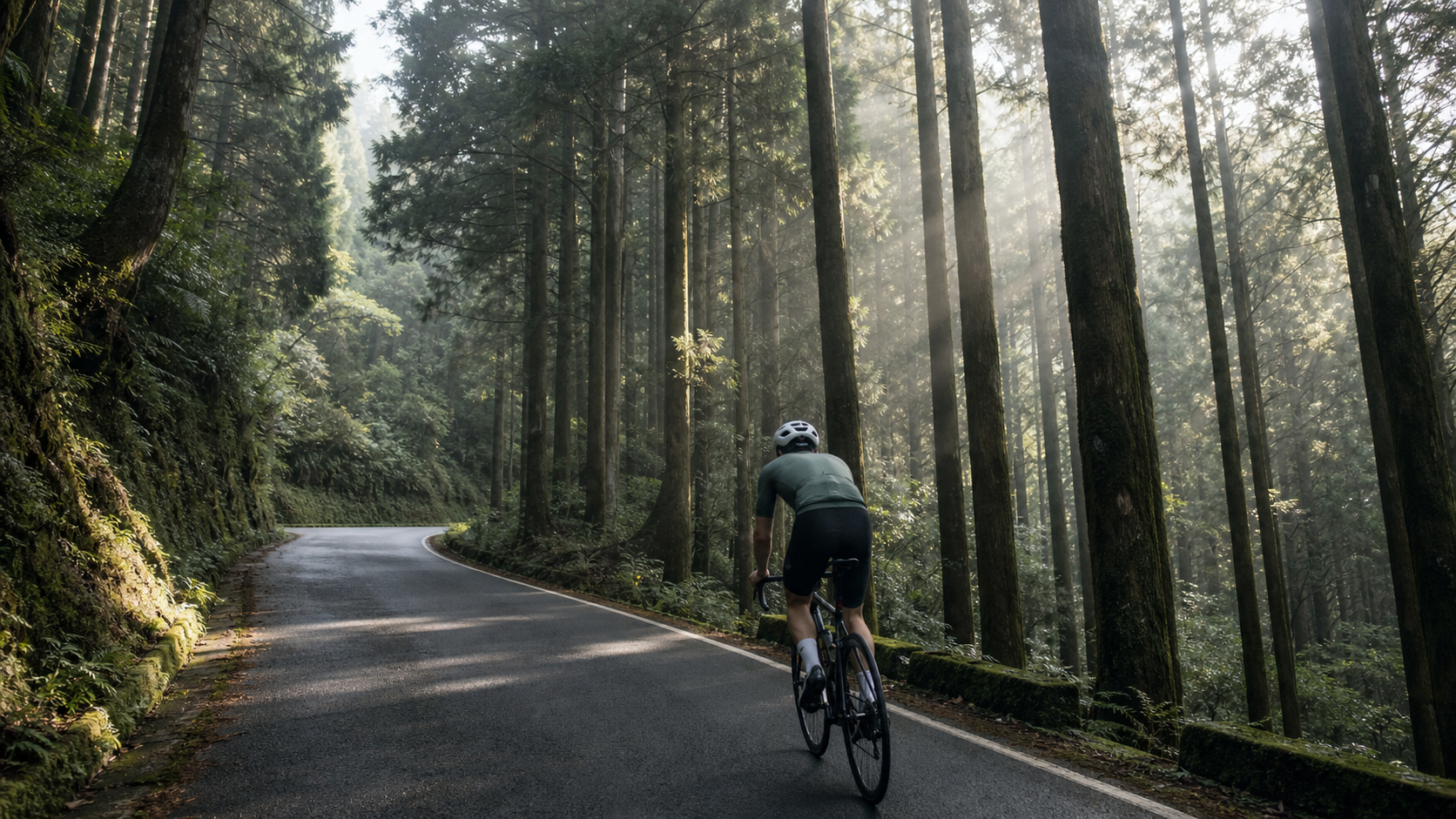
12.4 Kilometers Deep in the Cryptomeria Forest: A Ride and Reflections on Dongyan Mountain
“Some roads aren’t meant to be conquered, but to be conversed with.”
I set out on an ordinary morning in Fuxing District, ready to take on the 12.4-kilometer route up Dongyan Mountain with its 501.4 meters of elevation gain. I’d checked the data before leaving and knew the average gradient was around 4.0%—the numbers didn’t look particularly fierce. But what truly drew me here wasn’t that string of figures; it was the name “Dongyan Mountain” itself, and the forest behind it, said to be planted with cryptomeria trees and offering distinct scenery across all four seasons.
The Geography and Forestry History of Dongyan Mountain
Dongyan Mountain, at an elevation of roughly 1,200 meters, falls within the administrative jurisdiction of Fuxing District, Taoyuan City. It is one of the national forest recreation areas managed by the Forestry Bureau (now the Forestry and Nature Conservation Agency). When it comes to the story of this forest, the most frequently mentioned keyword is “cryptomeria plantation”—during Taiwan’s earlier era of forestry management, this area saw large-scale planting of cryptomeria as part of the commercial timber forest system. The exact start date and scale of the afforestation vary somewhat across different local records and accounts, so I won’t presume to make definitive claims here. I can only conservatively say that the tall, upright cryptomeria groves visible on Dongyan Mountain today are remnants of that era’s forestry operations, which have since been transformed into a forest recreation area serving both ecological conservation and recreational purposes.
This process of “transitioning from production forest to recreation forest” is, in fact, a common thread running through many of Taiwan’s mountain regions. Tree species originally planted for timber output, as forestry policy shifted toward conservation and sustainable management, gradually shed their role in economic production. Instead, with their dense forest cover, clean air quality, and rich ecological resources, they began attracting wave after wave of hikers, birdwatchers, leaf-peeping tourists, and riders like me—cyclists who want to measure this forest with two wheels. What makes the cryptomeria grove special is its orderly, upright form. When sunlight filters through layer upon layer of needles and spills onto the ground, it creates a unique rhythm of light and shadow—a visual signature that is perhaps the most recognizable and memorable image of Dongyan Mountain.
Riding atop this historical backdrop, I pedaled while imagining that, decades ago, this area might have seen the footprints of forestry workers, the tracks of timber hauling, and the sound of work chants. Today, most of those traces have been covered by time and vegetation, leaving only the verdant hillsides, quietly telling the story of the industrial transformation this forest once underwent. This feeling that “riding is also riding through history” added a layer of depth to what was otherwise a purely physical challenge.
That said, my first impression of Dongyan Mountain didn’t actually come from word of mouth within the cycling community, but from a family outing years ago—back then, I simply rode up in a car, walked a short stretch of trail, and my memory of the forest lingered on two vague adjectives: “cool” and “quiet.” Later, when I started riding road bikes, I gradually learned from fellow riders’ posts that the access road leading to the entrance of this forest recreation area was itself a fairly complete climbing practice route. And so Dongyan Mountain transformed in my mind from “a place I went to as a kid” into “a challenge I must get to know again with my own legs.” This process of identity shift, I think, reflects the relationship many riders have with this forest—the same place reveals entirely different faces depending on how we choose to approach it.
Departure: From Gentle to Gradually Tightening Gradients
For the first two kilometers or so, the gradient remained fairly mild. I deliberately kept my pace slow, letting my body ease into the effort. The morning in Fuxing District carried a slight chill, and the mountain breeze met me head-on, mingled with the scent of vegetation—a feeling that’s hard to describe precisely in words, somewhere between “fresh” and “damp earth,” with a hint of evaporating dew.
As the kilometers accumulated, the gradient began to tighten bit by bit. I knew from the route data that the average grade was 4.0%, with the full 501.4 meters of climbing distributed relatively evenly across the 12.4-kilometer distance. This “evenness” creates a unique riding sensation—unlike certain routes that hide sudden, punishing steep sections, Dongyan Mountain feels more like a steady, composed elder, testing your patience and endurance with a consistent and resolute pace, rather than your explosive power.
Around the three- or four-kilometer mark, the vegetation on both sides began to shift noticeably into dense forest scenery. Beneath the canopy’s embrace, the asphalt surface took on a dappled play of light and shadow—sunlight slipped through gaps in the tree crowns, casting trembling patches of light on the road that swayed gently with the breeze. I slowed my breathing rhythm, letting my cadence follow my breath. Gradually, the climb stopped being mere physical labor and became something like a rhythmic ritual.
Just past the halfway point, I began to notice occasional openings in the roadside vegetation, offering brief glimpses of the layered mountain ridges in the distance. Every time I passed such a stretch, I couldn’t help but ease off slightly, letting my peripheral vision linger for a few extra seconds—these stolen moments of scenery during a climb are more precious than deliberately stopping to take photos, because they’re a visual bonus earned while the body is under load. Sweat trickled down my temples and dripped onto the handlebars, mixing with the mountain’s characteristic humid air. That contradictory sensation of sticky yet exhilarating—only those who have truly pedaled this road can understand it.
Landmarks Along the Way and Imagining the Sweetgum Trail
Among the most well-known attractions within the Dongyan Mountain Forest Recreation Area is the Sweetgum Trail. Although my ride this time wasn’t during the peak foliage season, and I didn’t witness the hillsides ablaze with red maples along the way, imagining the scene of this forest turning red and gold each year around November to December still added a sense of anticipation and longing to the ride. As far as I know, the Sweetgum Trail and its surrounding viewing platforms are the primary destinations for many visitors and photography enthusiasts visiting Dongyan Mountain in autumn and winter. The actual opening hours, trail conditions, and the best timing for foliage viewing vary each year depending on climate and park announcements. I don’t have first-hand, up-to-date information on these details, so I’d recommend relying on official announcements and on-site conditions to avoid showing up disappointed due to outdated information.
Aside from the Sweetgum Trail, the park typically includes basic service facilities such as a visitor center, serving as a rest stop, supply point, and information hub for tourists and riders alike. I didn’t specifically verify the current details of each facility, as such information tends to change frequently. But based on the overall atmosphere I felt while riding through, Dongyan Mountain indeed gives the impression of a “well-planned forest recreation area that invites you to slow down”—compared to hardcore challenge routes purely about speed and gradient, it offers a greater sense of composure.
At several points along the way where the view opened up, I could gaze out at the layered ridgelines of surrounding mountains. Mist occasionally drifted and gathered through the valleys. Even without deliberately stopping to admire the view, a mere glance from the corner of the eye was enough to ease the fatigue of climbing considerably. This, I believe, is what makes Dongyan Mountain most enchanting—it doesn’t require you to stop and take photos for social media; the scenery itself is woven into the riding experience, flowing past naturally with each pedal stroke and breath.
It’s also worth mentioning that along the way, I occasionally encountered other hikers, or fellow cyclists huffing and puffing their way up. When we passed each other, we’d usually exchange a nod, or even a brief shout of encouragement. These fleeting moments of camaraderie in the mountains, though short-lived, never failed to inject a bit of extra motivation into tired legs. Compared to the occasional competitive undertone among riders on flat roads, on a forest route like Dongyan Mountain, everyone seems more willing to shed their competitive mindset and simply enjoy the shared experience of being in the mountains together. This subtle difference in atmosphere is one of the reasons I particularly treasure routes like this.
Sensory Memories in the Forest: Scents, Sounds, and Light
If I had to describe the most profound sensory memories from riding Dongyan Mountain, I’d say it’s the dual embrace of “scent” and “sound.” The plant aroma emanating from the cryptomeria and mixed coniferous-broadleaf forest carries a subtle woody note with a hint of cool herbal fragrance. This is what academics often refer to as “phytoncides,” said to help relax the body and stabilize the mind. While I don’t have scientific instruments to verify the specific effects of this claim, the sensation of my chest gradually loosening and my breathing deepening while riding through it is undeniably different from riding on urban asphalt.
Bird calls were another background sound that ran through the entire ride. Different species’ songs rose and fell—some crisp and short, others long and melodious. Occasionally, I could hear the rustling of leaves stirred by the wind, interweaving with my own heavy breathing and the subtle mechanical whir of the chain, forming a curious natural symphony. This acoustic environment stands in stark contrast to the engine noise and horns of traffic on flat roads, and it’s one of the reasons many riders are particularly drawn to mountain forest routes—cycling isn’t just exercise; it’s an immersive sensory experience.
The play of light and shadow shifted constantly with elevation and forest density. On more open stretches, sunlight poured down directly, bringing warmth or even a slight heat; the moment I entered dense shade, it turned instantly cool, and I could even feel the slight chill of sweat being carried away by the mountain breeze on my skin. This alternating sensation of hot and cold, combined with the flowing brightness and darkness of the forest light, constitutes the part of the Dongyan Mountain riding experience that’s hardest to capture fully in photographs, yet easiest to retain in memory.
Beyond smell and hearing, the tactile details are equally worth recording. The road vibrations transmitted through my palms on the handlebars shifted subtly with changes in gradient and road surface—sometimes fine and buzzing, sometimes dull and heavy. The solid transfer of power between my shoes and the pedals also changed as muscles gradually fatigued, evolving from light, nimble strokes at the start to a more deliberate, conscious effort. These subtle shifts in bodily sensation are, in fact, the most authentic part of a long climb—far closer to the lived experience than any data record could ever be.
The Body-Mind Dialogue During the Climb
Around the seven- or eight-kilometer mark, physical fatigue began to surface noticeably. The soreness building in my thigh muscles and the deepening, quickening of my breath were reminders that this seemingly gentle route’s cumulative elevation gain was no joke. At this stage, I found myself engaging in an internal dialogue with my body—not forcing myself to push through, but trying to listen to the signals it was sending, adjusting my cadence and posture as needed to distribute fatigue more evenly, rather than exhausting one particular muscle group.
Climbing, in a way, is very much a practice of being with oneself. There aren’t many external stimuli or distractions—just the steady cadence, the rise and fall of breath, and the road endlessly stretching ahead. Within this simple, repetitive motion, thoughts paradoxically become clearer. I found myself thinking about some unresolved worries from recent life, and within the rhythm of pedaling, those tangled thoughts seemed to slowly sort themselves out along with my breathing frequency. This is probably what many seasoned riders mean when they say “cycling is the best therapy”—not through words, but through physical exertion and the stillness of the environment, allowing the mind to settle naturally.
As I neared the vicinity of the Dongyan Mountain Forest Recreation Area, the gradient seemed to tighten slightly again. I deliberately slowed my breathing, telling myself not to rush just because the end was in sight. This self-reminder—“the finish is near, so maintain patience even more”—was perhaps the most practical lesson this ride taught me: often, the real challenge isn’t in the hardest middle section, but in that final stretch where you’re close to the finish yet still need to maintain focus and discipline.
That self-restraint before the final push also brought to mind past riding failures—more than once, I’d rushed near the end, only to cramp up or blow through my energy reserves, ending up shamefully walking my bike for the last short stretch. This time, deliberately reminding myself to hold a steady pace was, in a sense, a belated correction for those impatient versions of myself. In cycling, the accumulation of experience often isn’t reflected in speed, but in this mastery of one’s own bodily rhythm—an increasing understanding of when to hold back and when to let go.
Arrival and Looking Back: The Meaning of the Ride
When I reached the vicinity of the Dongyan Mountain Forest Recreation Area, I stopped the bike and let my heart rate and breathing gradually settle. Looking back at the mountain road I’d just climbed, winding and disappearing into layers of tree shadows, it was hard to believe I’d just pedaled my way up from the depths of that greenery, stroke by stroke. That sense of accomplishment didn’t come from breaking records or beating other riders, but from a kind of unspoken understanding and reconciliation reached between my body and this forest.
I often feel that the most precious part of cycling isn’t just the physical training, but the process of reconnecting with the environment and with one’s own rhythm. On a forest route like Dongyan Mountain, there’s no urban noise or rush—only the stillness of the cryptomeria grove, the company of birdsong, and the rhythm woven from my own cadence and heartbeat. This experience runs far deeper and lasts far longer than simply completing a route’s mileage and elevation numbers.
It’s because of this realization that I’ve come to understand why so many riders return to Dongyan Mountain again and again—perhaps not to beat their personal bests, but simply to re-experience that process of conversing with themselves in the forest, to reclaim the inner peace that gets buried under the minutiae of daily life.
A Seasonal Imagination: Waiting for the Day the Maples Turn Red
Although this visit wasn’t during the foliage season, I spent the entire ride imagining the scene along the Sweetgum Trail as it turns red and gold each year around November to December. They say that during that period, the entire sweetgum grove gradually takes on rich layers of orange-red and golden yellow, creating a striking contrast with the surrounding evergreen cryptomeria forest, drawing photography enthusiasts from far and wide to capture this fleeting beauty. I can’t give a precise best-viewing time here, because each year’s climate conditions and day-night temperature differences affect the pace of leaf color change. For this, I’d recommend keeping an eye on real-time foliage updates from the Forestry and Nature Conservation Agency or relevant local authorities—that would be the more reliable approach.
Still, just imagining that scene—riding along this same cryptomeria-lined path I’d just climbed, but with both sides now dressed in autumn red—the contrast and layering of colors would surely be an entirely different visual spectacle. This also made me quietly resolve that my next visit to Dongyan Mountain will be timed for the Sweetgum Trail’s most beautiful season, to witness with my own eyes the most resplendent moment in this forest’s cycle of seasons.
Beyond autumn foliage, Dongyan Mountain also has its own spring and summer character—after rain, the cryptomeria grove appears especially vivid and lush, and the occasional thin mist that drifts through the mountains lends the entire forest a dreamy, hazy atmosphere. This quality of “something to see in every season” is perhaps the core charm that keeps drawing riders and visitors back to Dongyan Mountain time and again.
Suggested Side Trips and Surrounding Scenery
If time and energy permit, Dongyan Mountain is well suited to being arranged as a half-day or full-day itinerary combining forest recreation with a cycling challenge. The trail system and viewing platforms around the park are ideal for a bit of walking exploration after completing the riding challenge—allowing the tight leg muscles to recover through gentle strolling, while also letting you experience the finer details of this forest more deeply, rather than just the scenery rushing past during the ride.
Fuxing District also boasts several other mountain attractions and routes worth visiting, including stretches known for mid-to-long-distance climbs that riders often string together into full-day cycling itineraries. However, specific shops, business hours, or facility conditions are details that change quickly, so I won’t presume to make definitive statements here. I’d recommend researching the latest information from multiple sources before your trip, or directly consulting the local visitor center, deferring to on-site announcements.
Words for Future Challengers
If you’re hesitating about whether to take on Dongyan Mountain, let me tell you this: it’s not a route that will make you question your life choices, but it absolutely deserves to be taken seriously. 501.4 meters of climbing, 12.4 kilometers of distance, an average gradient of 4.0%—combined, these numbers are just enough to make you break an honest sweat, yet not enough to make you want to give up halfway.
More importantly, what this route gives you goes far beyond physical training results. The stillness of the cryptomeria grove, the company of birdsong, the shifting play of light and shadow, and the inner dialogue that unfolds with the rhythm of your pedaling—these are experiences that mileage and elevation numbers can’t quantify, yet they linger genuinely in the depths of memory.
I think the most moving thing about Dongyan Mountain is the way it invites every rider, in a gentle yet firm manner, to slow down and truly feel—feel the forest’s breath, feel your own heartbeat, feel those inner voices that everyday life usually drowns out but that have always been there. If you, too, long for a ride that’s not just about physical challenge but about reconnecting with yourself, I sincerely recommend you pick a clear day, come to Dongyan Mountain, and experience for yourself the unique scenery and emotions hidden within this 12.4-kilometer mountain road.
On the day I left Dongyan Mountain, I turned back for one last look at the foot of the mountain. In the afternoon light, the cryptomeria grove appeared especially serene and steady, as if entirely unaffected by the hurried pace of the world below, still growing quietly at its own rhythm, quietly waiting for the next visitor to arrive. I know I’ll be back—perhaps for that legendary blaze of autumn red, or perhaps simply to surrender myself once more to this familiar yet ever-fresh climbing route, to feel again the unique forest breath and cadence that belong to Dongyan Mountain alone. And this, perhaps, is what makes cycling so captivating and so addictive—the same road, ridden each time, leaves behind entirely different scenery and insights depending on the state of your mind at that moment.
Related Reading
- Dongyan Mountain Practical Guide: 12.4 km, 501 m of Climbing, an Intermediate Training Ground at 4.0% Average Gradient
- Sacred Trees and Celestial Lake in the Clouds: A Cycling Pilgrimage Up Daxue Mountain, Riding Altitude into a Spiritual Practice
- Xitou to Shanlinxi: A Cloudy Journey Through Cryptomeria, Monster Village, and Songlongyan Waterfall
- Sanxia North 113 Dongyan Bridge Practical Guide: Don’t Be Fooled by the “6.7% Average Gradient”—This Road Hides a 12% Grade Killer Move
台北闊瀨陡坡 騎旅 / 日本單車雜誌編輯車友臨時加入!/ 髮香才是最強的 / feat. 北迴歸線小隊 / 公路車 CT Yeh
6 個月前
大武山後門26%歡樂陡坡!JJSC南台灣單車行Day2 / 被颱風追著跑 / 公路車 / CT Yeh
2 年前
一定要騎一次!阿里山最深處:里佳部落!單車旅行 | 2800m爬升 | 深度部落體驗:嗨翻晚會、螢火蟲、銀河 | feat. JJSC & 廢物伙伴 | 公路車 CT Yeh
10 個月前
阿里山塔塔加 兩倍特濃版!全新隧道開通! 進喔!公路車 | CT Yeh
3 年前
新竹羅平 x 天湖部落 大禹嶺級變態陡坡! 4K超高畫質 空拍 | 公路車
5 年前
觀霧 變好騎了! | 北高車友爆笑大會師 | 公路車 | 單車旅遊 Taiwan Cycling Route GuanWu
6 年前
太平山單車員工旅遊 | 這樣玩CP值最高!| 公路車
5 年前
爬坡ITT實境)台中 魔王 松鼠坡 首航 6:12 大肚山 大三元 科福路
8 年前