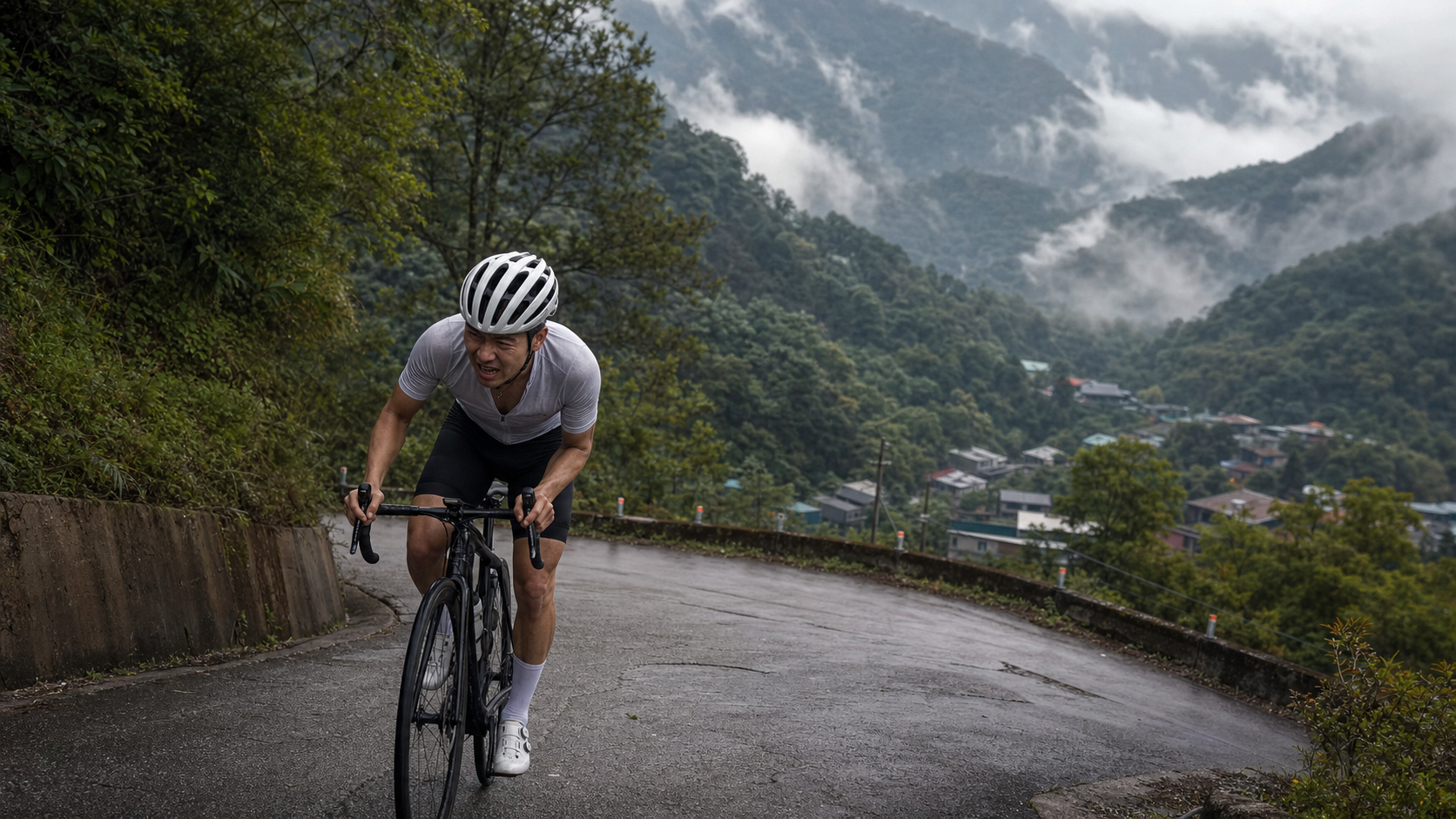
On the 10.2% gradient of Xuelu Nao, I learned to have a dialogue with my own limits
This is not a guide on how to ride faster, but a confession about “why we ride.” With nearly 10 kilometers and over 1,000 meters of climbing, Xuelu Nao forced me to rediscover the boundaries of my body and willpower.
1. The Geography and Origin of the Name Xuelu Nao: Tribal Memories Hidden in the Mountains of Fuxing District
Xuelu Nao is located in the mountainous area of Fuxing District, Taoyuan City. It is a winding industrial road that connects tribal settlements deep in the mountains of Fuxing District. The name “Xuelu Nao” carries a peculiar poetic quality when spoken aloud—first-time listeners often pause, unable to resist imagining whether this is a place perpetually shrouded in mist, as if enchanted by nature. Regarding the origin of this place name, local lore suggests it may be a transliteration from the Atayal language, but the exact meaning is debated. Whether it refers to the terrain, the climate, or some aspect of tribal life, there is no unified or definitive version. I dare not assert any single interpretation here, for the evolution of language and place names is often worn down by time and distorted through oral transmission. Rather than imposing a “correct answer,” it is better to let this uncertainty itself become part of the mystery of these mountains.
The mountainous area of Fuxing District has long been an important homeland for Atayal tribal communities. Scattered among the layered ridges are numerous small settlements built against the slopes, where residents have lived for generations on this steep terrain, cultivating farmland and growing high-altitude vegetables and tea. In a sense, the Xuelu Nao industrial road carries this historical context—it was likely not originally built for cycling, but rather as a lifeline connecting tribes to the outside world, facilitating travel and the transport of agricultural produce. When we road cyclists arrive with our gear and determination to take on this astonishingly steep mountain road, we are, in a way, stepping onto land steeped in deep local living memory. This awareness gave me a greater sense of respect for the mountains and the land during my ride, rather than treating it merely as a physical test.
The terrain of Fuxing District is itself renowned for its steepness—the ridges rise and fall dramatically, and roads wind upward along the contours of the mountains. This explains why Xuelu Nao can accumulate 1,020 meters of elevation gain over just 9.9 kilometers—such terrain conditions are almost a limit-challenge course crafted by nature itself. For residents who have lived in these mountains for generations, such steep terrain may simply be part of daily life, but for cyclists coming to take on the challenge, it is a hard-fought battle that demands thorough preparation and full commitment.
2. First-Person Riding Narrative: From Overconfidence to Questioning Life, Then Gritting Through
That morning, I set up my bike, took one last sip of water, and looked at the entrance of that seemingly calm but secretly treacherous industrial road, still carrying a hint of the complacent mindset of “it’s just a climb.” After all, I had ridden Fengguizui countless times and had finished the western ascent of Wuling, believing I had a solid grasp of climbing. However, Xuelu Nao’s first shock came earlier than I expected—less than two kilometers in, I could already feel my thighs burning, my breathing turning rapid, and the gradient reading on my navigation showing no sign of letting up.
Around the third or fourth kilometer, I began to wonder if I had chosen the wrong gear ratio. I had deliberately switched to a lighter cassette before departure, yet my legs still felt as if they were filled with lead. At that moment, countless thoughts of “maybe I should just get off and walk” flashed through my mind. Sweat kept dripping from inside my helmet, blurring my vision and my confidence alike. I remember stopping at the edge of a switchback, hands braced on the handlebars, gasping for air. Looking up at the road still steeply ascending ahead, a profound sense of smallness welled up inside me—so this was all my much-vaunted climbing ability amounted to in the face of such a gradient.
But it was precisely at that moment of near surrender that some indescribable stubbornness was ignited. I told myself that since I had already made it this far, walking back down wouldn’t be any easier than continuing to climb. I might as well use the slowest, most energy-efficient cadence and chew through it segment by segment. So for the rest of the ride, I stopped looking at the remaining distance on my navigation and instead narrowed my focus to the ten or twenty meters directly ahead, moving forward one utility pole at a time. On the middle section where the gradient visibly steepened again, I even doubted whether I could maintain balance while riding—my speed was so slow I nearly toppled over. But strangely, at the edge of my limits, my body found a kind of eerie calm—when you no longer have spare energy for panic or doubt, all that remains is the simplest act of “push down, push down again.”
On the final kilometer or two, although I rationally knew the end was near, the fatigue in my body showed no sign of easing. Instead, after prolonged high-intensity output, a state of near numbness began to set in. I remember the moment I reached the finish—I nearly collapsed onto the handlebars, unable to dismount for a long time. My throat was parched, my legs trembling, but what surged up inside me was an indescribable sense of exhilaration and pride. It wasn’t the satisfaction of easily completing something; it was the profound sense of accomplishment that comes only after being truly pushed to your limits and enduring through sheer willpower.
3. Landmarks and Scenery Along the Way: Mountain Impressions on Steep Terrain
The scenery along Xuelu Nao is less about “tourist” attractions and more about a朴实 and primal impression of the mountains. The entire route winds through dense forest, with lush vegetation on both sides at times, and at others, glimpses of layered mountain ridgelines in the distance. As elevation gradually rises, so does the field of view. Due to the steep gradient, most riders don’t have much spare capacity to carefully admire the scenery while riding—this is the biggest difference between Xuelu Nao and other scenic routes. It is not a route for leisurely sightseeing; it is a path of cultivation that demands your full attention on the pedals and your breath.
However, if you choose to stop briefly along the way to catch your breath and replenish fluids, looking up and around, you can still feel the unique tranquility and grandeur of the Fuxing District mountains. Layered ridges appear and disappear amid swirling mist, and occasionally the calls of birds and insects drift through the forest, forming a stark contrast to the clamor of the city. As for whether there are clearly identifiable tribal attractions or specific landmarks along the route, since actual road conditions and surrounding developments may change over time, riders are advised to rely on what they see on-site and the latest official road information, rather than planning based on impressions or uncertain online information. Mountain roads are naturally more susceptible to changes from weather and maintenance work.
It is worth noting that precisely because Xuelu Nao has few bustling commercial facilities along the way, it retains a relatively原始 and pure mountain atmosphere. When you are utterly exhausted and drenched in sweat, and you happen to catch a glimpse of a mist-shrouded valley by the roadside, or distant layered ridgelines glowing golden in the sunlight, the stark contrast between that visual impact and the physical ordeal tends to leave an especially deep impression in your memory—a kind of beauty that only those who have personally experienced extreme athletic exertion can truly appreciate.
4. Sensory Memory: Rediscovering Your Body at the Limit
Taking on a climb as intense as Xuelu Nao makes you rediscover your body in ways you never have before. First is breathing—normally, we barely notice our breathing rhythm, but under sustained high-intensity output on gradients above 10%, breathing becomes a near-primal instinct, rapid and ragged, as if your lungs might burst through your ribcage at any moment. Next is the heartbeat—that intense sensation of nearly feeling your blood pulsing at your temples is a bodily signal rarely experienced in everyday life.
The burning sensation in the thigh and calf muscles is another sensory memory that cannot be ignored. When the gradient stays above 10% for over half an hour, the lactic acid buildup in the muscles brings a dull, searing pain, and every pedal stroke feels like haggling with your own body. The salty taste of sweat runs down your cheeks and into the corners of your mouth; the scalp under your helmet is soaked, and the sticky sensation reminds you that your body is using every ounce of strength to meet the challenge at hand. And when you finally crest the steepest section and the gradient eases for those few seconds, the feeling of relief can almost be described as “bliss”—it’s remarkable how just a percentage point or two less gradient can make such an enormous difference to the body.
There is also a very distinctive sensory experience: visual “tunneling.” When the body is in a state of maximal output, your field of vision unconsciously narrows and focuses, leaving only the few meters of road directly ahead, with everything around blurring into the periphery. This is a physiological response in which the body automatically reallocates resources, concentrating all available attention on the most critical task. Such sensory experiences are something we who sit in offices and live routine lives rarely encounter, and precisely because of that, they feel especially precious and profound.
In addition, a change in hearing also left a deep impression on me. As the sound of breathing and heartbeat grew louder, external sounds seemed to be gradually shut out, replaced by my own heavy panting, the rhythmic friction of gears and chain, and the subtle vibrations of tires rolling over asphalt. These sounds, which would never normally be noticed, became extraordinarily clear in a state of exhaustion, as if the body had redistributed all sensory resources to the signals most relevant to survival and continuing forward. The sensation of my hands gripping the handlebars also changed over time—initially a steady application of force, but later, after prolonged tension, gradually giving way to numbness and soreness, which in turn affected the finesse of bike handling. This reminded me that the toll of long, high-intensity climbing is not limited to the legs and cardiovascular system, but engages every muscle and nerve throughout the entire body.
5. The Meaning of Riding and Reflective Insights: The Significance of Pushing Limits for Psychological Growth
After finishing Xuelu Nao, I spent a long time mulling over what this ride meant to me. On the surface, it was simply completing a steep industrial road, but in reality, it made me rethink what “limits” truly mean to me. In daily life, we rarely have the opportunity to truly push ourselves to the physical and mental edge. Most of the time, we live in a relatively comfortable, predictable rhythm. A route like Xuelu Nao forces you to confront the true boundaries of your physical fitness and willpower head-on. That raw, unvarnished self-dialogue is an experience that no comfortable daily routine can provide.
I particularly remember that moment in the middle section when I nearly wanted to give up. That psychological struggle bore a striking resemblance to many other difficult moments in life—hitting a plateau at work, setbacks in relationships, the fatigue of pursuing a long-term goal. At their core, they are all like that version of myself on the steep middle section, nearly ready to abandon the effort, torn between “continuing” and “giving up.” What Xuelu Nao taught me is that there is no shortcut around this struggle. The only thing you can do is break the enormous challenge down into tiny, immediately executable next steps, and then focus on doing that one step in front of you well.
The meaning of challenging a limit route perhaps lies not in proving how strong you are, but in honestly recognizing where your limits are and learning how to coexist with them. Xuelu Nao did not go easy on me because of my complacency. It showed me, in the most direct and honest way, the true face of my physical and psychological resilience. This understanding, in turn, gave me a more grounded and humble view of myself after the ride—I know where my limits are, and I know that through sustained training and preparation, those limits can be gradually expanded. This sense of groundedness carries more weight than any speed record or social media check-in photo.
I also began to understand why so many cyclists are willing to return again and again to such high-intensity climbs to challenge themselves. On the surface, it seems like a form of self-inflicted suffering, but in reality, the process of repeatedly probing the edge of your limits and gradually widening your capacity holds an indescribable appeal. Every challenge is a comparison with the self of the past—perhaps this time’s finish time wasn’t faster than last time, perhaps you still had to stop and catch your breath midway, but as long as you are willing to set foot on that road again, the courage to keep facing challenges is itself a form of growth. A route like Xuelu Nao is, in a sense, an honest mirror, reflecting who you truly are at each stage, rather than the polished version presented on social media. This honesty may well be the most precious—and most easily overlooked—value of this sport.
6. Seasonal Scenery: The Many Faces of Xuelu Nao Across the Seasons
The mountainous area of Fuxing District, where Xuelu Nao is located, presents strikingly different appearances as the seasons change. In spring, a thin mist often lingers among the trees, and the air carries the moist scent of vegetation. Riding through the mist-wreathed slopes feels like being inside a traditional ink-wash painting—that hazy, tranquil atmosphere forms an interesting contrast with the tense body and mind engaged in tackling the steep gradient.
Summer brings a different face to Xuelu Nao—the dense mountain vegetation appears especially lush and verdant under the blazing sun, but at the same time, the summer heat and humidity add further physical demands to an already grueling climb. If you choose to set off in the early morning hours, you can also capture the mountain’s unique dawn scenery, with sunlight filtering through the trees and casting dappled patterns on the road—a visual feast reserved exclusively for early-rising challengers.
As autumn and winter approach, temperatures in the Fuxing District mountains gradually cool, and the air becomes crisper. On clear days, the views from high vantage points are often exceptionally clear, with layered mountain contours sharply visible, and in the distance, one might even glimpse the ridgelines of more remote ranges. In winter, sea-of-clouds phenomena occasionally appear in the mountains. If you happen to encounter one, the sight of clouds churning below your feet amid the arduous climb will be a cycling memory you’ll never forget. Of course, actual seasonal scenery varies depending on the year’s climate conditions and the day’s weather. Riders planning to visit are advised to keep a close eye on real-time weather and mountain condition updates before departure, so they can better plan their own season-limited riding experience.
7. Suggested Side Trips: Plan Your Itinerary According to Your Capacity
After tackling a high-intensity route like Xuelu Nao, the body is usually quite exhausted. If you wish to arrange side trips, it is recommended to do so in a relaxed manner that doesn’t expend extra energy, rather than pushing yourself into other high-intensity activities. The mountainous areas around Fuxing District actually offer quite a few natural and cultural attractions worth visiting along the way. Whether appreciating the local mountain scenery or experiencing the character of tribal culture, these can add richer layers to your challenge journey. As for specific shops, attraction names, and business status, these change over time, so it is recommended to base your itinerary planning on the latest information you find at the time, rather than relying on potentially outdated online information.
If your energy and schedule allow, finding a spot overlooking the mountain scenery to pause and unwind after finishing Xuelu Nao would be a wonderfully restorative arrangement—after all, you’ve just conquered a boss-level climb with everything you had. Giving yourself time to savor that post-finish sense of achievement and tranquility is far more meaningful than rushing to the next stop. It is also advisable to pay attention to your body’s condition after the challenge, replenishing fluids and nutrition appropriately to allow your body to gradually recover from the high-intensity exertion, rather than immediately diving into another physical activity.
8. Words from the Heart for Future Challengers: Know Your Limits, But Don’t Give Up on Your Dreams
If you’re hesitating about whether to take on Xuelu Nao, let me tell you this: this is absolutely not a route to be taken lightly. 9.9 kilometers of distance, 1,020 meters of elevation gain, an average gradient of 10.2%—behind these numbers lies genuine physical and mental ordeal. It will not go easy on you just because you have a heart that yearns to challenge yourself. Before you actually set foot on this road, please honestly assess your physical condition and climbing experience, and prepare through proper training, rather than charging in on a whim.
But at the same time, I also want to tell you: if you have prepared properly—solid training accumulated, appropriate equipment, adequate nutrition planning—then Xuelu Nao is a route well worth challenging. What it offers is not merely the sense of accomplishment after finishing, but also an opportunity for deep dialogue with yourself, a precious experience of rediscovering the limits of your body and mind. That process of nearly wanting to give up on the most painful sections yet gritting through anyway will leave a mark in your heart far more enduring than the ride time itself.
Finally, I want to say to every future challenger: knowing your limits is always the most important principle of this sport. Don’t feel that you must push through just because others have finished, and don’t deny your abilities because you didn’t succeed once. Xuelu Nao will always be there, waiting for the day you are ready. When you truly set foot on this road, whether you finish with ease or need to stop and walk your bike midway, as long as you honestly confront your body and your limits, the courage to take on the challenge itself is already something to be proud of. May every rider who comes with respect and thorough preparation find their own profound insight on the slopes of Xuelu Nao.
Related Reading
- The Complete Guide to Xuelu Nao: 9.9 km, 1,020 m of Climbing, a Boss-Level Industrial Road with an Average 10.2% Gradient
- That Wall Called Zihe Road: One Man’s Dialogue with Limits over 2.87 Kilometers
- Alone, One Forest Road, 24.94 Kilometers: The Solitude and Grandeur of Xuejian Sima Lin Road
- Sweat and the Hustle of Everyday Life: A 7.6-Kilometer Mountain Ride to Wulai Baoqing Temple
台北闊瀨陡坡 騎旅 / 日本單車雜誌編輯車友臨時加入!/ 髮香才是最強的 / feat. 北迴歸線小隊 / 公路車 CT Yeh
6 個月前
新竹白蘭部落! 爬陡坡還能講笑話...? 廢物伙伴の約騎 | 公路車 | CT Yeh
4 年前
大武山20%魔王陡坡【JJSC南台灣遊騎Day2】!屁股真的要裂開了...凡士林抹滿也沒用?神秘金教堂還有超便宜夜市
3 個月前
一定要騎一次!阿里山最深處:里佳部落!單車旅行 | 2800m爬升 | 深度部落體驗:嗨翻晚會、螢火蟲、銀河 | feat. JJSC & 廢物伙伴 | 公路車 CT Yeh
10 個月前
大武山後門26%歡樂陡坡!JJSC南台灣單車行Day2 / 被颱風追著跑 / 公路車 / CT Yeh
2 年前
新竹羅平 x 天湖部落 大禹嶺級變態陡坡! 4K超高畫質 空拍 | 公路車
5 年前
萬年峽谷! 30% 超激陡坡 里佳部落DAY2 還是很硬! | 公路車 | CT Yeh
3 年前
爬坡ITT實境)台中 魔王 松鼠坡 首航 6:12 大肚山 大三元 科福路
8 年前