Millennia and an Instant in the Gorge: Riding from Tianxiang to Xibao in Taroko, Reading the Weight of a Road
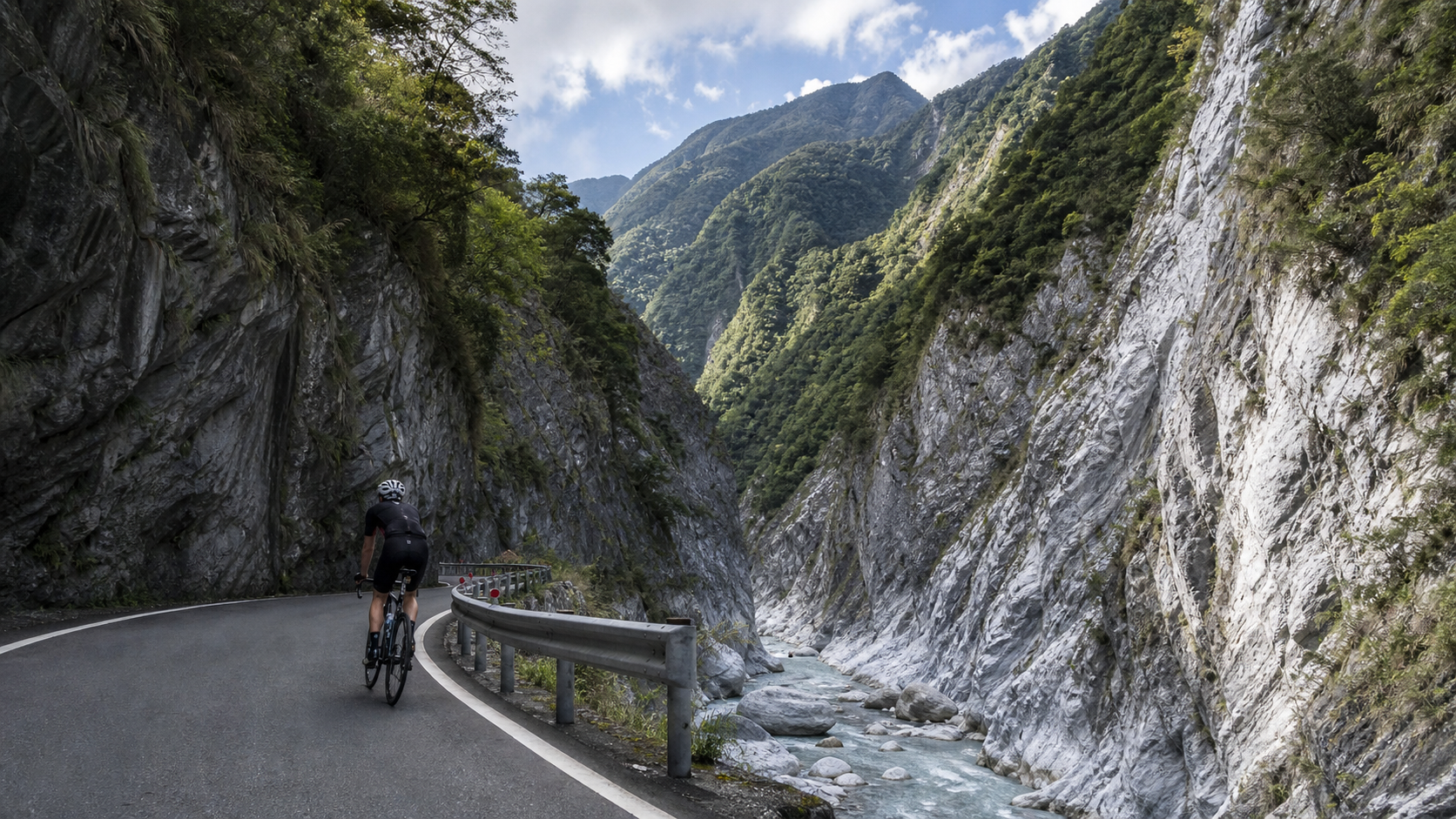
A Road of Only 7.86 Kilometers, Yet Condensing a Geological History of Tens of Millions of Years
Some routes win by length, some intimidate with gradient, but the 7.86 kilometers from Tianxiang to Xibao in Taroko relies on something else—it lets you, within just half an hour of pedaling, traverse both the hundred-million-year geological rings of the marble gorge and the construction history of one of Taiwan’s most iconic highways.
From the moment you set off from Tianxiang, you are already standing at a crossroads of geology and culture. Tianxiang, at an elevation of about 480 meters, is one of the most important rest stops along the Central Cross-Island Highway (Provincial Highway 8) and lies at the heart of the traditional territory of the Truku people. Riding further up toward Xibao, the direction points to the more distant Hehuan Mountain and Dayuling—the skyline that Taiwan’s highways can reach. But this stretch from Tianxiang to Xibao is not the opening move of some grand narrative; it is more like a quiet yet solid transitional scene: the gorge terrain slowly closes in behind you, while the alpine zone gradually unfolds before you.
As a cycling route, its numbers are actually quite honest—7,858.1 meters, 434.2 meters of climbing, 5.5% average gradient, and Strava classifies it as Category 3. These numbers are cold and impersonal, but anyone who has ridden it knows that numbers are never the true weight of this road. The real weight is the feeling, when you look up at the rock walls on both sides, of being compressed by a sense of geological time spanning hundreds of millions of years into just a few seconds of visual impact.
The geological story of Taroko Gorge begins with the Liwu River. This river, originating in the Central Mountain Range, has cut through the marble layers with astonishing patience, carving out one of the most spectacular gorge terrains in all of East Asia. Marble is a metamorphic rock—originally limestone deposited on the seafloor—that, after millions of years of crustal compression and metamorphism, formed the hard yet finely textured rock layers we see today. This stretch from Tianxiang to Xibao happens to run along the terrain boundary where the marble gorge gradually transitions into the alpine forest zone—you will notice the color and texture of the rock walls subtly changing as you ride, and that is not an optical illusion; it is real evidence that you are personally passing through different geological eras and altitudinal ecological zones.
This experience of “feeling geological time with your body” is perhaps the most captivating—and most easily overlooked—value of the Tianxiang to Xibao route. Most cyclists pursue speed and heart-rate numbers, but this road reminds you that some scenery is worth slowing down for, letting your eyes follow the textures of the rock walls and your breath keep pace with the changing altitude.
The Construction History of the Central Cross-Island Highway: A Road Carved into the Gorge with Blood and Sweat
To understand the significance of the Tianxiang to Xibao stretch, one cannot ignore the construction history of the Central Cross-Island Highway. Provincial Highway 8, the Central Cross-Island Highway as we know it, was one of the most arduous road engineering projects in post-war Taiwan, crossing the Central Mountain Range to connect the east and west coasts. The road was carved upward along the Liwu River gorge, and construction through the geologically unstable, steep-walled Taroko Gorge section was, as one can imagine, fraught with difficulty and danger. Many veterans and laborers who participated in the road construction worked tirelessly under extremely harsh conditions to chisel out the road that we can now ride, drive, and hike through.
Riding along this stretch, you will pass through several tunnels—these are not just engineering necessities but also tangible testimony to the wisdom and perseverance of the road builders of that era. In a time without modern heavy machinery, carving passable tunnels through hard marble layers was an immensely formidable task. Every time you ride into a tunnel and feel the rock walls pressing close on both sides, take a moment to imagine how that tunnel was chiseled out inch by inch back then.
This is also why this article specifically reminds readers: be sure to equip tail lights and reflective gear for tunnel sections. Not just for safety reasons, but to a certain extent, it is also a form of respect for this hard-won road and for the efforts of those who built it—the fact that we can easily ride through the gorge today is built upon the arduous contributions of those who came before us.
After the Central Cross-Island Highway opened, Tianxiang quickly became one of the most important strongholds along the route. It is not just a geographic waypoint on the east-west crossing highway, but also carries multiple roles in tourism, recreation, and cultural exchange. And before and after Tianxiang, this gorge territory has an even earlier, deeper human foundation—the Truku people.
The Traditional Territory of the Truku People: The Gorge Is Not Just Scenery, It Is Home
Before the Central Cross-Island Highway was carved out, the magnificent mountains and forests of Taroko Gorge had long been the traditional territory where the Truku people lived for generations. The Truku are one of Taiwan’s indigenous peoples, and the name of the tribe itself is deeply connected to this gorge terrain. They lived alongside the mountains and rivers, developing a unique way of life and cultural wisdom amid the steep terrain, with a profound reverence for and dependence on the mountains and streams.
The Tianxiang area, before becoming a highway rest stop, likewise carried the historical memory of the Truku people and was also an important stronghold during the Japanese colonial period. This land has experienced the traditional life of indigenous peoples, the traces of Japanese colonial rule, and the modernization impact brought by the opening of the Central Cross-Island Highway after the war—layers of historical narratives all stacked upon this road that seems to be merely “a stretch of climbing.”
When we, as cycling enthusiasts, enjoy the visual splendor and riding pleasure the gorge offers, perhaps we should also take some time to understand the deeper cultural context of this land. The relationship between the Truku people and this gorge is not a tourist-oriented symbol but a real, ongoing foundation of life and culture. Riding through with this understanding and respect will make the journey more meaningful—you are not just “consuming” a beautiful landscape, but witnessing a human story that is still being written.
Today, Taroko National Park Headquarters and related cultural institutions are also committed to preserving and promoting the cultural assets of the Truku people, allowing more travelers visiting this gorge to learn about this history through trail interpretation, cultural exhibitions, and more. If time permits, riders are advised to take note of any nearby cultural interpretation facilities when pausing at Tianxiang, making this ride not just a physical challenge but also an opportunity to get to know the land.
First-Person Narrative: The Visual Impact of Shuttling Through the Gorge and Tunnels
Let me take you through this road again in the first person.
Setting off from Tianxiang in the early morning, the air still carries the unique moisture and coolness of the mountain region. In those first few seconds after mounting the bike and starting to pedal, the body hasn’t fully warmed up, but the eyes are already stunned—the marble cliffs on both sides rise almost vertically from the floor of the Liwu River valley, and that near-oppressive verticality is an experience flatland riding can never give you. The angle of sunlight in the gorge is always subtle; sometimes it is completely blocked by the rock walls, and other times it suddenly spills down from a corner, dyeing the entire rock face in a warm golden hue.
As the cadence stabilizes, the body begins to adapt to this sustained 5.5% gradient. This is not the kind of steep climb that makes you struggle in agony, but rather a dense, continuous ascent that requires patience to tackle—each pedal stroke reminds you that there is more elevation ahead to conquer, yet it never pushes you to despair. This “just right” intensity actually leaves me more room to appreciate the surrounding scenery rather than staring fixedly at the numbers on the bike computer.
At a certain bend, a tunnel entrance suddenly appears ahead, the dark opening forming a stark contrast with the bright gorge light outside. I turn on my headlight in advance and confirm the tail light is flashing—the moment I ride into the tunnel, the temperature seems to drop a few degrees, and the sound changes too; my own breathing and cadence are amplified in the confined space. Occasional water stains seeping from the tunnel walls remind me of just how hard the rock layers were that this tunnel had to be bored through. Dozens of seconds later, when light reappears, that feeling of returning from darkness into the embrace of the gorge gives me goosebumps every time.
Continuing upward, the elevation gradually rises, and the oppressive closeness of the gorge begins to loosen; the mountain walls on both sides are no longer so near, replaced by increasingly dense forest vegetation. The smell in the air also changes—from that mixture of stream moisture and rock minerals at the gorge floor to the fresher phytoncides of the forest. The rhythm of breathing adjusts with the altitude; although the oxygen concentration drops slightly, the psychological relaxation brought by the forest environment offsets the physiological burden to some extent.
In the final few hundred meters approaching Xibao, the view suddenly opens up, the forest environment becomes more expansive, and in the distance the outline of Xibao Elementary School, with its architecture blending into nature, is faintly visible. At the moment of reaching the endpoint, looking back toward the gorge direction I just rode through, I truly realize how dramatic a terrain and ecological transition I have experienced in just half an hour—this is the unique riding narrative of the Tianxiang to Xibao stretch.
The Significance of This Road for Cyclists: A Short but Extraordinary Test
In the world of cycling enthusiasts, mileage is often used as the yardstick for measuring the value of a ride—the longer the distance, the higher the elevation gain, the greater the sense of accomplishment. Yet the Tianxiang to Xibao route, a mere 7.86 kilometers, directly challenges this mindset of measuring value purely by distance.
The significance of this road lies not in its length, but in how it condenses the most essential geological and cultural landscapes of Taroko Gorge, and with a gradient that for most riders is “just challenging enough, yet not overly demanding,” it allows you to complete a physically and mentally fulfilling riding experience within a limited time and distance. It is like a short poem rather than a novel—but the conciseness and impact of a short poem can sometimes be more memorable than a lengthy one.
For riders preparing to take on longer sections of the Central Cross-Island Highway (such as continuing toward Dayuling or the Hehuan Mountain area), the Tianxiang to Xibao stretch often plays the dual role of “warm-up” and “touchstone.” It allows you to experience a scaled-down version of the terrain and climate variations before formally tackling higher altitudes and longer climbs, helping you assess whether your physical condition and equipment are adequately prepared. Many seasoned Central Cross-Island challengers regard this stretch as a ceremonial starting point—the moment you push down on the first pedal stroke, in a sense, also represents the first step toward a greater challenge.
For recreational riders who simply want to experience the beauty of Taroko Gorge without pursuing extreme challenges, this stretch holds equally irreplaceable value. Its gradient is not intimidating, its length does not leave you exhausted, yet it offers the most concentrated and direct experience of the gorge’s geology and culture. This quality of being “accessible yet far from ordinary” is perhaps precisely why this route continues to attract cycling enthusiasts from across Taiwan and around the world.
Every rider who has traversed this stretch is, to some degree, moved by the grandeur of the gorge and the weight of the road’s construction history. This sense of awe is something no indoor trainer or flat-road ride can provide—it reminds us that cycling, beyond the pursuit of numerical progress, is also a way of engaging in dialogue with the land, with history, and with nature.
Seasonal Scenery and Suggested Side Trips
The appearance of Taroko Gorge transforms dramatically with the changing seasons, which makes the Tianxiang to Xibao stretch worthy of repeated visits throughout the year.
In spring, the mountain vegetation begins to awaken, the greenery of the forest belt gradually deepens, and with relatively stable weather and lower rainfall probability, it is a favored season for many riders. During this time, the Liwu River’s water flow is typically steadier, and the play of light and shadow within the gorge is especially gentle.
For summer visits, be sure to watch out for the possibility of afternoon convective thunderstorms; it is recommended to set out early in the morning and complete the ride as soon as possible. But summer’s advantage lies in the fact that the gorge’s streams, swollen by abundant rainfall, appear more turbulent and spectacular—an excellent time to appreciate the erosive power of the Liwu River carving through the terrain—provided, of course, that weather and road conditions have been confirmed safe.
In autumn, Taroko’s climate typically turns dry and stable, making it one of the best seasons of the year for arranging long-distance challenges. At this time, the diurnal temperature range in the mountains begins to widen, so it is advisable to carry warm clothing to cope with temperature changes between morning and evening.
In winter, although the Hualien mountains are not as cold as the northern plains, the damp cold brought by the northeast monsoon, combined with possible fog affecting visibility in the mountains, makes riding relatively more difficult. It is recommended to strengthen cold-weather and reflective gear preparations.
Regardless of which season you choose to visit, the geological landscape of Taroko Gorge itself remains perpetually magnificent—the marble cliffs, the rushing currents of the Liwu River, and the riding experience of alternating tunnels and gorge sections are the core appeal of this route in all four seasons.
As for suggested side trips, Tianxiang, as an important hub along the Central Cross-Island Highway, is itself worth setting aside time to explore. After finishing the ride, consider resting briefly at Tianxiang to appreciate the historical layers accumulated in this place—once part of the traditional territory of the Truku people and later an important site during the Japanese colonial period. If time and energy permit, Taroko National Park also features several renowned trails and scenic viewpoints, suitable for arranging side activities beyond the cycling itinerary, allowing you to gain a more comprehensive understanding of the park’s natural and cultural assets.
If you plan a multi-day Taroko cycling trip, it is recommended to use Tianxiang as an important staging point for lodging and resupply, and to flexibly adjust your daily riding route and distance based on the latest official road condition and weather announcements. The charm of Taroko Gorge deserves to be visited repeatedly and savored at a more leisurely pace.
In Closing: Humility Beyond the Ride
Having finished writing this article and revisiting the photos and memories of this stretch, what surfaces in my mind is not just the sense of accomplishment from riding, but more so a humility before nature and history. Taroko Gorge, through billions of years of geological time, has carved the magnificent landscape we are able to traverse today; the Truku people have guarded this traditional territory for generations, accumulating a profound cultural foundation; and the builders of the Central Cross-Island Highway, with blood and sweat, chiseled through the hard marble rock to create a road that later generations can traverse with ease.
As a cyclist who pedals along and enjoys all of this, we are in fact standing atop the efforts of countless predecessors and the gifts of nature to have such a riding experience. This is also why, whenever discussing riding strategies for the Taroko section, the importance of verifying road conditions and safety equipment is repeatedly emphasized—not only to protect oneself, but also, in a sense, to hold due reverence for this hard-won gorge highway.
Tianxiang to Xibao: 7.86 kilometers, 434 meters of elevation gain—it sounds like just a string of numbers. But those who have ridden it know that this stretch carries far more than the numbers suggest. If you haven’t ridden this stretch yet, find a day with stable weather and confirmed road conditions, and go experience it for yourself—let the grandeur of the marble gorge, the awe of tunneling through rock, and the freshness of the forest unfolding before you become a short epic in your cycling career, one worth revisiting again and again.
Between Gorge and Mountains: A Route, a Transition Between Two Ecosystems
If you simply interpret the section from Tianxiang to Xibao as “a climb,” you actually underestimate its richness in ecology and landscape. What is truly fascinating about this route is that it is a clearly discernible ecological transition zone—you can use your own legs and lungs to personally experience the complete process of gradually shifting from a low-elevation gorge ecosystem to a mid-to-high-elevation forest ecosystem.
Tianxiang sits at an elevation of approximately 480 meters, with vegetation dominated by subtropical broadleaf forests, supplemented by the rock-dwelling plants unique to gorge terrain. These plants have adapted to the barren yet well-drained environment of marble cliffs, displaying tenacious vitality. You will see many plants emerging directly from cracks in the rock walls, clinging and growing at nearly inconceivable angles—this is concrete evidence of the geological and ecological forces in Taroko Gorge pulling against each other while simultaneously completing each other.
As elevation gradually rises, approaching the Xibao section, the vegetation composition begins to show noticeable changes. The proportion of broadleaf forest gradually gives way to mixed coniferous and broadleaf forest, and the forest structure becomes denser and more humid. The forest environment around Xibao, to a certain extent, also explains why Xibao Elementary School is called the “Forest Elementary School”—the natural conditions here are inherently completely different from the dry, rocky environment of the Tianxiang gorge section.
This ecological transition is not just a visual change; it is also directly reflected in the perceived temperature and humidity while riding. Many riders report that when they reach the section near Xibao, they clearly feel the air humidity rise and the temperature drop slightly, accompanied by the forest’s distinctive phytoncide aroma—a sensory experience that is difficult to describe precisely in words, yet leaves a deep impression in one’s riding memory. If you are willing to slow down and pay more attention to the changes in your surroundings, this route of just 7.86 kilometers actually offers a vivid introductory lesson on Taiwan’s mid-elevation mountain ecology.
What makes Taroko National Park so precious is precisely that it encompasses a complete ecological gradient from sea level to nearly 3,000-meter-high mountains within a relatively concentrated geographic area. Although the Tianxiang to Xibao section is only a very small segment of this, it happens to fall precisely on the transition zone where ecological changes are most distinct and discernible—which is also why many ecology enthusiasts and cyclists specifically recommend this route as an introductory path for understanding Taroko’s natural assets.
During the ride, if you slow down slightly and pay attention to the subtle changes in roadside vegetation and the play of light and shadow, you will discover that this road is far richer than mere “climbing data.” Wildflowers occasionally peeking out from rock walls, dappled sunlight filtering through the forest, the sound of water flowing from the creek below—these fragmented yet genuine sensory moments are what truly make the Tianxiang to Xibao section moving. Data can quantify gradient and elevation gain, but it cannot quantify the cool sensation of wind sweeping through the gorge that momentarily makes you forget the fatigue of pedaling—this may be precisely why even veteran riders who have ridden this route many times are still willing to return again and again to this route of just 7.86 kilometers.
It is also precisely because of this ecological and geological sensitivity that every cyclist who visits this gorge is not merely a passerby, but more like a visitor temporarily granted entry into this natural sanctuary. The very purpose of Taroko National Park’s existence is to hope that humans and nature can coexist on the premise of mutual respect—which also reminds us that keeping the environment clean while riding through, not disturbing wildlife and plants, and complying with the relevant regulations of the national park are basic qualities that every cycling enthusiast should possess. Approaching this gorge with humility may be more worthy of our remembrance than any personal-record-breaking ride.
Related Reading
- Taroko to Tianxiang: Taiwan’s Most Spectacular Gorge Road Cycling
- Taroko Tianxiang to Xibao Complete Guide: Category 3 Real-World Data Analysis of 7.86 km and 434 m of Climbing
- Eastern Taiwan Hualien Taroko Route: High-Difficulty Riding Guide Through Spectacular Gorge Landscapes
- Taroko Gorge Cycling Journey: The Marble Corridor from Xincheng to Tianxiang
台灣登山王之路 KOM 全程參賽4K臨空錄影 PART1 穿越峽谷地形! #東進武嶺 太魯閣 / 燕子口 / 天祥 / 西寶 PART1 (公路車 / CT Yeh)
3 年前
嘉義大埔、阿婆灣挑戰賽,美到以為在日本!ft. 環騎5 Cool 西拉雅188 / 公路車 / CT Yeh
7 個月前
新竹羅平 x 天湖部落 大禹嶺級變態陡坡! 4K超高畫質 空拍 | 公路車
5 年前
台北闊瀨陡坡 騎旅 / 日本單車雜誌編輯車友臨時加入!/ 髮香才是最強的 / feat. 北迴歸線小隊 / 公路車 CT Yeh
6 個月前
一定要騎一次!阿里山最深處:里佳部落!單車旅行 | 2800m爬升 | 深度部落體驗:嗨翻晚會、螢火蟲、銀河 | feat. JJSC & 廢物伙伴 | 公路車 CT Yeh
9 個月前
萬年峽谷! 30% 超激陡坡 里佳部落DAY2 還是很硬! | 公路車 | CT Yeh
3 年前
阿里山塔塔加 兩倍特濃版!全新隧道開通! 進喔!公路車 | CT Yeh
3 年前
大武山20%魔王陡坡【JJSC南台灣遊騎Day2】!屁股真的要裂開了...凡士林抹滿也沒用?神秘金教堂還有超便宜夜市
3 個月前