Chike Mountain's Golden Daylily Sea: A Humanistic Cycling Journey Through the East Rift Valley Written with Pedals
A Mountain Named After a Tree: The Origin of Chike Mountain’s Name and the Daylily Industry
On the eastern side of the Rift Valley in Yuli Township, Hualien County, there lies a hill about 800-plus meters above sea level, whose name carries a touch of rustic antiquity—Chike Mountain. This name does not come from the surname of an early pioneer settler, nor does it commemorate a legendary tale; rather, it genuinely derives from a plant that once flourished on this hillside: the chike tree. Chike is a species of the Fagaceae (beech) family, with hard and dense wood. In earlier years, mountain residents often used its timber to make tool handles and building components, and even burned it to produce charcoal. It was an important resource gifted by the forests to the people in an era of relative material scarcity. As times evolved, the chike tree gradually faded from people’s daily lives, but the place name was preserved, becoming a window for later generations to recall the history of their ancestors’ symbiotic relationship with this land.
If it were merely a mountain covered in chike trees, it might not attract the endless stream of tourists and cyclists who come to pay homage today. What truly made Chike Mountain famous was another crop that farmers later switched to—daylilies. Daylilies, scientifically known as Hemerocallis, also called “forget-your-sorrow flowers,” are one of the most representative cash crops in the hilly terrain of eastern Taiwan. Growing daylilies requires ample sunlight and well-drained sloping land, and Chike Mountain’s topography and climate conditions happen to meet these needs perfectly. Combined with the inconvenient transportation of earlier times and the relatively low cost of acquiring mountain land, daylilies became an important source of income for local farmers. Around the “Start of Autumn” solar term each year, daylily flowers gradually bloom, with layers of orange-yellow blossoms blanketing the entire hillside, forming one of eastern Taiwan’s most iconic seasonal landscapes.
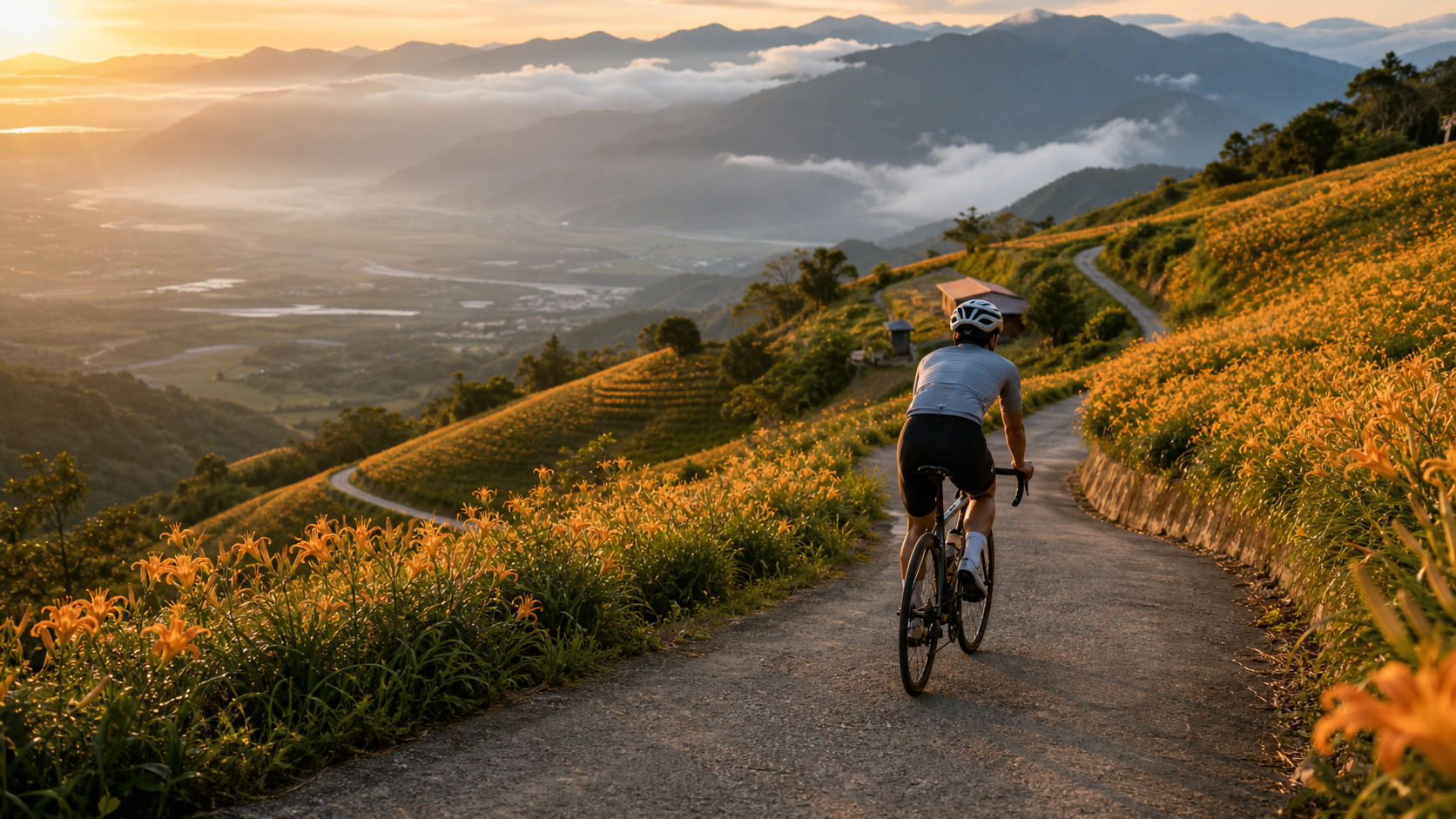
When mentioning Taiwan’s daylily-producing regions, most people immediately think of Liushishi Mountain in Fuli Township or the Taimali Daylily Mountain also located around the East Rift Valley, but Chike Mountain is by no means inferior. In fact, in the minds of many seasoned flower enthusiasts and photography lovers, Chike Mountain’s undulating terrain and viewing angles offer even greater depth and dimension. Because the flower fields on Chike Mountain are spread across rolling hill terrain, with the magnificent silhouettes of the East Rift Valley and the Coastal Mountain Range as a backdrop, photos of the daylily flower sea taken here often possess a three-dimensional depth that other flower fields find difficult to replicate—the foreground features orange-yellow blossoms swaying in the breeze, the middle ground shows winding industrial roads, and the background reveals continuous mountain ridges and drifting clouds, layer upon layer composing an image of striking visual tension.
For farmers around Chike Mountain, the daylily industry is not merely a tourist attraction but a livelihood passed down through generations. Harvesting daylilies is highly labor-intensive, typically requiring picking in the early morning just before the buds are about to bloom, because once a daylily fully opens, its economic value drops significantly. This is why, during the blooming season, visitors often see local farmers bending over, working diligently among the flower fields under the dawn light—a scene that forms an interesting contrast with tourists leisurely admiring and photographing the flowers. It also reminds us that behind this beautiful landscape lies the farmers’ day-in, day-out hard work. In recent years, as the tourism industry has gradually merged with agriculture, Chike Mountain has also developed a leisure-agriculture model combining flower viewing, dining, and accommodation, allowing this hillside to preserve its original agricultural functions while bringing more diverse economic vitality to the area.
It is worth noting that the flower conditions and exact peak blooming period at Chike Mountain fluctuate each year depending on climatic conditions (such as rainfall and temperature changes), typically falling between August and September, but the actual optimal viewing period should still be confirmed based on on-site announcements or local information. This uncertainty of dancing with nature, to some extent, makes every visit feel especially precious—you can never predict with absolute certainty what the flower conditions will be like in any given year, but precisely because of that, when you pedal your bike around one bend after another and finally catch sight of the daylily flower sea blanketing the mountainside from an open vantage point, that surprise and emotion feel all the more genuine and profound.
The Cultural Charm of Yuli Township: An Important Town in the Southern Rift Valley
To truly understand Chike Mountain, one must first get to know Yuli Township at its foot. This town, located in the southern section of the East Rift Valley, is an important settlement in Hualien County second only to Hualien City and Ji’an Township. Since its development in the Qing Dynasty, it gradually grew into the commercial and living center for surrounding agricultural settlements due to its strategic location at the crossroads of the Rift Valley. The origin of Yuli’s name has various accounts; one theory holds that the area was once covered in lush forests with beautiful scenery, hence the name “Pushekaku” (a historical name still explained near Yuli Railway Station today), later changed to Yuli during the Japanese colonial period, meaning “jade-like mountains and charming scenery.”
Cycling through Yuli’s urban area, you’ll find that while it’s not particularly large, it has everything one needs. Traditional markets, temples, old-street architecture, and modern convenience stores coexist, presenting a leisurely pace unique to small towns in eastern Taiwan. Yuli is also the junction of Provincial Highway 9 and Provincial Highway 30, making it an important supply and lodging point on East Rift Valley road trips and island-wide cycling routes. Many long-distance cyclists on island tours choose to stop in Yuli, replenish their energy, and then continue southward or northward. This also links Yuli with nearby attractions like Chike Mountain and Antong Hot Springs, forming an in-depth travel route that combines both culture and nature.
Yuli’s most famous local delicacy is undoubtedly Yuli noodles. This is a dry noodle dish rooted in a fusion of Hakka and local food culture, featuring fine, chewy noodles paired with a simple yet rich sauce and braised toppings. It’s the meal that many travelers and cyclists from elsewhere most look forward to rewarding themselves with after finishing a grueling climb. Yuli Township has several noodle shops with long histories, each with its own loyal followers and preferred flavors. As for which shop to choose, it’s best to ask local residents on-site or check real-time reviews—after all, everyone’s definition of “most authentic” differs. Rather than recommending specific establishments, it’s better to encourage every visiting cyclist to explore on their own and find the bowl of Yuli noodles that speaks to them.
Besides Yuli noodles, the agricultural products around Yuli are also abundant, including the well-known Yuli rice (one of the premium rice-producing areas in the East Rift Valley), seasonal fruits and vegetables, and the aforementioned dried daylilies and related processed foods—all popular souvenirs that many visitors like to buy. Yuli also preserves numerous historic buildings and cultural landscapes, such as shrine ruins from the Japanese colonial period, old street houses, and traces of the diverse culture formed by the coexistence of Hakka, Hokkien, and indigenous peoples. These are all worth exploring for interested cyclists who can slow down a bit during their rest stops.
For cycling travelers, Yuli is not just the gateway to Chike Mountain but also a waystation that allows one to recharge and experience the rhythm of local life. When you finish a sweat-soaked climbing challenge and return to Yuli’s downtown to sit down for a steaming bowl of noodles, watching the leisurely residents and the occasional tricycle passing by, that pace of life so different from the city often makes one rethink the meaning of travel and cycling—not just conquering a mountain, but forging a genuine connection with a piece of land and the people living on it.
Scenic Landmarks Along the Way: Daylily Flower Seas, Rift Valley Vistas, and Tea Plantation Views
A large part of Chike Mountain’s cycling appeal comes from the constantly changing layers of scenery along the way. Starting from Yuli’s urban area, the initial stretch mostly retains the pastoral scenery of ordinary countryside roads, with rice paddies, orchards, and scattered farmhouses on both sides. As the road begins to climb, the landscape gradually shifts to typical hilly terrain, and neatly arranged tea plantations begin to appear along the winding industrial roads.
Besides daylilies, tea is also one of the important cash crops on this hillside around Chike Mountain. Tea gardens are planted in layers along the slopes, and the rows of emerald-green tea bushes, illuminated by sunlight, present a regular and serene visual beauty that forms a striking contrast with the brilliant, unrestrained daylily flower sea further ahead. If you visit outside the blooming season, this tea plantation scenery instead becomes the visual centerpiece—no crowds of tourists, only the rustling sound of wind through tea leaves and the occasional chatter of tea pickers, creating a completely different yet equally moving mountain atmosphere.
As altitude continues to rise, Chike Mountain’s proudest Rift Valley vista gradually unfolds. The East Rift Valley is a uniquely narrow, elongated valley in Taiwan’s geological structure, flanked by the Central Mountain Range and the Coastal Mountain Range, with waterways like the Xiuguluan River winding through it, forming a magnificent scene of layered mountains and crisscrossing fields. On the middle and upper sections of Chike Mountain, on clear days, you can look west to see the majestic ridgeline of the Central Mountain Range, and east to see the undulating contours of the Coastal Mountain Range, with a lush, checkerboard-like valley plain sandwiched between them. That sense of openness is a visual shock difficult to experience on flatland rides.
And of course, Chike Mountain’s most iconic scenic landmark is none other than the daylily flower sea. Every blooming season, the hillsides are covered with orange-yellow blossoms swaying in the wind. From the foot of the mountain looking toward the summit, it seems as if someone has spilled an entire bucket of orange paint across the slope, spreading in layers. The flower sea interweaves with the winding industrial roads, creating countless breathtaking photo angles—cyclists riding through often can’t help but stop at safe road shoulders, just to take another look, snap a few more photos, and preserve this rare visual feast.
It’s worth noting that the flower fields on Chike Mountain are not one single continuous expanse but are distributed across the undulating terrain in patches of various sizes and shapes. This makes the scenic experience during the ride even richer and more varied—you might just pedal past a flower field gently shrouded in mist, then round the next bend to find another golden sea of blossoms shimmering in the sunlight. This ever-changing sense of surprise is precisely the core charm that draws countless travelers and cyclists back to Chike Mountain time and again.
In addition to the flower sea and Rift Valley vistas, the area around Chike Mountain also preserves many traditional rural landscapes, such as scattered farmhouses, rest pavilions, and some viewing platforms shared by visitors and farmers. These seemingly unremarkable corners all carry the traces of generations of local residents’ farming lives, and they have also allowed this industrial road, originally serving agricultural functions, to gradually develop a unique character with dual value in both production and tourism.
First-Person Riding Narrative: The Visual Impact of the Daylily Blooming Season
It was an early morning in late August, just at daybreak, when I set off from Yuli’s urban area, heading toward Chike Mountain. The air still carried the lingering coolness of the night, mixed with the scent of rice paddies and soil—that distinctive early-morning fragrance of the East Rift Valley that always makes you feel instantly awake the moment it fills your lungs.
The initial stretch was still relatively gentle, and I maintained an easy cadence, enjoying the pastoral scenery gradually waking up on both sides. Farmers were already busy in the fields, a few rooster crows echoed in the distance, and occasionally a scooter whizzed by carrying workers heading up the mountain to harvest daylilies. This simple, rhythmic rural pace, so different from the hurried mornings of the city, unconsciously slowed my heartbeat and my breathing.
As the road began to climb, the gradient revealed its true nature. I adjusted my gear ratio, stabilized my cadence, and felt my thigh muscles gradually warming with each pedal stroke. The tea gardens along the roadside sparkled with dew in the morning light, and a breeze carried a faint fragrance of tea, mingling with the saltiness of sweat and the warmth of my breath, creating a strange yet addictive cycling experience. At this point, Chike Mountain had not yet revealed its most stunning side, but the unique tranquility and groundedness of the mountain forest was already enough to give anyone long accustomed to city life a long-missed sense of relaxation.
The real shock came without warning, after climbing past one bend after another in the middle section. I remember that moment—I was looking down, focused on my pedaling rhythm, breathing a bit heavily, when I suddenly looked up, and the scene before me instantly made me forget the soreness in my legs—the entire hillside was completely covered in a sea of orange-yellow blossoms, gently swaying in the breeze like countless small flags saluting every traveler who had worked hard to climb up. In that instant, I almost instinctively stopped pedaling, letting inertia carry the bike slowly forward, just so I could take in this view completely, uninterrupted by my own panting.
The orange of the daylilies actually has subtle gradations. The flowers up close are vivid and full-bodied, with a nearly fluorescent orange-red hue; the fields farther away, due to the angle of sunlight and distance, blend into a softer apricot-orange, extending layer upon layer to the ridgeline, then interweaving with the deep blue sky and rolling white clouds in the background, forming a scene that hardly seems real. I stopped at the road shoulder, letting sweat drip as I drank water to replenish electrolytes, unable to tear my gaze away from the flower sea before me for a long time.
The rest of the climb became completely different. The pedaling that had felt heavy due to the gradient now seemed to be injected with new energy by the ever-changing flower-filled scenery. Every turn was like flipping to a new scenic postcard—sometimes a flower field gently veiled in thin mist, dreamlike and hazy; sometimes a sea of blossoms under direct sunlight, colors so saturated they were almost dazzling; occasionally, early-rising photography enthusiasts could be seen setting up tripods, patiently waiting for the perfect light and angle. That atmosphere of people gathering because of the same scenery yet each immersed in their own world made the entire climb feel especially warm and far from lonely.
When I reached the most open section with the widest view, I finally stopped the bike and turned around to look down at the entire East Rift Valley. The ridgeline of the Central Mountain Range appeared and disappeared through the thin mist, the Coastal Mountain Range stood quietly on the other side, and between them lay the checkerboard-like valley plain, while beneath my feet was the very daylily flower sea that had captured my heart. At that moment, all the soreness, panting, and sweat of the climb seemed to have found their purpose—it turned out that all the effort was simply to earn this one moment of the purest, most unadorned emotion.
What This Route Means to Cyclists: A Short but Concentrated Sense of Achievement
In the cycling community, people often measure the value of a route by its distance and elevation gain—routes like Wuling, Hehuan Mountain, and Southern Cross-Island Highway, spanning dozens of kilometers with thousands of meters of climbing, are often regarded as “true challenges,” while a stretch like Chike Mountain, with only 11 kilometers and less than 700 meters of elevation gain, can sometimes be categorized as a “warm-up route” or a “light challenge.” But after riding it yourself, you’ll find that this way of categorizing overlooks the truly unique value of Chike Mountain.
The first thing Chike Mountain teaches cyclists is that “short doesn’t mean easy.” With its solid, consistent 6.2% average gradient and localized sections exceeding 10%, this route condenses the intensity tests found on long climbing routes but compresses the time to under an hour. This “quick but concentrated” challenge model offers an excellent training and challenge opportunity for cyclists who are busy with work and can’t dedicate large amounts of time to long-distance riding—you don’t need to plan a full-day trip or face hours of long-distance depletion; just invest forty to fifty minutes of focused output, and you can gain a sense of achievement and training effect comparable to long climbing routes.
Chike Mountain also teaches cyclists something even more important: scenery and challenge are never mutually exclusive. Many climbing routes renowned for their “difficulty” often have relatively monotonous scenery along the way, with cyclists focused entirely on numbers and pacing, rarely having the chance to truly look up and appreciate their surroundings. But Chike Mountain is different—it skillfully combines steep gradients with the stunning daylily flower sea and the magnificent Rift Valley vista, making every pedal stroke both a physical workout and a spiritual cleansing. This unique experience of “pain and pleasure intertwined” is perhaps the core reason Chike Mountain keeps so many cyclists coming back, unable to forget it.
For many seasoned cyclists, Chike Mountain has gradually become a symbol of “ritual”—when the blooming season arrives each year, they always arrange a dedicated ride there, not just to set new personal records but more like an annual ritual of reconnecting with themselves and this land. Looking at the same flower sea, in different years and different states of mind, one can always savor different feelings. This cycling experience synchronized with nature’s rhythms is something that man-made training facilities or indoor trainers can never replace.
For novice cyclists attempting Chike Mountain for the first time, this route is more like a valuable introductory lesson—it teaches you how to pace yourself, how to face the psychological pressure of localized steep sections, and how to find balance between beautiful scenery and physical limits. The sense of achievement gained after completing the challenge is not diminished by the shorter distance; on the contrary, thanks to the solid gradient test and the stunning visual reward, this sense of achievement feels especially substantial and three-dimensional.
A Seasonal Dual Persona: Chike Mountain in Blooming and Non-Blooming Seasons
Perhaps the most fascinating thing about Chike Mountain is that it reveals two completely different yet equally moving faces depending on the season. This “one mountain, two sceneries” quality makes Chike Mountain not just a “season-limited” check-in spot but a cycling route worth visiting year-round, each time with its own distinct charm.
During the blooming season, Chike Mountain belongs to liveliness and splendor. The daylily flower sea covering the hillsides, the endless stream of tourists and photography enthusiasts, and the chorus of camera shutters echoing across the mountain create an almost carnival-like atmosphere. This season’s Chike Mountain suits cyclists who enjoy sharing beautiful scenery with crowds and capturing stunning images during their rides. The blooming season also reminds us that nature’s beauty often has a time limit—precisely because the daylily blooming period is brief, every encounter feels especially precious, making us cherish every moment we see before us.
And when the blooming season ends and the tide of tourists recedes, Chike Mountain quickly returns to its original tranquil, rustic self. This season’s Chike Mountain belongs to another group—the hardcore cyclists who pursue pure riding experiences and enjoy the process of dialogue with themselves. Gone are the crowds and the constant shutter sounds, replaced by the rustling of mountain wind through tea gardens and the occasional birdsong. At this time, Chike Mountain’s gradient remains just as solid and its views just as open, only without the brilliant colors of the flower sea, replaced by a serenity and purity that belongs to the mountain forest itself. Many seasoned cyclists actually prefer Chike Mountain in this state, because without the distractions of crowds and traffic, they can focus more on their pacing rhythm and bodily sensations, engaging in an undisturbed private conversation with the mountain.
The tea plantation scenery also becomes the visual centerpiece in the non-blooming season. The rows of emerald tea bushes, the busy figures of tea pickers, and the thin mist drifting around the mountain compose a mountain landscape painting completely different from the blooming season yet equally worthy of savoring. If you’ve visited Chike Mountain during the blooming season, consider planning a return trip in the off-season—you’ll be amazed to discover that the same route can reveal such completely different faces and moods.
Whether it’s the brilliant exuberance of the blooming season or the tranquil simplicity of the non-blooming season, Chike Mountain always maintains its most essential charm—a mountain once named after the chike tree and now famous for daylilies, continuing to welcome every traveler willing to explore this land with their own two feet on pedals, with its solid gradients and ever-changing scenery.
Suggested Side Trips: Yuli’s Local Cuisine and Nearby Attractions
After completing the cycling challenge of Chike Mountain, consider extending your itinerary a bit and incorporating the worthwhile attractions and food in and around Yuli, making this East Rift Valley trip even more complete and enriching.
On the food front, the aforementioned Yuli noodles are an absolute must-try local representative. It’s recommended that after finishing the challenge, you first let your body rest a bit and rehydrate, then head to Yuli’s downtown to find a noodle shop that catches your eye, order a classic dry noodle bowl paired with a simple soup. That solid sense of satisfaction is often the most healing reward after completing a grueling climb. Besides dry noodles, the Yuli area also offers plenty of authentic East Rift Valley snacks, such as various rice-based dishes, seasonal local wild vegetables, and rice products made from premium local rice—all worth taking time to explore and taste. As for specific shop choices, it’s recommended to check on-site reviews or ask local residents to find the one that best suits your palate.
If time permits, there are several other attractions worth visiting around Yuli. The Antong Hot Springs area, located south of Yuli, is one of the few hot spring resorts with some renown in the East Rift Valley. For cyclists who have just finished a tough climb with slightly sore and fatigued muscles, if time and schedule allow, arranging a hot spring soak can be quite helpful for relieving muscle tension and speeding up recovery. Additionally, Yuli’s traditional market, old street buildings, and some well-preserved Japanese colonial-era historic structures are also well suited for a leisurely stroll, allowing you to experience the unique cultural atmosphere of this Rift Valley town.
If your schedule allows for an overnight stay, the area around Chike Mountain has also developed a leisure-agriculture model combining flower viewing and accommodation in recent years. Some farms or bed-and-breakfasts offer lodging experiences with close-up views of the daylily flower sea, allowing visitors and cyclists to enjoy the mountain’s most tranquil and moving moments in the early morning or at dusk, when tourists haven’t yet arrived or have already dispersed, and to capture beautiful light and scenes that are hard to obtain during the crowded daytime hours.
For cyclists planning a long-distance cycling trip through the East Rift Valley, Chike Mountain is actually very well suited as a key stop on the itinerary, linking up with well-known riding destinations in the southern Rift Valley such as Yuli, Fuli, and Chishang to plan a multi-day trip combining training intensity with cultural scenery. From the waves of rice paddies in Chishang, to the everyday warmth of Yuli, to the flower sea and steep gradient trials of Chike Mountain, this route connects not just geographical movement but a journey of deeply understanding the multi-layered beauty of the East Rift Valley.
Whether you’re a hardcore cyclist who came specifically to take on this Category 4 climb, or a tourism-oriented rider attracted by the daylily flower sea, Chike Mountain proves one thing in its own unique way: the value of a route is never just about the numbers of distance and elevation gain, but also about the industrial stories it carries, the cultural charm, and the unique emotions and memories that every traveler who personally sets foot on this road harvests between pedal strokes.
Related Reading
- From Taimali to Jinzhen Mountain in Taitung: A Complete Guide to the Hilly Route Through Southern Taiwan’s Flower Sea Country
- Between Steep Slopes and Daylily Flower Seas: A Riding Experience and Cultural Memory of Taimali Jinzhen Mountain
- Spring Cycling in Taiwan’s East Rift Valley: A Dreamlike Route Connecting Mountains and Sea
- Riding Toward Teapot Mountain: A Mountain Journey Through a Century of Mining Memories
太平山單車員工旅遊 | 這樣玩CP值最高!| 公路車
5 年前
鯉魚潭水庫 歡笑單車騎旅,季節限定大景 | 大湖/鯉魚潭水庫/龍騰斷橋/薑麻園 | 公路車 | CT Yeh
3 年前
無耳茶壺山 半屏山 空拍震撼絕景 驚險O型縱走
8 年前
高雄綠園道鐵路自行車道 / 外地人能輕鬆駕馭 還是整路崩潰? / 2025 全線開通 春節實地探索一次!(附GPS連結)/ 公路車 / CT Yeh
1 年前
嘉義大埔、阿婆灣挑戰賽,美到以為在日本!ft. 環騎5 Cool 西拉雅188 / 公路車 / CT Yeh
7 個月前
#北橫 + #北進武嶺 最硬的員工旅遊 EP1 | #公路車 #拉拉山 | 明池 | 武嶺 | 武陵農場 | 雲海 | Taiwan Cycling Route Wulin
6 年前
大武山20%魔王陡坡【JJSC南台灣遊騎Day2】!屁股真的要裂開了...凡士林抹滿也沒用?神秘金教堂還有超便宜夜市
3 個月前
5 ℃ 櫻花之旅 / 75萬單車直接雨中洗車.../ 平菁街 / 北迴歸小隊 / 公路車 / CT Yeh
5 個月前