Riding into the Mountains and Soul of Nanzhuang: Hakka, Saisiyat, and Cloud-Mist Stories on the Xianshan KOM Route
Before You Set Off, a Story of Nanzhuang
In the minds of many, Nanzhuang Township in Miaoli County is first and foremost about its old street—the aroma of osmanthus syrup drifting from Osmanthus Lane, the sight of elderly women squatting by the washing pits scrubbing clothes, and the rich, nutty flavor of Hakka lei cha with its blend of sesame and roasted tea leaves. But for cyclists, Nanzhuang has another identity—it is a mountain town embraced by peaks, a gateway to Xianshan, to Xiangtian Lake, and to the sacred grounds of the Saisiyat people’s Pas-ta’ai (Short People’s Festival). And the “Xianshan KOM,” this 12.93-kilometer king-of-the-mountain time-trial segment with 507.8 meters of total elevation gain and an average gradient of 3.9%, is the most honest physical examination of this mountain town—a way to measure every rise and fall of Nanzhuang with your own legs.
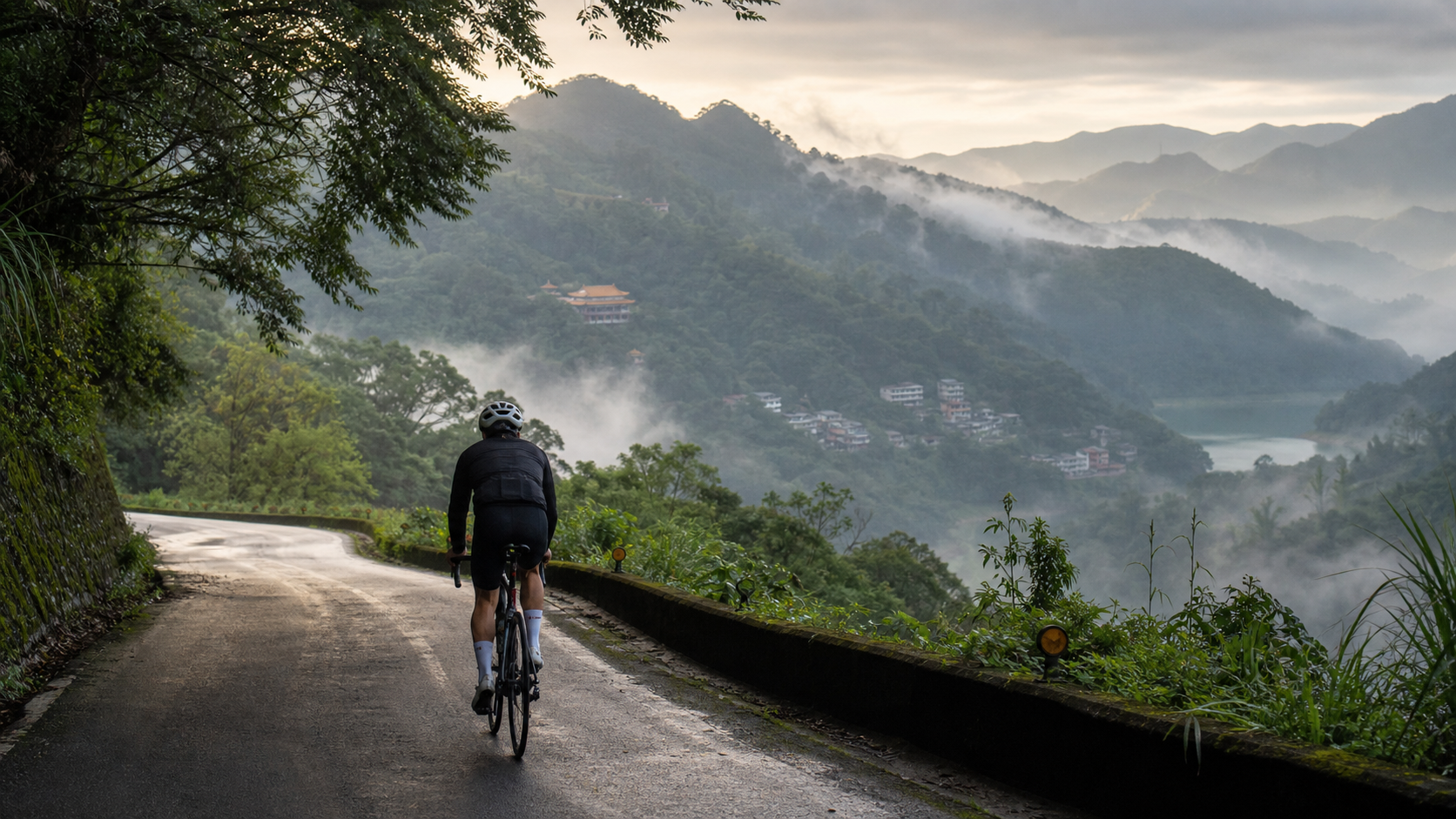
I remember the first time I heard the tag “Nanzhuang KOM.” The image that came to mind wasn’t racing or numbers flickering on a timer, but a certain early morning when the mist had yet to lift, dew still clinging to the trees lining the road, and a lone rider making their way up the industrial road toward Xianshan, the only sounds being the click of the derailleur shifting gears and the gradually deepening rhythm of their own breathing. This route, as I understand it, is a time-trial challenge course planned with Xianshan as its main climbing segment. KOM—King of the Mountain—this title carries a sense of both romance and gravity: you’re not competing against others; you’re having a dialogue with the mountain and with your own limits.
Nanzhuang Township’s geographic location sits precisely at the junction between Miaoli’s foothills and the northern section of the Central Mountain Range, a topography that has given rise to its rich ecology and diverse ethnic cultures. The Hakka people have cultivated this land for generations, leaving behind traces in every brick and tile of the old street; the Saisiyat people have lived here for centuries, and the Pas-ta’ai (Short People’s Festival) by Xiangtian Lake is one of Taiwan’s most important indigenous ceremonies, held every two years in a grand ritual that draws countless visitors. As for Xianshan, it stands at approximately 1,400-plus meters in elevation, with temples such as Xianshan Lingdong Gong on its summit, where incense has burned steadily for years, making it a popular hiking destination as well. When a cycling route intertwines with such cultural and human landscapes, the Xianshan KOM becomes more than just a time-trial segment—it becomes a journey through Nanzhuang’s multiple identities: from the hearth-smoke bustle of Hakka settlements, riding toward the tranquil forests of the Saisiyat sacred grounds, and then ascending into the cloud-wreathed religious atmosphere of Xianshan.
Before setting off, riders are advised to take some time to stroll through Nanzhuang’s old street and absorb the daily rhythm of this mountain town. The old street isn’t large—a leisurely loop takes no more than half an hour—but the atmosphere of a settlement nestled between mountains and water, where Hakka and indigenous cultures coexist, will add a layer of depth to the ride ahead: you’re not just climbing a mountain; you’re riding into a living, breathing piece of local memory.
The Dual Imprint of Hakka and Saisiyat: Nanzhuang’s Cultural Depth
To understand the significance of the Xianshan KOM route, one must first understand the dual cultural imprint of this land. The development history of Nanzhuang Township is, in a sense, a microcosm of the interactions, conflicts, and eventual coexistence between Hakka pioneers and the Saisiyat indigenous people. Since the Qing Dynasty, Hakka immigrants followed the streams upstream, clearing forests and planting camphor and tea in the Nanzhuang area, gradually forming the settlement scale seen around today’s old street. The buildings along the old street still preserve much of their Japanese colonial and early postwar appearance—red brick walls, wooden eaves, and narrow yet deeply lived-in alleyways are all tangible traces of this pioneering history.
Osmanthus Lane is the most poetic stretch of the old street. As I understand it, it takes its name from the osmanthus trees once planted along both sides of the lane; when the osmanthus bloom in autumn, the entire alley fills with fragrance, making it a must-stop corner for visitors to Nanzhuang. The washing pits are another spot brimming with the flavor of daily life—in the early years before piped water was available, residents relied on mountain spring water flowing through these pits to wash their clothes. Today, while their practical function has faded, they have been preserved as a living site of local memory, and residents can still often be seen washing there, offering visitors a glimpse into the early lifestyle of this Hakka mountain town. The old post office, with its retro architectural style, has become another popular photo spot on the old street—its red mailbox and brick building telling of the town’s historical role as a regional administrative and postal hub.
The Saisiyat cultural imprint, meanwhile, is most vividly expressed around Xiangtian Lake. The lake is an important sacred site for the Saisiyat people; the lake itself was formed by water accumulating in a depression created by subsidence, surrounded by mountains on all sides, its scenery serene and secluded. The Pas-ta’ai (known in the Saisiyat language as Pas-ta’ai), held every two years, is the most important ceremony of the Saisiyat people. During the ritual, tribe members don traditional attire, chant ancient ceremonial songs, and dance steps passed down through generations, offering respect and prayers of atonement to the legendary dwarf people who once taught the Saisiyat agricultural techniques but perished in conflict. This ceremony is not only the core of Saisiyat cultural identity but has also become one of the most representative indigenous ritual traditions in Taiwan. The Xianshan KOM route passes near Xiangtian Lake and the Baguali tribe; even though the time-trial segment itself may not directly traverse the heart of these sacred areas, the mountain scenery and tribal settlement views along the way still allow riders to feel that Saisiyat culture continues to thrive vividly on this land.
The Hakka and the Saisiyat—two ethnic groups with vastly different cultural backgrounds—have each found their own space for survival and cultural expression among the forests of Nanzhuang, and through years of interaction have gradually formed a unique sense of local community. For riders taking on the Xianshan KOM, if they are willing to spend a little time before departure or after arrival understanding the dual cultural weight this land carries, the meaning of the ride will far transcend a mere physical challenge, becoming a miniature journey into the multi-ethnic history of Taiwan.
Xianshan: Where Religious Aura Meets Natural Splendor
After riding past the bustle of Nanzhuang’s old street and the tranquil tribal scenery in the direction of Xiangtian Lake, Xianshan itself presents a distinctly different atmosphere—a unique character that blends religious aura with the quietude of mountain forests. Xianshan, standing at approximately 1,400-plus meters in elevation, is a renowned hiking and religious destination within Nanzhuang Township. The Xianshan Lingdong Gong temple on its summit has seen incense burn steadily for years, serving as an important place of worship that many devotees visit regularly to pray for safety. Legend has it that the name “Xianshan” (Immortal Mountain) is tied to the mountain’s year-round shroud of clouds and mist, which lends it an otherworldly, fairy-tale quality, and echoes the religious atmosphere of the temple atop it. Over time, “Xianshan” became the name mutually accepted by locals and visitors alike.
For those who climb by bicycle, the religious atmosphere of Xianshan subtly seeps into the physical experience of the ride. When your legs begin to ache and burn from the sustained effort of 12.93 kilometers and 507.8 meters of climbing, if you happen to catch a glimpse of a temple’s upturned eaves half-hidden among the trees, or catch a wisp of incense carried on the wind, that complex sensation of bodily exhaustion intertwined with spiritual calm is something you could never experience on flat ground. This may well be why the name “Xianshan KOM” is so intriguing—it is not merely a geographic coordinate, but a hint at a state of mind for riding: at the edge of physical limits, searching for a focus and tranquility that borders on the meditative.
Xianshan is also one of the area’s popular hiking routes, with lush, verdant forests along the trails and a different face in every season. It is said that in autumn and winter, as temperatures drop, vegetation at higher elevations undergoes color changes with the shifting climate. While Nanzhuang is not a region renowned for autumn foliage, the occasional layers of color scattered through the forests still add a seasonal visual delight to the ride; actual scenery depends on the year’s climate and vegetation conditions, and one should not expect the spectacular scale of higher-elevation maple-viewing spots. In the early morning hours, the Xianshan area is often cloaked in a thin mist, with sunlight piercing through the fog to cast dappled light on the road surface—that play of light and shadow is a treasured memory that many riders who have taken on the Xianshan KOM at dawn fondly recall.
Beyond the forests themselves, the unique geology and vegetation of the Miaoli mountain region are also worth noting along the way. Thanks to abundant rainfall and a mild, humid climate, the Nanzhuang area nurtures a remarkably rich native plant ecosystem. Ferns, camphor trees, acacia, and other common low-to-mid-elevation species form a green canopy on both sides of the route, providing precious shade on the hot summer climbing sections. Riding along such tree-lined roads, even as the gradient steadily climbs, the oppressive heat you feel is often somewhat alleviated by the forest cover—another reason the Xianshan KOM feels more forgiving on the body compared to other exposed mountain climbs.
First-Person Narrative: That Morning, My Conversation with Xianshan
I arrived in Nanzhuang nearly an hour early that day. The sky still held an ambiguous blue-gray hue, and most of the shops along the old street had yet to open—only a few early-rising cats paced beneath the arcades. I pulled my bike out, did a quick warm-up, and watched the distant ridgeline gradually sharpen in the growing light. I thought to myself that this road I was about to ride—I had no idea what kind of scenery it would show me.
For the first 3 kilometers after setting off, the road was relatively gentle, and I deliberately kept my output low, letting my body ease into its rhythm. The morning air still carried the dampness of the previous night’s dew, and each breath had an indescribable crispness. Occasionally I passed Hakka farmhouses along the roadside, with neatly stacked firewood beneath the eaves and what looked like everyday vegetables growing in the courtyards. That sense of simple, grounded living naturally slowed the pace of my mind as I rode through it—even as my legs had already begun to feel the gradually increasing gradient.
Around the 5-kilometer mark, the grade began to climb noticeably, and my breathing grew heavier. I remember passing through a stretch where the tree cover thinned slightly, and sunlight slanted through the treetops, casting dappled shadows across the asphalt. Combined with the rhythmic sound of my chain as I pedaled, it created a nearly meditative focus. This section wasn’t brutally steep, but the relentless, continuous ascent made the muscles in my thighs gradually accumulate a burning sensation—not a sharp pain, but a lingering soreness that demanded to be negotiated with and persuaded through sheer willpower. I began to realize that this road’s true test wasn’t instantaneous explosive power, but whether you were willing to keep pushing the pedals forward as fatigue steadily built up.
After the 8-kilometer mark, I faintly heard what sounded like chanting or wind chimes drifting from afar—I later guessed it was the sound coming from the direction of Xianshan Lingdong Temple, echoing through the forest with an especially ethereal quality. At that moment, I instinctively slowed my breathing. Though my legs kept applying force, a strange sense of calm welled up inside me. It turned out that once climbing reaches a certain threshold, physical fatigue coexists with a state of near-meditative focus. You still feel the soreness in your muscles, but you’re no longer dominated by it—instead, it’s as if you’ve reached a silent understanding with it.
For the final 2 kilometers, the gradient seemed to tick up slightly again, and I knew the finish couldn’t be far. This was actually the stage where my mental state needed the most soothing—the body was nearing its limit, and the uncertainty of the finish line only amplified that anxiety. I told myself not to watch the distance countdown on my cycling computer, but instead to focus on the next bend ahead, that particularly tall tree, that distinctive rock—breaking the long challenge down into one small, immediately achievable goal after another. When I finally saw the gradient ease and the signpost signaling the approaching summit, that complex emotion of fatigue mixed with accomplishment nearly made me laugh out loud on the pedals.
After finishing, I didn’t immediately turn back. Instead, I found a spot with an open view nearby and lingered for a while, watching the settlement of Nanzhuang Township slowly wake in the morning light, with cooking smoke rising in wisps from several rooftops. In that moment, I felt deeply that what makes Xianshan KOM so captivating has never been merely the 507.8 meters of climbing—it’s that this route weaves together geographic ascent, physical challenge, and a nearly spiritual shift in mindset, all compressed into just 12.93 kilometers, allowing everyone who rides it seriously to take away an insight uniquely their own.
What This Route Means to Riders: More Than Timing—It’s Self-Dialogue
In the world of cycling, the original purpose of a Segment was to allow riders to objectively quantify their performance, gaining motivation and a sense of accomplishment through comparison with others and with their own past results. As a clearly marked King of the Mountain segment with precise data, Xianshan KOM naturally carries this competitive significance as well—12.93 kilometers in distance, 507.8 meters of total elevation gain, a 3.9% average gradient, and an official Category 3 classification. For riders chasing times and hoping to leave their names on the leaderboard, these numbers represent clear and concrete goals.
But I’ve always believed that the significance of Xianshan KOM goes far beyond the numbers ticking on a cycling computer. What makes this route special is that it places the act of “climbing” within a geographical context rich in cultural heritage—you’re not timing yourself on a randomly selected industrial road; you’re on land that carries the history of Hakka reclamation, the ritual culture of the Saisiyat people, and the spiritual aura of Xianshan itself. With the strength of your legs, you measure the undulations and heights of this land inch by inch.
For many riders who have been cycling for years, climbing has never been merely a display of physical fitness—it’s a process of dialogue with oneself. When the gradient continues relentlessly and the summit remains out of sight, physical fatigue gradually amplifies into mental wavering—you begin to question your pacing strategy, question whether you overestimated your abilities, and even question the fundamental issue of “why am I working so hard to ride a bike?” And Xianshan KOM, with its moderate yet sustained gradient, happens to provide a stage long enough—but not so long as to completely break you—for this self-dialogue to unfold fully, and to arrive at a clear answer within a relatively reasonable time. Whether it’s the joy of completion or the reflection of failing to meet expected results, both are valuable takeaways from this conversation.
I’ve also met quite a few riders who treat Xianshan KOM as a kind of “annual assessment” segment, returning to challenge it every so often, using the same route and the same set of data to measure how their training has evolved over that period. In a way, this approach echoes the spirit behind the title “King of the Mountain”—it has never been about defeating others, but about inviting you to keep coming back, to compete against the person you were before, to continually surpass and continually grow. Xianshan, this mountain carrying religious spirituality and natural tranquility, seems especially well-suited to serve as a witness to such a long-term journey of self-cultivation.
Seasonal Scenery: Mountain Mists, Clouds, and the Changing Seasons
The four-season character of the Nanzhuang and Xianshan area, while not as dramatically distinct as in high mountain regions, still reveals a unique atmosphere and scenery in each season upon closer appreciation. In spring, Nanzhuang’s forests burst with fresh greenery, the air carries the crisp scent of plant growth, and rainfall gradually increases without yet reaching the peak of the plum rain season—making it a relatively suitable time for riding while enjoying the vibrant vitality of the mountain forests.
Summer on Xianshan is characterized by dense green shade and occasional afternoon thunderstorms. If you can set out early in the morning, you can often capture the dreamlike sight of mountain mists slowly rising from the valley and lingering halfway up the slopes. The gradual transformation of that cloud vapor from milky white to translucent in the sunlight is one of the most enchanting scenes of a summer morning on Xianshan. However, the convective weather of summer afternoons should not be underestimated—mountain rainfall often arrives suddenly and intensely. Riders planning a summer challenge should adhere to the principle of “ride out early, return early” to avoid being caught in sudden downpours while lingering in the mountains.
Autumn and winter are considered by many riders to be the best seasons for tackling Xianshan KOM. Temperatures cool, the chance of rain decreases relatively, and the mountain air becomes exceptionally clear, improving visibility. Standing at the heights of Xianshan and looking back at the settlements of Nanzhuang Township and the layered mountain ranges beyond, the view is especially magnificent. It’s said that during certain periods of sharp temperature drops, some mountain vegetation undergoes color transitions in response to the climate. While Nanzhuang isn’t a famous spot known for maple viewing, this seasonal scenery—carrying an element of surprise and unpredictability—gives every autumn or winter ride up Xianshan a unique flavor. The specific sights, of course, depend on the actual natural conditions at the time of your visit.
In winter, on particularly cold days, the summit area may experience cloud condensation, creating a hazy, dreamlike scene as if stepping into a fairyland—which echoes the poetic imagination inherent in the name “Xianshan” (Immortal Mountain) itself. Of course, winter challenges also require attention to staying warm and the risks of frost or slippery road surfaces. It’s not advisable to attempt the climb rashly under poor weather conditions or limited visibility.
Regardless of which season you choose to visit, the forests of Xianshan and Nanzhuang always respond to each rider’s current state of mind with their own unique rhythm. This is why many riders, even after having challenged Xianshan KOM multiple times, are still willing to return in different seasons—because with every ride, the mountain greets you with a different expression.
Suggested Side Trips: Old Street Charm and Hakka Food Culture
After finishing the Xianshan KOM challenge, stopping by Nanzhuang Old Street for a while is an unspoken ritual shared by nearly every cyclist who visits this mountain town. After expending so much energy, nothing soothes the body and mind quite like a warm bowl of Hakka lei cha. Lei cha is one of the most representative elements of traditional Hakka food culture—tea leaves, sesame seeds, peanuts, and other ingredients are ground into a powder in a mortar, then brewed with hot water. The result is rich and fragrant, packed with oils and protein, making it an ideal post-race refueling option for riders who have just finished a long climb and urgently need to replenish energy. Many shops along Nanzhuang Old Street offer Hakka lei cha experiences, and visitors can even grind the ingredients themselves to enjoy the fun of this traditional craft. However, we recommend choosing a specific shop based on on-site reviews and your own taste preferences.
Beyond lei cha, Nanzhuang’s Hakka food culture also includes a wide variety of traditional dishes built around local ingredients. Classics such as Hakka stir-fry, stir-fried pork intestines with ginger, and braised pork with preserved mustard greens are must-order items on many food lovers’ lists when visiting Nanzhuang. In the alleys around the old street, you’ll also find stalls selling local specialty snacks—from traditional ban tiao (flat rice noodles) and handmade mochi to a variety of pickled agricultural products—allowing riders who have just conquered a solid climb to reward themselves through their taste buds. Since specific shops change frequently, we suggest riders choose based on what they see on-site and local word of mouth, without feeling tied to any particular list.
If time permits, we also highly recommend visiting Xiangtian Lake in addition to the Xianshan KOM challenge, to personally experience the tranquil atmosphere of the Saisiyat sacred ground. Even if you don’t happen to catch the biennial Pas-ta’ai (Short People’s Festival), the lake and mountain scenery alone carry a power that settles the mind. The classic Nanzhuang Old Street landmarks—Osmanthus Alley, the Clothes-Washing Pit, and the Old Post Office—are also worth slowing down to explore one by one, adding a touch of cultural warmth and everyday life to this cycling-focused trip to Nanzhuang.
Conclusion: Xianshan Is More Than a Mountain, Nanzhuang Is More Than a Road
Writing this, I recall that early morning on the mountainside of Xianshan, when I heard the faint, almost imperceptible sound of chanting, and the calm that welled up inside me. The Xianshan KOM—this King of the Mountain time-trial segment stretching 12.93 kilometers with a total elevation gain of 507.8 meters and an average gradient of 3.9%—might, on paper, look like just another run-of-the-mill Category 3 climb among the many on Strava. But when you actually push down on the pedals, climbing meter by meter, passing through the everyday life of a Hakka mountain town, sweeping past the tranquil forests of the Saisiyat sacred ground, and finally reaching Xianshan with its year-round heavy incense smoke and swirling clouds and mist, you come to understand that the weight this route carries far exceeds that 507.8 meters of vertical distance.
Nanzhuang, this Miaoli mountain town, with its uniquely diverse cultural heritage, its historical fabric woven from the intertwined Hakka and Saisiyat peoples, and the distinctive character of Xianshan that blends religious spirituality with natural beauty, endows this King of the Mountain time-trial segment with a deeper meaning that raw data alone cannot fully capture. For every rider who has challenged—or is about to challenge—the Xianshan KOM, this journey is perhaps not merely a test of physical endurance, but also a precious opportunity for dialogue with this land and with one’s own inner self. May every rider who pedals up this mountain road find their own peace and strength amid the clouds and mist of Xianshan, and carry the unique warmth of this Nanzhuang mountain town onward to the next leg of their journey.
Related Reading
- Complete Xianshan KOM Guide: Data Analysis of Nanzhuang’s King of the Mountain, 12.93 km at 3.9% Average Grade
- Riding to the Saisiyat Sacred Ground: The Distance Between the Xiangtian Lake Climb and the Pas-ta’ai Legend
- The Sacred Mountain’s Steep Slopes in a Hakka Mountain Town: Riding into Shitan, Encountering Xianshan
- Miaoli Tongxiao to Nanzhuang Mountain Route: Complete Guide to Climbing in Hakka Mountain Towns
2024 南庄仙山KOM 多視角賽事精華!/ 500元報名費媲美富士山登山賽!/ 公路車 / CT Yeh
1 年前
超激烈!2025 南庄仙山KOM 賽事精華 / 男菁英A x 女菁英A / 公路車 / CT Yeh
9 個月前
2026南庄山水悠遊行 仙山KOM 網路直播 /LIVE
7 天前
台灣登山王之路 KOM 全程參賽4K臨空錄影 PART1 穿越峽谷地形! #東進武嶺 太魯閣 / 燕子口 / 天祥 / 西寶 PART1 (公路車 / CT Yeh)
3 年前
2023 夏季KOM 參賽實況 / 穿越空拍視角 / 整車都凸台 / 太魯閣峽谷x合歡山絕美大景 / 東進武嶺 / Taiwan KOM Challenge / 公路車 / CT Yeh
3 年前
2025南庄山水悠遊行 仙山KOM 網路直播! / 男菁英組A / 女菁英組A
9 個月前
[4K空拍] 三灣落羽松 秘境 與 神仙谷
7 年前
#東進武嶺 全程實況錄影 5小時半 #夏季KOM #太魯閣 Taiwan KOM Challenge Reality Video Taroko scenery
7 年前