Wind on the Plateau, Red Earth, and a Climb Called Dake Road: A Cultural Journey on Linkou's Cycling Routes
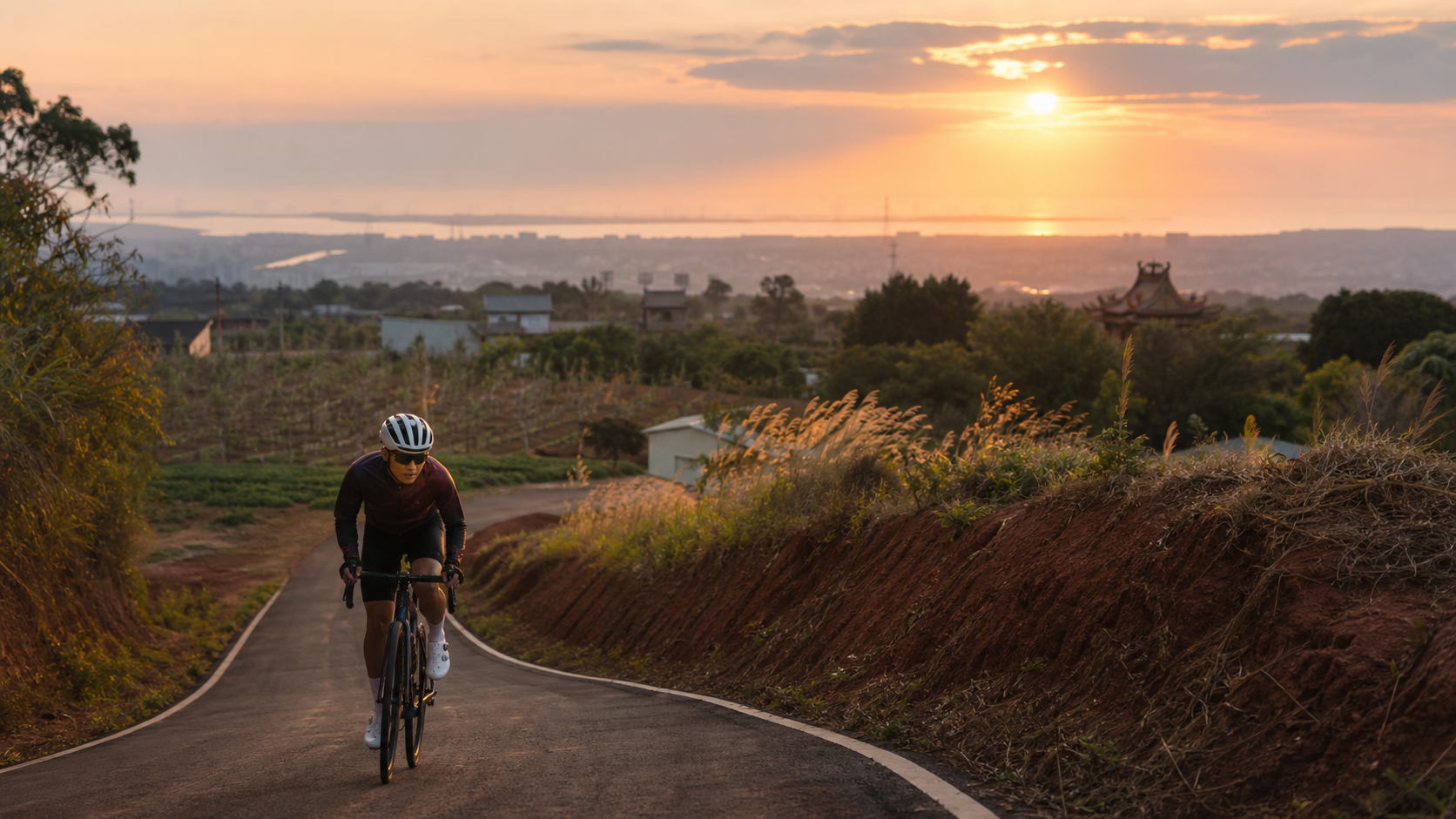
Wind, Red Clay, and a Climb Called Dake Road
“Some roads never appear in travel guides, but they show up in every breath you take while riding.”
The first time people hear the name “Dake Road,” many assume it’s some kind of access road to a tech park. Not so—it quietly lies along the edge of the tableland where Linkou and Taishan meet in New Taipei City, an industrial road just over 5 kilometers long with roughly 255 meters of total elevation gain and an average gradient of 4.2%. There are no grand mountain vistas, no famous landmark photo spots, but ride it once and you’ll likely understand why this unassuming climb keeps coming up in conversations among local cyclists.
The Linkou Tableland: A Place Shaped by Red Clay and Wind
To understand Dake Road, you first need to understand the land it sits on—the Linkou Tableland. This is a relatively distinctive landform at the western edge of New Taipei City, with an average elevation of about 255 meters, composed of flat tableland surfaces, hilly valleys, and coastal flats, with the tableland and hilly valleys each accounting for roughly 40 to 50 percent or more of the area. Unlike the Taipei Basin, with its surrounding mountains and heavy humidity, the Linkou Tableland is relatively open. Standing at the edge of the tableland and looking outward, your view can stretch all the way toward the coastline, and on clear days you can even feel the damp, salty breath of sea breezes drifting in.
The geology of this tableland is known for its red clay terraces. In earlier times, because the soil drained quickly and was poor in nutrients, agricultural development never flourished here the way it did in neighboring plains, which instead allowed the area to retain a relatively pristine, underdeveloped hilly character over the long term. This is also why, when riding on an industrial road like Dake Road, you’re rarely surrounded by high-rises or dense commercial districts. Instead, you get low orchards, vegetable plots, the occasional corrugated-iron work shed, and grasses and trees swaying in the wind—a unique atmosphere somewhere between the urban fringe and the countryside.
From a climatic perspective, the Linkou area falls under a hot, rainy subtropical climate, with an annual average temperature around 22°C. In the peak of July, the average monthly high can approach 29°C, and annual rainfall exceeds 2,000 millimeters, making it a genuinely rain-rich region. These climatic conditions, combined with the fast-draining red clay geology of the tableland, together shape the distinctive vegetation of this land—you’ll see drought-tolerant, nutrient-poor scrub forests and grasslands interspersed, occasionally mixed with planted fruit trees and cash crops, forming a transitional landscape that is neither true wilderness nor manicured farmland. This地貌 character, caught between nature and human intervention, echoes in some ways the personality of Linkou itself—half rapidly expanding new town, half untamed hilly open country that hasn’t been fully domesticated.
Riding on Dake Road, you can clearly feel how this geology translates into a different riding experience. Compared to other common mountain climbs in the north (such as those industrial roads that follow river valleys, hemmed in by cliffs on both sides), Dake Road, sitting at the edge of the tableland, offers relatively open views, and the gradient changes lack that steep, oppressive feeling compressed by canyon terrain. Instead, you get a long, steady climbing rhythm. For riders accustomed to flat urban roads who rarely venture into mountainous terrain, Dake Road can be considered a relatively friendly “entry-level mountain route”—you feel the cardiovascular challenge of climbing, but without being scared off by excessively steep gradients.
Linkou was formerly known as “Shulinkou” (Tree Grove Mouth). According to records, Han settlement began around the 18th century, primarily by immigrants from Quanzhou who came to clear and cultivate the land. During the Japanese colonial period, the administrative division of Linkou Village (Linkou Zhuang) was established, and after the war it was reorganized as Linkou Township, Taipei County, until the end of 2010 when it was formally upgraded to Linkou District following New Taipei City’s elevation to a special municipality. From a relatively peripheral rural settlement to a rapidly developing new urban area driven by the high-speed rail, airport MRT, and large-scale redevelopment zones, Linkou has changed enormously over these decades. But even as high-rises go up one after another in the urban core, the winding industrial roads along the tableland’s edge have largely retained their original character—and that’s one source of Dake Road’s appeal: it lets you switch instantly into a completely different rural rhythm just a short ride from the Linkou redevelopment zone.
Scenery Along the Way: Tableland Daily Life Seen from an Industrial Road
Riding on Dake Road, you won’t see deliberately designed tourist attractions. Instead, what you get is a genuine landscape of everyday life for local residents. On both sides of the road, orchards and vegetable gardens occasionally appear, growing seasonal produce, and sometimes you’ll spot farmers bent over tending their fields; further along, you might come across a small farmstead for aquaculture or livestock, with faint scents of grass and earth drifting in the air. This sense of “lived-in life” is precisely why many urban cyclists treasure Dake Road—riding here, what you feel isn’t a curated tourist route but the实实在在 workings of rural life on this tableland.
As the gradient climbs, the views gradually open up. Looking back, you can see the layered contours of Linkou’s urban area and surrounding hills, and on clear days, you can even glimpse the shimmering surface of the Taiwan Strait in the distance. This image of “looking back at the road you’ve climbed” is often the moment riders most enjoy capturing during a mid-ride rest—not because the scenery is spectacular or breathtaking, but because that sense of accomplishment—“I’ve actually climbed this high”—lends an ordinary hilly view a special glow.
In autumn and winter, when the northeast monsoon strengthens, the wind at the high points along the tableland’s edge is noticeably stronger than in the urban area. This strong wind can sometimes make climbing harder, but looked at another way, it’s also the unique geographic character of the Linkou Tableland—unlike valley routes enclosed by mountains that feel airless, it preserves an open, transparent riding sensation, closer to the sky. On summer afternoons, brief thunderstorms occasionally roll in, with dark clouds piling up rapidly from the direction of the sea, followed by a sudden downpour washing over the entire tableland, and the air fills with the distinctive scent of red clay dampened by rain—for veteran riders who frequent Dake Road, this smell has almost become a kind of bodily memory.
Local Culture and Surroundings: Linkou Is More Than Just a Redevelopment Zone
When Linkou is mentioned, many people’s first thought might be large shopping centers like Mitsui Outlet Park Linkou, or the high-rise redevelopment districts that have grown rapidly in recent years. But if you’re willing to spend time exploring, you’ll find that Linkou actually preserves quite a few corners closer to the roots of local culture. Zhulin Shan Guanyin Temple is a well-known local center of faith, dedicated to the Eighteen-Armed Guanyin, with thriving incense offerings. It’s an important place for many local residents to worship and pray in daily life, and a window into understanding Linkou’s indigenous religious culture. The Linkou Grand Canyon is another distinctive landscape—originally exposed terrain left by sand-mining operations, it has, through the passage of time, unexpectedly become a secret spot for photography enthusiasts to capture images—those yellowish strata textures, paired with occasional lake reflections formed by accumulated water, create an almost surreal visual impact.
If you still have energy left after riding Dake Road, consider exploring the area around Linkou Old Street to experience the unique blend of old and new that this city presents amid rapid urbanization—on one side, rows of new construction projects and MRT co-development buildings; on the other, a traditional eatery that has been operating for decades, insisting on time-honored methods. As for which specific shops are worth recommending, it’s best to rely on on-site reputation and local community recommendations, since businesses rise and fall quickly. Rather than pinning down a single shop name in an article, it’s better to encourage everyone to go out and discover their own finds in the alleys themselves.
In recent years, with the airport MRT opening and the large number of new construction projects completed in the Linkou redevelopment zone, this city’s skyline is changing at a visible pace. From the top of Dake Road looking toward the urban area, you’ll see a scene where a whole stretch of new high-rises coexists with traditional low farmhouses—this stark contrast between old and new is precisely the most authentic portrait of Linkou during its transformation. For those who have long followed this land, there may be some wistfulness—those low hills and vegetable fields that once dominated the view are gradually being replaced by high-rises and road construction. But precisely because of this, an industrial road like Dake Road, which still preserves its original landforms and rural way of life, becomes all the more precious—it’s like a time capsule temporarily preserved, allowing riders, in the gaps of rapid urbanization, to briefly return to a rhythm closer to the essence of the land.
Beyond local religious culture, the Linkou area also preserves quite a few old buildings and traces of ancient trails that bear witness to the development of settlements. Though their scale isn’t as grand as famous heritage sites, for riders who enjoy exploring local history, these small traces scattered among the hills often sketch out a city’s true growth trajectory better than bustling tourist attractions. It’s recommended that, beyond riding, you slow down and pay attention to those seemingly unremarkable old houses, earth-god shrines, or boundary markers along the roadside—they often hold fragments of stories about how this land was cleared, named, and given meaning by generations of residents.
First-Person Riding Narrative: A Five-Kilometer Journey from Gasping to Release
That day was a weekday evening, and I deliberately left work early, hoping to finish this ride up Dake Road before the sky was completely dark. Starting from Linkou’s city center, I followed the industrial road toward the edge of the plateau. Before I even officially entered the climb, the distant sky had already begun to take on a faint orange-red hue. The moment I turned onto Dake Road, the gradient immediately shifted from gentle to a noticeably steeper angle. Instinctively, I shifted to an easier gear and began this familiar yet unfamiliar climbing journey.
The first half of the climb wasn’t too brutal. I could still maintain a relatively comfortable cadence, and although my breathing was gradually becoming heavier, it was still within the range where I could chat. In an orchard by the roadside, an elderly man was watering his plants with a hose. Seeing me pass by, he looked up and smiled—that kind of pressure-free greeting that belongs purely to rural daily life instantly added a touch of warmth to the entire ride.
Entering the middle section, the gradient began to increase noticeably, and my breathing shifted from “able to chat” to a panting rhythm of “can only respond in short bursts.” Sweat began dripping along the edges of my helmet, my vision narrowed slightly from the focus of pedaling, and the whole world seemed to shrink to just the small patch of asphalt ahead and the growing ache in my thigh muscles. At moments like this, all sorts of thoughts surface in my mind—“How much longer,” “Should I slow down,” “I shouldn’t have come today”—but my body honestly keeps turning the pedals, round after round, as if muscle memory had made the decision to “keep going” long before my willpower did.
Around the last kilometer or so, the view suddenly opened up, and the wind began blowing more directly against my face. Looking back, the road I’d come up stretched far below, and the silhouettes of Linkou’s buildings were beginning to show scattered lights against the darkening sky. In that instant, all the earlier gasping, soreness, and hesitation seemed to be diluted by the expansive view, replaced by an indescribable sense of groundedness—not the feeling of conquering some great mountain, but simply, with my own legs, having pedaled out this 255-meter elevation gain.
After reaching the top, I didn’t immediately turn around to descend. Instead, I stopped by the roadside, letting my heart rate slowly settle, watching the sky shift from orange-red to deep blue. In that moment, I suddenly understood why so many riders who live in the city, who have far more diverse route options, still return again and again to this slope that isn’t particularly long or spectacular—because it offers just the right amount of challenge, allowing you, within a limited time, to trade physical effort for a complete, personal arc of emotional ups and downs.
On the descent back, the wind rushed past my ears, and my thigh muscles, which had been sore and burning moments ago, gradually regained sensation in the cool breeze. I deliberately slowed down, in no hurry to race down the hill, instead letting my eyes capture the details I’d missed on the way up because I was too breathless and too focused—a clump of silvergrass swaying by the roadside, the warm yellow light spilling from a window in a distant house, the air carrying a mix of earth and vegetation. This sense of ease that only appears on descents is, in a way, another pleasure of riding Dake Road: first giving your all to bear the challenge gravity presents, then using that same gravity to earn back a stretch of nearly effortless gliding—like a fair transaction between body and gravity, where you pay first and then get repaid.
Back on flat ground, I stopped at a convenience store, bought a sports drink, and sat on the steps outside, watching the passing traffic and pedestrians. That unique blend of fatigue and relaxation that follows a focused workout, mixed with a hint of accomplishment, is the closing moment I treasure most after every ride up Dake Road. My phone screen lit up as Strava auto-synced, showing the elevation and time data for the ride—but those numbers, after all, are just a small part of the record of this experience. What truly remains in my body and memory are the gasps, the scenery, and those fleeting yet utterly real thoughts and feelings.
What Dake Road Means to Riders: A Repeated Dialogue with Yourself
In cycling, we often chase those distant, grand, iconic long-distance challenges—Wuling, Hehuan Mountain, the island loop. But these are ultimately goals that require massive amounts of time and physical preparation; they’re not something you can achieve every day or every week. Routes like Dake Road—“short yet solid”—instead take on a role closer to everyday life: it’s the kind of route you can decide on a whim to ride on a weekday evening while there’s still some light; it’s the kind of route you can ride carrying all sorts of different moods—fatigue, irritability, excitement, confusion—and then, gasping for air at the summit, reset your state of mind.
For many riders who have long made Dake Road a regular route, this road is more like a mirror. If the climb feels especially easy today, perhaps it reflects that recent training has been paying off; if it feels especially breathless and laborious today, it might accurately reflect irregular sleep patterns or excessive stress lately. This quality of “the body honestly reflecting your condition” is the unique value of this kind of short, highly repeatable route—you can’t fool yourself, and the gradient won’t become gentler just because you’re in a bad mood.
I know several local riders who regularly check in on Dake Road. They describe it as their “emotional regulator.” When work stress piles up, they ride up to huff and puff and break a sweat, letting the accumulated irritability drain out with the perspiration; when feeling down, they also choose to ride this road—not to chase any PR, but simply to quiet the chaotic thoughts through physical exertion. This phenomenon of internalizing a single route into a life ritual can be seen in many long-time riders—repeatedly riding the same road, and over time, that road ceases to be just a set of coordinates on a map and becomes a kind of emotional vessel, carrying your moods and states from different phases of life. It’s precisely for this reason that many people distinctly remember a particular moment on a familiar slope—a time they especially wanted to cry, or especially wanted to laugh out loud. Those moments are often etched more deeply into memory than any scenic photo.
Seasonal Scenery and Suggested Side Trips
Dake Road offers a different riding experience in each season. In spring, you can occasionally catch faint floral scents in the mountain air, and the climate is relatively pleasant—it’s the season when many riders restart their training rhythm. Summer is hot, so it’s recommended to schedule rides in the early morning or near sunset. Besides avoiding the heat, the sunset views at the plateau’s edge during early evening are especially captivating, with orange-red light spilling across the red-soil slopes, creating a warm palette that’s hard to replicate in the city.
Autumn can be said to be one of the most comfortable riding seasons of the year. Before the northeast monsoon fully kicks in, temperatures are cool and humidity is moderate—ideal for arranging a slightly longer training session, linking Dake Road with other routes around Linkou into a loop. In winter, you should be mentally prepared for the stronger northeast monsoon winds at the plateau’s edge, as well as occasional damp, cold rain. It’s advisable to have proper thermal and waterproof gear ready, and to keep an eye on weather conditions before deciding whether to head out.
If you still have energy after riding Dake Road, consider exploring the Linkou area—whether it’s visiting Zhulin Shan Guanyin Temple to experience the local religious atmosphere, heading to the Linkou Grand Canyon to admire its distinctive landscape, or simply finding a small local eatery in an alley, sitting down for a drink and a snack to let your body gradually shift from high-intensity climbing mode back to relaxation. Any of these is a wonderful way to put a warm finishing touch on the ride.
Conclusion: A Climb for Weekdays, a Climb for Yourself
Dake Road won’t appear on any glamorous “Top 100 Cycling Routes in Taiwan” list—it’s too short, too ordinary, too unremarkable. But precisely because of that, it has become a route so many riders are willing to revisit—no need for cross-county expeditions, no need to invest a full day of trip planning. All it takes is one evening, one bike, and the desire to work up a good sweat, and you’re ready to go.
If you also live in the greater Taipei area but always feel that long-distance goals like Wuling or the Northern Cross-Island Highway are out of reach, why not start with Linkou’s Dake Road. Let this 255-meter-elevation plateau climb become a daily ritual in your cycling journey—one you can practice repeatedly, converse with repeatedly, and repeatedly make peace with yourself on.
The next time you’re at dusk, gazing at the sun gradually sinking in the west, hesitating about whether to head out for a ride, perhaps you can think of this road—think of the wind blowing across the red-soil plateau, think of that casual smile from the elderly man watering his vegetable garden by the roadside, think of that expansive view at the summit where you can see all the way to the coastline. The most captivating thing about cycling has never been just how many meters of elevation you conquer, but rather the connection to yourself and to this land that you rediscover between each pedal stroke. Dake Road isn’t long, but it’s enough—through one visit after another—to slowly introduce you to that quiet yet solid plateau landscape at the edge of this city, shaped together by red soil and sea breeze.
Related Reading
- Linkou Dake Road Practical Guide: A 5.13 km, 255 m Climb — An Introductory Urban Hill Route
- New Taipei Linkou Plateau Route: Riding Routes and Supply Guide for the Northwest Coastal Hills
- From Penglai Rice to Calla Lily Fields: A Ride Up Zhuzihu Road Is a Lesson in Forgotten Industrial History
- The Gentle Slopes of Zhongshe Road: Among the Scenery of Waishuangxi, the Reasons That Keep Me Coming Back
高雄綠園道鐵路自行車道 / 外地人能輕鬆駕馭 還是整路崩潰? / 2025 全線開通 春節實地探索一次!(附GPS連結)/ 公路車 / CT Yeh
1 年前
4K單車實境) 嘉義 梅山36灣 訓練台 爬坡 輕鬆騎
6 年前
半日 小台灣 極限單車路線挑戰實錄
7 年前
觀霧 變好騎了! | 北高車友爆笑大會師 | 公路車 | 單車旅遊 Taiwan Cycling Route GuanWu
6 年前
虎豹潭!日本老師來台一日約騎 台灣車友熱情招待私房路線 / CT Yeh
19 天前
單車 梅山36灣 坡度介紹 路段介紹 空拍 (相關遊記影片,請參考說明或我的頻道喔,歡迎訂閱)
6 年前
4K單車實境) 舊陽金P字道 第1P 仰德大道至小油坑 誤跟武嶺神人們 被拉爆爽飛天 Taiwan Cycling Climb Route Recommend
7 年前
嘉義大埔、阿婆灣挑戰賽,美到以為在日本!ft. 環騎5 Cool 西拉雅188 / 公路車 / CT Yeh
7 個月前