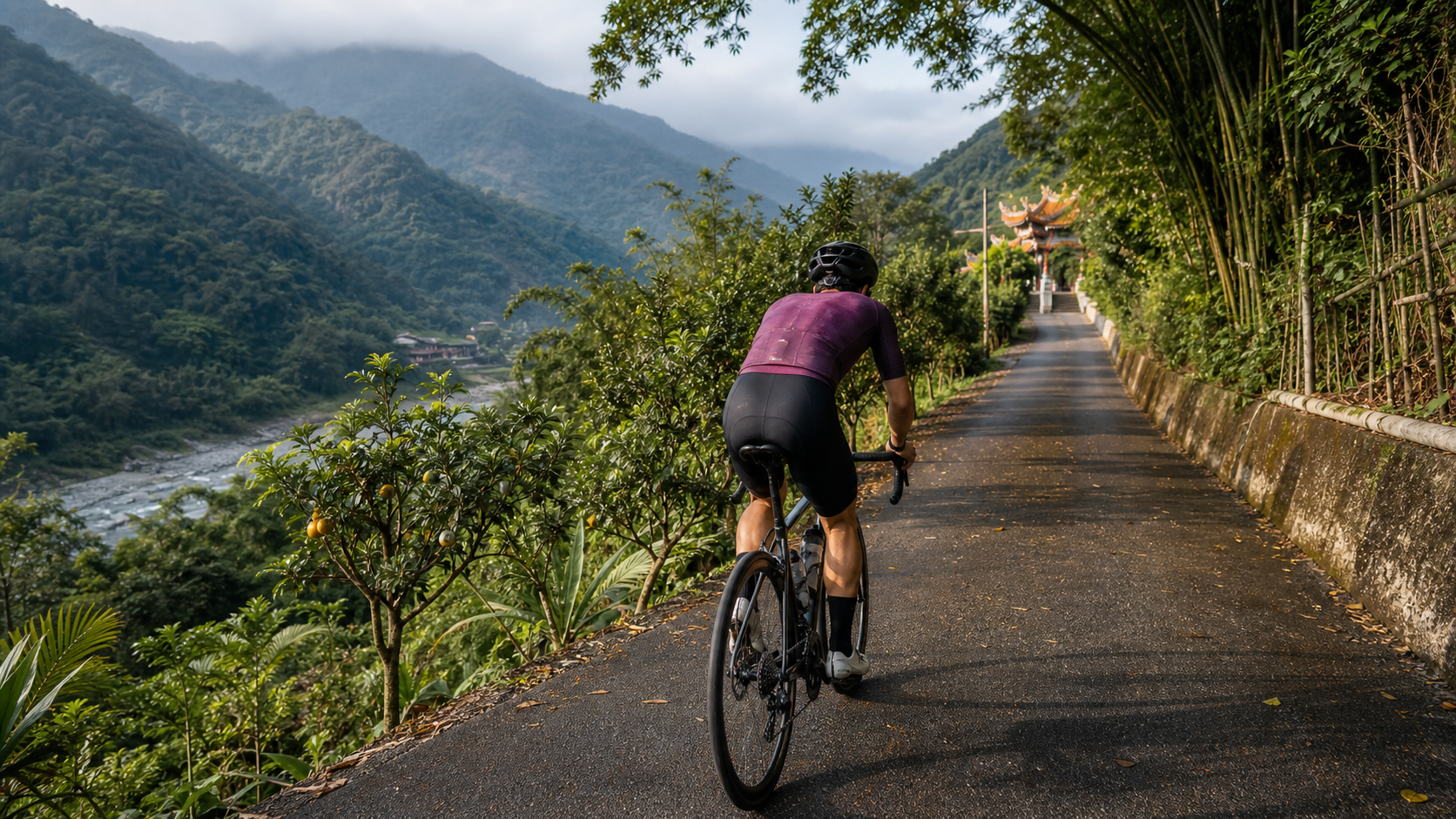
Sweat and the Smell of Fireworks: A 7.6 km Mountain Ride to Wulai Baoqing Temple
Before Setting Off: A Place Name About “Very Hot Water”
After cycling for a while, you gradually develop a habit—whenever you visit a place, you can’t help but look up the story behind its name. The name Wulai comes from the Atayal word “Ulay,” meaning “the water is very hot, be careful.” It is said that in the early days, the Atayal people discovered hot springs bubbling up here and warned their tribespeople to be careful of scalding. This place name, carrying a hint of warning yet full of everyday life, somewhat aptly describes the first impression this climbing route to Baoqing Temple gives: it doesn’t look intimidating at first, but you only feel the real heat once you start riding.
That day when I wheeled my bike out the door, the sky still held a hint of grayish blue. Traffic on Xinsin Road was sparse, with only the occasional early-rising truck roaring past. Riding south along Provincial Highway 9A from Xindian city center, the density of buildings on both sides visibly decreases with each kilometer—from row houses and convenience stores, gradually transitioning to scattered tin sheds and vegetable gardens, and a bit further on, you begin to see the river valley and mountain contours closing in from both sides of your view. That shift in scenery is essentially the signal for both body and mind to switch into “mountain mode.” The moment you turn onto Huanshan Road, the road narrows, and the gradient shifts from a gentle rise to a noticeable climb. The 7.59 kilometers and 464 meters of elevation gain to Baoqing Temple officially begin right before you.
I’ve always felt that a good route isn’t just about impressive numbers—it’s about the moments you remember after finishing: a certain instant, a play of light and shadow, a view that suddenly opens up after a turn. The road to Baoqing Temple is exactly the kind of climb that leaves images etched in your memory.
The Gentle Trap at the Start: From Xinsin Road to Huanshan Road
For the first kilometer or two after turning from Xinsin Road onto Huanshan Road, the gradient is actually quite mild. On both sides of the road, you can occasionally spot orchards and vegetable plots, with farmers bent over tending their crops, looking especially tranquil in the morning light. The riding experience on this stretch is genuinely comfortable, even giving you the illusion that “this road today isn’t as hard as I imagined”—until the gradient truly begins to ramp up, and you realize that the gentle slope you just climbed was merely a warm-up. The real test is only just beginning.
I like to understand this kind of terrain structure as a “gentle trap.” It doesn’t scare you off with the steepest gradient right from the start. Instead, it builds your confidence with a mild rhythm, letting you enter the mountains with a relaxed mindset, and only when you’re truly immersed in the rhythm of riding does it slowly reveal the true face of the gradient. This progressive narrative of terrain, in a way, echoes the first impression the mountains of Wulai give you—from the foot of the mountain, the slopes look gentle and mild, but once you go in, you discover that the layered ridgelines and river valleys are far more complex and profound than you imagined.
Along the way, you occasionally encounter local residents out for their morning exercise, walking their dogs or slowly cruising on old bicycles. We nod to each other in acknowledgment—that unique warmth of a small mountain community, a goodwill conveyed without words, is a feeling hard to experience amid the hustle and bustle of city riding. Wulai District has a population of just over 6,000, making it the least densely populated administrative district in New Taipei City. As a result, it retains a relatively pure, slow-paced way of life, and this atmosphere seeps into the mindset of your ride bit by bit through the scenery along the way and the expressions of the residents.
The Mid-Section Steep Climb: A Stretch of Conversation with Yourself
Entering the main climbing section in the middle, the gradient noticeably rises to 6–8%, with some switchbacks even approaching double digits. This is the most honest stretch of the entire route—no scenery to distract you, no descents to catch your breath, just you, your breathing, the sound of the chain engaging with the cassette, and the occasional birdsong filtering through the trees. At times like this, cycling becomes a deeply personal, almost meditative state.
I remember on that day, riding through the steepest section, my mind could barely think of anything—only the instinctive calculations of how far to the next utility pole, whether the gradient would ease after the next bend. Sweat dripped down along the helmet straps, my vision narrowed from focus, and the entire world seemed to shrink to just the few meters of asphalt in front of me. This state is something long-distance runners or swimmers might also recognize—when the body is pushed to a certain intensity, thoughts actually quiet down, entering a state of near “flow” concentration.
Interestingly, in that state of focus, the sounds of the mountain become exceptionally clear. The tributaries of the Nanshi River babbled through the valley, occasionally interspersed with the rustling of bamboo groves stirred by the wind. These are sounds you’d never notice riding through the city, but in this state where the body is pushed to its limits yet the senses are unusually acute, they become the most profound memory fragments of the entire ride. This is probably why so many riders are willing to return again and again to challenge the same climb—not because it’s easy, but because it can take you into a state of focus that’s hard to reach in everyday life.
The Atayal Mountains and the Story of the Nanshi River
Wulai District is the only indigenous mountain district among the special municipalities in Taiwan, with indigenous people accounting for about 40% of its population, primarily the Atayal people, belonging to the Sekoleq group. The Atayal have long been skilled at hunting, farming, and weaving in the mountains, with a traditional culture that holds deep reverence for and dependence on the forests. This philosophy of coexisting with nature is, to some extent, reflected in the natural landscape that Wulai’s mountain area still preserves and its relatively restrained development intensity.
The Huanshan Road area where Baoqing Temple is located sits geographically in the upper reaches of the Nanshi River watershed. The Nanshi River originates from Songluo Lake between Qilan Mountain and Quantoumu Mountain, stretching about 45 kilometers in total. Along its course, it gathers tributaries such as the Hapen River and Tonghou River before eventually flowing into the Xindian River, making it one of the most important water systems nourishing the Wulai and Xindian areas. The deep valleys and cliff terrain carved by the river have created Wulai’s famous “Youxian Gorge” and other valley landscapes, giving the entire Wulai mountain area a richly layered topography—towering ridgelines, steep river valleys, and winding industrial roads interwoven together. This is why Wulai’s climbing routes are always full of switchbacks and terrain variation, rarely featuring long, straight, monotonous climbs.
Riding through these mountains, it’s hard not to imagine how the Atayal people traveled, migrated, and hunted for survival across these forests hundreds of years ago. Today, we ride lightweight road bikes, wearing moisture-wicking technical apparel, completing in under an hour a journey that, for the tribespeople of that era, might have been an everyday path requiring foot travel, carrying heavy loads, and crossing mountains and ridges. This contrast across time adds a layer of historical weight to riding this route, reminding us that these mountains are not a tourist resource that exists out of nowhere, but land carrying the memories of generations of life.
The Finish at the Temple Plaza: Baoqing Temple and Local Faith
After finishing the mid-section steep climb, the gradient gradually eases, followed by a brief stretch to catch your breath, and then a final short steep push to the plaza in front of Baoqing Temple. When the wheels finally come to a stop on the open ground before the temple, and you take off your helmet, the mountain breeze sweeps across your sweat-soaked neck, bringing an indescribable sense of exhilaration—not just the satisfaction of completing a climb, but something closer to finishing a small pilgrimage.
As the local center of faith, Baoqing Temple has witnessed the lives and prayers of generations of residents in this mountain area of Wulai. Small mountain temples in Taiwan are often more than just religious sites; they are the core nodes of community life—the temple plaza serves as a gathering place for village meetings, temple festivals are important moments for bonding community emotions, and for residents who have lived in the mountains for years, these temples carry not just faith but also a symbol of collective memory and identity.
Standing before the temple plaza and looking back at the road you’ve traveled, you can see layered mountain ridges with clouds and mist slowly drifting between the ridgelines. That commanding view makes you instantly understand why so many riders are willing to endure the agony of the mid-section steep climb, just to trade it for this moment of scenery. This is also the most captivating thing about cycling—it uses the most honest way to let you exchange the effort of your legs for the height of your view. There are no shortcuts, yet precisely because of that, every arrival feels all the more real.
Suggested Side Trip: Healing Time at Wulai Old Street and Hot Springs
If time permits, after completing the Baocing Temple challenge, consider a side trip to Wulai Old Street to give the ride a more complete finish. Wulai Old Street sits right next to the Nanshi River and retains many shops showcasing Atayal cultural characteristics, selling local specialties such as mountain delicacies, bamboo tube rice, grilled skewers, and river shrimp. For specific shops and items, it’s best to rely on the actual on-site conditions and shop signs, since turnover among old street vendors is fairly quick. Rather than memorizing a particular shop name, treating “eat as you wander, follow the crowds to find the lines” as the safest strategy is more practical.
The history of Wulai’s hot spring development can be traced back to its discovery in 1903 during the Japanese colonial period. Today, numerous hotels and bathhouses offering hot spring baths can still be found around the old street. For riders who have just completed a high-intensity climb with sore legs, soaking in a hot spring to relieve muscle pain is the perfect way to wrap up the trip. The heat of the hot spring promotes blood circulation, accelerates the metabolism of lactic acid, and eases muscle tension—in a sense, it’s a natural post-ride recovery therapy.
If you still have energy to spare, consider taking the Wulai Aerial Cable Car to Yun Hsien Resort to enjoy the forest recreation scenery above the waterfall, or arrange a trip to the Xinxian area to walk the suspension bridge and hiking trails, experiencing the mountain scenery from a different perspective than from the saddle. Stringing these attractions together turns the Baocing Temple ride into more than just a physical challenge—it becomes a mini-journey combining sport, nature, and culture.
Seasonal Scenery: When to Ride for the Best Views
The mountain scenery of Wulai changes with each season. Spring (March–April) is when mountain cherries and azaleas bloom in succession, and along the ring road you can occasionally catch glimpses of scattered blossoms dotting the emerald green forests. Summer (June–August) brings the densest canopy and richest greenery; early morning rides offer the mountain’s characteristic cool air, but afternoon clouds and even thunderstorms are common, so it’s advisable to complete the main climbing sections in the morning hours.
Autumn (October–November) typically has the most stable weather, with lower humidity and better visibility—the best season for appreciating the Nanshi River valley and distant mountain ridgelines. In my personal opinion, it’s also the best time of year to take on Baocing Temple—temperatures are neither too hot nor too cold, sweat levels are moderate, and visibility is usually at its clearest. In winter (December–February), under the influence of the northeast monsoon, the mountain area is prone to fog, and temperatures are noticeably lower than in the city. If you choose to ride in this season, be sure to take proper保暖 measures, especially on the descent back, where the wind chill effect can make the perceived temperature drop sharply.
What This Road Means to Me: Cycling Is More Than Just Cycling
Every time I finish riding Baocing Temple and sit on the steps in front of the temple square drinking water and resting, I find myself thinking about what cycling truly means to me. Perhaps it’s not just the simple physiological aspect of training the heart and lungs or building muscle—it’s more like a way to temporarily step away from the pace of daily life and reconnect with the land, with history, and with my own body.
The length and elevation profile of the Baocing Temple route sit right at a sweet spot of “challenging enough to feel it, but not enough to intimidate,” which also makes it a route well-suited for repeated visits—each ride, with a different physical state and a different state of mind, offers slightly different scenery and emotions. Sometimes it’s a training mindset focused on numbers and pacing; other times, like this time, it’s about slowing down and truly absorbing the forests, streams, temples, and human warmth along the way.
If you also live in the greater Taipei area and haven’t ridden Baocing Temple yet, I sincerely recommend picking a clear morning, wheeling your bike out the door, and heading south along Xinwu Road to personally experience what this 7.59-kilometer mountain road has to offer—not just 464 meters of climbing, but an entire conversation with the mountains, with faith, and with yourself.
Comparison with Other Greater Taipei Climbing Routes: Baocing Temple’s Unique Position
The greater Taipei area offers a rich variety of climbing routes, from the Yangmingshan system’s Fengguizui, Neishuangxi, and Dongshan routes, to the Nine Bends and Eighteen Turns on the Beiyi direction, to the Wulai system in the south—each with its own character and temperament. Compared to a climb like Fengguizui, which is relatively monotonous and characterized by a continuous steep ascent, Baocing Temple’s terrain structure is noticeably more layered—a three-part narrative of gentle start, steep middle section, and easing finish—making the entire ride experience closer to a story with a beginning, development, turn, and conclusion, rather than mere physical exertion.
Also, because the Wulai area sits within the Nanshi River watershed, the entire ring road system connects with surrounding branch routes, allowing for combinations of routes with various lengths and difficulty levels. This is one of the reasons Baocing Temple is particularly beloved by greater Taipei riders—it can serve as a standalone short training ride, or as one segment of a longer loop connecting toward Xinxian and Fushan. This flexibility makes Baocing Temple a route where “beginners can take on the challenge, and veterans won’t get bored”—something that’s actually quite rare among climbing routes.
I’ve also ridden the Yangmingshan system climbs many times, and in comparison, the mountain atmosphere around Wulai feels more primal and less eroded by urban expansion. Perhaps it’s due to Wulai’s special administrative status as an indigenous district, combined with development restrictions on reserved mountain land, that this forest area has retained a relatively unspoiled appearance. This ambiance directly translates into the psychological experience of riding—compared to the occasional traffic and tourist crowds on the Yangmingshan system, Baocing Temple most of the time still offers a sense of tranquility, a riding experience that feels almost like having the mountain all to yourself.
Glimpses of Daily Life in the Mountain Village: Moments Passed By
Riding the Baocing Temple route, what impresses me most often isn’t the grand scenery, but those fleeting moments of everyday life passed by. During the middle climbing section, I occasionally pass a few homes built into the mountainside, with freshly harvested crops drying under the eaves or a few pieces of clothing fluttering in the wind. Around a bend, I might see an elderly man squatting in his vegetable garden weeding, looking up to wave at passing riders with a wrinkled smile.
This unique rhythm of mountain life stands in stark contrast to the hurried pace of the city. Often, between breaths on the climb, I can’t help but take an extra look at those seemingly ordinary scenes along the roadside that are full of traces of life—drying chili peppers, stacked firewood, casually parked old scooters. These details piece together a picture of mountain life far more authentic than any tourism promotional photo.
There have also been a few times when I was pushing near my limit on the steep middle section, almost ready to get off and walk, when a local resident driving by in a small pickup truck would roll down the window and shout “Keep going!”—that kind of unpretentious encouragement from a stranger is often more energizing than any sports drink. This is probably the warmth you can only experience on lesser-known mountain routes—not the loud and boisterous cheering crowds, but this quiet, simple, yet sincere human kindness that accumulates bit by bit into the warmest part of riding memories.
Final Thoughts: Anticipation for the Next Visit
Every route ridden repeatedly gradually transforms from a mere geographic coordinate into an emotional map carrying personal memories as the number of rides increases. For me, Baocing Temple has long ceased to be just a segment number in Strava records—it’s a series of concrete images: the orchard path climbing slowly in the morning light, the breathing rhythm on the steep middle section so focused it approaches meditation, the exhilaration of looking back at the mountains from the temple square, and the warm steam of hot springs in the old street.
Writing this article is also, in a way, an invitation to those who haven’t ridden this route yet: find your own time and build your own Baocing Temple memories. After all, data can be recorded, compared, and surpassed, but those subtle sensations during the ride—the temperature of the mountain wind, the saltiness of sweat, the scent of temple incense, the sound of the distant stream—these can only truly be possessed by personally stepping on the pedals and experiencing them firsthand. The mountains of Wulai still hold many stories, worth writing anew, again and again, with your legs and your breath.
For First-Timers: Some Gentle Reminders
If this is your first time preparing to take on Baoqing Temple, my advice isn’t about pacing or gear ratios—those have been covered extensively in guide-style articles—but rather some reminders closer to the emotional side of things. First, please don’t treat this route as a race you must win at all costs. A large part of Baoqing Temple’s charm comes from the immersive experience it offers. If you spend the entire ride staring at the numbers on your bike computer, you’ll likely miss the canopy of shade carved into dappled light by the sun during the mid-section climb, or that moment near the end when the road opens up after a turn and you can suddenly see the ridgelines of the distant mountains.
Second, approach everything along the way with a sense of curiosity—not just the scenery, but also the people living on this land and their stories. As the traditional territory of the Atayal people, the cultural weight carried by these mountains and forests runs far deeper than most riders imagine. If you pass by tribal settlements or cultural exhibition spaces during your ride, feel free to slow down and observe with respect, rather than treating them as mere photo backdrops.
Third, and most importantly: after you finish riding, give yourself some time to sit in front of the temple square, or find a corner overlooking the valley, and just be still for a while. The pace of modern life is too fast; we’re too accustomed to packing every moment of our schedules full, rushing off to the next activity or scrolling through our phones to share updates right after a ride. But a route like Baoqing Temple—one that blends physical challenge, natural scenery, and cultural depth—deserves you to set aside a little time to let the fatigue in your body and the sense of fulfillment in your heart properly settle. That is the truly complete ending to this ride.
May you, too, one morning hear the rhythmic clicking of the chain, the whisper of mountain wind passing through the treetops, and your own heartbeat, as you slowly climb this mountain road of Baoqing Temple—a road that belongs to Wulai, to the Nanshi River basin, and to everyone willing to measure the mountains with their own two feet.
Related Reading
- Complete Guide to Wulai Baoqing Temple: 7.6 km, 464 m of Climbing—How to Ride This “Backyard of Xindian” Without Blowing Up
- A Hard Climb Without a Name: Riding into the Wulai Mountains to Lushan, a 546-Meter Conversation with Yourself
- Wulai Waterfall and Xianxin in New Taipei: A Valley and Stream Ride on the Outskirts of Taipei
- On the 10.2% Gradient of Syuewunao, I Learned to Have a Conversation with My Own Limits
觀霧 變好騎了! | 北高車友爆笑大會師 | 公路車 | 單車旅遊 Taiwan Cycling Route GuanWu
6 年前
嘉義大埔、阿婆灣挑戰賽,美到以為在日本!ft. 環騎5 Cool 西拉雅188 / 公路車 / CT Yeh
7 個月前
大武山20%魔王陡坡【JJSC南台灣遊騎Day2】!屁股真的要裂開了...凡士林抹滿也沒用?神秘金教堂還有超便宜夜市
3 個月前
Q老師約騎烏來瀑布 / 該買樂透了!?/ 公路車 / CT Yeh
11 個月前
大武山後門26%歡樂陡坡!JJSC南台灣單車行Day2 / 被颱風追著跑 / 公路車 / CT Yeh
2 年前
5 ℃ 櫻花之旅 / 75萬單車直接雨中洗車.../ 平菁街 / 北迴歸小隊 / 公路車 / CT Yeh
5 個月前
阿里山塔塔加 兩倍特濃版!全新隧道開通! 進喔!公路車 | CT Yeh
3 年前
台北闊瀨陡坡 騎旅 / 日本單車雜誌編輯車友臨時加入!/ 髮香才是最強的 / feat. 北迴歸線小隊 / 公路車 CT Yeh
6 個月前