Riding Toward the Saisiyat Sacred Ground: The Distance Between the Xiangtian Lake Climb and the Legend of the Short People's Ritual
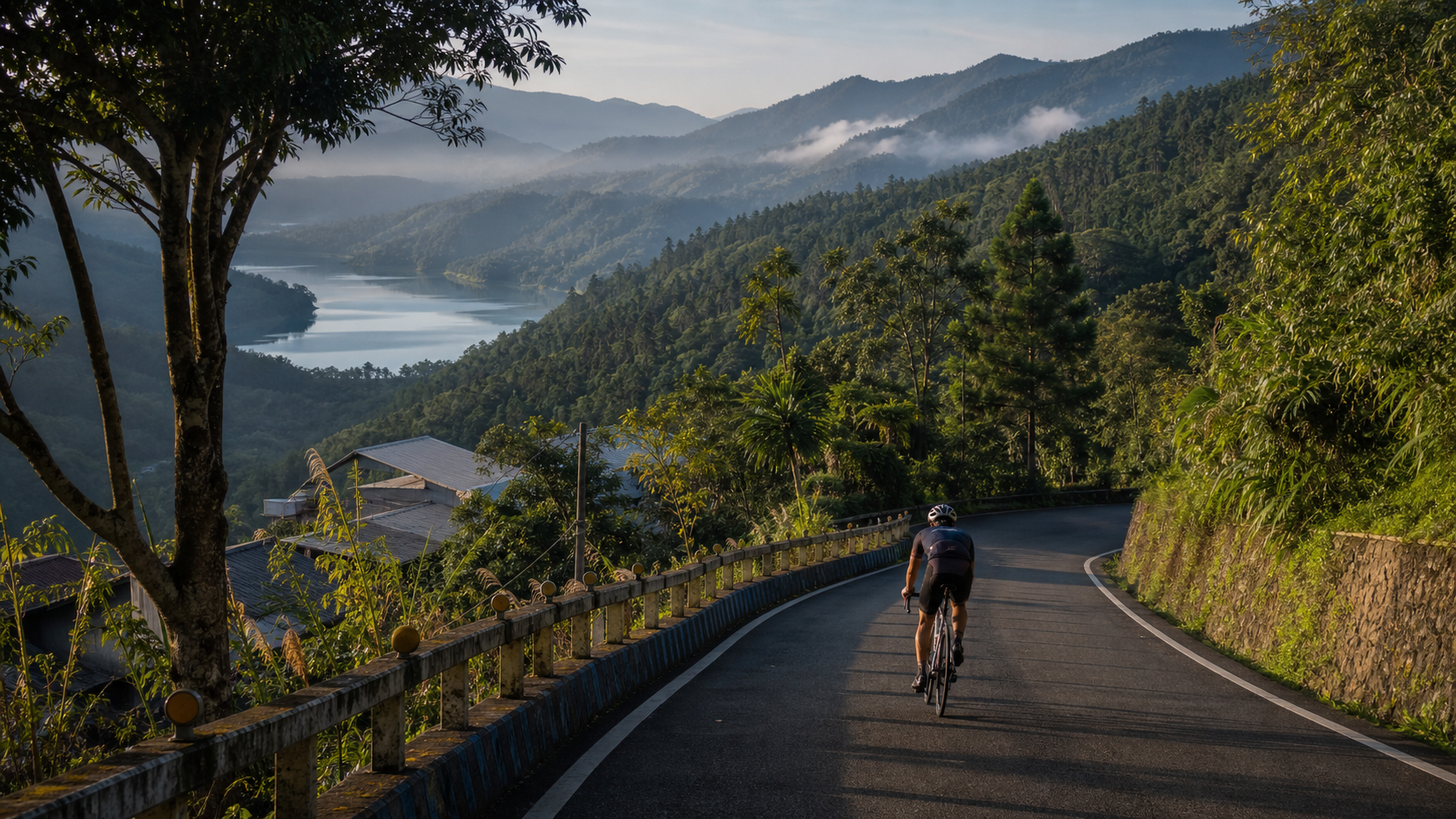
Nanzhuang: The Gateway Where Mountain Town and Ethnic Groups Meet
To reach Xiangtian Lake, you must first pass through Nanzhuang. This mountain town in the southeast of Miaoli County has long been known for its old-street charm and forested scenery, making it a popular choice for many Taiwanese people’s weekend getaways. But for travelers arriving by bike, Nanzhuang holds greater significance as a place where diverse ethnic groups converge—here you’ll find the deep roots of Hakka settlements, as well as the traditional territories of Saisiyat and Atayal indigenous tribes. These multiple cultures weave together a unique human tapestry across this hilly terrain.
Setting out from downtown Nanzhuang and riding along the winding mountain road toward Xiangtian Lake, you’ll clearly feel the shift in settlement patterns. Around the town center, the commercial atmosphere typical of a Hakka mountain town remains—old wooden buildings and food stalls line the historic street. But as the elevation gradually rises, the landscape along both sides of the road transforms into dense forest interspersed with scattered tribal settlements. This dual transition of terrain and culture is precisely what makes the Xiangtian Lake climb so captivating—it’s not just a physical challenge, but a journey across the boundaries of ethnic cultures.
Nanzhuang’s terrain is dominated by rolling hills and river valleys, with streams winding through the area. In earlier times, the abundant forest resources and the difficulty of access from the interior meant that relatively intact indigenous traditional territories and ways of life were preserved here. The area around Xiangtian Lake is precisely the core region where the Saisiyat people have long lived and held their important ceremonies, which gives this climbing route a cultural weight far deeper than mere athletic data.
Xiangtian Lake: The Sacred Ground of the Saisiyat People
Xiangtian Lake is a well-known alpine lake within Nanzhuang Township, Miaoli County. With its calm waters and surrounding mountains, it is a scenic spot in its own right. But what gives Xiangtian Lake its special place in the cultural history of Taiwan’s indigenous peoples is that it is one of the important venues for the Saisiyat’s most significant ceremony—the Dwarf Ceremony (Pas-ta’ai).
The Saisiyat are one of Taiwan’s indigenous peoples with a relatively small population, yet they have preserved their cultural traditions quite completely. They are mainly distributed around Wufeng Township in Hsinchu County and Nanzhuang Township in Miaoli County. The Dwarf Ceremony, Pas-ta’ai, is the Saisiyat’s most representative and most widely known ritual, traditionally linked to the long-standing legend between Saisiyat ancestors and the short dark-skinned people (the Ta’ai). According to the Saisiyat’s orally transmitted narratives, the Ta’ai once lived alongside the Saisiyat, teaching them farming, song, and dance skills. But a conflict later arose, and the Ta’ai were nearly wiped out. To appease the spirits of the Ta’ai and pray for peace and bountiful harvests, the Saisiyat established this ceremonial tradition that has been passed down to this day.
The Dwarf Ceremony is conducted with great regularity and sanctity. The ritual process includes multiple stages such as inviting the spirits, entertaining the spirits, and sending off the spirits. During the ceremony, tribal members chant specific ritual songs and perform distinctive dance steps. The overall atmosphere is solemn and reverent, making it the core arena for the Saisiyat to consolidate ethnic identity and pass on their culture. The area around Xiangtian Lake is one of the important locations where Saisiyat tribes hold related ceremonial activities, and it is therefore regarded as the sacred ground of the Saisiyat people. As for the exact cycle of the Dwarf Ceremony, the detailed ritual procedures, and the rules regarding outside participation, these involve the Saisiyat’s profound belief system and tribal autonomy. For those interested in learning more or hoping to participate in person, it is strongly advised to rely on official announcements from the Saisiyat tribes and relevant cultural authorities, and to approach this precious intangible cultural heritage with respect and humility.
As outside riders, when we cycle past Xiangtian Lake, the most important mindset to adopt is one of reverence—this is not merely a scenic spot suitable for photo check-ins, but a sacred domain where a people has passed down its faith and memories through generations.
Scenery and Landmarks Along the Way
The landscape along the Xiangtian Lake climb changes considerably. The early section of the route mostly passes through orchards and scattered homes on the outskirts of Nanzhuang. As the elevation rises, the road gradually enters deeper mountain forest, with vegetation shifting from cultivated fruit trees to natural secondary forest, and the humidity and woody scent in the air growing increasingly pronounced. In the middle section, where gradients rise and fall in alternation, views are somewhat limited due to the terrain—mostly a mix of switchbacks and shaded forest that demands the rider’s full concentration to handle the changing slopes. But occasionally, rounding a bend offers a glimpse of layered mountain ridges in the distance—a rare visual reward on this stretch.
As the road approaches Xiangtian Lake, the terrain gradually opens up, and the distinctive alpine landscape around the lake begins to reveal itself. The lake itself is calm, surrounded by mountains on all sides. On clear days, the water surface reflects the surrounding mountain colors and the sky, forming a serene and beautiful scene. This is also one of the origins of the name “Xiangtian Lake”—the lake surface seems to mirror the sky, tranquil and vast.
A lakeside walking trail surrounds Xiangtian Lake, perfect for switching to a pedestrian pace after completing the cycling challenge, slowly circling the lake to enjoy the surrounding ecology and scenery. The lake area also houses the Saisiyat Cultural Museum, which displays traditional Saisiyat clothing, daily implements, and artifacts related to ceremonial culture. It serves as an important window for gaining a deeper understanding of Saisiyat history and cultural context. If time permits, a visit is highly recommended, turning this ride into not just a physical challenge but also a complete cultural learning journey.
Local Culture and Culinary Memories
The food culture around Nanzhuang and Xiangtian Lake blends two distinct yet equally rich culinary traditions: Hakka and indigenous. On the Hakka side, local eateries along the way commonly serve home-style dishes such as stir-fried pork intestines with ginger, Hakka stir-fry, and ban-tiao (flat rice noodles). On the sections closer to Xiangtian Lake and deeper into Saisiyat traditional territory, you may encounter food stalls or mountain-produce shops offering indigenous-style cuisine, such as wild vegetables and wild boar meat prepared with local ingredients.
Since these local eateries and mountain-produce shops are mostly family-run and small in scale, their names and opening hours may vary with the seasons or the owners’ personal arrangements. It’s best for riders to rely on on-site observation or ask local residents upon arrival, rather than fixating on specific establishments. This approach actually allows you to better experience the easygoing, spontaneous pace of life on this land.
The area around Xiangtian Lake is also one of the origins of traditional Saisiyat crops and handicrafts. If the timing is right, you may encounter small stalls along the way selling seasonal produce or handwoven items—these are the most direct ways to experience local life and also the most direct support for the local tribal economy.
First-Person Riding Narrative: First Encounter with the Lake
That day I set out from downtown Nanzhuang under clear skies, sunlight streaming through the clouds onto the winding mountain road. The gentle early slopes gradually got my body into gear, with orchards and scattered homes keeping me company, and my mood was still fairly relaxed. But once I entered the second section of alternating gradients, I truly realized that the Xiangtian Lake climb was markedly different from what I had imagined when I read “average gradient 7.1%, should be manageable”—the rhythm of slopes turning steep then easing forced me to constantly adjust my pedaling effort, and that continuous switching demanded more focus than simply sustaining steady pressure.
When I entered the third section, the core of the main climb, the gradient rose noticeably. My breathing quickened, and sweat ran down my cheeks. I tried to recall the information I had looked up before setting out—the end of this road is the Saisiyat’s sacred ground, one of the important venues for the Dwarf Ceremony. That thought, at the moment I pressed down hard on the pedals, suddenly gave this climb a weight different from a mere athletic challenge. I wasn’t just conquering a slope; I was approaching, step by step, with something like a pilgrim’s heart, a place that carries a people’s memory and faith.
On the final stretch of the climb, the gradient picked up again, but so did my sense of anticipation. When the view finally opened up and the surface of Xiangtian Lake appeared before my eyes, all the fatigue seemed to dissolve in an instant. The lake was perfectly calm, the reflections of the surrounding ridges clearly mirrored on the water. The atmosphere, a blend of tranquility and solemnity, made me unconsciously slow my breathing, and I even felt an impulse to bow slightly to this land.
I parked my bike by the lakeshore and stood quietly for a few minutes. What surfaced in my mind was not the sense of accomplishment in numbers, but a deep respect for this land and its people’s culture. This ride taught me that the meaning of some routes extends far beyond what gradient and distance can define.
What This Route Means to Riders
The Xiangtian Lake climb, to me, is a route that teaches “humility.” Unlike certain stretches that purely pursue speed and records, where one focuses solely on breaking numbers, this route—because its endpoint carries the profound cultural and spiritual significance of the Saisiyat people—compels every rider, at the moment of reaching the summit, to slow their heartbeat and reconsider their relationship with this land and this people.
For riders accustomed to treating cycling as pure physical training, the Xiangtian Lake climb serves as a valuable reminder—every mountain road on this island of Taiwan often carries historical and cultural weight that transcends sport itself. When we ride through these routes, we are also, in another way, drawing close to and learning to respect the diverse cultures that have long existed on this land.
Saisiyat Tribal Life and Land Wisdom
Although the Saisiyat are one of the smaller indigenous groups in Taiwan by population, the uniqueness and completeness of their culture have drawn significant attention in academia and the field of cultural preservation. Living for generations in the mountainous regions of Nanzhuang and Wufeng, the Saisiyat have developed a way of life highly attuned to the mountain forest environment—from traditional hunting trail identification and crop planting schedules to the close connection between ritual ceremonies and natural seasonal cycles—all demonstrating this people’s profound understanding of and respect for the land.
As you climb toward Xiangtian Lake, if you pay attention to the occasional tribal settlements and traditional house forms along the roadside, you will notice that Saisiyat living spaces are typically laid out following the natural contours of the mountain terrain, rather than forcibly reshaping the landscape to suit habitation needs. This philosophy of “working with nature” rather than “conquering nature” echoes, in a sense, the core spirit of cycling climbs—you cannot overpower a gradient with brute force; you can only understand its patterns of change and find a rhythm that coexists with it, moving with the terrain.
In recent years, with growing awareness of cultural preservation, Saisiyat communities have gradually developed a community-based tourism model that combines traditional crafts, agricultural products, and ecological guided tours, giving outside visitors the opportunity to understand Saisiyat culture in greater depth rather than through a superficial sightseeing checklist. As a traveler passing through on two wheels, if time permits, consider slowing down and approaching this land with humility and depth through formal tribal guided tours or cultural experience activities—rather than treating Xiangtian Lake merely as a finish line for a cycling challenge and rushing past it.
Lake Legends and Tribal Memory
Xiangtian Lake itself holds an important place in Saisiyat traditional narratives and tribal memory. The lake’s unique topography—surrounded by mountains on all sides—combined with its year-round water supply, has made it a vital hub for tribal life and spiritual activities since ancient times. Regarding the origin of the lake’s name and related tribal legends, there are numerous versions, often rich with the flavor of oral literary tradition. This is a defining characteristic of Taiwan’s indigenous cultural heritage—much precious historical memory is preserved not through written records but through generations of oral transmission.
For this reason, details and versions of the legends surrounding Xiangtian Lake and the Pas-ta’ai (Short People Festival) may vary somewhat between different tribal elders or different documentary records. This is a natural phenomenon of oral culture, and it reminds us that when engaging with such cultural assets, we should maintain an open and respectful attitude, refraining from using any single version as the absolute standard by which to judge the authenticity of other accounts. For a deeper and more accurate understanding of the complete cultural context of the Pas-ta’ai, the best approach remains seeking information from the Saisiyat tribe’s own cultural workers, elder oral accounts, or officially recognized cultural institutions—this is the truest way to honor the people’s own interpretive authority over their culture.
A Ride of Reflection on Respect
After completing the Xiangtian Lake climb, I sat quietly by the lakeshore for a long time, contemplating the relationship between cycling and local culture. Taiwan’s cycling culture has flourished in recent years, with countless riders enthusiastically collecting Strava records on various climbing routes and chasing KOM/QOM leaderboard positions. But in this pursuit of data and rankings, should we also invest more effort in understanding the historical and cultural weight carried by the land beneath each route?
The Xiangtian Lake climb does not end at a landmark built purely for tourism; it ends at a living, still-active site of indigenous spiritual practice. When we arrive here on our bikes, equipped with GPS computers and power meters, chasing personal bests, perhaps we should also remind ourselves to slow down and approach with greater humility—to learn about the Saisiyat culture that existed on this land long before the sport of cycling ever arrived. This shift in awareness won’t make your ride faster, but it will make the journey far more complete and meaningful.
An Ethnic Transition from Nanzhuang Old Street to Xiangtian Lake
If you choose to start from Nanzhuang Old Street and ride all the way to Xiangtian Lake, the route embodies a clear axis of ethnic and landscape transition worth savoring. Around Nanzhuang Old Street, you’ll find a typical Hakka and Hokkien mixed commercial settlement, where street-house architecture blends building vocabulary from different eras—the post office, old theater, and traditional general stores scattered among them, telling the story of this mountain town’s historical role as a distribution hub for mountain goods.
As your tires roll over the asphalt and the urban bustle gradually fades behind you, you’ll begin to notice road signs and place names showing traces of the Saisiyat language, and the tribal settlement houses look distinctly different from the town’s street houses—simpler, built into the hillside with locally sourced materials. This landscape transformation during the ride is, in itself, a living lesson in human geography—no textbook required. Simply through the changing views brought by each pedal stroke, you can personally experience the layers and interweaving of ethnic cultures on this island.
I particularly enjoy deliberately slowing down during the ride to observe the bilingual road signs that list Chinese place names alongside indigenous phonetic spellings. That image of coexisting writing systems symbolizes, in a way, the reality of Taiwan’s multicultural coexistence. The Xiangtian Lake climb is not just a cycling route; it is a condensed living textbook, giving every traveler who passes through the opportunity to reconnect with this island through physical experience.
The Significance of the Saisiyat Cultural Museum
Upon reaching Xiangtian Lake, if time allows, I strongly recommend visiting the Saisiyat Cultural Museum. This museum houses and displays traditional Saisiyat clothing, everyday implements, ceremonial artifacts, and historical imagery—an essential channel for outside visitors to understand Saisiyat cultural context within a formal, verified framework. Compared to piecing together a fragmented impression from online sources or hearsay, the museum offers a cultural interpretation compiled jointly by tribal members and cultural workers, one that more closely reflects the Saisiyat’s own perspective.
Inside the museum, you’ll see distinctive Saisiyat traditional garment patterns and ceremonial instruments such as the hip bell (臀鈴), objects that carry profound cultural meaning and generations of craftsmanship. For a rider who has just completed a high-intensity climb, still carrying the slight soreness and adrenaline of the effort, stepping into such a quiet and dignified exhibition space serves, in a way, as a valuable psychological settling process—transitioning from physical challenge to intellectual and cultural absorption. This shift in pace makes the entire Xiangtian Lake journey feel more dimensional and complete.
After the Ride: Reflections on the Lake and Time
Before leaving Xiangtian Lake, I returned to the lakeshore and lingered a while longer. The afternoon sun gradually shifted its angle, and the light playing on the lake’s surface changed accordingly—the serene, solemn atmosphere of the early morning now layered with a warm, gentle tone. I watched a few elders who appeared to be local residents chatting on wooden benches by the lake, their voices calm and unhurried, completely undisturbed by my presence as an outside visitor or by the occasional other tourists passing by. In that moment, I suddenly realized that for them, Xiangtian Lake is not a “destination” to be visited, but a natural, unremarkable part of daily life—as ordinary as a city park or a corner breakfast shop, yet carrying deep emotional connections accumulated over generations.
This contrast prompted me to reflect more deeply on my own identity as an outsider “passing through on a bike.” Those of us who ride in from the cities often carry clear intentions—conquer a climb, snap a check-in photo, collect a Strava badge—then depart hastily after a brief stop to continue to the next destination. But for local residents, Xiangtian Lake is the everyday backdrop of their lives, a spiritual site passed down from their ancestors, a real living scene that continues to function whether we visitors come or not. Recognizing this gap in temporality and spatial perception made me slow down especially on the road leaving Xiangtian Lake, trying to revisit every fragment of the journey with a more humble, more deliberate pace.
This reflection has also extended to how I approach other climbing routes since then. Before visiting Xiangtian Lake, I was perhaps more accustomed to reducing every route to quantifiable metrics—distance, elevation gain, gradient—and reducing cycling itself to a series of self-competitions chasing personal records. But Xiangtian Lake taught me to look beyond the numbers, to recognize that behind every route may lie a human weight far older and deeper than the cycling challenge itself. This shift in awareness hasn’t made me give up pursuing progress and records, but it has genuinely added to every route-planning session a curiosity and respect for the cultural background along the way—and perhaps that is the most precious and enduring gift the Xiangtian Lake climb has left me.
Seasonal Scenery and Suggested Side Trips
Xiangtian Lake presents a different face with each of the four seasons. In spring and summer, the surrounding forests are lush and green, and the lake water is crystal clear—this is the best season for a lakeside walk and ecological observation. In autumn and winter, temperatures in the mountains cool down and air clarity improves, often offering the clearest and most expansive views of the lake and mountains from afar, as well as prime opportunities to witness the beauty of swirling mist and clouds.
As for suggested side trips, after completing the Xiangtian Lake climb challenge, it is highly recommended to set aside time to visit the Saisiyat Cultural Museum to gain an in-depth understanding of the cultural context of the Pas-ta’ai (Short People’s Festival) and the historical stories of the Saisiyat people. This will make the entire ride more complete and meaningful. Additionally, you can also drop by Nanzhuang Old Street to experience the unique atmosphere where Hakka mountain towns and indigenous tribal cultures intertwine, or extend your challenge to nearby routes such as Xianshan and Shitan, turning this trip into a full-fledged deep exploration of the culture and landscapes of the Nanzhuang mountain area in Miaoli.
Whether you’re here for a Strava record or simply drawn by the lake’s scenery and cultural depth, this route will remind every visitor in its own unique way: the meaning of cycling has never been merely about conquering gradients—it’s also about learning to understand and respect the land and the people who have lived, and continue to live, on it.
The next time you ride up the Xiangtian Lake climb, try tucking your bike computer into your pocket for a moment and experiencing the road with your most primal senses—the temperature of the wind, the scent of the forest, the wisps of cooking smoke from the tribe faintly visible in the distance, and the indescribable serenity and solemnity you feel upon finally reaching the lakeshore. These experiences, far more than any power data or finish time, truly define the value of this ride, and help you understand why generations of Saisiyat people have treasured and protected this lake and its surrounding scenery.
Related Reading
- Riding into the Mountains and Soul of Nanzhuang: Stories of Hakka, Saisiyat, and Clouds on the Xianshan KOM Route
- The Complete Guide to the Xiangtian Lake Climb: 5.83 km, 418 m of Elevation Gain, Nanzhuang’s Classic Strava-Certified Grind
- Miaoli Tongxiao to Nanzhuang Mountain Routes: The Complete Guide to Climbing Rides in Hakka Mountain Towns
- Pedaling into Atayal Hunting Grounds: Mountain Riding Memories of the Luchang Steep Slopes and Shenxiangu Waterfall
新竹羅平 x 天湖部落 大禹嶺級變態陡坡! 4K超高畫質 空拍 | 公路車
5 年前
超激烈!2025 南庄仙山KOM 賽事精華 / 男菁英A x 女菁英A / 公路車 / CT Yeh
9 個月前
[4K空拍] 三灣落羽松 秘境 與 神仙谷
7 年前
2024 南庄仙山KOM 多視角賽事精華!/ 500元報名費媲美富士山登山賽!/ 公路車 / CT Yeh
1 年前
2025南庄山水悠遊行 仙山KOM 網路直播! / 男菁英組A / 女菁英組A
9 個月前
嘉義大埔、阿婆灣挑戰賽,美到以為在日本!ft. 環騎5 Cool 西拉雅188 / 公路車 / CT Yeh
7 個月前
觀霧 變好騎了! | 北高車友爆笑大會師 | 公路車 | 單車旅遊 Taiwan Cycling Route GuanWu
6 年前
梅山36彎 奮起湖 #公路車 之旅 2400m
6 年前