One Rider, One Forest Road, 24.94 Kilometers: The Solitude and Grandeur of the Sima Xian Forest Road in Xuejian
The Road to Xuejian: Geographic and Historical Background
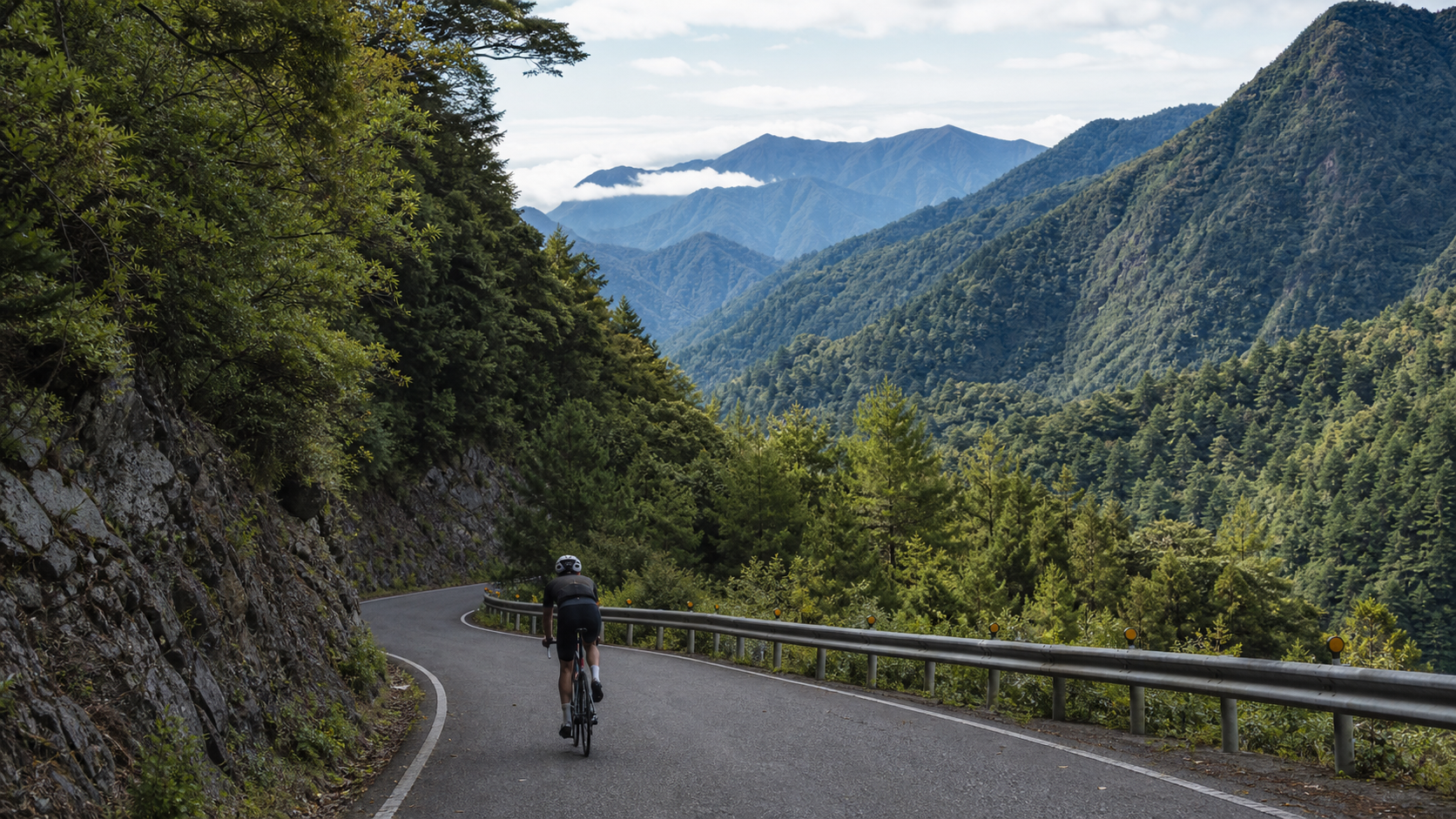
Tai’an Township, Miaoli County—for many, the first association with this name is hot springs. Tai’an Hot Spring has long been a renowned bathing destination in northern Taiwan. The winding Daan River valley nurtures the hot spring water veins, as well as the ancestral memories of the Atayal people who have lived in these mountains for generations. Deeper into the hot spring township, amid the higher-altitude forests, a network of industrial roads known as the Sima Xian Forest Road quietly leads to the Xuejian Recreation Area of Shei-Pa National Park—this is the true protagonist of this story, and for every cyclist who has ridden this route, an unforgettable memory of a long forest road.
Xuejian—the name itself carries a poetic quality. It sits on the southwestern side of Shei-Pa National Park, and due to its terrain and climatic conditions, it is one of the finest vantage points for gazing upon the majestic ridgelines of the Xueshan Range, hence the name “Xuejian”—meaning “a place where one can see the snow mountain.” To reach this recreation area, one of the most classic routes is to wind upward along the Sima Xian Forest Road system. The existence of this forest road is inextricably tied to the historical development of Taiwan’s forestry industry. Forest road systems in Taiwan’s mountainous regions largely originated from the forestry management and logging operations of the Japanese colonial period through the post-war era. The forest resources around Sima Xian were indeed historically one of the important areas of forestry development; the original function of the forest road was to allow timber-hauling vehicles to penetrate deep into the mountains and transport precious cypress and other timber resources down the slopes. As for the more detailed history of this road—including the exact years of its construction and the specific historical events of the logging operations—these details involve professional forestry history research, and the precise chronology should be referenced from official Shei-Pa National Park materials. This article will not over-speculate or fabricate. Suffice it to say, when we roll our bicycle tires over every inch of this forest road today, we are in fact treading upon a microcosm of Taiwan’s mountain forestry development history.
As Taiwan’s forestry policies transformed, these roads—once tasked primarily with timber production—gradually became important corridors for ecological conservation, mountain tourism, and outdoor recreation. The Sima Xian Forest Road is no exception. Its most important role today is as one of the access roads to the Xuejian Recreation Area of Shei-Pa National Park, allowing the general public, hikers, and cycling enthusiasts to approach this once remote wilderness—previously accessible only to forestry workers and indigenous hunters—in a relatively accessible manner. This shift in role, to some extent, reflects the transformation of Taiwanese society’s values over the past few decades regarding its relationship with the mountains: from “resource extraction” gradually moving toward “coexistence and shared stewardship.” When we ride our bicycles up this forest road, gasping for breath, we are in fact using our own bodies to relearn a gentler, more humble way of connecting with these mountains.
Tai’an Township itself, as one of the important ancestral homelands of the Atayal people in Taiwan’s central mountains, adds a layer of cultural depth to this cycling journey. The Atayal are renowned for their superb mountain survival wisdom and traditional culture, including weaving and facial tattooing. This mountainous region, embraced by the Central Mountain Range and the Xueshan Range, has been the living domain of the Atayal people for hunting, farming, and migration since ancient times. Today, riding along the Sima Xian Forest Road, we may not see specific tribal settlements (as the road itself primarily traverses forest compartments rather than tribal living areas), yet that cultural heritage of reverence for and interdependence with the mountains seems to be subtly conveyed to every passing traveler through the dense forests flanking the road and the scent of earth and vegetation mingling in the air.
Scenic Landmarks Along the Way and the Shifting Clouds and Mist
If flatland riding pursues speed and efficiency, then a long-distance mountain climb like the Sima Xian Forest Road pursues an entirely different kind of experience—a narrative of scenery that unfolds progressively with each gain in elevation.
At the start, the route is mostly in relatively low-elevation areas, with secondary forests lining both sides, occasionally dotted with farmland or orchards, and the air still carrying the warm, moist humidity characteristic of the hot spring township at the mountain’s foot. But as the wheels continue upward and the elevation climbs steadily, the surrounding vegetation begins to shift quietly. Secondary forests gradually give way to more pristine, more lush forest types. The height and density of the trees increase noticeably, and sunlight filters through the layered canopy onto the forest road, casting dappled, dancing shadows—a visual effect that is a unique experience difficult to replicate on low-elevation riding routes.
As elevation continues to rise, approaching 1,500 meters or even higher, the entire visual and sensory experience of the ride undergoes a dramatic transformation. The air becomes crisper, temperatures drop noticeably, and when weather conditions cooperate—particularly under the climatic patterns more common in autumn and winter—riders have the opportunity, at open viewpoints along the forest road, to behold the magnificent, sprawling ridgeline of the Xueshan Range. Layer upon layer of mountain peaks appear and disappear amid swirling clouds and mist. That sense of grandeur is an awe that no photograph or words can fully capture. The geographic position of the Sima Xian Forest Road is itself renowned for its views of the Xueshan ridgeline, which is precisely why the endpoint, the Xuejian Recreation Area, bears the name “Xuejian.”
The sea of clouds is another breathtaking gift this route offers. While the plains below are shrouded in urban clamor and humid heat, under specific climatic conditions in the mountains—typically in the early morning hours, when an inversion layer forms and moisture condenses at a particular elevation—a spectacular sea of clouds appears, with dense layers of cloud surging and flowing through the valleys, making the entire mountain range seem to float above the clouds. This spectacle cannot be encountered at any time; it requires the perfect alignment of weather and timing. Autumn and winter offer relatively better odds for such conditions, but even in summer, if early morning humidity and temperature shifts align, one may occasionally chance upon this wonder of a cloud sea. Precisely because of its unpredictability, every encounter with the sea of clouds at the higher elevations of the Sima Xian Forest Road makes the rider feel incredibly fortunate—as if the mountains, as a special reward for the arduous climb, have unveiled a mysterious veil.
Beyond the grand distant vistas, the details of the nearby forest are equally worthy of savoring. Ferns grow densely along both sides of the forest road, moss blankets damp rocks and tree trunks, and the occasional calls of unidentified birds drift through the air. These subtle natural sounds and scents constitute another layer of sensory experience during the ride. When riding alone for extended periods in such an environment, one’s senses become extraordinarily acute. The sounds of wind, birdsong, and the rhythmic whir of pedals and chain—all routinely overlooked in urban life—are amplified and felt in fine detail. This, too, is a meditative experience unique to long forest-road riding.
First-Person Narrative: 24.94 Kilometers of Dialogue with Myself
I will always remember the morning of that departure, when the sky still held a hint of unfaded ink-blue, and the air in Tai’an Township carried the faint sulfur scent unique to the hot spring area, mingled with the fresh fragrance of mountain vegetation. The moment I turned my wheels onto the forest road entrance, I knew that the nearly 25 kilometers ahead would be a long journey of dialogue with my own inner self.
In the first few kilometers, my body still carried the excitement and novelty of setting out, and my pedaling felt light and brisk, even carrying a restless urge to accelerate. But as the gradient gradually revealed itself, as the asphalt surface slowly transitioned into gravel forest road, I began to realize that this was not a route that could be conquered by a momentary impulse. It demanded a completely different kind of mental quality—patience, and the ability to coexist with solitude.
What makes a long forest-road climb most distinctive is that sustained, lingering sense of solitude. Unlike city riding, where traffic lights, pedestrians, and traffic constantly interrupt your thoughts, and unlike short climbs where the anticipation of seeing the finish line soon sustains you, Sima Xian Forest Road offers you something close to a meditative, unbroken stretch of time alone. You can hear your own breathing, the rhythmic rotation of the chain, the rustling sound of tires rolling over gravel—and beyond that, for long stretches, the only companion you have is the silence of the mountain forest itself.
Around the one-third mark of the ride, I began to feel the fatigue signals my body was sending. The soreness in my thigh muscles gradually accumulated, and my breathing grew heavier. At that point, various thoughts began to surface in my mind—should I take a break? Should I doubt whether I could really complete this nearly 25-kilometer challenge? This inner wavering is actually a psychological phase that every long-distance challenger goes through, and how you converse with these doubts, how you convince yourself to keep moving forward rather than give up, is precisely the lesson that long forest-road climbs truly teach us—far more profound than mere physical training.
By the middle section, the surface had fully turned into gravel forest road, and with every pedal stroke I could feel the subtle friction between tire and ground and the shifting of grip. This section, which demanded more focused handling, actually allowed me to temporarily pull away from my fixation on fatigue and concentrate entirely on reading the road surface a few meters ahead. Interestingly, this state of focused “living in the present” somewhat alleviated the psychological pressure of riding alone for so long, helping me rediscover my rhythm.
As the elevation gradually climbed above one thousand meters, the change in temperature began to remind me clearly of the altitude I was at. Sweat on my skin was swept by the mountain breeze, bringing a sensation that was cool yet slightly piercing. I began to glimpse the layered silhouettes of distant mountain ridges, and in that moment, all the fatigue seemed to be slightly diluted by the vastness of the view. This is precisely the most captivating and contradictory aspect of long-distance mountain riding—the body is in a state of exhaustion at the edge of its limits, yet the mind feels an unprecedented sense of ease and expansiveness because of the magnificent scenery before it.
At roughly the 80 percent mark of the route—the stage where many riders tend to hit the “wall”—I genuinely felt that near-overwhelming fatigue that makes you want to give up. My legs felt as if they were filled with lead, and every pedal stroke required more willpower to drive. But it was precisely at this moment that I came to understand the true meaning of long-distance forest-road climbing—it is not testing your maximum power output, nor is it testing how fast you can sprint. It tests whether, when your body is exhausted to its limits and the solitude has grown intense enough to make you question yourself, you can still find the reason and the strength to keep moving forward. That strength sometimes comes from the anticipation of the finish, sometimes from a stubborn refusal to quit halfway, and sometimes, simply because the body has grown accustomed to the rhythm of pedaling, and so it continues forward in a mechanical yet profoundly resolute manner.
The moment I reached the entrance of the Xuejian Recreation Area at the finish, the sense of accomplishment was beyond words. It was not the kind of explosive, instantaneous joy, but rather a deep, grounded feeling welling up from the very depths of the body, as if I had just completed a long conversation with my inner self and, at the end of that conversation, found an answer about persistence and endurance. Looking back at the road I had come from—that winding forest road stretching nearly 25 kilometers through the mountains—it no longer appeared to me as merely a transportation route, but as a genuine mark etched into my own life’s journey.
The Significance of Long-Distance Forest-Road Climbs for Riders
In the world of cycling, we often talk about power, heart rate, and climbing times—data that can be precisely quantified. But a long-distance forest-road climb like Sima Xian Forest Road offers riders something that far exceeds what these cold numbers can encompass.
Long-distance climbing, especially sustained challenges exceeding 20 kilometers, is essentially a dual test of endurance and willpower. Physical endurance is relatively easier to build up progressively through scientific training, but the forging of willpower more often requires accumulating concrete experiences of choosing to keep going, time and again, when facing real fatigue, real solitude, and the urge to give up. With its nearly 25 kilometers of distance, Sima Xian Forest Road provides an excellent proving ground for this, giving every rider the opportunity to engage in direct dialogue with that inner voice that is quick to give up and quick to compromise, and through repeated experiences of completing the ride, gradually build a more resilient mental constitution.
The value of cultivating this mental toughness often transcends cycling itself, extending into the rider’s daily life and workplace challenges. When a person has personally experienced completing a long-distance challenge even in a state of near-total physical exhaustion and deep self-doubt, relying on willpower and strategic adjustment, that experience transforms into a deep-seated self-trust—a belief in one’s own ability to face difficulties and see things through. This is also why many seasoned riders are particularly drawn to these long-distance, high-intensity route challenges, because what they provide is not just physical training, but a crucible for tempering psychological resilience.
Furthermore, the solitude of long forest-road climbs is actually a rare experience in the modern world. In an era of information overload and social media saturation, our attention is constantly fragmented into countless pieces, and we rarely have the opportunity to truly quiet our minds and engage in deep dialogue with our inner selves. A long stretch of solitude like Sima Xian Forest Road, lacking in signal and far from the hustle and bustle, offers a rare chance for riders to temporarily detach from external distractions and focus on their own breathing, cadence, and thoughts. This near-meditative experience, for the mental health of modern people, actually has unexpectedly therapeutic effects.
A Seasonal Mountain Feast
The seasonal changes of Taiwan’s central mountain region are displayed with striking clarity and beauty on mid-to-high elevation routes like Sima Xian Forest Road. Although this article does not intend to give absolute month-by-month guarantees—after all, mountain weather is inherently variable and difficult to predict precisely—based on general knowledge of seasonal changes in mountain forests, some conservative and reasonable seasonal observations can still be offered.
Autumn and winter are typically the periods when Taiwan’s mountain areas display their richest layering of colors. As temperatures gradually drop, deciduous plants in certain elevation zones begin to turn red and yellow, adding a rare touch of seasonal color to Sima Xian Forest Road, which is primarily composed of evergreen coniferous and broadleaf mixed forests. While the maple scenery is not the most famous autumn foliage destination in central Taiwan, the scattered patches of changing leaves along the route, combined with the crisp autumn weather and better visibility, often reward riders with several surprisingly stunning vignettes of autumn color during their arduous climb.
The sea of clouds spectacle, already mentioned in the scenic landmarks section earlier, is also more likely to appear in autumn and winter, related to the relatively stable temperature inversion layer characteristics of that season. Riders who set out in the early morning to challenge this route, if lucky, have a good chance of encountering that surging, flowing sea of clouds at open viewpoints above mid-mountain, adding an unexpected visual feast to their arduous climb.
Challenging this route in summer is an entirely different experience. The dense forest displays its most vigorous vitality in summer, with cicadas and birds calling in succession, and the shade of the forest canopy makes the perceived temperature on some sections relatively comfortable. However, the risk of afternoon thunderstorms in summer is also correspondingly higher, which has already been detailed in the strategy guide section, so it will not be repeated here. Riders are simply reminded that if they choose to take on the challenge in summer, they must pay extra attention to weather changes and schedule planning.
Suggested Side Trip: The Healing Finale of Tai’an Hot Springs
After completing a long-distance forest-road climb that demands both physical effort and mental fortitude, what better way to conclude than soaking in a hot spring and letting muscles that have been tense all day fully unwind? Tai’an Township itself, as a renowned hot spring destination in northern Taiwan, offers an excellent side-trip option, allowing riders to reward their bodies in the most comfortable way after conquering the grueling challenge of Sima Xian Forest Road.
The spring quality of Tai’an Hot Springs and the surrounding mountain forest environment have long been favored by many mountain tourism enthusiasts. The spring water has a notably significant relaxing effect on relieving muscle soreness and fatigue after prolonged exercise. Specific hot spring resort and facility information is updated over time, so riders are advised to search for the latest operating and service information in the Tai’an Township hot spring area when planning their itinerary, and choose a hot spring resort that fits their needs and budget, bringing a warm and healing conclusion to this long forest-road challenge.
In addition to the hot springs, the Atayal culture and local cuisine around Tai’an Township are also worth a brief stop and a closer experience after the ride. Tasting local dishes with mountain-region characteristics and feeling the unique imprint the Atayal culture has left in these mountains can extend this journey, which began with cycling, into a richer and more diverse cultural dimension—far beyond being merely a physical challenge.
As the sun sets, sitting by the hot spring pool and recalling the nearly 25 kilometers of solitude and grandeur on Sima Xian Forest Road during the day, and the long hours of repeated inner dialogue with yourself, you will find that what this journey truly leaves you with has long surpassed what can be measured by finishing time or elevation gain. It is a profound memory about perseverance, about coexisting with the mountains, and about rediscovering your own limits and resilience—and that is precisely the most precious and irreplaceable charm of long-distance forest-road riding.
A Word to the Next Challenger
If you ask me what mindset you should bring to Sima Xian Forest Road, I would say: let go of your obsession with speed and records, and treat it as a journey of deep dialogue with yourself. This route will not test your explosive power with slopes steep enough to make you despair; instead, it uses a gentler yet more grinding approach—the accumulation of time and distance—so that during the long, steady pedaling, you gradually shed the layers of pretense and anxiety from daily life, returning to the simplest state: one person, one bike, a forest road with no visible end, and the sound of your own breathing growing clearer as the altitude rises.
When many riders look back after completing this challenge, they often do not remember the number of a particularly steep gradient, nor how many minutes they ultimately took to finish. Instead, they remember a certain moment—perhaps the sight of clouds and mist surging through the valley, perhaps the moment dappled light spilled across both sides of the forest road, or simply the psychological struggle of choosing to keep pedaling in extreme fatigue and the eventual release. These moments are etched into memory far more deeply than any data, and they are why, despite how grueling the challenge is, wave after wave of riders are willing to return to this forest road again and again, to re-experience that unique feeling where physical limits and spiritual grandeur intertwine.
Also, please always remember that the mountains will never change their original appearance or rules because of your courage or determination. Respecting the weather, respecting the road conditions, and respecting every signal your body sends are always the first principles for traveling safely through this magnificent wilderness. May every rider who sets foot on this forest road complete their own unique story of Xuejian Sima Xian Forest Road with humility and reverence.
Related Reading
- Xuejian Sima Xian Forest Road Guide: Full Analysis of the 24.94 km Forest-Road Climb, Data, Gear Ratios, and Refueling Strategy
- On the 10.2% Gradient of Xueshan Wunao, I Learned to Have a Dialogue with My Own Limits
- Dasyueshan Forest Road Cycling Challenge: A Primordial Forest Climb in Taichung’s Hidden Gem
- Sacred Trees and Heavenly Lake in the Clouds: A Cycling Pilgrimage to Dasyueshan, Riding Altitude into a Spiritual Practice
觀霧 變好騎了! | 北高車友爆笑大會師 | 公路車 | 單車旅遊 Taiwan Cycling Route GuanWu
6 年前
虎豹潭!日本老師來台一日約騎 台灣車友熱情招待私房路線 / CT Yeh
20 天前
秘境雪場 日本 八甲田 冰樹探險與滑雪體驗 ft. Q老師 & 運動生活
7 年前
台中大雪山 膏王領騎 震到都沒畫面了 公路車
5 年前
半日 小台灣 極限單車路線挑戰實錄
7 年前
大武山後門26%歡樂陡坡!JJSC南台灣單車行Day2 / 被颱風追著跑 / 公路車 / CT Yeh
2 年前
日本島波海道 EP1 / 五大絕景路線之一! / 私房溫泉 x 豪華單車客棧 / 今治 to 大三島 / 公路車 / CT Yeh
2 年前
一定要騎一次!阿里山最深處:里佳部落!單車旅行 | 2800m爬升 | 深度部落體驗:嗨翻晚會、螢火蟲、銀河 | feat. JJSC & 廢物伙伴 | 公路車 CT Yeh
9 個月前