From Penglai Rice to Calla Lily Fields: A Ride Up Zhuzihu Road Is a Forgotten Lesson in Industrial History
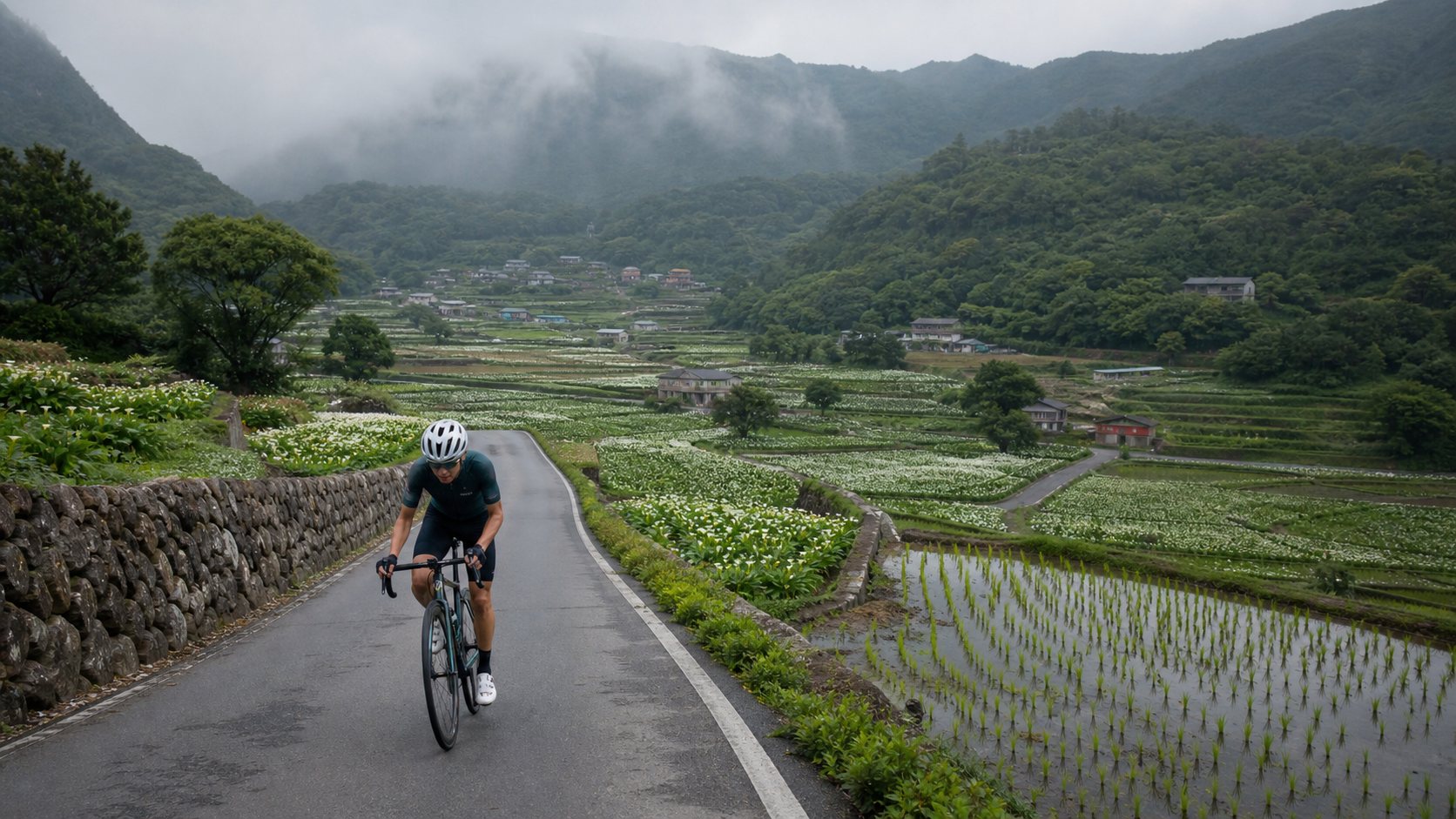
Some routes are worth riding not just because the gradient numbers look good, but because they carry the weight of a period of time. Zhuzihulu Road is exactly such a place—as you push the pedals, gradually climbing 253.6 meters and traversing a 5.16-kilometer valley path, you are actually passing through land that once changed the look of Taiwan’s dining tables.
The Secret in the Valley: A Basin Embraced by Mountains
Zhuzihulu is not a “lake,” at least not anymore. It is a valley basin nestled between Mt. Datun and Mt. Qixing, sitting at an elevation of around 670 meters, surrounded by mountains on all sides, forming a relatively enclosed geographic unit. This topography gives rise to Zhuzihulu’s unique microclimate: considerably cooler than downtown Taipei, with higher humidity and frequent afternoon fog, which in turn nurtures agricultural conditions vastly different from the surrounding lowlands.
I will never forget the first time I rode into the Zhuzihulu valley—having just climbed up from the suburban outskirts around Yangde Avenue, the perceived temperature dropped noticeably within just a few kilometers, and the air carried a moist, grassy scent, occasionally mixed with a faint hint of soil. That feeling is hard to describe precisely in words; it is closer to an illusion of “switching scenes,” as if crossing some invisible threshold, shifting from the urban clamor at the edge of the Taipei Basin into a mountain village where time flows more slowly.
This topographic character also explains why Zhuzihulu Road, as a cycling route, offers that layered sensation of “climb first, then the view opens up.” The early slopes are mostly flanked by hillsides and vegetation on both sides, with relatively enclosed sightlines; as elevation gradually increases and you approach the core of the valley, the view slowly opens up, revealing patchwork fields and scattered farmhouse rooftops. This gradual change in scenery is an experience that few flatland routes can replicate—it does not lay the entire landscape before you at the start, but instead lets you “unlock” it bit by bit with sweat and breath.
The Birthplace of Penglai Rice: A Nearly Forgotten Agricultural History
If you ask ten tourists snapping photos among the flowers in Zhuzihulu, probably few would know that this land was once the site of a major breakthrough in Taiwan’s agricultural history. During the Japanese colonial period, agricultural scientist Iso Eikichi conducted rice variety trials in the Zhuzihulu area, ultimately leading to the birth and promotion of “Penglai rice.” In 1923, the Penglai Rice Seed Farm Office was established here, making Zhuzihulu an important testing ground for this agricultural innovation.
The significance of Penglai rice goes far beyond a mere variety name. Before this, the rice grown locally in Taiwan differed considerably in texture from the varieties Japanese people were accustomed to. The successful cultivation and promotion of Penglai rice, to some extent, redefined the direction of Taiwan’s rice cultivation and briefly elevated Zhuzihulu—this seemingly remote valley—to a location of landmark significance in agricultural history.
Yet historical turns are always full of irony. After the war, as high-mountain regions like Lishan gradually rose in competition for rice cultivation and other agricultural products, combined with practical factors such as funding shortages, the Penglai Rice Seed Farm Office in Zhuzihulu was ultimately abolished. This land that had once nurtured a variety that changed Taiwan’s rice culture faced a period of uncertainty regarding its industrial positioning.
But Zhuzihulu did not fade into silence. Local farmers and later operators keenly recognized the valley’s unique climatic advantages—cool, humid, with pronounced day-night temperature differences—which proved highly suitable for flower cultivation. So Zhuzihulu’s industrial focus began to quietly shift from food crops to tourism-oriented flower farming. This pivot laid the crucial seeds for Zhuzihulu’s later transformation into Taipei residents’ go-to flower-viewing destination.
As you ride along Zhuzihulu Road, catching glimpses of fields and trellises flashing by on either side, imagine this: the land once grew rice that changed Taiwan’s dining tables, and now grows flowers that let city dwellers briefly escape the hustle and bustle. The same piece of land, having changed its identity once, has always played some role of “supply”—only what it supplies has shifted from sustenance to beauty and moments of tranquility.
Calla Lily Fields and Hydrangeas: The Valley’s Seasonal Scenery
Zhuzihulu’s most widely recognized image today is undoubtedly its calla lily fields. The western part of Zhuzihulu is renowned for its vast calla lily fields, with the blooming season concentrated between February and May each year—also the period when Zhuzihulu sees its densest crowds. Official agencies and local operators have long collaborated on the “Zhuzihulu Calla Lily Season,” gradually turning flower viewing into an annual spring ritual on the outskirts of Taipei.
The experience of riding past these flower fields is completely different from arriving by car or tour bus. A bicycle’s speed is slow enough that you can clearly see the details of an entire expanse of white calla lilies swaying gently in the breeze; yet faster than walking, so you are not entirely trapped in the rhythm of roadside vendors and crowds. That way of viewing—somewhere between “passing through” and “pausing”—I think suits these flower fields particularly well: it requires a bit of speed to feel the sweeping momentum of the sea of blooms, but also demands slowing down to capture the glisten of dew on the petals.
Besides calla lilies, the Zhuzihulu area also has a hydrangea viewing period, usually falling around early summer, but the exact blooming time fluctuates slightly each year depending on the climate. I recommend checking the latest announcements from official sources or local farms before heading out, rather than rigidly planning around a fixed month. This “depending on the weather” characteristic is, in fact, the essence of agricultural landscapes—unlike man-made attractions, they cannot be precisely predicted and always carry a hint of uncertainty, and that uncertainty, to some degree, makes every visit feel all the more precious.
Personally, I prefer riding up Zhuzihulu Road on weekday early mornings, quietly circling the small paths around the flower fields before the tourists flood in. That atmosphere of only birdsong, wind, and the occasional sounds of farm work is a completely different world from the bustling, noisy Zhuzihulu of holidays. If you too want to experience a Zhuzihulu closer to an “industrial landscape” than a “tourist attraction,” the early morning is definitely the most recommended time.
Xiaoyoukeng: The Volcano’s Whisper at the Valley’s Edge
Although Xiaoyoukeng is not on the main line of Zhuzihulu Road, as a well-known nearby extension attraction, it deserves a brief introduction here, and I recommend riders with sufficient energy and time to arrange a detour. Located on the northwestern foothills of Mt. Qixing, Xiaoyoukeng is a typical volcanic landform at an elevation of about 805 meters, with steam continuously venting from the ground year-round and the air filled with the smell of sulfur.
The first time I detoured to Xiaoyoukeng, the pungent sulfur odor and the white vapor rising from the ground gave me a strange sense of dissonance—having just ridden through the lush, pastoral Zhuzihulu valley, a single turn brought me into this volcanic landscape with its raw geological character, as if within a very short distance I had experienced a scene shift from “agricultural landscape” to “geological wonder.” This stark contrast in landscapes is precisely the charm of the Yangmingshan system as an active volcanic group—it is not just a “mountain,” but an entire geological system still in motion, constantly reminding riders that the land beneath their feet is not a static, unchanging backdrop.
Qingtiangang and Memories of the Surrounding Pastures
Another cultural landscape in the Yangmingshan system worth mentioning is Qingtiangang, known during the Japanese colonial era as the “Dalingqiao Ranch,” a grazing area developed at the time. Although Qingtiangang and Zhuzihulu Road do not directly overlap in route, both belong to the same cultural landscape lineage of the Yangmingshan system, both reflecting the different industrial roles this mountain area was assigned at various historical stages—from ranch, to agricultural testing fields, to today’s recreational leisure spaces. Yangmingshan has always played the role of that “multifunctional hinterland” on the edge of the Taipei metropolis.
Such historical depth adds a layer of meaning to riding routes in the Yangmingshan system that goes beyond mere exercise or scenery. Every climb feels like flipping through the industrial annals of this mountain across different eras—except this chronicle is written on the land and terrain, and it takes the rider’s own legs and breath to slowly read it out.
A Cyclist’s Zhuzihu: The Observational Perspective of Slow Speed
Compared to driving or taking a tour bus, cycling offers a unique observational advantage in a valley terrain like Zhuzihu. Because the speed is slow enough, you can notice many details that are easily overlooked: wildflowers growing casually along the field ridges, crops drying under the eaves of farmhouses, and the shifting light and shadow on distant misty peaks at different times of day. These details, when flashed past through a car window, often leave only vague impressions; but through the sensation of cycling speed, they become clear and concrete.
Although the climbing intensity of Zhuzihu Road isn’t enough to leave you breathless and unable to take in your surroundings, it’s still sufficient to keep riders in a state of focused, slightly tense alertness. This state is fascinating—when the body is under a certain level of physical exertion, the senses actually become sharper, and awareness of the surrounding environment increases. Many cyclists have had similar experiences: on gentle, flat sections it’s easy to get distracted and let the mind wander, but on climbing sections that require maintaining a rhythm, you can actually focus more intently on the scenery and scents of the moment.
Personally, I especially enjoy pausing briefly after completing the climb and reaching the relatively flat sections of the valley, finding a spot with an open view, and sitting quietly for a while. Watching the clouds and mist drift through the valley in the distance, listening to the wind rustling through flower fields and bamboo groves—that sense of tranquility is completely different from riding on flat ground. This is also why, even though the length and elevation gain of Zhuzihu Road aren’t the most challenging in the Yangmingshan area, I’m still willing to return to this route again and again—what it offers isn’t just the sense of accomplishment from exercise, but also an opportunity to engage in dialogue with the history of the land.
A Rider’s Notes Through Four Seasons
If you ride Zhuzihu Road through all four seasons of the year, you’ll discover that this route actually has four distinctly different faces, far richer than mere gradient numbers suggest.
Spring is probably the Zhuzihu most people are familiar with—the calla lily season is in full bloom, and the valley is filled with an atmosphere that’s both lively and fresh. At this time, the biggest challenge for cycling isn’t actually the gradient, but the crowds and traffic. On weekends, the roads around Zhuzihu tend to get congested, and the walking routes of flower-viewing tourists often intersect with cycling routes, which requires even more slowing down, patience, and courtesy. But precisely because of this liveliness, Zhuzihu Road in spring feels especially full of vitality—that sense of an entire valley being awakened is something other seasons can hardly replicate.
Summer in Zhuzihu is a completely different experience. The scorching temperatures of over 35°C in Taipei’s urban area are often diluted by a few degrees in the Zhuzihu valley, and with the occasional mountain mist and humidity drifting in, summer rides on Zhuzihu Road take on a sense of “natural heat relief.” I remember one midsummer afternoon when the city was so hot the asphalt was shimmering, and as I rode all the way into the Zhuzihu valley, that sudden chill almost made me think I’d gotten the season wrong. Of course, summer also brings the highest chance of afternoon thunderstorms and localized fog, so ride plans should be timed carefully to avoid being trapped in the mountains by sudden weather changes.
In autumn, the crowds at Zhuzihu noticeably thin out. The valley loses the clamor of flower seas but gains a quiet sense of layered depth. This season is best suited for riders who aren’t chasing a destination but simply want a place to let their thoughts settle. The fields have been tidied up, exposing bare soil and crop stubble—that scenery bearing the traces of agricultural labor actually feels closer to Zhuzihu’s essence as a “place of industry” than when the flowers are in bloom.
Winter, meanwhile, tests a rider’s gear preparation. Under the influence of the northeast monsoon, temperatures at Zhuzihu can drop significantly, and combined with the damp, chilly sensation, even a climb of just over 5 kilometers warrants thorough insulation measures. But winter Zhuzihu also has its unique charm—mist-shrouded valleys, with clouds occasionally hanging so low they’re almost within reach. That hazy visual effect carries a certain ink-painting quality that photography-loving riders won’t want to miss.
Brief Encounters with the Locals
While riding Zhuzihu Road, you’ll occasionally have brief interactions with local farmers and shopkeepers—perhaps when passing a certain bed-and-breakfast, the owner is tidying the flower beds in front of the property and looks up to smile and nod at you; or perhaps when taking a short rest by the roadside, you meet a farmer heading out to check the fields and exchange a few simple words about the weather and crop conditions. These interactions, though brief and trivial, are one of the most charming aspects of cycling—they make you not just “pass through” a place, but briefly and genuinely connect with the life on this land.
Most of the dining and accommodation businesses around Zhuzihu have developed alongside the transformation of the tourism industry. Many local chicken restaurants and seasonal wild-vegetable dishes have also become popular choices for riders to reward themselves after completing the climb. Although this article doesn’t single out any particular establishment, simply riding slowly around the Zhuzihu valley will reveal plenty of places worth stopping at to rest and replenish energy, experiencing the honest warmth of human connection that this land has preserved through its transition from agriculture to tourism.
Valley Light and Shadow: An Impromptu Performance of Clouds and Mist
The ever-changing clouds and mist of the Yangmingshan range are the most addictive “added value” of Zhuzihu Road. Due to the valley terrain, moisture tends to accumulate in the afternoon, flowing with the air currents through the valley and forming layers of fog that are sometimes thick, sometimes thin. This cloud and mist isn’t a fixed background—it’s more like an impromptu performance that changes at any moment. The same bend might be bathed in sunshine with clear visibility when you ride past in the morning, but by the afternoon, it could be shrouded in a thin layer of fog, with distant peaks appearing and disappearing.
Once, during an afternoon ride, I watched with my own eyes as a bank of clouds slowly rose from the bottom of the valley, and within just a few minutes, swallowed up the previously visible flower fields and farmhouses in a hazy white. The awe that scene inspired was no less than any deliberately crafted tourist attraction—it was a pure display of natural forces, subject to no human arrangement, and therefore all the more precious. Of course, this ever-changing fog also reminds riders to constantly monitor visibility, especially on descents, where fog can suddenly affect sight lines. Be sure to slow down and turn on your lights to ensure the safety of yourself and other road users.
These shifts in light, shadow, and mist also make Zhuzihu Road a favorite location for photography enthusiasts. Many riders deliberately time their visits to periods when the cloud and mist activity is more dynamic, completing their climbing training while capturing fleeting scenes. This style of riding that combines sport with photography, to some extent, echoes the enduring character of the Zhuzihu land—it has never been a place serving a single function, but rather a composite space capable of satisfying multiple needs and sensory experiences simultaneously.
What This Route Means to a Rider
Every rider probably has a few “meaningful routes” of their own—not because they’re particularly difficult or long, but because a particular riding experience left special memories on that road. For me, Zhuzihu Road is exactly that. It’s not the most hardcore challenge in the Yangmingshan range; it could even be called a relatively gentle climb. But precisely because of that, it has become the route I revisit most often and the one I’m most willing to take newbie friends to tackle.
Here, the sense of accomplishment from exercise and the depth of cultural history find a perfect balance. You don’t need top-tier fitness to feel the achievement of climbing; you don’t need to do special research to vaguely sense, along the ride, the weight of industry this land once carried. This quality of being “easy yet not shallow” is precisely what makes Zhuzihu Road most precious.
I’ve also brought friends who were new to cycling to take on this route, watching them complain breathlessly about the gradient while simultaneously being drawn in by the scenery along the way and slowing down to take photos. That contradictory yet genuine reaction always brings a knowing smile to my face. Climbing has never been easy, but when the scenery and historical stories are willing to climb alongside you, the effort seems to become worthwhile. This is also why I continue to recommend Zhuzihu Road to friends—it proves that a route doesn’t need extreme gradient numbers to justify its value. Gentle, substantial scenery can leave equally profound riding memories.
Suggested Add-Ons: Adding Zhuzihu Road to Your Yangmingshan Day Trip
If time permits, we recommend incorporating Zhuzihu Road into a more complete cycling route through the Yangmingshan area, pairing it with other well-known scenic spots and road segments to plan a day trip that combines climbing practice with cultural scenery. If you visit during the blooming season, remember to set aside extra time for crowds and traffic controls; outside the blooming season, you can focus more on enjoying the tranquil atmosphere of the valley and the cooling effect of its microclimate.
If your energy and schedule allow, consider making a detour to Xiaoyoukeng to experience the striking contrast as the scenery shifts from pastoral fields to volcanic landscapes; or extend your ride toward Qingtiangang to experience the multiple historical identities of the Yangmingshan area, from agriculture and ranching to tourism and recreation. Although these extended segments are not on the core route of Zhuzihu Road, they can add greater cultural depth to your entire ride.
In terms of route planning, we suggest placing Zhuzihu Road in the first or middle portion of your ride, completing this moderate-intensity climb while your energy is still fresh, then deciding based on your condition whether to take on additional segments. If you simply want to ride this one route, turning back the same way is also a comfortable option—the round trip is just over ten kilometers, and with the scenery along the way and the possible blooming-season views, even a half-day trip can be quite rewarding. For urban riders who are busy with work and can only catch their breath on weekends, Zhuzihu Road offers exactly this precious experience: “no need for a long expedition, yet a complete shift in mindset.”
Whether you come for the training data or simply to find a hidden paradise on the edge of the city, Zhuzihu Road is worth slowing down for, to savor this valley that once transformed Taiwan’s rice culture and now adorns the city’s weekends with blossoms. Every pedal stroke is a silent conversation with a century of industrial change—and this conversation will always welcome you to join in.
Related Reading
- Wind on the Tableland, Red Clay, and a Slope Called Dake Road: A Cultural Ride Through Linkou’s Cycling Routes
- Zhuzihu Road Practical Guide: 5.16 km, 253.6 m of Climbing, a Rhythm Lesson on Yangmingshan’s Valley Ascent
- A Six-Kilometer Journey Through Time: The 921 Memories of Caoling Highway, Tea Garden Light and Shadow, and the Warmth of Zhushan
- Shuidao, a Quiet Yet Demanding Slope on the Mountainside of Zhuqi Township
新竹羅平 x 天湖部落 大禹嶺級變態陡坡! 4K超高畫質 空拍 | 公路車
5 年前
觀霧 變好騎了! | 北高車友爆笑大會師 | 公路車 | 單車旅遊 Taiwan Cycling Route GuanWu
6 年前
嘉義大埔、阿婆灣挑戰賽,美到以為在日本!ft. 環騎5 Cool 西拉雅188 / 公路車 / CT Yeh
7 個月前
虎豹潭!日本老師來台一日約騎 台灣車友熱情招待私房路線 / CT Yeh
20 天前
廢物伙伴の約騎 緯緯的湖口後山無菜單路線! | 公路車 | CT Yeh
4 年前
半日 小台灣 極限單車路線挑戰實錄
7 年前
台北闊瀨陡坡 騎旅 / 日本單車雜誌編輯車友臨時加入!/ 髮香才是最強的 / feat. 北迴歸線小隊 / 公路車 CT Yeh
6 個月前
大武山20%魔王陡坡【JJSC南台灣遊騎Day2】!屁股真的要裂開了...凡士林抹滿也沒用?神秘金教堂還有超便宜夜市
3 個月前