Riding into Tea Mountains and Immortal Traces: Maokong Zhinan Temple, a Cycling Route Written with 140 Years of Incense and Tea Aroma
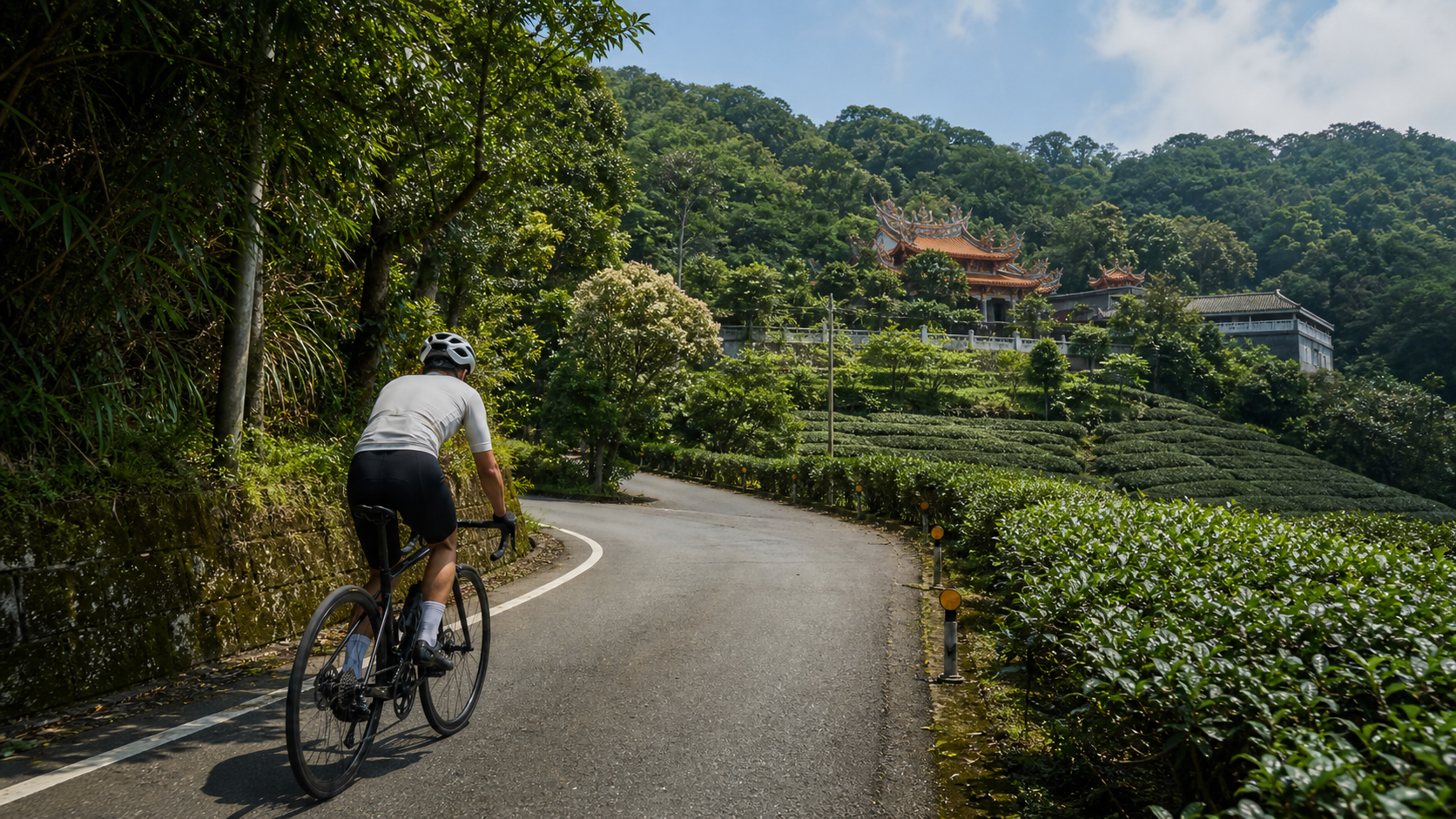
Riding into Tea Mountains and Immortal Traces: Zhinan Temple in Maokong, a Cycling Route Written with 140 Years of Incense and Tea Aroma
“When you’re climbing and can barely catch your breath, you look up and see the upturned eaves of Zhinan Temple peeking out from the treetops—at that moment, it feels like all your exhaustion has found a place to rest.”
Some routes are ridden for the numbers; others are ridden for the stories. The Zhinan Temple route in Maokong, which climbs all the way from Shenkeng into Wenshan District, belongs to the latter. At 6.93 kilometers with 388 meters of elevation gain, the numbers sound unremarkable on paper. But if you know that at the end of this road stands a temple dedicated to Lü Dongbin with over 140 years of continuous incense offerings, that this is Taipei’s largest tea-producing area, and that it serves as a shared coordinate of memory for countless Taipei residents who cycle, hike, drink tea, and enjoy night views here on weekends, you’ll realize that the weight of this climb carries far more than the number 388 meters can ever express.
From Yongle Temple in Shanxi to Houshankeng: Zhinan Temple’s 140 Years of Incense
The story of Zhinan Temple begins in a place far, far away—Yongle Temple in Shanxi Province. According to legend, in 1882 (the 8th year of the Guangxu reign of the Qing Dynasty), a government official named Wang Binlin, who served as the assistant magistrate of Monga, brought a divided spirit of Lü Dongbin from Yongle Temple in Shanxi to Taiwan, where it was initially enshrined at “Yuqing Zhai.” Lü Dongbin, known in folk belief as Emperor Fuyou, is one of the Eight Immortals in the Taoist pantheon and has long been regarded in Han society as a symbol of medicine, scholarship, and salvation.
The journey of this divided spirit statue in Taiwan was not a peaceful one. When a plague broke out in the Jingmei area, the statue was moved to Jingwei (today’s Jingmei area) for worship, becoming a source of hope for local believers seeking safety. It wasn’t until the 16th year of the Guangxu reign, 1890 AD, that the temple was formally established at Houshankeng in Muzha—this is the origin of today’s Zhinan Temple. From the spirit’s arrival in Taiwan in 1882 to the temple’s formal establishment in 1890, nearly a decade of wandering in between reflects the turbulent picture of Taiwan’s immigrant society in the late 19th century—plague, migration, and starting over. The process of building a temple is often also a microcosm of the history of everyday people’s lives.
Fast-forward to the 21st century: in 2003, Zhinan Temple added the “Shanxi Lüzu Shengzun Baodian” (Hall of the Sacred Venerable Lü Ancestor from Shanxi), echoing the statue’s origins as a divided spirit from Yongle Temple in Shanxi—a spiritual connection spanning a century and a strait. Today, Zhinan Temple sits at an elevation of approximately 285 meters. Standing in front of the temple plaza, you can gaze out over the entire Taipei Basin—which is why so many cyclists treat “climbing to Zhinan Temple to see the Taipei Basin” as the most direct psychological reward of this route. When your legs are weak and your breathing is ragged midway through the climb, what you’re thinking about is that open vista, which becomes the concrete reason that keeps you pushing to the top.
It’s worth noting that Lü Dongbin, the primary deity enshrined at Zhinan Temple, carries a peculiar cultural phenomenon in Taiwanese folk belief—legend has it that Lü Dongbin was a romantic figure by nature, and thus a folk saying circulates that couples should not visit Zhinan Temple together, for fear that Lü Dongbin might get jealous and break up their relationship. This playful folk legend adds a layer of cultural conversation that Taipei residents love to chat about in their leisure time, giving this century-old temple an extra touch of everyday humor.
From the perspective of religious history, the 140 years of incense at Zhinan Temple also reflects the development of mountain settlements on the edge of the Taipei Basin. In the late 19th century, the Houshankeng area of Muzha was still a relatively remote mountain settlement whose residents mostly lived off farming. The fact that a temple dedicated to Lü Dongbin could be established under such geographic conditions and sustain its incense for over a century speaks to the cohesive role folk religion played in immigrant farming communities—a temple is not merely a religious site but also the shared spiritual anchor and community center of a settlement. Today, the area around Zhinan Temple has transformed from a purely agricultural settlement into a composite space combining religious tourism, hiking, and the tea industry, yet the curling incense smoke before the temple plaza still carries the same original devotion from over a hundred years ago.
For those who ride up the mountain, Zhinan Temple is not just a geographic coordinate but something of a psychological milestone. Taiwanese folk culture widely embraces the tradition of “climbing mountains to pay homage”—using physical exertion to earn spiritual clarity and supplication. This spirit of pilgrimage through bodily effort aligns remarkably well with the ethos of cycling itself, which prizes “measuring the land with your own legs.” Many riders who complete this route, even if they aren’t devout believers, will take the opportunity to step into the temple plaza upon arrival and soak in that unique atmosphere where religious ambience meets a high vantage point with sweeping views.
A Tea Garden in the Ergai Mountain Range: Maokong’s Industrial Heritage
After conquering the climb to Zhinan Temple, you’ll find yourself immersed in the unique geographic and industrial space that the name “Maokong” represents. Geographically, Maokong belongs to the Ergai Mountain Range in Wenshan District and is the largest tea-producing area in all of Taipei, long renowned for its Tieguanyin (Iron Goddess) oolong tea.
Tieguanyin is a semi-fermented tea that demands specific processing techniques, with particular emphasis on the craft of “roasting.” This has led Maokong’s tea houses to develop a distinctive business model—not merely the cultivation and sale of tea leaves, but a gradual integration of tea ceremony experiences, dining, and tourism, forming a commercial pattern of “tea garden leisure tourism.” On weekend afternoons, you’ll see many Taipei residents driving or taking the gondola up the mountain, finding a tea house with an open view, ordering a pot of Tieguanyin, and pairing it with simple tea snacks while overlooking the Taipei Basin skyline and enjoying the leisurely breeze of the mountain air.
For cyclists, Maokong’s tea industry offers a “post-ride ritual” that few other climbing routes can match—when you finish the 6.93-kilometer climb gasping for air and arrive in the Maokong area, what greets you isn’t an empty mountaintop but an entire leisure space perfumed with tea aroma. Many seasoned riders, after completing this route, will deliberately find a tea house to sit down and have a cup of tea, letting their bodies gradually unwind from the high-intensity exertion. This experience of “immediate reward after exercise” is, to some extent, one of the reasons the Maokong Zhinan Temple route is so popular—it isn’t just a training climb; it’s a small journey that can be fully experienced and properly concluded.
The tea garden landscape of Maokong also takes on different faces with the seasons. When morning mist shrouds the hilltops, the emerald green of the tea bushes appears and disappears through the fog—a scene beloved by many photography enthusiasts. When afternoon sunlight spills across the gardens, the tea leaves reflect a warm, gentle luster—another kind of beauty altogether. For riders passing through in the early morning or evening hours, the visual experience this tea mountain provides is, beyond the asphalt itself, another kind of scenery that makes the ride worthwhile.
The craft of making Tieguanyin is itself a subject worthy of careful appreciation. Unlike ordinary green tea or Baozhong tea, Tieguanyin emphasizes a “triple process” of heavy withering, heavy fermentation, and heavy roasting. The tea master must repeatedly adjust the withering and fermentation times based on the day’s temperature, humidity, and the condition of the tea leaves, and finally, through prolonged low-temperature roasting, gradually develop the tea’s mature, rounded aroma and sweet aftertaste. This craft, which requires accumulated experience and patience, shares a certain resonance with climbing training on a bike—neither can be rushed, both demand day-by-day refinement before delivering the best results at the critical moment.
Most of Maokong’s tea houses are family businesses passed down through generations. Many second- and third-generation tea farmers’ children are continuing the tea-making skills handed down from their ancestors while also attempting to transform their tea houses into composite spaces combining dining, accommodation, and tourism experiences, making the tea culture of this mountain more approachable for younger generations. This trajectory of industrial transformation echoes, to some extent, the broader development of the Maokong area from a purely agricultural settlement into a leisure and sightseeing destination.
Gondola and Hiking Trails: Maokong’s Multiple Ways Up the Mountain
One important reason the Maokong Zhinan Temple route stands out among the many mountain routes on the outskirts of Taipei is its “accessibility”—besides cycling up, there are also the Maokong Gondola and hiking trails, making this a truly multi-generational leisure space.
The Maokong Gondola officially opened on July 4, 2007, becoming Taipei’s first aerial gondola system, connecting the Taipei Zoo Station with the tea-growing areas around Maokong. Shortly after opening, the gondola was temporarily suspended due to typhoon damage; after repairs, it resumed operations on March 26, 2010, continuing to serve visitors traveling to and from Maokong. The gondola’s Zoo Station connects to the Wenhu Line of the Taipei MRT, tying it closely to the city’s transit network—which also makes Maokong one of the easiest suburban mountain destinations for Taipei residents to reach on their days off. A full-fare gondola ticket costs NT$120, and the line includes a Zhinan Temple Station, allowing visitors who neither ride bikes nor hike to easily reach Zhinan Temple for worship.
Beyond the gondola, Maokong is also a popular destination for hiking on Taipei’s outskirts. The trail system connecting National Chengchi University to the summit of Maokong has long attracted city residents who enjoy hiking. On weekends in particular, the steady stream of hikers on the trails and visitors coming up at night for the city views make Maokong a composite leisure space that’s active day and night, in every season. This also means that cyclists tackling this climb, especially on weekends, need to maintain heightened awareness and courtesy toward the hikers and slower traffic they may encounter along the way—this mountain has never belonged to cyclists alone.
For riders, these multiple ways up the mountain create a peculiar psychological contrast—when you’ve sweated your way up this hill on your own legs, you’ll meet tourists at the top who rode the gondola up for tea, as well as hikers who arrived on foot along the trails. Three entirely different modes of arrival converging on the same mountaintop embodies, in a way, the inclusiveness of Maokong—it never demands that you approach it in any particular way, but opens its arms to welcome every person who wishes to draw near to this tea mountain and this temple.
First Person: A Riding Memory of Climbing from Shenkeng into the Clouds
Just past six in the morning, the old street of Shenkeng had yet to release the aroma of stinky tofu. I stood at the starting point with my bike, looking at the 6.93-kilometer climb ahead, mentally calculating my pacing strategy for the day. The route data I’d reviewed the night before told me the average gradient was 5.6% with a total elevation gain of 388 meters—numbers that don’t sound too intimidating, but anyone who has ridden a few mountain roads on Taipei’s outskirts knows that numbers never tell you the whole truth.
For the first two kilometers, the road was still relatively gentle, and the morning air carried that particular dampness of mountain areas, mixed with the vegetal scent of unidentified plants along the roadside. I deliberately kept my cadence low, refusing to burn too much energy during this warm-up stretch—past lessons had taught me too many times that the price of impatience is always paid in suffering later on.
Around one-third of the way up, the gradient began to steepen noticeably, and the trees on both sides grew denser, with sunlight being sliced into patches of light scattered across the asphalt. Sweat began to seep from my forehead and run down my cheeks, and my breathing shifted from steady to slightly rapid. This is the “moment of honesty” that every climbing route brings—you can’t fool your body; how steep the slope is and how much energy you have left are answered by your body in the most direct way possible.
Midway through, I hit a series of consecutive switchbacks. With each turn, the view opened up a little more, revealing the faint outlines of distant peaks. At that point, the image of Zhinan Temple involuntarily surfaced in my mind—that temple dedicated to Lü Dongbin for over 140 years, which should be hidden somewhere in the misty mountains ahead. And with that thought, my heavy pedaling rhythm seemed to gain a bit more momentum.
On the final stretch, a faint hint of tea aroma began to drift through the air—that distinctive scent of Maokong’s tea gardens, a blend of damp soil and roasted tea leaves. This olfactory signal was more convincing than any milestone marker or navigation cue: the end was near. When I finally rode into the area around Zhinan Temple, stopped my bike, and caught my breath, I turned to look back toward the Taipei Basin. The city’s skyline spread out before me in the late-morning sunlight, and in that moment, the view made every gasp and every drop of sweat worthwhile.
I parked my bike by the roadside and walked into a tea house, ordering a pot of Tieguanyin. The owner asked if I’d ridden up; I nodded, and he smiled, saying lots of people ride this road, especially on weekends, and that plenty of others come by gondola or on foot. As I sipped the warm, sweet tea, I thought about how there are many ways to reach this mountaintop—some choose their feet, some choose the gondola, some choose hiking, and I chose the hardest but most rewarding way: pedaling my bike, climbing the elevation one turn of the cranks at a time. This sense of arrival earned through your own effort is something the gondola can never offer.
Sitting on the tea house terrace, a gentle breeze blowing through my still sweat-dampened cycling jersey, my body gradually relaxed from the tension of high-intensity output. The lingering soreness in my muscles became, instead, a tangible proof—proof that I had indeed earned every one of those 388 meters of climbing, one pedal stroke after another. In the distance, the faint sound of gondola cabins gliding along the cables drifted by; closer at hand, the soft gurgle of water being poured into a teapot. The two sounds interwove to form the unique quiet soundtrack of a Maokong afternoon. In that moment, I suddenly understood why so many riders keep coming back to this route again and again—it offers not just physical training, but a complete experience that, once finished, leaves you properly settled and properly cared for.
Maokong’s Seasonal Scenery
This tea mountain of Maokong takes on entirely different appearances as the four seasons turn, giving this climbing route a distinct riding experience in each season.
In spring, rainfall is frequent in the mountain area. The moist climate makes the tea bushes grow vigorously and often keeps the entire hillside shrouded in a faint, elusive mist. The greatest pleasure of riding up in this season lies in the hazy beauty of swirling clouds and fog—you’ll see the outlines of tea gardens appearing and disappearing through the mist, as if you’ve ridden into a Chinese ink-wash painting.
In summer, afternoon convective showers are the most common weather phenomenon in this mountain area. It’s advisable to schedule your rides for the early morning, which both avoids the risk of afternoon thunderstorms and lets you enjoy the cool mountain air and fresh vegetal scents unique to the morning hours—making summer the best season of the year for an early-morning ride.
In autumn and winter, the cold, damp air brought by the northeast monsoon often keeps the Maokong area under a veil of drizzle and low temperatures. Riding in these seasons tests not just your fitness but your willpower—yet precisely because there are fewer visitors, the mountaintop feels especially serene. If you don’t mind the cold, Maokong on an autumn or winter morning offers a solitary beauty found in stillness, well suited to riders who enjoy quiet reflection in a low-key atmosphere.
Suggested Side Trips: After the Ride, Don’t Rush Down
If you set aside a full morning or afternoon to take on this route, there’s no need to hurry back down after finishing. The area around Maokong offers a rich selection of side trips worth slowing down for, turning your ride into a complete little journey.
The most obvious choice is, of course, to find a tea house with an open view, order a pot of local Tieguanyin, and pair it with simple tea snacks while letting your body gradually unwind from the intensity of the ride. Many tea houses have terraces with excellent views—on clear days you can look down over the entire Taipei Basin, making it a superb vantage point for the city skyline.
If you still have energy to spare, you can park your bike temporarily and walk a section of the hiking trail connecting National Chengchi University to the summit of Maokong, experiencing this tea mountain at the different rhythm of your own two feet—compared to the speed of cycling, walking lets you savor the details of the roadside vegetation and tea gardens more closely.
And if you’d like to revisit the road you just climbed so hard from a different perspective, consider taking the Maokong Gondola downhill (on some sections, bicycles can be transported or alternative shuttle arrangements made), viewing from above the hillside you just conquered with your legs. It will be an entirely different experience and emotion—you’ll see the road you once pedaled with all your might now reduced to a thin line winding through the tea mountains, and you, once a small figure straining upward on that line.
The incense of Zhinan Temple has burned for over 140 years; the tea aroma of Maokong has drifted through countless generations. This 6.93-kilometer climbing route is not merely a test of physical endurance but a journey through time—what you measure with your legs is not just 388 meters of elevation gain, but a story at the edge of a city, a quiet yet enduring tale of faith, industry, and a way of life.
A Note to Those About to Set Off
If this is your first time taking on the Maokong Zhinan Temple route, consider letting go of any obsession with pacing and performance, and plan it instead as a small journey combining sport and cultural experience. Set off in the early morning to avoid the afternoon thunderstorms and the heavier crowds, feeling your body gradually warm up while paying attention to the changes in roadside vegetation and the scent of the air—from the ordinary mountain-road aroma at the Shenkeng start, to the increasingly lush fragrance of forest greenery in the middle section, to the faint tea aroma near the finish. This route itself is a journey for all five senses.
Riding a bike up a mountain shares, in a sense, a similar essence to the pilgrims who walked up on foot to pay homage to Lü Dongbin a century ago—both use physical effort to earn an arrival worth remembering. When you finally stand before the plaza of Zhinan Temple and gaze out at the open skyline of the Taipei Basin, the view in that moment will make you understand why this seemingly ordinary 6.93-kilometer climb holds such a firm and enduring place in the collective memory of Taipei’s cycling community. It is not just a road; it is a living history connecting faith, industry, landscape, and countless personal riding memories, quietly waiting at the boundary between Shenkeng and Wenshan District for every person willing to measure it with their own legs to write their own chapter of the story.
Related Reading
- Maokong Zhanghu Traverse: Between Tea Aroma and Clouds, Rediscovering the Original Leisure of Cycling
- Maokong Zhinan Temple Practical Guide: Complete Analysis of Taipei’s Classic Intermediate Climb—6.93 km, 388 m Elevation Gain, 5.6% Average Gradient
- Sacred Trees and Heavenly Lake in the Clouds: A Cycling Pilgrimage to Daxueshan, Turning Elevation into a Practice
- Maokong Climbing Training Ground: Complete Guide to Multiple Climbing Routes from Muzha to Maokong
台北闊瀨陡坡 騎旅 / 日本單車雜誌編輯車友臨時加入!/ 髮香才是最強的 / feat. 北迴歸線小隊 / 公路車 CT Yeh
6 個月前
2024 如來神掌 百人約騎挑戰!feat. 秘境單車社團 / 神人們太可怕 / 全程錄影 x 完整坡度解析 / 公路車 / CT Yeh
2 年前
雙十節的溫腥感人約騎,升旗到升天一次滿足 | 公路車 | 鳳山寺 | 米粉坡
6 年前
觀霧 變好騎了! | 北高車友爆笑大會師 | 公路車 | 單車旅遊 Taiwan Cycling Route GuanWu
6 年前
台北大雁西飛 約騎挑戰 feat. Doris | 公路車 | CT Yeh
3 年前
大武山20%魔王陡坡【JJSC南台灣遊騎Day2】!屁股真的要裂開了...凡士林抹滿也沒用?神秘金教堂還有超便宜夜市
3 個月前
藤枝二集團 單車行 Day1 | 南部小武嶺 | 爬坡爬到罵罵叫 | JJSC | 公路車 | CT Yeh
3 年前
一定要騎一次!阿里山最深處:里佳部落!單車旅行 | 2800m爬升 | 深度部落體驗:嗨翻晚會、螢火蟲、銀河 | feat. JJSC & 廢物伙伴 | 公路車 CT Yeh
10 個月前