Ju Ming Museum Slope: A Cycling Memory of a Steep Climb on the North Coast, and the Legend of "Buddha's Palm" in the Cycling World
Introduction: One Name, Two Identities
Spend enough time in the North Coast cycling scene, and you’ll inevitably hear someone casually say, “Let’s go take on the Buddha’s Palm today.” Visitors from out of town are baffled, while seasoned locals just crack a knowing smile—the kind that says, “You know what I mean.”
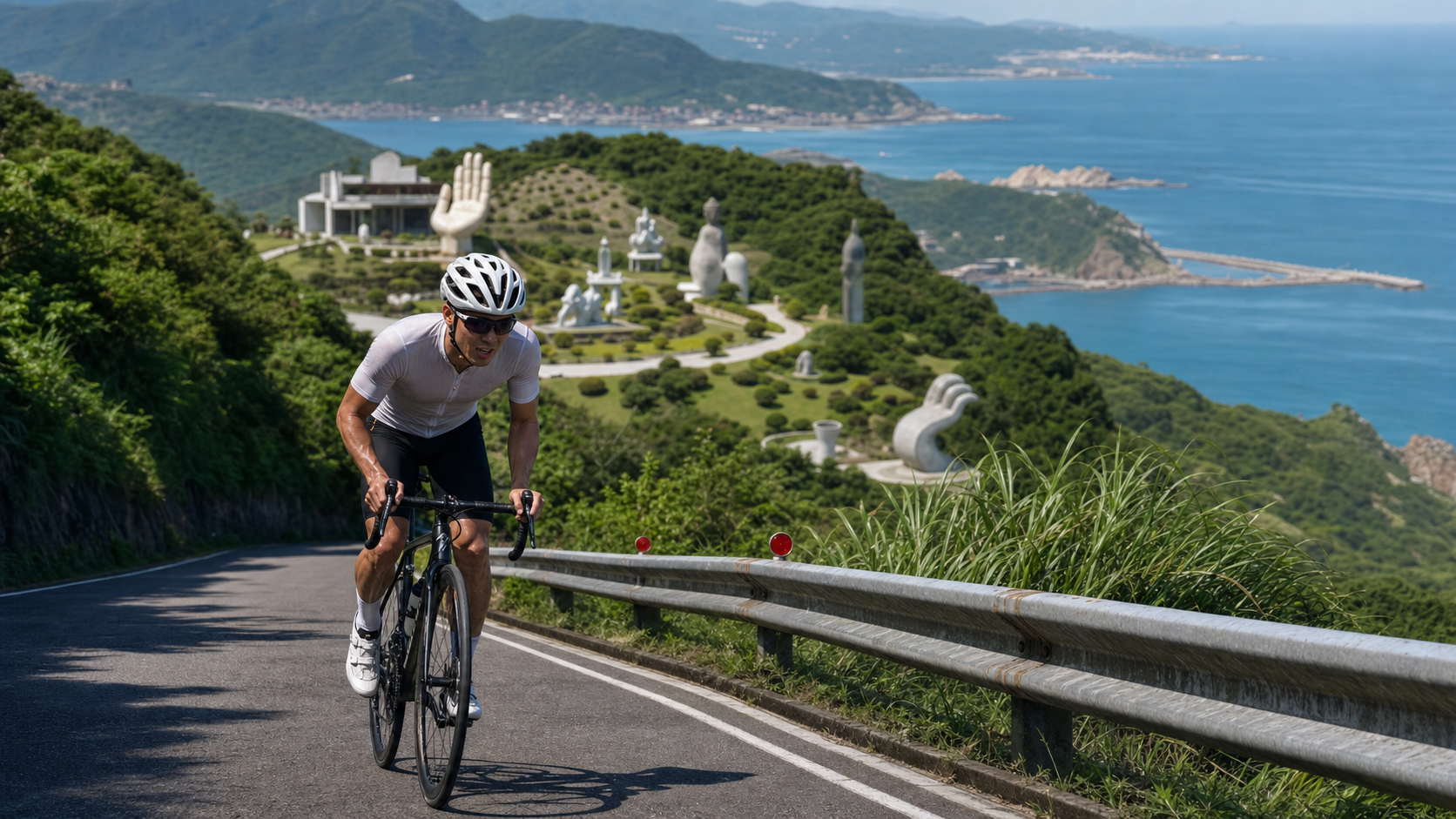
On Strava’s official records, this road is formally registered as “Buddha’s Palm Counterclockwise (Thumb Climb Segment)”—a name that sounds like a move straight out of a martial arts novel. But ask the locals in Jinshan, or casually mention to a friend that you’re going for a ride, and everyone simply calls it “Zhu Ming Museum Slope”—because its summit is none other than that internationally renowned outdoor sculpture museum. One road, two names: one is the folk title on an official digital platform, the other a familiar nickname rooted in maps and everyday memory. This dual identity actually mirrors the road’s own dual nature: it is both a punishing steep climb and a pilgrimage route leading to art and ocean views.
In this article, I want to take you along this road in a more personal, warmer way—not just the numbers of 2.29 kilometers and 294 meters of elevation gain, but what you see and feel while riding it.
Jinshan: A Small Town Embraced by Mountains and Sea
To understand this climb, you first need to understand Jinshan. Located at the northernmost tip of New Taipei City, Jinshan borders the waters where the East China Sea meets the Pacific Ocean. Topographically, it is a narrow coastal plain squeezed between mountain ranges—this “mountains almost touching the sea” characteristic is the shared personality of the entire North Coast region. It’s hard to find a completely flat road here, because the distance between the hills and the coastline is simply too short.
Jinshan’s most familiar landmarks are probably its old street and local food. Jinshan Old Street (Jinbaoli Old Street) is a historic commercial thoroughfare in the area, preserving the street-house textures of an early settlement, bustling with crowds on weekends. And when it comes to Jinshan, many people immediately think of “duck meat”—Jinshan duck has become almost synonymous with a local flavor in Taiwan, a reason for many cyclists and drivers passing through to stop and grab a meal. These common local symbols form the first impression Jinshan gives outsiders: a seaside town with a hint of sea breeze saltiness and a touch of rustic warmth.
And at the edge of this small town, where the terrain begins to rise, lies something with a character entirely different from the town itself—the Jhu Ming Museum.
Jhu Ming Museum: A Sculptor’s Mountain Sanctuary Built with a Lifetime
The Jhu Ming Museum is located at No. 2, Xishihu, Jinshan District, New Taipei City, and officially opened to the public on September 19, 1999. The museum’s birth is itself a story worth telling: its founder, Ju Ming, is one of Taiwan’s most internationally renowned sculptors, famous worldwide for his “Taichi Series.” He spent twelve years building this museum, gradually transforming a hillside into a sprawling outdoor museum covering approximately eleven hectares—reportedly the largest of its kind in Taiwan.
The museum grounds sit at an elevation of roughly 165 to 185 meters. That’s not particularly high, but because of its proximity to the coast, the views are exceptionally expansive—from the highest point of the grounds, looking north, the Jinshan coastline and seascape unfold before you. Beyond Ju Ming’s own sculptures scattered across the outdoor grounds, blending seamlessly with the surrounding natural landscape, the museum also houses works by his teacher Li Jinchuan, as well as important Taiwanese artists like Yang Yuying, and even pieces by international masters such as Picasso, Miró, and Dalí. For the history of contemporary art in Taiwan, the significance of this museum goes without saying.
The first time I rode here, honestly, what I felt upon arrival was the soreness in my legs and the pounding of my heart. It was only after a few minutes of catching my breath that I truly began to “see” the place—that sequence of pushing through physical limits first, then being rewarded with visual and spiritual release, is perhaps, in some sense, exactly the experiential design this road offers to cyclists. Of course, the museum’s original purpose had nothing to do with cycling, but terrain and landscape have so cleverly overlapped here, giving this road its unique riding narrative.
The Steep Climb: The “Buddha’s Palm” in Bodily Memory
If I had to use one word to describe the physical sensation of riding this road, it would be “compressed suffering.” Unlike long climbs like the Northern Cross-Island Highway or the Beiyi Highway, which can take one to two hours, the Zhu Ming Museum Slope is astonishingly short—so short that before you even settle into what you’d call a “climbing rhythm,” you’re already pushed to your limit. This is what makes the nickname “Buddha’s Palm” so fitting: the name sounds mighty and imposing, but the actual experience is more like being slapped hard across the legs—swift and heavy.
What does an average gradient of 11.9% really mean? For those accustomed to gentle climbs, the number might not register at first glance. But once you actually ride it, you’ll find this road gives you almost no room to catch your breath. The gradient is so steep on some sections that you half-wonder if your tires are about to slip; your speed drops to near walking pace, and your breathing becomes so rapid that all you hear is your own heartbeat. A climb of this intensity tests your willpower as much as your muscles—many riders start having internal conversations halfway up: “How much longer?” “Should I get off and walk?” And the answer is often that pushing through is closer than you think, because this road really is that short.
This is why the local cycling community uses a name like “Buddha’s Palm”—playful yet reverent—to describe it. It’s not a route that demands a long-term campaign; it’s an instantaneous, concentrated, almost violent release of energy. Those who’ve ridden it often use words like “woken up” or “zapped” to describe the feeling of having your strength drained in an instant by the steep grade. This slightly underworld-flavored naming, in a way, reflects the self-deprecating humor of the cycling community—using an exaggerated martial arts move name to defuse the pain and seriousness of the climb itself.
Scenery Along the Way: From Farm Road to the Border of Art and Sea
The visual narrative of this road actually has layers. In the early part of the climb, the roadside is mostly low vegetation and rolling hills, with a relatively enclosed view. Your attention is largely consumed by the ache in your legs and your breathing rhythm, leaving little room to appreciate the scenery. But as elevation gradually increases and the gradient eases slightly, the view begins to change—the horizon, previously hidden by terrain, slowly opens up, and the color of the distant sea slips into your line of sight when you least expect it.
This “bitter first, sweet later” visual rhythm is, to some extent, a shared trait of many North Coast climbs: you must first pay a sufficient physical price to earn the expansive scenery that rewards you in the latter half. When you finally reach the museum area, stop your bike, and look up at the distance while catching your breath, the outline of the Jinshan coastline—and on clear days, even stretching to where sea meets sky—makes the pain of the climb instantly worth it.
Venturing further into the grounds, the scene presents another contrast—sculptures scattered across grassy slopes and among trees, the Taichi Series’ blend of hardness and softness, of motion and stillness, forming a strange resonance with the bodily memory of tense muscles and rapid breathing from the ride up. Perhaps this is why this road deserves to be told as its own story: it’s not just a training climb, but a spatial transition from “physical limits” to “artistic tranquility.”
The Yangjin Highway System and the Jinshan Area: The Climb’s Place in the Road Network
The North Coast region around Jinshan is geographically closely tied to the Yangjin Highway system (the network commonly referred to around Provincial Highway 2C and County Road 101). This area has long been an important corridor connecting the Taipei Basin to the North Coast, and even to the mining settlements of Jinguashi and Jiufen. For cyclists planning routes, the Zhu Ming Museum Slope is often incorporated into larger North Coast loops or mountain-and-sea series routes, serving as a segment of iconic difficulty.
This sense of position within the road network adds another layer of meaning to the climb—it’s not just a standalone challenge, but potentially a memorable interlude within a multi-day ride. Many cyclists, after completing a long North Coast loop, will deliberately detour to take on this climb, treating it as the “most painful yet most rewarding” climax of the entire trip.
Seasonal Scenery: Not Just a Climb, but a View
The North Coast has a distinct personality when it comes to weather, with each season presenting a completely different face. This also gives the climb a different atmosphere depending on when you ride it.
In spring and summer, on relatively clear and stable days, looking out over the Jinshan coast from around the museum, the sea shimmers in interwoven shades of azure and emerald under the sunlight—the best seasonal window for photos. In autumn and winter, when the northeast monsoon kicks in, the Jinshan area is often shrouded in damp, cold clouds and fog. Riding this steep climb then becomes even more arduous—wet pavement and biting sea wind make every pedal stroke feel harder-earned. But precisely because of that, the sense of accomplishment from “conquering both weather and gradient” after completing the challenge in autumn or winter feels especially profound.
It’s also worth noting that the natural ecology and agricultural products around Jinshan change with the seasons. The surrounding mountains and plains display different landscape colors at different times of year, and this ever-shifting character of the land means every visit to this road can offer a slightly different sensory experience.
What This Road Means to Cyclists: A Ritual of Self-Dialogue
For many long-time cyclists, the Zhu Ming Museum Slope is more than just a training climb—it’s more like a ritual they return to periodically. Every so often, they want to come back and challenge it again, to see if their training has paid off, whether they can shave a few more seconds off their time, or reduce the number of times they need to stop and catch their breath.
This sense of “self-calibration” is precisely why many hardcore short, steep climbs are so popular in the cycling community. Unlike long-distance challenges that require planning an entire day, the barrier to entry here is relatively accessible—just one or two hours round trip is enough to complete a full self-test. And because it’s easy to fit into a schedule, many cyclists living in the Taipei metropolitan area treat this climb as a routine training option after work on weekdays or on weekend mornings. Over time, the road has accumulated a collective memory and emotional connection within the local cycling community.
I myself have returned to this road at different stages of my life—sometimes at my peak, wanting to prove myself; sometimes in a slump, looking for an outlet to focus my energy and emotions. No matter what mindset I set out with, this road always responds honestly—it doesn’t get easier just because you’re having a bad day, nor does it automatically add difficulty when you’re in top form. This experience of “dialoguing with the gradient purely through your body” is perhaps what makes it most captivating and addictive.
Suggested Side Trips: Extending Your Ride into a North Coast Mini-Journey
If you’re planning to make a special trip to take on this climb, consider making the itinerary a bit more complete, turning the ride into a small North Coast cultural and culinary journey.
Before the ride: You can take a brief rest around Jinshan town center. Jinshan Old Street is a great starting point—besides soaking in the atmosphere of the local settlement, you can also stock up on water and simple food to prepare for the climb ahead.
After the ride: Once you’ve completed the climb, caught your breath around the museum, and enjoyed the sea views and sculpture grounds, consider taking time on the way back to savor Jinshan’s famous duck dishes as a reward for your efforts—this has almost become a fixed ritual for many cyclists visiting Jinshan.
Time planning: Since the climb itself doesn’t take long, even with time spent lingering around the museum, the overall itinerary doesn’t need to be rushed. It fits well into a half-day or full-day North Coast mini-trip, and can be combined with other nearby attractions or routes.
Recommended mindset: You don’t need to treat this climb as a mission that must be completed “perfectly without stopping.” Stopping midway to catch your breath, take a photo, or admire the view are all precious parts of the journey.
Comparing Personalities with Other North Coast Climbs
Anyone who has ridden several of the North Coast’s well-known climbs probably shares a common realization: every climb has its own unique “personality.” Some climbs are like gentle elders, gradually testing your patience and endurance; others are like hot-tempered challengers, hitting you with a heavy punch right from the start. The Zhu Ming Museum Slope undoubtedly belongs to the latter.
If you compare it with other equally famous climbs along the North Coast, you’ll find the Zhu Ming Museum Slope’s “personality” is especially distinct—it doesn’t play psychological games with you, doesn’t make you repeatedly calculate how many kilometers remain or how much longer you need to endure during a long ascent. Instead, it puts the hardest test right at the front, using the shortest time and most direct method to probe your limits. This “quick-strike” style, in a way, matches the fast-paced, time-constrained reality of modern life—many cyclists in the Taipei metro area only have one or two hours of riding time squeezed out after work on weekdays. Routes like the Zhu Ming Museum Slope, with their concentrated challenge and controllable time, become an excellent choice for quickly obtaining that “rush of exhilaration” and sense of achievement amid a busy life.
Every time I finish this climb, the soreness my body reports is especially direct and honest—no lingering, drawn-out torment, just a brief, intense burst of exertion. This “clean-cut” riding experience has led many cyclists to list it as their go-to stress reliever when feeling down: rather than agonizing over complex, unsolvable problems in life, you pour all your focus into the two-plus kilometers of steep road ahead, letting your physical limits temporarily override the noise in your head.
The People You Meet on the Slope
Ride this road long enough, and you’ll gradually notice an interesting phenomenon: even though the Zhu Ming Museum Slope isn’t the most famous climb in Taiwan, if you come on a holiday morning or in the early evening, you’ll still encounter a handful of fellow cyclists who’ve chosen to take on this steep challenge. Sometimes they’re fully kitted-out, well-equipped competitive riders, spinning high cadence as they whiz past; other times they’re everyday riders on city bikes, huffing and puffing as they push their bikes up on foot, simply wanting to experience for themselves just how hard this legendary climb really is.
This scene of cyclists of vastly different levels converging on the same slope, in a way, embodies what’s most captivating about cycling—unlike certain sports with clear entry barriers, no matter your fitness level, you can find your own way to challenge and experience this road. When you see a rider walking their bike, occasionally a complete stranger will stop and offer a word of encouragement. These brief, warm exchanges between strangers cheering each other on are among the most touching added values of cycling.
Occasionally, at the parking area near the museum entrance, you’ll meet fellow riders who’ve just finished the climb, gulping water and catching their breath. You might chat about gear setups, gear ratio choices, or swap notes on how the climb rides in different seasons and weather. These fleeting exchanges, born from a shared challenge of a hard climb, though often just a few minutes of small talk, frequently become some of the most vivid fragments of cycling memory.
Looking Up from the Base: Those Few Seconds Before the Attack
Every time I prepare to take on this climb, there are always those few seconds when I deliberately stop at the bottom, look up at the asphalt road ahead that seems to rise almost vertically into view. This moment has, in a way, become a personal ritual for me—not to delay, but to give myself a bit of psychological preparation: adjust my breathing, confirm my gear ratio, take a sip from my water bottle.
This pre-attack ritual is common in many hardcore cycling circles. Facing a route whose data already states “average gradient 11.9%,” your body honestly produces an almost instinctive alertness—it’s not exactly fear, more like the focus and excitement an athlete feels at the starting line. Experienced riders all understand that this pre-race ritual helps you enter a focused state more quickly, reducing mistakes caused by insufficient mental preparation at the start.
Standing at the base looking up, the road surface of the Zhu Ming Museum Slope appears strangely compressed due to the steepness—the road ahead seems to overlap with the road right in front of you. This visual illusion is precisely the first impression impact a climb averaging nearly 12% delivers. Many first-time challengers, just from seeing this sight, are already half-intimidated psychologically. But it’s precisely this powerful first impression that makes the sense of accomplishment after completing the challenge so vivid—what you’ve conquered isn’t just your physical limits, but also the fear that welled up at the start.
A Late-Night Imagination: If This Road Could Speak
Sometimes late at night, recalling the climb I rode during the day, I can’t help but imagine: if the Zhu Ming Museum Slope could speak, how would it describe the years of being rolled over by countless wheels? Perhaps it would say it has witnessed too many riders’ gritted teeth in the middle of the steep section, witnessed too many people’s frustration at failing their first attempt and walking their bikes up, and witnessed even more people, after repeated attempts, finally completing the entire climb in one go—that indescribable elation and pride.
This road itself has no life, but what it carries is the collective memory piled up by countless riders through sweat and willpower. Every scrape of tire on asphalt, every rapid breath, every relieved sigh upon finally reaching the summit—all of it plays out again and again on this short 2.29-kilometer stretch. This invisible yet real accumulation of emotion is perhaps why a route can transcend being a mere “geographic coordinate” and become a “meaningful place” in a cyclist’s heart.
And at the summit, the Jhu Ming Museum stands quietly, witnessing it all—the works an artist built with a lifetime of devotion, and the sense of achievement riders earn through physical limits, interweaving on the same hillside into a strange yet harmonious resonance.
Conclusion: One Slope, Two Identities, Countless Emotions
The Zhu Ming Museum Slope—or the Buddha’s Palm—condenses the multifaceted character of the North Coast into a mere 2.29 kilometers. It holds the everyday flavor of Jinshan town, an artistic sanctuary built by a master sculptor over half a lifetime, the ever-changing weather woven from northeast monsoons and coastline, and the personal memories of countless cycling enthusiasts pouring sweat and engaging in self-dialogue on its steep grade.
Next time you decide to take on this road, when you reach the summit and stop, gasping for breath, take a moment to quietly look at the sculptures before you and the sea in the distance. In that moment, you’ll understand why this road deserves to be remembered—not just for its steepness, but because it places pain and beauty on the same journey.
Related Reading
- Jinshan Zhu Ming Museum Slope Practical Guide: How to Ride the 2.29 km, 11.9% Average Gradient Ultra-Steep Short Climb
- Between Steep Climbs and Golden Daylily Fields: A Cycling Experience and Cultural Memory of Taimali’s Jinzhen Mountain
- Selected Scenic Routes in Northern Taiwan: Road Cycling Guides for Yangmingshan, the North Coast, and Jiufen
- The Weight of Nine Bends and Eighteen Turns: A Beiyi Highway Memory from Spirit Money to Pedals
2024 如來神掌 百人約騎挑戰!feat. 秘境單車社團 / 神人們太可怕 / 全程錄影 x 完整坡度解析 / 公路車 / CT Yeh
2 年前
4K單車實境) 舊陽金P字道 第1P 仰德大道至小油坑 誤跟武嶺神人們 被拉爆爽飛天 Taiwan Cycling Climb Route Recommend
7 年前
密境!雙灣自行車道 / 環法日月潭 x YAKIMA 百人大約騎 / 公路車 / CT Yeh
11 個月前
大武山20%魔王陡坡【JJSC南台灣遊騎Day2】!屁股真的要裂開了...凡士林抹滿也沒用?神秘金教堂還有超便宜夜市
3 個月前
虎豹潭!日本老師來台一日約騎 台灣車友熱情招待私房路線 / CT Yeh
21 天前
大武山後門26%歡樂陡坡!JJSC南台灣單車行Day2 / 被颱風追著跑 / 公路車 / CT Yeh
2 年前
台北闊瀨陡坡 騎旅 / 日本單車雜誌編輯車友臨時加入!/ 髮香才是最強的 / feat. 北迴歸線小隊 / 公路車 CT Yeh
6 個月前
水金九不厭五分 10度寒流冷到不願停!feat. 卡卡 / 公路車 / CT Yeh
6 個月前