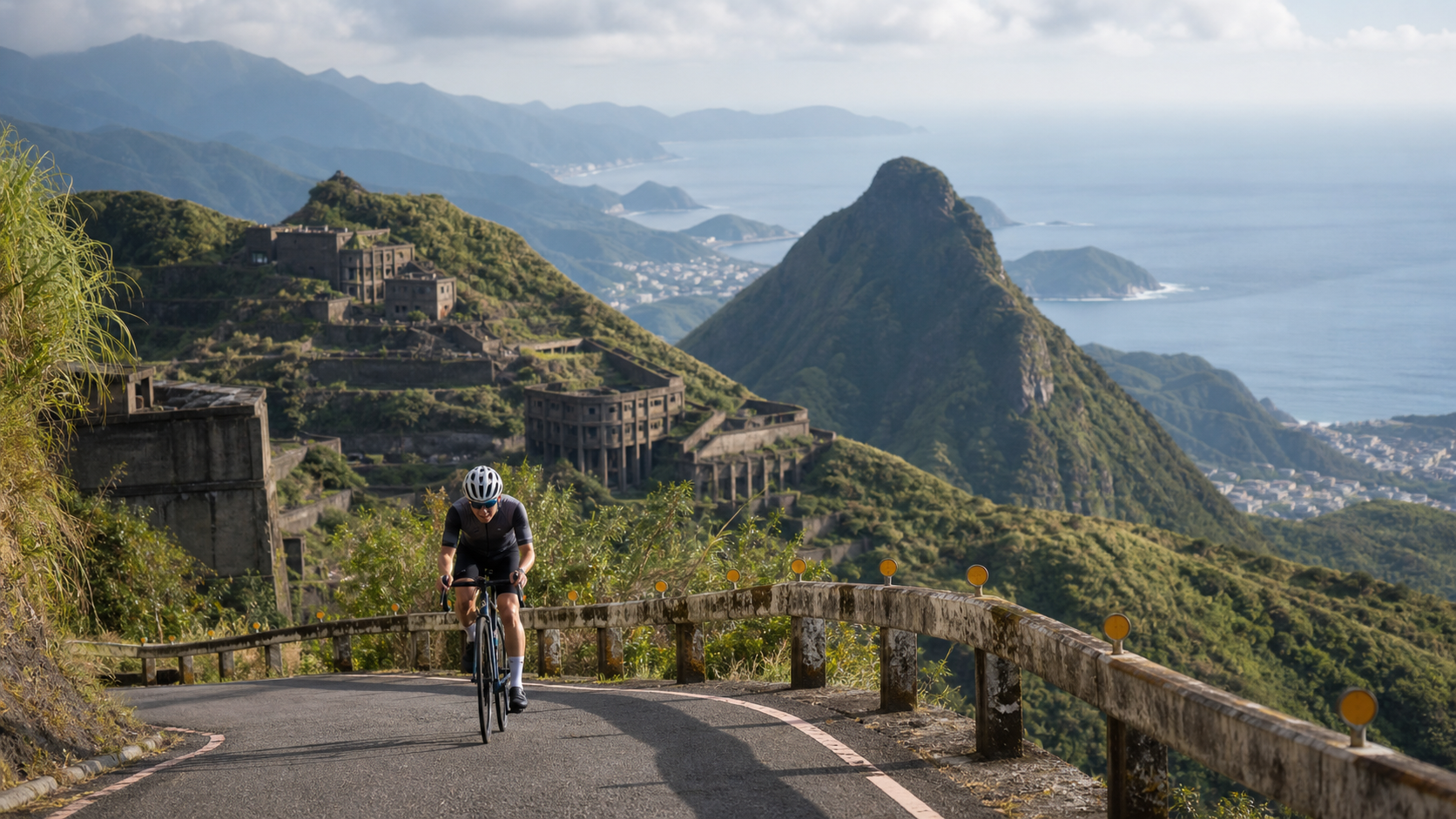
Introduction: Riding into a Former “Asia’s Premier Precious Metal Mine”
As the wheels roll over the asphalt roads of Jinguashi, it’s hard not to imagine that over a hundred years ago, countless gold prospectors and miners flooded into these hills in search of gold. Today, the traces they left behind have become museum parks, abandoned ore-processing plant ruins, and also this very mountain road I am currently climbing.
The Teapot Mountain climb in Jinguashi spans 3.15 kilometers with an elevation gain of 223.6 meters and an average gradient of 7.1%. These numbers tell you the physical difficulty of this road, but they cannot convey the dramatic rise and fall of a century of mining history behind this land. This article aims to take you on a slower, more nuanced journey to rediscover this road—not just to ride it, but to understand what stories every inch of the ground beneath your wheels has witnessed.
Jinguashi: A Legend That Began with a Golden Pumpkin-Shaped Rock
The origin of the name Jinguashi (Golden Pumpkin Rock) is directly linked to the mineral deposits hidden beneath this land. According to records, in 1893, a farmer surnamed Li discovered the Xiaojinguashi (Little Golden Pumpkin) gold vein here, ushering in nearly a century of mining history in this mountainous region. Over the following decades, the area gradually developed into one of Taiwan’s most important precious metal mining settlements. In 1938, mineral production reached its historical peak, with annual gold output approaching 70,000 taels, earning it the reputation of “Asia’s Premier Precious Metal Mine”—what a glorious title, symbolizing how this mountain once held a pivotal position in the mining landscape of the entire Asian continent.
However, all mining operations eventually reach their end. As ore veins gradually depleted and extraction costs continued to rise, the once-thriving Taijin Company finally ceased operations in 1987, drawing the curtain on nearly a century of gold production. The mining settlement lost its economic lifeline overnight, and many communities that had flourished because of mining gradually fell into decline and obscurity.
It wasn’t until 2004, when the Gold Museum Park officially opened, that Jinguashi returned to the public eye in a completely new form—this time, no longer as a gold-producing mine, but as a cultural asset carrying historical memory. The park preserves the Taitung Guesthouse, a dormitory building for high-ranking officials during the Japanese colonial period, and also preserves Benshan No. 5 Adit as an exhibition space for the museum. The ruins of the Gold Shrine remain as well, where the torii structure left behind from those days can still be seen today, quietly telling the story of the colonial and industrial history this land once experienced.
Teapot Mountain: A Landmark Named for Its Shape
Within this mountainous region steeped in a century of mining memory stands a peak reaching 602 meters in elevation—Teapot Mountain. The mountain earned its name because its silhouette resembles a teapot without a handle, which is why locals also call it the “Handleless Teapot Mountain.” Interestingly, if you view the mountain from a different angle—from the north—its shape takes on the outline of a crouching lion, which is why it was also historically known as “Lion Rock.” The same mountain, viewed from different perspectives, yields two completely distinct images. This peculiar geological formation has made Teapot Mountain one of the most recognizable landmarks in the entire Ruifang Scenic Area.
Geologically, this mountainous region belongs to a silicified breccia ore-pipe formation, part of the Third Changren gold-copper ore body—in other words, the peculiar rock formations of Teapot Mountain are themselves geological evidence of the rich mineral deposits this land once held. As you climb and gradually approach the mountain, take a moment to slow down and carefully study its contours, imagining how miners a century ago, in such rugged geological conditions, used the most primitive methods to extract gold and copper buried deep beneath the earth.
The hiking trail is 4.5 kilometers long in total, with the trailhead located behind Jinguashi Chuanjitang Temple. It takes approximately two hours to walk to the summit, offering panoramic views of Yin-Yang Sea and the ruins of the Shuinandong Ore Refinery along the way—this is the perspective of hikers, while we cyclists on the climbing section experience the undulations and breathing of this land at a different rhythm.
Yin-Yang Sea: The Ocean Also Remembers the Mining Era
Riding along the mountain roads of this area, a stretch of sea with an unusual color in the distance often catches the eyes of cyclists and tourists alike—this is the bay commonly known as “Yin-Yang Sea,” whose official name is actually “Liandong Bay.” The peculiar half-blue, half-yellowish-brown appearance of these waters is caused by minerals—when pyrite oxidizes to form ferric iron compounds, they flow into the sea with rainwater and groundwater, forming colloids in the seawater that dye it a yellowish-brown hue distinctly different from the surrounding blue waters.
This seascape can be described as the most direct and visually striking “souvenir” this entire mining settlement has left for posterity—nature, in its own way, has recorded the profound traces that a century of human mining activity has left on this land and sea. When you look back at this bay during your climb or after reaching the summit area, take a moment to pause and reflect on the story of industrial and environmental change carried behind this beautiful yet bittersweet seascape.
Golden Waterfall and the Ore Refinery Ruins: Other Fragments of Memory Along the Way
If you extend your itinerary slightly to the Jinshui Road area around this climbing route, you’ll encounter another famous sight—the Golden Waterfall. Located on Jinshui Road heading toward the Changren community, this waterfall is formed by mineral water converging from the adits of Benshan No. 6 Pit and Changren No. 5 Pit. Because of its high mineral content, the water displays a distinctive yellowish-brown iron-rust coloration. One important note here: the water of the Golden Waterfall contains heavy metals, so visitors and cyclists must not touch or play in the water—simply admire its unique visual spectacle from a distance.
Another landmark worth mentioning is the Shuinandong Ore Refinery ruins, which locals often call the “Thirteen-Level Ruins,” although the complex actually consists of eighteen levels of structures. Completed in 1933, this refinery was one of the most important processing facilities during the heyday of the mining industry. It was registered as a historic building in 2007. Today, the layered ruins built into the mountainside have become one of the most iconic photography spots in the area, with many people making special trips just to capture the image of sunset light spilling across these weathered remnants.
Jinguashi and Jiufen: The Twin Settlements of the Jingu Area
When mentioning Jinguashi, it’s hard not to mention its neighbor—Jiufen. Due to their geographical proximity and similar mining history, these two settlements are collectively known as the “Jingu Area,” the most renowned region in the entire Northeast Coast tourism landscape. Thanks to the success of the film A City of Sadness, Jiufen successfully transformed into a popular tourist destination after the 1990s, with its mountain-town old streets, stairway alleys, and nostalgic atmosphere woven together by red lanterns attracting countless domestic and international visitors.
Compared to Jiufen’s bustling, tourist-oriented character, Jinguashi retains more of the quiet, raw atmosphere of a mining settlement. Along Jinshui Road, numerous locally developed guesthouses offer travelers who wish to slow down and deeply experience the historical texture of this land a place to stay overnight. As a cyclist, if time permits, consider arranging a more leisurely itinerary and spending an extra night in Jinguashi, savoring the tranquility that returns to this mountain town after the crowds have dispersed.
The Physical Experience of Riding: A Dialogue with History on the Steep Ascent
Actually riding this 3.15-kilometer climb with an average gradient of 7.1%, the physical fatigue and the historical atmosphere of the surroundings create a strange, interwoven experience. Each forceful pedal stroke seems to echo the mining era of this land—imagine the miners of a century ago, on these very slopes, carrying heavy loads of ore and tools, trudging forward step by difficult step. The physical exertion they endured is likely something the pain we feel climbing on our bicycles today cannot even begin to compare with.
This riding experience, infused with historical imagination, makes the Teapot Mountain climb more than just a physical training route—it becomes a cultural journey that connects you with the memory of the land. When you reach the top, gasping for breath, gazing at the peculiar rock silhouette of Teapot Mountain, then turning back to look down at the mining settlement that was once bustling with activity but has now returned to stillness, that complex emotion of physical exhaustion interwoven with spiritual resonance is perhaps what makes this route most unique and most worthy of savoring.
Seasonal Scenery: The Mining Mountain Through the Four Seasons
Located in the Northeast Corner region, the Jinguashi area experiences highly variable weather patterns, giving this route a distinctly different atmosphere with each season.
On clear days, climbing high to gaze at the Yin-Yang Sea and the distant coastline, the visual contrast between the azure waters and the yellowish-brown bay is especially striking—an ideal moment for photography and panoramic views. When the northeast monsoon settles in and mist wraps around the mountains, the entire mining settlement and surrounding peaks take on a more hazy, weathered, and mysterious character, as if drawing closer to the historical depth this land has witnessed.
Regardless of the weather, this land seems to find a way to present itself in a manner befitting its character—whether it’s the vast grandeur of a sunny day or the quiet desolation of an overcast one, both are seasonal sights unique to Jinguashi.
Suggested Add-ons: Extending the Ride into a Mining Culture Trip
If you’re planning to make a dedicated trip to tackle the Teapot Mountain climb, consider making the journey more complete and enriching by linking this climbing route with the surrounding cultural attractions.
Before the ride: You can visit the Gold Museum to understand the mining history of this land, including the Prince Chihiro House and the Benshan No. 5 Tunnel Museum, building a deeper cultural context before taking on the climb ahead.
During the ride: Keep an eye out for views of the Yin-Yang Sea along the way. If time and energy permit, you can also detour toward Jinshui Road to see the unique appearance of the Golden Waterfall (be sure not to touch the water).
After the ride: Once you’ve completed the climb, consider extending your trip to the nearby Jiufen Old Street to experience a completely different tourist-town atmosphere, or linger a while at a local B&B in Jinguashi, savoring a ride that blends physical challenge with history and culture.
Photography tips: The area around the Shueinandong Smelter Ruins is widely recognized by photography enthusiasts as an excellent vantage point, with the most ideal light in the late afternoon. If your schedule allows, it’s worth making a dedicated stop.
Quanjitang Temple and the Trailhead: Where Faith and Sport Converge
The entrance to the Teapot Mountain hiking trail is located behind Quanjitang Temple in Jinguashi. Quanjitang itself is an important center of faith in the area, with incense burning year-round. For the residents of this mining settlement, it is not only a spiritual anchor but also carries the collective memory of residents praying for safety and smooth fortunes through the rise and fall of the mining industry. When the cycling route intersects with the landscape around this temple, it creates an interesting juxtaposition—on one side, a modern sporting scene demanding physical limits; on the other, a traditional space of faith that has endured for decades or even a century. The two coexist on the same hillside without conflict, together forming the rich cultural layers of this land.
Every time I ride past Quanjitang, I always see worshippers and tourists coming and going. The temple’s upturned eaves set against the contours of the surrounding mountains create a scene rich with local character. If time allows, it’s worth pausing briefly before or after the ride to soak in the unique tranquility around the temple—this encounter with a sacred space is a part of the Teapot Mountain climb that is easy to overlook yet well worth savoring.
The Miner’s Daily Life: Imagining the Labor of a Century Ago
Every time I ride up this steep mountain road, I can’t help but imagine how the miners of a hundred years ago spent their days in this terrain. According to historical records, during the peak of Jinguashi’s mining industry, a large labor force gathered here, forming a fully functional mining settlement—complete with shops, theaters, schools, and even dedicated medical facilities, resembling a self-sufficient small town.
The miners’ working conditions were far harsher than the physical exertion we feel on a bike today—they had to descend into underground tunnels, working in dim, damp, dust-filled environments, extracting ore with the most primitive manual labor before hauling the heavy loads back to the surface. Compared to the intensity of their daily toil, the fatigue we feel tackling this 3.15-kilometer steep climb is perhaps just a drop in the bucket. But it is precisely this contrast that gives the route an extra layer of meaning worth pondering—it reminds us that this seemingly peaceful mountain landscape was once a place where countless laborers earned their livelihood with blood, sweat, and their very lives.
Today, most of the old mine shafts are sealed or have been converted into tourist exhibition spaces, but the memory of that labor continues to speak to later generations through the preserved tunnel remains and everyday artifacts in the Gold Museum. If you can ride through this land with a bit more understanding and respect for its history, the experience will surely carry far richer depth than a purely physical challenge.
Sunset at the Thirteen Levels Ruins: A Wait of Light and Shadow
Once, after finishing the Teapot Mountain climb, I deliberately stayed until near dusk before slowly riding toward the Shueinandong Smelter Ruins, waiting for that sunset moment so often spoken of among photography enthusiasts. The smelter ruins, built layer upon layer into the hillside, appear in daylight as nothing more than a mottled, weathered outline of ruins. But when the last rays of the setting sun gradually stain the sky red, and the light strikes those crumbling structures at a low angle, the entire scene seems to gain new life—the cold, hard concrete, bathed in warm orange light, appears both desolate and deeply moving.
At that moment, standing at the viewpoint near the ruins, gazing at what was once a thriving smelting and processing hub completed in 1933, now reduced to broken walls for people to remember, a complex and indescribable emotion welled up inside me. The rise and fall of industrial civilization seemed condensed within these ruins painted red by the sunset—once, this was an industrial heartland with roaring machinery and miners moving about; now, it stands quietly between mountain and sea, a landmark full of narrative tension in the lenses of photographers.
This posture of standing firm despite a century of weathering echoes, in a way, the character of the entire Jinguashi region—even though mining has passed into history, this land continues to tell its story in another form, drawing generation after generation of travelers and riders to visit, pause, and imagine.
For First-Time Riders in Jinguashi: A Few Practical Tips
If this is your first time riding to Jinguashi and the Teapot Mountain area, beyond the route guide mentioned earlier, there are a few local-specific tips worth keeping in mind.
First, the mountain roads here have many curves, and some sections run close to cliffs and sea bluffs. Be sure to maintain an appropriate speed, especially during busy holiday periods when tourist traffic is heavy—stay alert to pedestrians and vehicles around you. Second, the Jinguashi settlement is not large, and shops and supply points are relatively limited. It’s recommended to stock up on essentials in Ruifang city center or around Jiufen before setting out, to avoid arriving and finding nowhere suitable to rest or resupply.
Additionally, because this mountain area is close to the coast, the wind is often stronger than expected. Especially on ridgelines or open stretches with wide views, crosswinds can affect riding stability. Stay vigilant and reduce speed when necessary. Finally, the cultural and historical depth of the Jinguashi area is profound—if time allows, slow down and don’t treat this merely as a climbing training ground. Taking a little extra time to learn about the mining stories behind this land will make the entire ride far richer and more dimensional.
A Final Conversation with Myself
Every time I finish a ride in Jinguashi and pack up my gear for the return trip, I can’t help but glance back at that teapot-shaped peak and think: in just over a hundred years, this land has gone from an obscure mountain forest, to the pinnacle of Asia’s most valuable precious-metal mine, to the silence that followed the industry’s closure, and finally to being remembered anew through tourism and cultural heritage—such a dramatic arc of fortune could almost be condensed into a complete epic of industrial rise and fall.
And I, as a traveler who came here purely for the love of cycling, have in a sense become part of this history as it continues to be written and told—every pedal stroke, every moment spent pausing to gaze at the ruins and the sea, adds a new chapter to this land’s story, one told from a contemporary cyclist’s perspective.
This, perhaps, is the most precious meaning of riding a route with a story: it is not merely a training ground for physical fitness, but an ongoing dialogue with the land and its history, giving every pedal stroke a weight far greater than mere exercise.
For Travelers Seeking a Deeper Connection with This Land
If, like me, you enjoy taking a bit of extra time beyond the ride itself to learn the stories of the land beneath your wheels, Jinguashi is well worth slowing down for. Beyond the Gold Museum and the Teapot Mountain hiking trail, this area preserves numerous relics and traces of daily life tied to its mining history, quietly scattered through the alleys of the settlement, waiting for curious souls to discover them.
To me, a bicycle is not merely a means of transport or exercise—it is a way of getting to know the land. At a pace that is relatively slow yet deep enough, it lets you weave between city and countryside, feeling the years that every inch of ground has passed through. Jinguashi and Teapot Mountain are among the best arenas for this riding philosophy: they challenge your physical limits while, almost without notice, leading you into a century-spanning story of industrial rise and fall.
Perhaps next time you ride this road, try slowing down a little, taking a longer look at the landscapes and buildings around you, and imagining the countless stories this land once carried. You will discover that cycling can hold far deeper meaning than mere exercise.
Conclusion: A Mountain Road Connecting Effort and Memory
The Jinguashi Teapot Mountain climb, with its 3.15 kilometers of distance and 223.6 meters of elevation gain, carries a story far richer than its numbers suggest. This was once the site of “Asia’s premier precious-metal mine,” witnessing both the most glorious and the most bittersweet chapters in Taiwan’s mining history. Today, in the form of a cycling climb, it invites every rider to use the power of their legs to reconnect with the years this land has passed through.
Next time you ride this road, in the gaps between your gasps for breath, take a moment to look at the surrounding mountain contours and the distant sea view, and think about the weight this land once bore. You will find that Teapot Mountain is not just a landmark—it is more like a silent history book written in geology and ocean, and every pedal stroke you make in this moment is turning one of its pages.
Related Reading
- Riding into Asia’s Premier Precious-Metal Mine: The Golden Years of Jinguashi’s Jinshui Road and the Liandong Bay Legend
- Jinguashi Teapot Mountain Practical Guide: A Complete Breakdown of the 3.15 km, 7.1% Average Grade Mining-Area Climb
- Chike Mountain’s Golden Daylily Fields: A Humanistic Cycling Journey Through the East Rift Valley, Written in Pedal Strokes
- Keelung Nuannuan to Pingxi: A Cycling Tour of Taipei’s Suburban Mountain-Town Coal-Mining Culture
無耳茶壺山 半屏山 空拍震撼絕景 驚險O型縱走
8 年前
一定要騎一次!阿里山最深處:里佳部落!單車旅行 | 2800m爬升 | 深度部落體驗:嗨翻晚會、螢火蟲、銀河 | feat. JJSC & 廢物伙伴 | 公路車 CT Yeh
9 個月前
嘉義大埔、阿婆灣挑戰賽,美到以為在日本!ft. 環騎5 Cool 西拉雅188 / 公路車 / CT Yeh
7 個月前
日本公路最高登山賽,台灣首位YT挑戰實錄,乘鞍登山賽40週年,賽前篇完整版,請到我的YT收看 #公路車 #cycling
10 個月前
[空拍][4K] 茶壺山 驚險攀爬之旅 預告
8 年前
太平山單車員工旅遊 | 這樣玩CP值最高!| 公路車
5 年前
那瑪夏x茶山 阿里山系深山單車行 Day2 累積爬升6000M | 🥶超陡連續下坡 整路看隊友刷 | 爬升一座西進武嶺 | JJSC | 公路車 | CT Yeh
3 年前
#北橫 + #北進武嶺 最硬的員工旅遊 EP1 | #公路車 #拉拉山 | 明池 | 武嶺 | 武陵農場 | 雲海 | Taiwan Cycling Route Wulin
6 年前