Riding into Asia's Premier Precious Metal Mine: The Golden Years of Jinguashi's Jinshui Road and the Legend of Liandong Bay
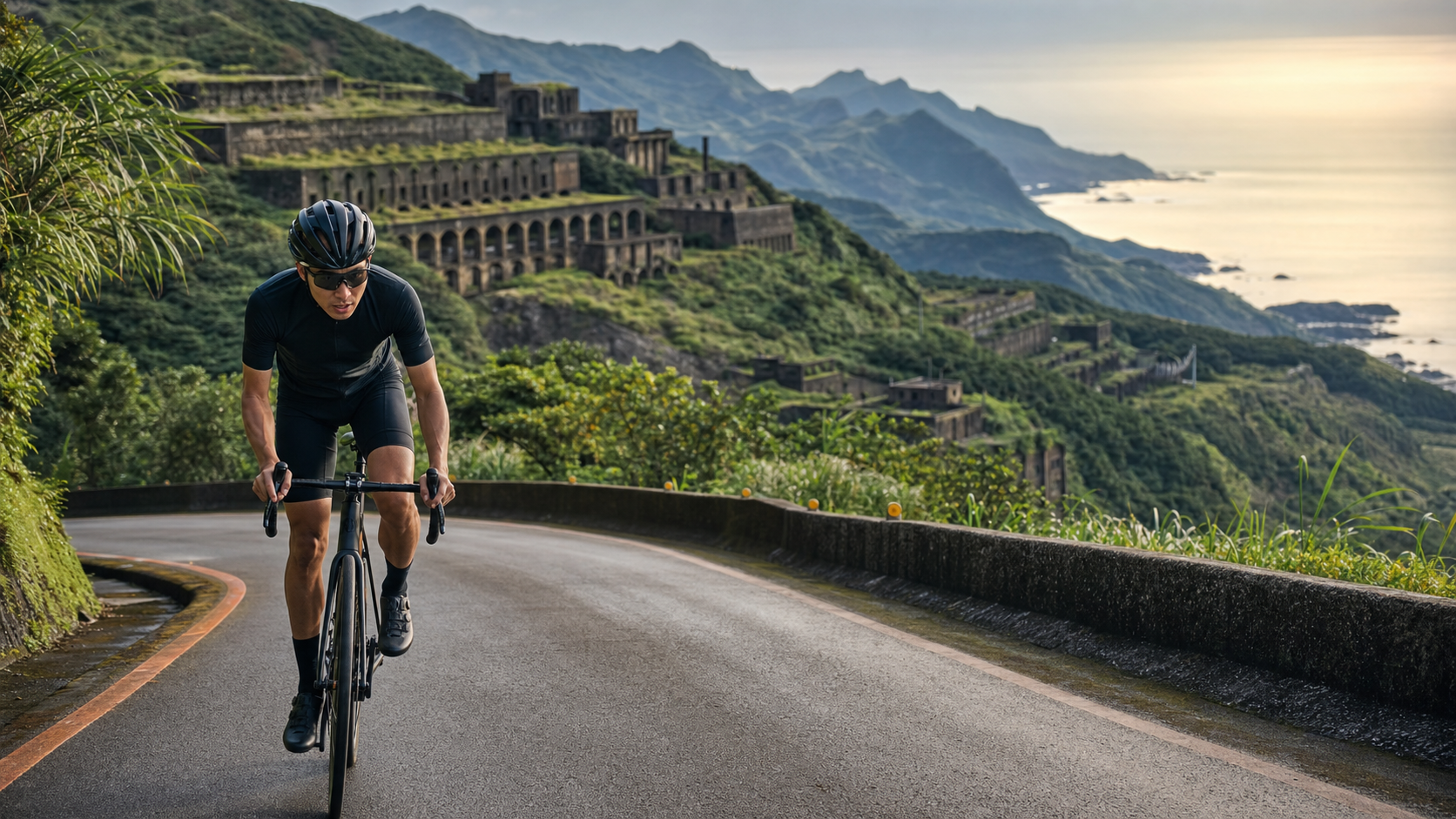
Prologue: Riding a Bike into a Mountain That Once Produced the Most Gold in All of Asia
As my wheels roll over the asphalt of Jinshui Road, I often think of this: over a hundred years ago, this mountain region was once the “richest precious metal mine in Asia.” In 1938, Jinguashi’s mineral output reached its historical peak, with an annual gold production of nearly 70,000 taels. In that era, Jinguashi was one of the most astonishingly productive gold-mining corners in all of Asia. Today, most of those tunnels have been sealed, and the smelting plants have long ceased operation. But as you pedal up along Jinshui Road, you can still clearly feel it—this is not a tourist road that “exists purely for the scenery,” but a mountain road layered upon the fabric of mining history, carved out by sweat and the footsteps of miners.
Jinguashi’s Jinshui Road spans 4.84 kilometers in total, with a cumulative elevation gain of 316.8 meters and an average gradient of 6.3%. As a cycling route, its difficulty is enough to make your thighs burn and your heart race; but as a vessel of history, it carries far more weight than those numbers suggest. In this article, I want to temporarily set aside pace charts and power meters, and simply use a rider’s eyes and legs to reacquaint myself with this mountain—its rise and fall in mining, its faith and traces of daily life, the Gold Museum Park it left for posterity, and that bay with its eerily beautiful, breathtakingly colored waters.
A Legend That Began at Little Jinguashi: The Rise and Fall of Jinguashi’s Mining Industry
The story of Jinguashi begins in 1893. Legend has it that a farmer surnamed Li discovered a gold vein here that year. That outcrop, shaped like a pumpkin—also called a “golden gourd” (jīn guā)—became the origin of this mountain region’s name. Once word spread, a gold rush swept in, and the once-quiet mountain area gradually gathered large numbers of miners and speculators, giving birth to a settlement that thrived on the mineral veins.
During the Japanese colonial period, Jinguashi’s mining development became further systematized and scaled up. By 1938, mineral output reached its historical peak, with annual gold production approaching 70,000 taels. Placed on the map of East Asian mining at the time, that figure was enough to earn Jinguashi the reputation of “Asia’s richest precious metal mine.” Imagine, in an era without modern heavy machinery to assist extraction, achieving such output meant countless miners deep in the tunnels, chipping away with the most primitive methods, pick by pick.
After the war, the mining operation was taken over by Taiwan Metal Mining Corporation (Taijin Company), which continued extraction for decades. However, as gold and copper veins gradually depleted, extraction costs rose, and the international mining environment shifted, the once-glorious industry eventually reached its end. In 1987, Taijin Company officially ceased operations, closing the curtain on nearly a century of gold production in Jinguashi. That year, many families dependent on mining had to seek new livelihoods, and the fate of the entire settlement turned a corner.
Today, as you ride past along Jinshui Road, you’ll occasionally catch glimpses of tunnel entrances left on the hillsides and abandoned mining structures. These silent traces are the imprints left by nearly a century of gold production. They aren’t meticulously preserved like artifacts in museum display cases, but rather scattered among the forests, left to the elements—and precisely because of that, they tell the story of this mountain’s glory and vicissitudes all the more authentically.
This history also reminds every passing rider: today we pedal lightweight carbon-fiber bikes, enjoy modern equipment and technology, and casually ride through this mountain region, snapping photos and making fond memories. Yet less than a hundred years ago, this same mountain bore a completely different kind of toil and danger. This stark contrast across time is what makes Jinshui Road both the most fascinating and the most weighty of routes.
Gold Museum Park: Stepping into the Depths of the Tunnels, Touching That Era
If you’re not in a hurry, the Gold Museum Park near Jinshui Road is well worth stopping for. Officially opened in 2004, this park is one of the few museum clusters in Taiwan themed around mining culture. It preserves numerous mining and residential buildings from the Japanese colonial period through the postwar era, allowing later generations to literally “walk into” that history rather than merely imagining it through text.
Prince’s House (Taizi Binguan) is one of the park’s most iconic buildings. This Japanese-style wooden structure was originally a guesthouse-level residence for high-ranking officials during the Japanese colonial period. Its architectural craftsmanship is refined and meticulous, with elegant garden landscaping—a concrete testament to the prosperity of the mining economy and the frequent exchanges between local gentry and officials in that era. Stepping into Prince’s House, you can sense how the wealth accumulated by the mining settlement was translated into architecture and the aesthetics of daily life—forming a stark yet coexisting historical contrast with the miners’ grueling labor in the tunnels.
Benshan Fifth Tunnel (Benshan Wukeng) is one of the Gold Museum Park’s core exhibition areas. Today it serves as the museum’s main space, displaying early mining tools, processes, and the daily lives of miners. Walking through the simulated tunnel exhibition, even just a few dozen meters of experiential pathway, the dim, damp, slightly oppressive spatial sensation is enough to give you a small taste of the hardship and danger miners faced going underground every day. These tunnel depths were once the economic lifeline of countless families, and they also harbor many untold stories of sorrow.
The Gold Shrine Ruins (Huangjin Jinshe) is another spot particularly worth lingering at. Though the shrine’s main structure has long collapsed, the torii gate remains, standing quietly on the hillside. During the Japanese colonial period, mining companies often built shrines near mining areas to pray for safe operations and bountiful yields—the Gold Shrine is a microcosm of that faith culture. Today, with the torii gate surviving amid overgrown silvergrass, there’s a peculiar desolate beauty to it—a once-thriving site of worship now stands as a historical landmark for hikers and cyclists passing through, bearing witness to the changing of eras and the evolution of belief.
If you plan to visit the Gold Museum Park during your ride along Jinshui Road, I’d suggest slowing your pace, or even finding a safe spot to park and walk through on foot, because the historical details here are hard to truly see at riding speed. The park’s exhibition route is quite comprehensive, from the arc of mining history and miners’ daily lives to the opposite extreme of Japanese-era officialdom—all coming together in a single visit to piece together a complete, three-dimensional picture of Jinguashi’s past.
The Thirteen-Level Ruins: That Vast Industrial Relic by the Sea
Continuing along Jinshui Road toward the coast, in the distance you’ll see a massive gray complex of buildings stacked layer upon layer against the mountain, standing by the sea—this is the Shuinandong Smelter Ruins, commonly called the “Thirteen-Level Ruins” by cyclists and visitors alike, though the actual number of levels far exceeds thirteen.
Completed in 1933, this smelter was a crucial facility in Jinguashi’s mining industry chain, responsible for processing and smelting the ore extracted from the mines. The entire structure was built tier by tier following the hillside terrain, on a massive scale. Even today, in its idle, weathered, and rusted state, it still delivers a stunning visual impact—that unique melancholic beauty of industrial ruins has drawn countless photography enthusiasts and served as a backdrop for films and advertisements. In 2007, the Shuinandong Smelter Ruins were officially registered as a historic site, signifying official recognition of its value as an important witness to Taiwan’s mining history—not just a pile of abandoned concrete, but a cultural asset deserving preservation and remembrance.
The first time I rode past here, catching sight of that gray expanse of buildings standing between mountain and sea, I honestly felt an indescribable awe. It’s not a refined, fully restored tourist attraction, but something bearing rust and decay, yet still possessing an immense presence—as if silently telling you: once, this was the busiest node in the entire mining chain, where ore extracted from the mountains passed through layer upon layer of processing, ultimately yielding the gold and metals that sustained the economic lifeline of the entire settlement. And now, it simply stands by the sea, letting the ocean wind and time continue their slow erosion.
When cyclists pass through this area, I’d recommend slowing down and finding a safe viewpoint to pause for a while. The scene composed of this vast industrial relic, the mountains behind it, and the bay before it is one of the most visually striking landscapes along Jinshui Road—worth several minutes of quiet contemplation rather than a fleeting glance. Especially under different weather and lighting conditions, this site takes on entirely different moods—the rugged industrial feel on clear days, the desolate, bleak atmosphere when mist shrouds it on overcast or rainy days—each telling its own story and emotion, worthy of repeated visits and repeated appreciation.
Yin-Yang Sea and Golden Waterfall: A Spectacle Woven from Nature and Mining Legacy
Riding along Jinshui Road, another striking sight is that oddly colored bay—officially named “Liandong Bay,” but more commonly known as the “Yin-Yang Sea.” Viewed from above, one side of the bay appears deep blue or dark green, while the other is a distinct yellowish-brown. The two colors form a clear boundary on the water’s surface, as if deliberately separated by a painter’s brush—hence the name “Yin-Yang Sea.”
The cause of this peculiar landscape is closely tied to the region’s mining history. Minerals such as pyrite in the mountains, after prolonged oxidation, produce ferric iron compounds. These rust-colored minerals flow into the sea via surface and groundwater, mixing with seawater to form a colloidal state, which gives the nearshore waters a rust-like yellowish-brown hue. This is a unique landscape born from the long-term interaction between nature and human mining activities—in a sense, it is both a beautiful visual marvel and a silent testament to the intensive mining development this mountain area once experienced.
Following this logic, you can also understand the origin of another famous landmark along the way—the Golden Waterfall. Located on Jinshui Road heading toward Changren Community, the waterfall’s water source comes from the collected mine water of Benshan No. 6 Pit and Changren No. 5 Pit. These underground waters seeping from deep within the tunnels are rich in minerals, and after prolonged oxidation and sedimentation, the entire waterfall takes on an intense yellowish-brown hue. From a distance, it looks as if real gold has melted and flowed down, which is how it earned the name “Golden Waterfall.”
The color of the Golden Waterfall is indeed stunningly beautiful, especially under sunlight, where the golden hue contrasts sharply with the surrounding lush green mountains, making it a popular spot for tourists and photography enthusiasts alike. However, a special warning must be given to all readers: the water of the Golden Waterfall contains heavy metal minerals. Under no circumstances should you wade in or allow prolonged skin contact with the water flow. The minerals that give the waterfall its mesmerizing golden color are harmful to human health. Simply admire it with your eyes and capture the spectacle with your camera or phone—do not risk your safety on a whim.
Riding along Jinshui Road, encountering both the Yin-Yang Sea and the Golden Waterfall on the same stretch—two landscapes born from the same mining history yet presented in entirely different ways—is a truly unique experience. You come to realize that the relationship between human activity and the natural environment is never a simple dichotomy of destruction versus preservation, but rather layers upon layers of complex, interwoven traces, left for future generations to understand and interpret from different perspectives. It is precisely for this reason that every time I ride this road, I remind myself to slow down—not just for safety, but also to give these landscapes, which carry both beauty and cautionary meaning, a little more time for contemplation and reflection.
The Jinguashi-Jiufen Region: The Geographic Bond Between Jinguashi and Jiufen
Anyone who has ridden Jinshui Road has probably heard of the term “Jinjiu Region”—it refers to the combined name of Jinguashi and the neighboring Jiufen. These two settlements are geographically close, and their historical trajectories are tightly interwoven. Both are mountain towns that rose to prominence because of mining, yet after the industry declined, they took entirely different paths of transformation.
The story of Jiufen is perhaps more familiar to many—the film A City of Sadness was shot there and achieved success, unexpectedly driving a wave of tourism to Jiufen. This mountain town, which had been gradually fading into obscurity after the mining industry collapsed, was transformed into an internationally renowned tourist destination. Today, Jiufen Old Street is bustling with visitors; red lanterns, mountain stairways, teahouses, and street food together form what many consider the most iconic image of a Taiwanese mountain town.
In comparison, Jinguashi’s transformation has been more understated and gradual. It lacks the overnight tourism boom that Jiufen experienced. Instead, along the Jinshui Road corridor, a tourism model centered on bed-and-breakfasts has gradually developed. Many old houses have been converted into guesthouses, allowing visitors and cyclists to stay overnight and quietly absorb the tranquil pace of the mountain town—a stark contrast to Jiufen’s bustle. This relatively slower transformation, which preserves more of the local way of life, has to some extent allowed Jinguashi to retain more of its original settlement texture and atmosphere—less commercialized packaging, and more of a sense of historical depth.
For cyclists, the geographic relationship of the Jinjiu Region also means rich possibilities for route connections—Jinshui Road itself is already a solid climbing challenge. If energy and time permit, you can connect to the nearby Teapot Mountain section in Jinguashi, also in Ruifang District, or even extend to roads around Jiufen, planning a deep northeast coast ride encompassing mining history, mountain town charm, and coastal landscapes. This experience of connecting multiple historic settlements in a single ride is precisely the most unique advantage of the northeast coast compared to climbing routes within the Taipei Basin—what you ride through is not just gradients and mileage, but a microcosm of modern Taiwan’s mining development history.
First-Person Riding Narrative: Dialoguing with History on the Slopes
I set out early that day. The mountain area was still shrouded in a thin mist, and the air carried a moist, salty scent—a distinctive trait of coastal mountain regions. The initial climbing section had a relatively gentle gradient, so I deliberately kept my power output low, letting my body gradually adapt to the sustained climbing ahead. After a few turns, the view suddenly opened up, and that familiar yet unfamiliar cluster of massive gray buildings came into sight—the ruins of the Shuinandong Smelter. In the thin mist, it looked especially serene, like a giant beast forgotten by time, quietly gazing down at the bay below.
Continuing upward, the gradient became noticeably more demanding, and my thighs began to feel that familiar burning sensation. Between breaths, I spotted an abandoned mine adit on the hillside beside the road. The iron fence was rusted and mottled, and the darkness inside was impenetrable. I couldn’t help but stop and stare for a few seconds—it’s hard to imagine that over a hundred years ago, countless miners passed in and out of such adits, using the most primitive methods, deep in the dark, damp underground, chipping away pick by pick to produce the output that once elevated Jinguashi to the status of “Asia’s premier precious metal mine.” The hardship and danger of that labor is something we riders on modern carbon-fiber bikes, wearing breathable cycling jerseys, can scarcely truly empathize with.
When I reached the vicinity of the Golden Waterfall, that intense golden hue still amazed me. Even though I already knew the cause behind it—oxidation and sedimentation of mine water—seeing that color cascade down the rock face with my own eyes still felt surreal. I slowed down, pulled over, and simply watched for a good while before continuing upward, silently reminding myself that behind this beauty lies a health warning that must not be taken lightly.
The steepest section appeared in the latter part of the ride—a sustained, relentless climb that pushed my breathing and heart rate into a high zone. I tried to shift my focus from “how much farther” to “maintaining a steady pedaling rhythm,” spinning one revolution at a time, concentrating on each individual stroke. Interestingly, when you direct your attention to these small details of motion, the seemingly endless climb somehow passes without you even noticing at a certain moment.
When I reached a section with an open view and looked back, the entire coastal mountain area and the distinctly colored waters of Liandong Bay lay spread out before me. The sense of accomplishment at that moment came not just from completing a climb with a 6.3% average gradient, but more from a sense of settling and emotion after dialoguing with the history of this land—this mountain once produced staggering amounts of gold, once gathered tens of thousands of families dependent on mining for their livelihoods. Now, nearly four decades have passed since the mines closed, yet those adits, the smelter, the shrine torii gates, and that bay stained by mine water all remain quietly in place, waiting for riders like me to rediscover, with our feet and our wheels, this history that has been covered by time but never truly disappeared.
On the descent, I passed by the vicinity of the Prince’s Mansion again. The afternoon sun slanted across the eaves of the Japanese-style wooden building, and a few tourists were taking photos in the garden. At that moment, the two faces of the mountain town appeared before me simultaneously—on one side, the solid, arduous climbing challenge; on the other, the leisurely, unhurried pace of tourism. And this mountain area of Jinguashi perfectly blends these two contrasting rhythms into a unique and captivating overall atmosphere.
Suggested Itinerary and Riding Tips
If you’re also planning a cultural cycling trip along Jinguashi’s Jinshui Highway, here are a few suggestions for your reference:
Suggested Itinerary Planning: Don’t rush this ride. The Jinshui Highway itself isn’t long, but there are plenty of spots worth stopping at along the way—the Gold Ecological Park, the Shueinandong Refinery Ruins, the Yin-Yang Sea viewpoint, and the Golden Waterfall. Each one deserves time to savor rather than just riding past for a quick photo. It’s recommended to set aside at least half a day to a full day to fully experience the cultural depth of this route. If you’re planning to go on a weekend, it’s best to set off early to avoid the busier hours and give yourself more time to explore.
Clothing and Gear: The wind and humidity in the Northeast Coast mountain area are quite noticeable. Even for a purely cultural excursion, it’s recommended to wear sporty clothing paired with a lightweight windbreaker to easily adapt to changing weather. If you plan to walk around the Gold Ecological Park or the refinery ruins, it’s advisable to bring comfortable walking shoes, as some of the park’s trails and tunnel experience routes are not suitable for cycling shoes.
Respect for Historical Sites: Whether it’s the torii gate at the Gold Shrine ruins or the abandoned structures around the refinery ruins, these are cultural assets of historical significance. Riders and visitors are advised to maintain a respectful attitude—do not climb on or damage these relics. Simply record them with your eyes and camera, and leave these precious historical witnesses for future generations to visit.
Safety Reminders: The mine water around the Golden Waterfall contains heavy metals—do not play in the water or have prolonged contact with it. Some abandoned mine entrances and refinery structures are old and deteriorated; it’s recommended to stay only within the safe areas open to visitors and not to enter restricted zones on your own.
Connecting Nearby Attractions: If time permits, the Jinguashi–Jiufen area has many more corners worth exploring—the nearby Teapot Mountain climbing segment in Jinguashi and the mountain-town charm of Jiufen Old Street can all be linked with the Jinshui Highway for a more complete in-depth Northeast Coast journey. Whether it’s a pure cycling ride or a combined itinerary that includes walking through the museum park, the Jinguashi mountain area is well worth slowing down for, to savor the mining era that was once glorious and has since returned to tranquility.
After riding the Jinshui Highway, you’ll discover that this route offers riders far more than just a set of climbing data or a record of physical training. It’s a historical journey you can measure firsthand with two wheels—from the discovery of gold veins at Little Jinguashih in 1893, to production peaking at number one in Asia in 1938, to the closure of Taiwan Metal Mining Company in 1987 marking the end of an era. These mountains have witnessed nearly a century of rise and fall. And today, as we ride this road again on our bicycles, in a sense, we are also continuing this historical memory in our own way, ensuring it isn’t completely forgotten along with the decline of the mining industry.
Related Reading
- Riding to Teapot Mountain: A Mountain Journey Through a Century of Mining Memory
- Jinguashi Jinshui Highway Practical Guide: Complete Segment Analysis of 4.84 km at 6.3% Average Grade
- Chike Mountain’s Golden Daylily Sea: A Cultural Ride Through the East Rift Valley Written with Pedals
- Northeast Coast Highway 102 Coastal Ride: A Hidden Gem of Twin Cities Where Mountains Meet the Sea
嘉義大埔、阿婆灣挑戰賽,美到以為在日本!ft. 環騎5 Cool 西拉雅188 / 公路車 / CT Yeh
7 個月前
4K單車實境) 舊陽金P字道 第1P 仰德大道至小油坑 誤跟武嶺神人們 被拉爆爽飛天 Taiwan Cycling Climb Route Recommend
7 年前
水金九不厭五分 10度寒流冷到不願停!feat. 卡卡 / 公路車 / CT Yeh
6 個月前
山道猴出沒!? JJSC屏東單車行 Day1 一直催 / 皮卡丘來了!/ 墾丁 旭海 恆春 社頂 / 公路車 / CT Yeh
2 年前
司馬庫斯 | 單車員工旅遊 | 比武嶺還接近上帝的路 | 2021 全面實況 路況解析 | 空拍 櫻花炸開超濃密 | 財伯觀光果園 | CT Yeh
5 年前
密境!雙灣自行車道 / 環法日月潭 x YAKIMA 百人大約騎 / 公路車 / CT Yeh
11 個月前
#北橫 + #北進武嶺 最硬的員工旅遊 EP1 | #公路車 #拉拉山 | 明池 | 武嶺 | 武陵農場 | 雲海 | Taiwan Cycling Route Wulin
6 年前
大武山20%魔王陡坡【JJSC南台灣遊騎Day2】!屁股真的要裂開了...凡士林抹滿也沒用?神秘金教堂還有超便宜夜市
3 個月前