Riding from Jinshan's Coast to the Volcanic Crater: Geothermal Steam, Mist, and Local Warmth on Yangjin Road's Xiaoyoukeng
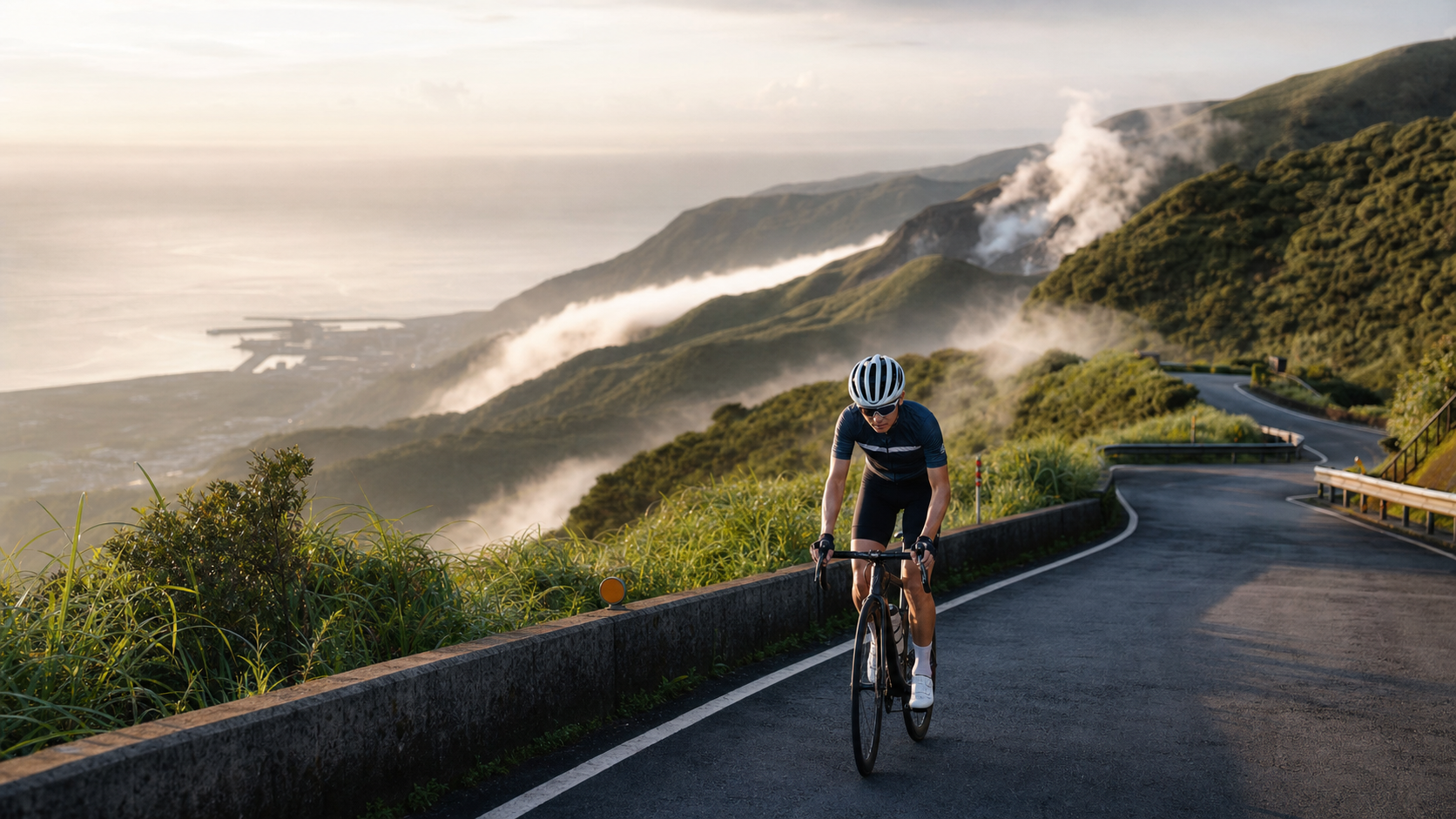
Riding from Jinshan’s Coast to the Volcanic Crater: Geothermal Steam, Clouds, and Local Warmth on Yangjin Highway’s Xiaoyoukeng
Summary: The Yangjin Highway connects Jinshan and Yangmingshan, climbing from a fishing harbor town to Xiaoyoukeng, where geothermal steam still vents from the earth. This is a ride that starts at sea level, cuts through a band of clouds and mist, and finally arrives at a volcanic landscape thick with the smell of sulfur—a route known to countless Taipei cyclists as the “pilgrimage road to the back hills.”
At 5:30 in the morning in Jinshan, the sky is just beginning to show a hint of pale light. By the harbor, early-rising fishermen are already sorting their catch, and the air carries a mix of sea salt and the aroma of freshly baked sweet potatoes—Jinshan Old Street’s sweet potatoes are a renowned local specialty, and many cyclists stop for a bite to fuel up before setting off. Wheeling out the bike, adjusting the saddle height, and taking a deep breath of that sea-scented air, you prepare to take on the 17.8-kilometer, 793-meter-climb challenge of the Yangjin Highway. Cyclists affectionately call this road “Yangjin” for short; its official designation is Provincial Highway 2C, and it is one of the most classic corridors linking Jinshan to Yangmingshan National Park.
One Road, a Meeting of Two Geologic Wonders
To understand what makes the Yangjin Highway unique, you have to start with the ground beneath your feet. Jinshan sits on the northern edge of the Tatun Volcano Group, right next to the Pacific Ocean, and is a typical transition zone between alluvial plains and rolling hills. The highway’s endpoint, Xiaoyoukeng, lies on the northwestern slope of Mount Qixing and is one of the few locations in the Tatun Volcano Group where significant geothermal activity is still visible. In other words, this ride climbs from marine alluvial terrain all the way up to a volcanic landscape that is still “breathing”—this dramatic geologic shift is one of the most fascinating, yet easily overlooked, layers of meaning on the Yangjin Highway.
Shortly after setting off, the road begins a gentle climb, with the low-rise buildings of downtown Jinshan gradually giving way to farmland and orchards on both sides, then transitioning further up into a hilly landscape of secondary forest and silvergrass. Along this stretch, you’ll occasionally see early-rising farmers heading to their vegetable plots with hoes in hand, offering a friendly nod as you ride past—that unhurried, easygoing pace of life unique to mountain towns stands in stark contrast to the rush of Taipei’s city center, and it’s exactly why many cyclists choose to set out at dawn, hoping to soak in this tranquility before the city wakes up.
A Theater of Clouds and Mist Among the Switchbacks
The middle section of the Yangjin Highway (roughly kilometers 7 to 13) is the most dramatic stretch of the entire route. Here the terrain is steep and the curves come thick and fast, with the road spiraling upward in a series of hairpin turns. Dense forest lines both sides, and a thin layer of mist often hangs over the area in the morning. As sunlight gradually breaks through the clouds and spills across the woods, the fog drifts slowly with the wind, creating a nearly dreamlike play of light and shadow. Many photography enthusiasts make the trip up by bike or car specifically to capture a moment from this “theater of clouds and mist.”
Riding this section is physically demanding—the constant switchbacks mean frequent changes in gradient, making it hard to find a steady pedaling rhythm, and the tree cover limits visibility, forcing you to focus on just the short stretch of road ahead. But precisely because of this, the section easily draws you into a state of “flow”: breathing, pedaling, heart rate—everything moves in sync with the winding road ahead, and outside distractions seem to get left behind at each curve. Many seasoned cyclists describe the experience of riding the middle section of the Yangjin Highway as “a form of dynamic meditation,” where pain and focus intertwine, leaving you with an indescribable sense of exhilaration once you’ve made it through.
Xiaoyoukeng: A Volcano Still Breathing
The moment you arrive at Xiaoyoukeng, the scene before you makes you instantly forget the fatigue of the climb. This place could not be more different from the lush green forests along the way—the ground, scorched by years of geothermal venting, appears yellowed and barren, with almost no vegetation. The air carries a faint smell of sulfur, and white steam continuously bursts from cracks in the earth, accompanied by a low hissing sound, as if the ground itself were still breathing. This is one of the few places in the Tatun Volcano Group where you can witness geothermal activity firsthand. Geologists have noted that heat from a magma chamber deep below continues to conduct upward, making Xiaoyoukeng a precious window into observing one of Taiwan’s few active volcanic landscapes.
Park your bike at the visitor center parking lot, and I’d recommend spending fifteen to twenty minutes walking the Xiaoyoukeng trail to experience this surreal landscape up close. Interpretive signs along the trail explain the formation of fumaroles and sulfur vents, as well as the unique plant life in the area—because the soil is highly acidic and the ground temperature is high, only a handful of hardy, tolerant species can survive here, creating a distinctive “geothermal wasteland” landscape. On clear days, looking north from Xiaoyoukeng, you can faintly make out the coastline around Jinshan and Wanli, taking in the entire road you just rode. That feeling of “I actually rode all the way up from so far away, from so low down” is a shared experience for every cyclist who completes the challenge.
Local Warmth and Flavors Along the Way
Although most of the Yangjin Highway is lined with mountain scenery, the Jinshan end still retains plenty of local character worth a detour. Jinshan Old Street is famous for its sweet potato products—crispy sweet potato chips, sweet potato ice, and roasted sweet potatoes are all popular choices for visitors. After completing the challenge and descending the mountain, cyclists often gather at a small eatery near the old street to reward themselves with a steaming bowl of misua noodles or some other local snack. Jinshan also has hot spring resources, with several hot spring resorts scattered across the area. Many cycling groups make “ride Yangjin, soak in hot springs” a regular weekend itinerary, using the warmth of the springs to soothe the muscle soreness accumulated from the climb—a perfect combination of riding and relaxation.
The catch at Jinshan Fishing Harbor is another local highlight. In the afternoon, you can often see freshly landed seafood coming ashore. Cyclists who enjoy seafood can plan their trip to arrive around midday, heading straight to the harbor area after the ride to enjoy fresh seasonal catches, experiencing the full journey from mountain to sea, from sweat to palate. This combination of “one ride, two landscapes, multiple sensory pleasures” is exactly why the Yangjin Highway keeps drawing cyclists back year after year.
Seasonal Scenes, Limited by the Calendar
The Yangjin Highway offers a different face in every season. In spring (March–April), Yangmingshan National Park enters its flower season, with azaleas and calla lilies blooming in succession along the route and in nearby Zhuzihu and Qingtiangang, attracting large numbers of visitors and photographers. Cyclists can enjoy the colorful blossoms along the way, but should also be mindful of the increased traffic on weekends and holidays. In summer (June–August), although the heat can be punishing, the misty mountain forests in the early morning are especially serene. And since vegetation around Xiaoyoukeng is sparse, when the afternoon sun beats down on the geothermal area, the sight of steam rising in wisps is particularly spectacular—a favorite subject for photographers.
In autumn and winter (October through February), the northeast monsoon brings more clouds, mist, and rain, and temperatures drop noticeably in the mountains. Around Xiaoyoukeng, you can occasionally witness the magnificent sight of a rolling sea of clouds, and with luck, even capture the wonder of a “cloud waterfall”—where cloud layers pour down through the valleys like a cascading waterfall. Many veteran cyclists consider this “the most beautiful seasonal scene on the Yangjin Highway.” Of course, winter riding also comes with the challenges of strong winds, low temperatures, and slippery roads, with higher physical risk. It’s advisable to dress warmly and carefully assess the weather conditions before heading out.
What This Road Means to Cyclists
For many cyclists who have ridden the Yangjin Highway for years, this road has long surpassed its simple purpose as training or a check-in spot. It’s a proving ground for beginners to confirm they can complete their first real climb, a fixed exam for veterans to gauge their fitness, and a social space for weekend group rides—chatting with friends while pedaling, sharing sweat and scenery together. Some cyclists even make a point of riding the Yangjin Highway again on their birthday or a special anniversary, linking the riding experience to personal milestones and giving the road a more intimate, emotional significance.
Standing in the parking lot of the Xiaoyoukeng visitor center, watching steam pour endlessly from cracks in the earth, and looking back at the long mountain road you just climbed, many people feel an indescribable sense of grounded accomplishment—something earned leg by leg, pedal stroke by pedal stroke, something no vehicle can replace. The Xiaoyoukeng section of the Yangjin Highway is not just a route; it’s a cycling pilgrimage road in the shared memory of Taipei’s riders—one that connects ocean and volcano, sweat and scenery.
Advice for First-Time Challengers
If you’re preparing to take on the Yangjin Highway to Xiaoyoukeng for the first time, I’d suggest starting on a clear weekday morning to avoid holiday traffic and give yourself plenty of time to slowly enjoy the scenery along the way, without rushing past the unique sights of clouds and geothermal steam. Bring enough water and supplies, wear appropriate warm and sun-protective gear, and have your phone or camera ready—because the geothermal landscape at Xiaoyoukeng is absolutely worth stopping for more than a few shutter clicks.
After completing the challenge, don’t rush straight back down the mountain. Take some time to sit near the visitor center, feel the mountain breeze on your face, listen to the low hiss of steam venting from the ground, and let both your body and mind settle. This ride, setting out from the coast of Jinshan and arriving at a volcano that is still breathing, deserves to be savored with the most relaxed mindset—taking in every scene and every breath along the way.
Memories of Yangjin Road in the Cycling Community
In the northern cycling community, almost every veteran team has its own Yangjin Road story. Some teams schedule their first group ride of the year on Yangjin Road, treating it as the starting point of their annual training cycle; others choose to retackle this route on special occasions such as a teammate’s birthday or retirement commemoration, using sweat and scenery to mark important moments in life. Many cyclists also had their first taste of “climbing may be painful, but the sense of accomplishment upon reaching the summit far outweighs the hardship along the way” on Yangjin Road, which sparked their love for long-distance climbing challenges—progressing from Yangjin Road to Wuling, Hehuan Mountain, and even taking on classic climbs abroad.
There is also a group of older cyclists who took up road cycling after retirement, treating Yangjin Road as their regular midweek exercise route. A few friends would agree to set off at dawn, chatting and pedaling along, enjoying this lifestyle of “connecting through cycling.” For them, speed and rankings are no longer the point; what matters is having a block of time each week to escape the urban hustle and find their own peace among the mountains and sea views. This cross-generational, cross-level participation is what makes Yangjin Road a truly “all-ages” classic route.
Seeing Yangmingshan National Park from a Rider’s Perspective
Many people’s impression of Yangmingshan National Park is limited to flower-viewing during bloom season or sightseeing activities like the gondola and buses. But through the slow ascent of a bicycle, you can experience a completely different sense of depth. A car passing through this stretch can reach the summit in just ten to twenty minutes, with the scenery flashing by in an instant; but climbing by bike, because of the slow speed and high physical exertion, gives you far more opportunities to notice how the roadside vegetation changes with elevation—from broadleaf forests at lower altitudes, gradually transitioning to secondary forests and silvergrass landscapes at mid-elevations, and finally arriving at the near-barren geothermal terrain around Xiaoyoukeng. This gradual ecological transition can only be truly appreciated through the most ground-hugging mode of travel.
Encountering wildlife unexpectedly during the ride is also a common occurrence. In the mountain area, Formosan macaques can occasionally be seen gathering along the roadside, reminding cyclists not to feed them or deliberately approach—just maintain a proper distance and observe. During dawn and dusk, if you’re lucky, you might also hear the calls of bamboo partridges or other birds piercing through the forest, adding a touch of natural vitality to a climb that would otherwise consist only of heavy breathing and the whirring of gears.
In Closing: The Yangjin Road That Belongs to Everyone
The reason Xiaoyoukeng on Yangjin Road has become a classic isn’t just its moderate difficulty or the magnificent geothermal summit—it’s because it carries the personal stories of so many different cyclists. Some completed their first proper climbing challenge here, some witnessed the curve of their fitness improvement here, and others simply treat it as a corner in their busy lives where they can catch their breath and have a good conversation with themselves.
Whether you come with the ambition of conquering gradient data or purely to admire this unique landscape where mountains meet the sea and geothermal steam rises, Yangjin Road will respond to every rider’s effort in its own rhythm. Next time you plan a northern cycling trip, consider putting Xiaoyoukeng on Yangjin Road back on your list, and use your wheels to re-measure this distance from ocean to volcano. I believe you’ll have your own unique experience.
Suggested Add-on: Fitting Yangjin Road into a Full-Day North Coast Itinerary
It would be a bit of a shame to treat Xiaoyoukeng on Yangjin Road as just a single-route challenge—this area can actually be linked into a rich full-day North Coast cycling mini-tour. After completing the climb starting from Jinshan in the early morning, you can head east along Provincial Highway 2 on the descent to visit Yehliu Geopark and admire the famous Queen’s Head and mushroom rock formations; heading west, you can ride toward Wanli and Keelung, enjoying the open sea views along the coastline that differ from the mountain scenery. This “climb first, see the sea later” arrangement allows a single outing to encompass geological wonders, mountain landscapes, and coastal scenery—far richer than a simple climb-and-check-in.
For cyclists who prefer a slower pace, consider splitting Yangjin Road into a two-day itinerary. On the first afternoon, ride to the Jinshan area to explore, check into a hot spring resort to relax, then tackle Yangjin Road lightly equipped the next morning, avoiding the interference of physical fatigue and facing the climbing challenge in peak condition. The hot springs around Jinshan are mostly weakly alkaline sodium bicarbonate springs; after soaking, your skin feels smooth, which is particularly helpful for relieving muscle soreness after a long ride. It’s a well-kept “post-ride recovery” secret among many veteran cyclists.
For families wanting to bring children to experience the nature education of Yangmingshan National Park, consider not chasing speed and instead treating Yangjin Road as a parent-child co-riding nature exploration route. Stop at the interpretive signs along the way to explain geology and ecology to the kids, making cycling not just exercise but a vivid outdoor nature lesson. Xiaoyoukeng has well-developed trails and interpretive facilities, making it an ideal endpoint for a family trip, allowing children to observe fumaroles and sulfur crystals up close and build awareness of and interest in Taiwan’s unique geological landscapes.
These diverse ways of enjoying the route are also an important reason why Xiaoyoukeng on Yangjin Road remains enduringly popular and continues to attract all types of cyclists—it’s not just a climbing route that tests your fitness, but a gateway to the rich cultural and natural resources of the North Coast, waiting for every rider to discover the unique stories of this land in their own way.
Riding Memories Woven from Light and Scent
Cyclists who have ridden Yangjin Road many times often say that what this road leaves in your memory isn’t just the visual scenery, but a multi-sensory experience. The sea breeze at the Jinshan starting point carries a salty, damp scent, which is gradually replaced by the fresh fragrance of mountain vegetation as elevation increases, and then shifts to the distinctive pungent smell of sulfur as you approach Xiaoyoukeng—over a distance of just 17.8 kilometers, the layers of scent your nose experiences can be so rich and varied, an unexpected bonus that many riders never anticipated.
The changes in light are equally dramatic. Setting off at dawn, the sky in the direction of Jinshan still carries the pinkish-purple tones of pre-sunrise; as you climb into the forest, sunlight filters through the treetops creating dappled spots of light; in the middle section’s continuous switchbacks, mist often lingers and light flickers in and out, creating a visual effect almost like cinematic cinematography; upon reaching Xiaoyoukeng, if your timing is right, you can catch the stunning scene of morning light directly hitting the geothermal area with steam rising in wisps. This serendipitous play of light is also why photography enthusiasts return to Yangjin Road again and again.
The layers of sound are also worth savoring. Seagulls calling by the harbor, the occasional rooster crowing and dog barking from suburban settlements, insects and birds chirping in the forest, your own heavy breathing and the sound of gears turning during the continuous switchback climb, and finally, upon reaching Xiaoyoukeng, replaced by the low, continuous hissing of fumaroles from beneath the earth—this sequence of sounds is like a soundtrack carefully composed by nature for the rider, from clamor to tranquility, from the烟火 of human life to the primal pulse of the earth’s depths, fully interpreting the journey’s dual crossing—spatial and emotional—from ocean to volcano.
It is precisely these sensory details that are difficult to quantify that elevate Xiaoyoukeng on Yangjin Road beyond the scope of a mere exercise route, making it a spiritual landscape that many cyclists savor repeatedly and are willing to visit again and again. Every ride, even though the gradient data remains the same, the light, scents, and sounds experienced always have subtle differences. This is why, even after riding it fifteen or twenty times, veteran cyclists will still say: “Yangjin Road is always worth riding one more time.”
Epilogue: Reasons to Save It for Next Time
Every cyclist probably has that one road in their heart—when a particular season or mood strikes, the thought suddenly arises: “I should go ride it.” For northern cyclists, Xiaoyoukeng on Yangjin Road often plays that role. It’s not the hardest route, nor the longest challenge, but its unique geological story, rich sensory layers, and the spatial narrative of climbing from sea level all the way to a volcanic crater give it an irreplaceable appeal that endures.
If you haven’t ridden this road in a long time, why not pick a clear morning and set out again? You’ll find that even though the route and gradient remain the same, each ride’s mood, physical condition, and even the people and scenery you encounter along the way add a new layer of memory to this old road. This, perhaps, is the most compelling reason why Xiaoyoukeng on Yangjin Road continues to be written into the collective memory of Taipei cyclists—and it’s the kind of authentic connection between oneself and the land that every cycling enthusiast spends a lifetime searching for.
Related Reading
- Yangjin Road and Lengshuikeng: A Loop Ride Through Yangmingshan’s Volcanic Landscape
- The Short Climb by Mazao Hot Springs: The Most Concentrated Sweat and Steam on Yangjin Road
- Yangjin Road Xiaoyoukeng Practical Guide: The 17.8km, 793m Climb Test in Taipei’s Backyard
- The Sulfur Scent and Mist of Lengshuikeng: A Riding Memory of Perseverance on the Eastern Side of Yangmingshan
4K單車實境) 舊陽金P字道 第1P 仰德大道至小油坑 誤跟武嶺神人們 被拉爆爽飛天 Taiwan Cycling Climb Route Recommend
7 年前
大武山20%魔王陡坡【JJSC南台灣遊騎Day2】!屁股真的要裂開了...凡士林抹滿也沒用?神秘金教堂還有超便宜夜市
3 個月前
水金九不厭五分 10度寒流冷到不願停!feat. 卡卡 / 公路車 / CT Yeh
6 個月前
金門 ! 我騎過最棒的離島了 / 最後可以騎車上金門大橋的機會!?/ 公路車 / CT Yeh
1 年前
經典 陽金P字道 | 路線解析 | 魔王親臨指導 | 武嶺備戰訓練營 | NeverStop | 公路車 | 單車
7 年前
觀霧 變好騎了! | 北高車友爆笑大會師 | 公路車 | 單車旅遊 Taiwan Cycling Route GuanWu
6 年前
台北闊瀨陡坡 騎旅 / 日本單車雜誌編輯車友臨時加入!/ 髮香才是最強的 / feat. 北迴歸線小隊 / 公路車 CT Yeh
6 個月前
微東進 太魯閣 蘇花 單車兩日遊 ! 颱風過後路況超刺激 行程大亂 | 最狂的鹹酥雞訂單 | CT Yeh | 4K 高畫質空拍絕景!
4 年前